





























Dunnock: How to attract this beneficial bird to the garden?
Portrait of a small, unobtrusive passerine, often mistaken for the house sparrow
Contents
An untrained eye might easily mistake the Dunnock (Prunella modularis) for a house sparrow, because of the similarity of their plumage. Yet they are completely different birds in terms of their lifestyle, habitat and nesting habits… Indeed, where the House Sparrow is noisy and often brazen, the Dunnock tends to be rather discreet, usually going unnoticed. That said, it does occasionally visit feeding stations in winter. And if your garden is punctuated by hedges, shrubs and conifers, there is a good chance you will spot it at ground level.
Discover how to recognise the Dunnock, this small passerine that can be a welcome addition to your garden.

How to recognise the Dunnock?
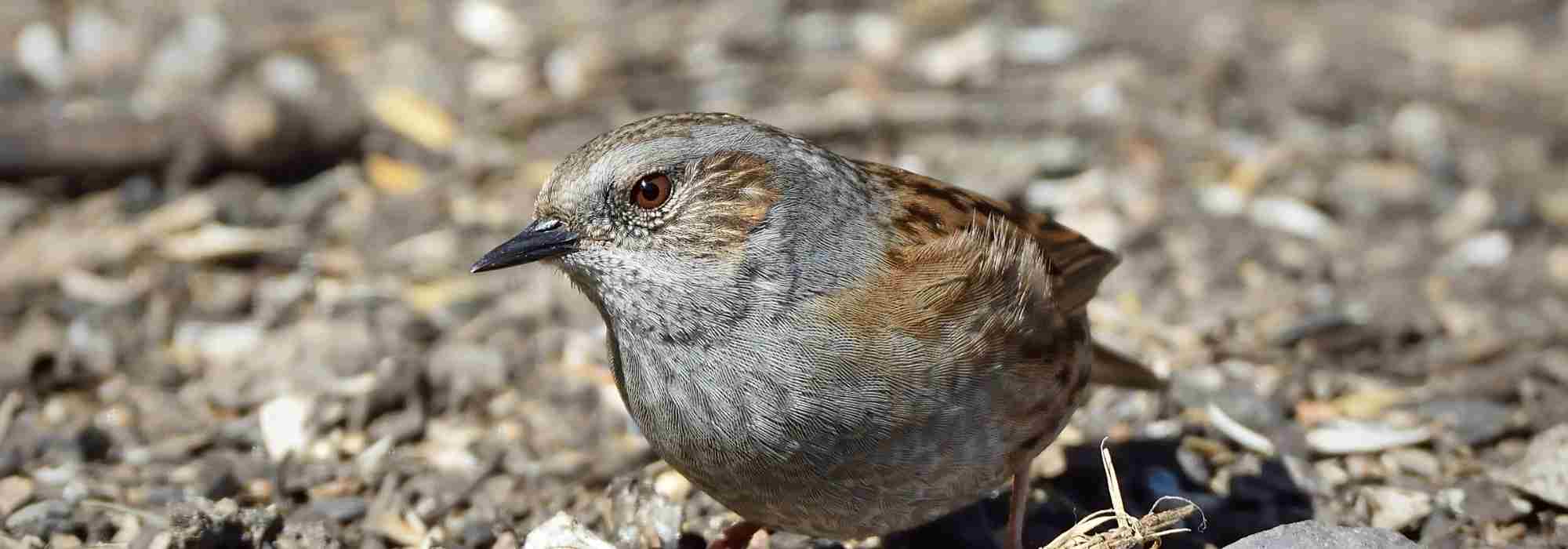
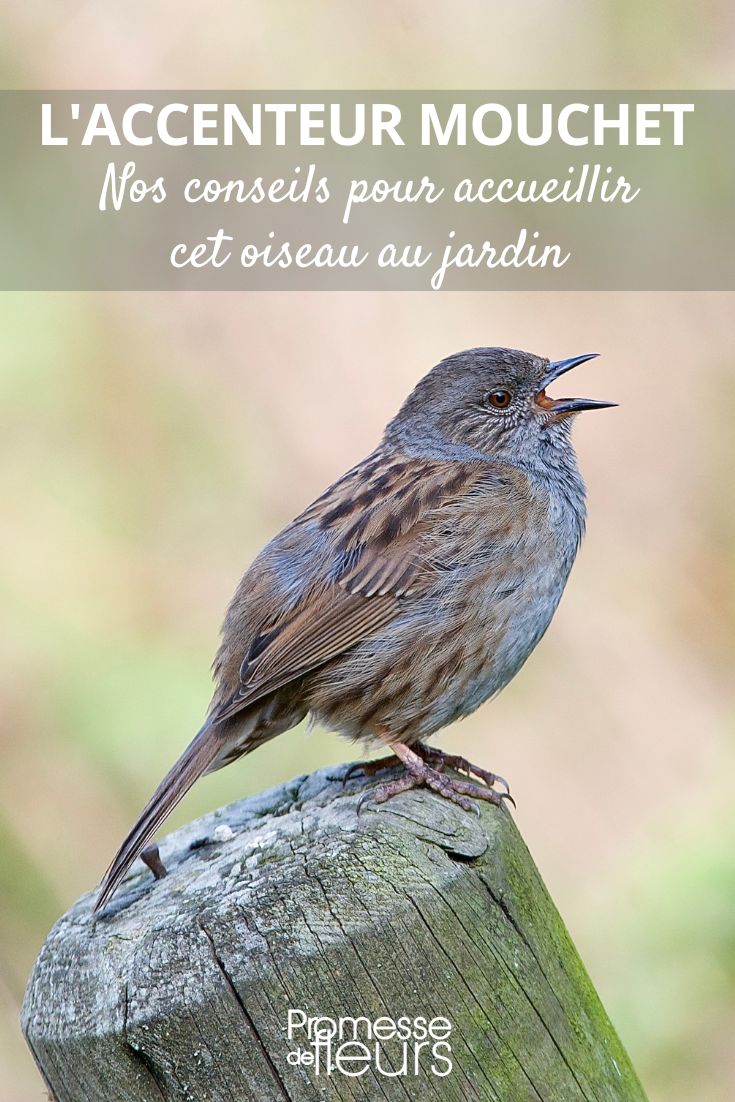
The dunnock is a passerine in the family Prunellidae, which comprises only 12 accentor species! It is a passerine about fifteen centimetres long, quite similar in silhouette to the robin. However, it mainly resembles the house sparrow with its brown-dominated plumage, striped with pale brown on the upper parts, and punctate with pale blue-grey on the underside. The female is quite similar to the male in appearance.
Its rather pointed beak, brown cheeks, and pinkish-brown to rosy legs make it easy to distinguish it from the house sparrow. Not to forget its behaviour. Indeed, unlike the house sparrow, which is often very noisy, cheeky, and a tad brazen, the dunnock is of absolute discretion that borders on shyness. Moreover, the dunnock generally lives alone, whereas house sparrows are highly gregarious. In short, the dunnock often goes unnoticed, and only a keen eye will spot it in the thickets.
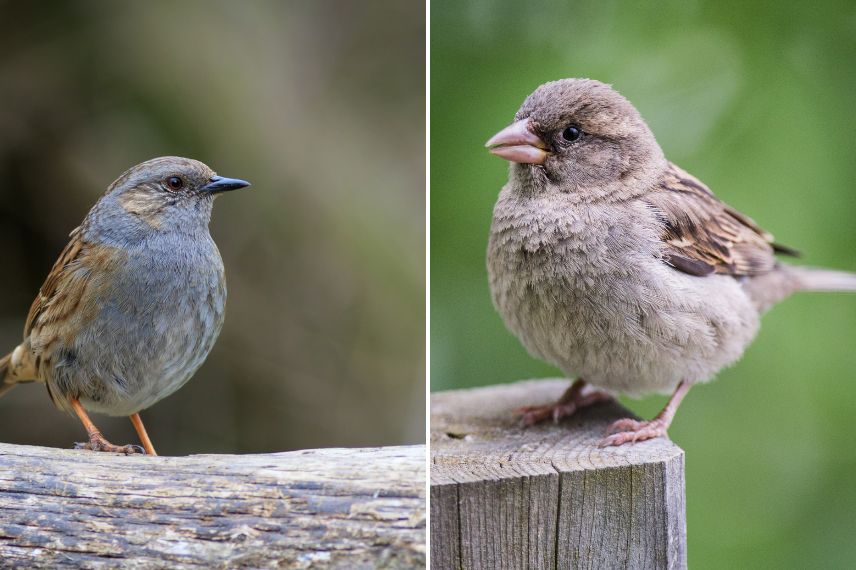
Despite numerous similarities, the dunnock (left) is distinguished from the house sparrow by its slender beak, pink to reddish legs… and its discretion.
The dunnock can make itself heard. Its call is very loud, and its song rather high-pitched, though pleasant to the ear. It is all the more noticeable because the dunnock likes to perch on a high, exposed promontory, for example at the top of a tree, to sing out for all to hear.
However, unlike the robin, the European Greenfinch or the Eurasian Nuthatch, the dunnock is a rarely observed bird, which does not attract admiration for its plain plumage and its discretion.
Read also
Hedge for birds: which shrubs to choose?Behaviour, habitat and breeding of the Dunnock
Although furtive, the Dunnock is a bird fairly close to people. It is even habitat-dependent. If it is relatively inconspicuous, on a walk you may glimpse it, foraging for its food. It is not in the sky you should look, but on the ground, and more especially in hedges or beneath the thickets. This tendency to rummage the ground has, incidentally, earned it the nickname “bush-dragger”.
Where do Dunnocks live?
The Dunnock particularly favours dense, low-lying vegetation. That is why it regularly frequents dense thickets, hedges, or low shrubs, leafy and coniferous. Thus, it likes to perch on young conifers such as spruces, from which it will deliver its courtship song. However, near this vegetation, space should be fairly open.
By its preferences, the Dunnock is found in parks and gardens, in forests and woodlands punctuated with shrubs and bushes.
A turbulent love life
If some Dunnock pairs are monogamous, others opt for a more casual arrangement. And their behaviour may seem peculiar. Indeed, both males and females may take multiple partners during the breeding season. Yet the male has his pride and is determined to ensure his offspring. That is why, just before mating, he will peck at the female’s cloaca to expel the sperm of any male who may have preceded him. Nevertheless, the eggs are often laid by two or even three males, who contribute to raising their respective offspring.
Once mating is established, the fertilised female builds her nest, in a shrub, at just 1.5 to 2 m high. Although low, it is particularly well concealed in dense vegetation. In bowl-shaped form, this nest is made of twigs, dry leaves and moss, rootlets, and lined with hairs and feathers. The female lays 4 to 6 turquoise eggs, slightly speckled. Incubation lasts 12 to 13 days, the nestlings staying in the nest for only about twelve days. When they have fledged, they stay close to the nest, fed by their fathers who do not share the brood. During this time, the mother concentrates on building another nest, for a second brood, or even a third.
The opportunistic cuckoo may choose to lay its eggs in the Dunnock’s nest.
What is the diet of this small, unobtrusive songbird?
Like most garden birds, the Spotted Accentor changes its diet with the seasons. Thus, in spring and summer, it feeds more particularly on a multitude of insects and their larvae, spiders, caterpillars, small molluscs, earthworms, beetles, or even ant eggs… that it finds in the soil. Indeed, it is a bird that does not hunt in flight, but forages for its prey on the ground, by scratching through layers of dead leaves and plant litter. It can also sometimes find its food in low vegetation, but this is much rarer. Generally, at this time it is easier to observe, as it moves in a very characteristic way: it makes small, twitchy hops, its tail regularly wagging.
To hear it foraging in the coppice, you could mistake it for a mouse. Not least because its plumage blends with the soil.
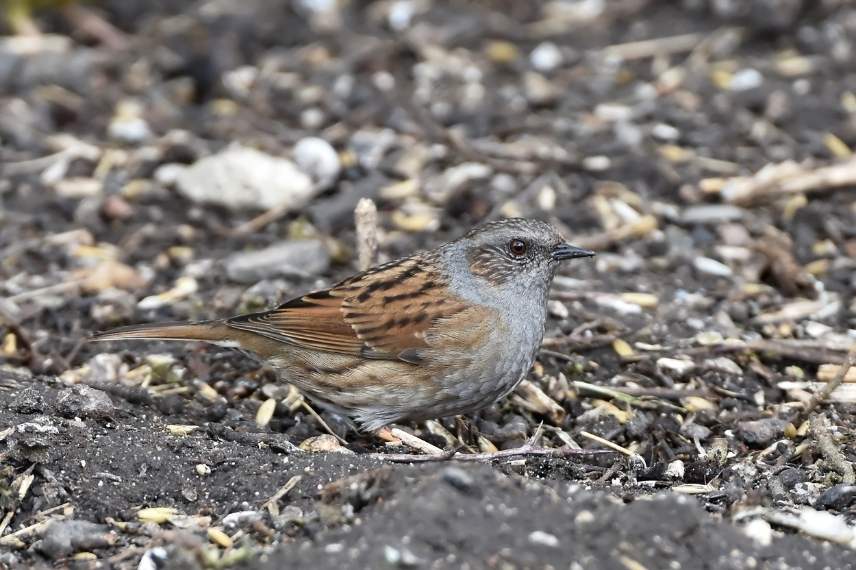 Spotted Accentor feeds on the ground
In autumn and winter, when insects become scarcer, the Spotted Accentor turns to herb seeds (plantain, nettle, dock, knotweeds and various grasses) and berries. It is during this cold period that it may frequent feeders, or rather the undersides of feeders. It will indeed retrieve seeds that fall to the ground. It is fairly fond of sunflower seeds, poppy seeds, sorghum, or peanut granules. By contrast, it spurns fat balls.
How to attract dunnocks to your garden?
Having a Spotted Flycatcher frequenting your garden is a boon, as it is a formidable predator of several pest insects during the warm season. Remember that it feeds on insect larvae and caterpillars…
For hosting the Spotted Flycatcher in your garden, you need a fairly large area planted with a variety of bushes, dense hedges, and even tall herbs. The Spotted Flycatcher will feed there, but also establish its nest or refugium there. If these hedge bushes bear berries in winter, that’s even better. Similarly, a feeder can also attract it, for our small passerine is content with seeds left by other birds, and/or fallen to the ground. If it is not yet present and you wish to welcome it, do not hesitate to let some scrub, brambles or nettles grow freely. It will appreciate the cover provided by these plants to hunt its prey. It may also appreciate a wall of ivy.
Installing a nest box for the Spotted Flycatcher is unnecessary. To establish its nest, generally at human height, the Spotted Flycatcher looks for open hedges of varied species, not too tall, or low conifers. The cotoneaster, the Elaeagnus ebbingei, the pyracantha, the bird cherry (Sorbus aucuparia), the elderberry (Sambucus), the berberis, the laurustinus, the blackthorn (Prunus spinosa), the dog rose (Rosa canina), the hawthorn, the European spindle, the mahonia… but also the juniper, the Canada hemlock (Tsuga canadensis) or the Lawson cypress (Chamaecyparis lawsoniana).
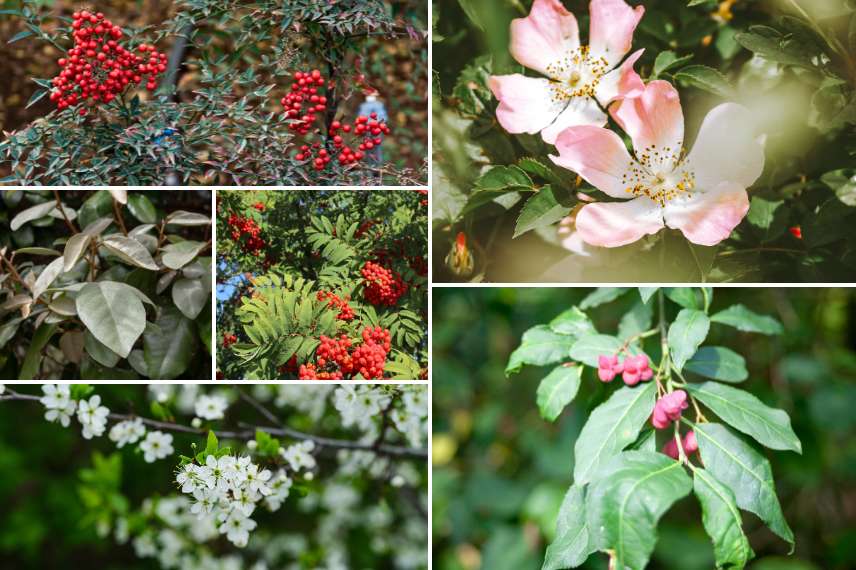
A free-growing hedge composed of cotoneaster, Elaeagnus, blackthorn, dog rose and European spindle provides a nesting site and refugium for the Spotted Flycatcher.
- Subscribe!
- Contents
Comments