





























Late-spring climbing plants: for a garden that heralds summer!
Advantages, characteristics and a guide to growing them in the garden or in pots
Contents
Climbing plants are essential garden staples due to their great versatility. Dazzling flowering, ornamental foliage, interesting fruiting… as many advantages as they can offer. They can brighten up much of the year, notably the late-spring transition period. Let’s see what the advantages of these late spring-flowering climbers are and how to choose them.

Why not overlooking plants that flower at the end of spring?
Days are lengthening, the sun is out more, and even the frostier regions have been able to start planting not very hardy plants and bring out tender potted plants: spring is well established.
One of the keys to having a beautiful garden all year round is to stagger the flowering. This keeps the space in constant motion, continually renewing itself in a true display of greenery. At the start of spring, many plants will already have begun to grow: bulbs, shrubs or early-flowering perennials. In summer, new plants will take over. But the end of spring is sometimes a transitional period, when some have ceased flowering, while others have not yet begun. Yet, between late May and late June, many of us enjoy spending time outdoors, making the most of the lovely days that are not yet too hot for summer. And it would be a pity not to take the opportunity to admire the garden, the terrace, or the balcony during this period, which is sometimes quieter.
Why choosing climbing plants to brighten up this season?
The cultivation of climbing plants is a natural and aesthetically pleasing solution for covering a wide range of supports in the garden. They can, indeed, dress an unsightly wall, accentuate a pergola, provide shade on the terrace, or creep along the ground to form a living carpet.
In parallel, they are often highly beneficial to biodiversity, providing shelter and food for many small creatures: birds, insects, small mammals, etc.
In permaculture, they are valued for making use of vertical space, enabling denser cropping. Taking up little ground space, they are indeed ideal for creating strata of different heights, which could hardly be exploited otherwise. All the while providing shade and cooling useful to neighbouring crops.
Moreover, they are generally easy-to-grow plants that do not require much maintenance.
To crown it all, they are plants that offer a rich diversity of colours, foliage and silhouettes.
Late-spring climbers will be easy to pair with:
- late-flowering bulbs (Alliums, Dutch iris, late-flowering tulips, Eremurus…) ;
- spring-flowering shrubs (Mexican orange blossom, rhododendrons, Weigelas, lilacs, mock oranges, Ceanothus, Deutzias, some spireas…) ;
- perennials (columbines, euphorbias, bleeding-hearts, Oriental poppies, some hardy geraniums, candlestick primrose, peonies…) ;
- etc.
Late-spring climbing plants: a variety of colours
White, yellow, pink, purple, mauve, blue, bi-colour… Late-spring climbing plants offer a beautiful range of flower colours, for all tastes and garden styles.
If you like pastel colours and romantic atmospheres, wisterias will of course be ideal choices to brighten late spring. For pink flowers, choose, for example, the Japanese wisteria Wisteria floribunda ‘Honbeni’ or the Wisteria venusta ‘Rosea’.
For white flowering, favour the Wisteria floribunda ‘Alba’ or the Wisteria brachybotrys ‘White Silk’.
Do you love purple flowers? Turn to the Wisteria frutescens ‘Longwood Purple’ or the Wisteria floribunda ‘Domino’.
Clematis are also among the queens of late spring, notably with the Clematis x patens ‘Miss Bateman’, which rewards us with hundreds of white flowers bearing red stamens around May. In always fairly soft shades, adopt the Clematis montana ‘Tetrarose’, which produces a multitude of pink-to-lilac flowers. For its part, the Clematis atragene ‘Country Rose’ rewards us with flowers with a slightly tousled look, bearing a soft delicate pink.
To highlight the transitional period between spring and summer, you can also choose to let the garden colour palette evolve: after winter, fresh and soft colours were in vogue. Just before summer, why not treat yourself to bolder colours? To herald the arrival of this season, you can for example opt for warmer colours, such as with the Banksia Rose ‘Lutea’ — a handsome giant that bears very double flowers in a butter-yellow. Plan for space and a sturdy support to hold its 12-metre height.
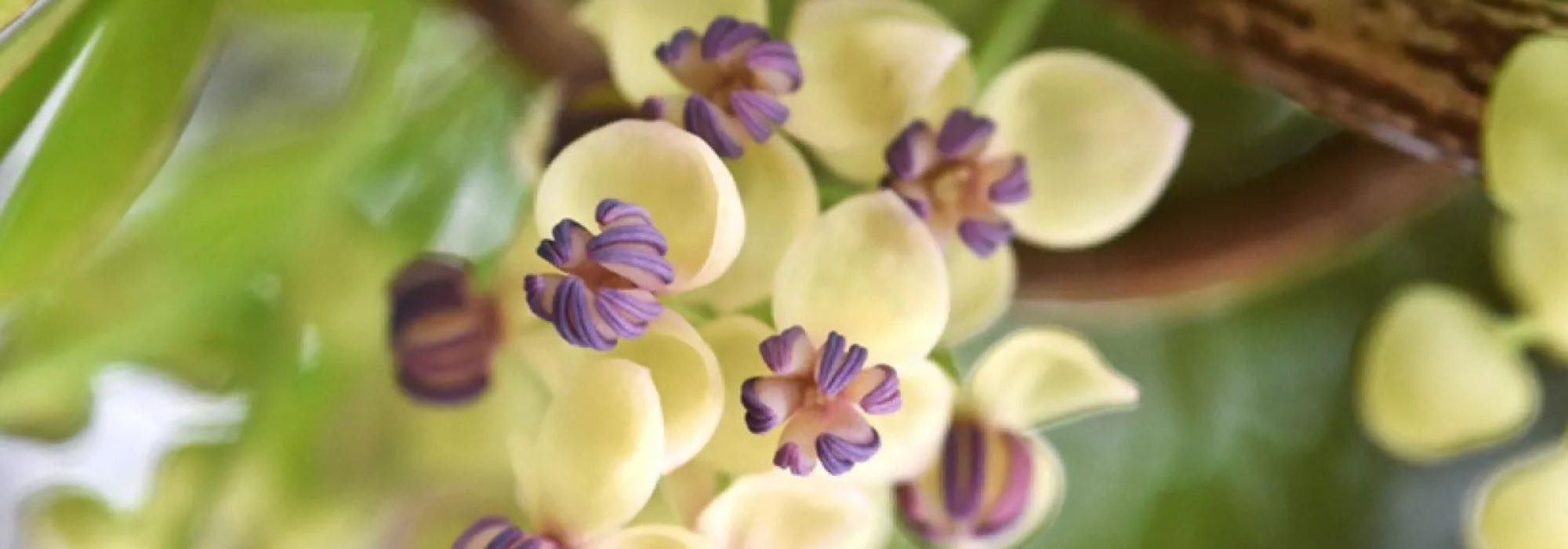
Also note the bi-colour flowering of the Akebia quinata ‘Cream Form’, which produces clusters of small cream-coloured flowers with pink and violet centres between April and May.
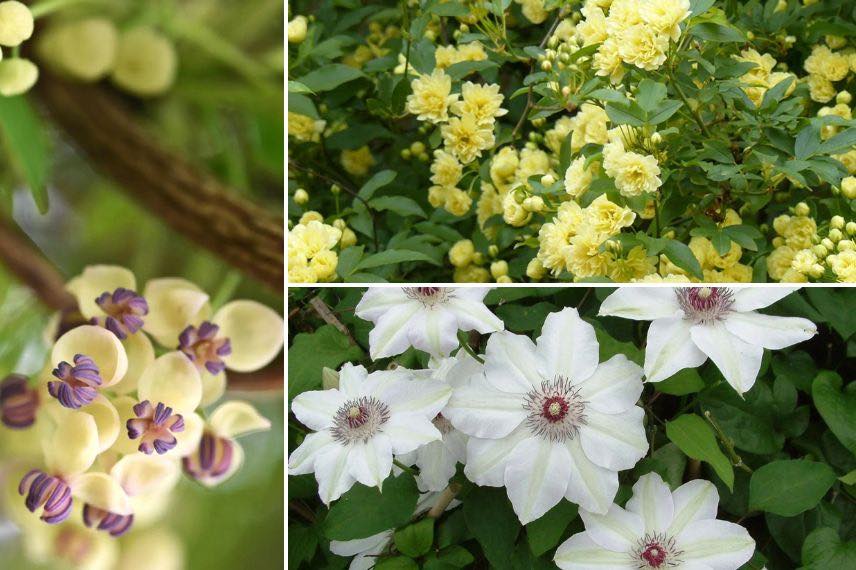
Akebia quinata ‘Cream Form’, Banksia rose ‘Lutea’, Clematis ‘Miss Batman’
Late spring flowering fragrant climbing plants
To enliven the garden, we can play with colour, texture and volume, but also with scents. For climbing plants with late-spring flowering, especially opt for the Clematis montana ‘Starlet White Perfume’. From April to June, it produces large double white flowers, diffusing a gentle floral fragrance. But for a truly intense fragrance, bet on the Clematis ‘Sugar Sweet® Scented Clem’, whose scent of the flowers evokes acacia. For its part, ‘Double Delight’ diffuses gourmand notes of vanilla and chocolate.
Impossible not to mention again the wisterias here, as with the Wisteria sinensis ‘Caroline’, whose clusters of blue-mauve flowers are particularly fragrant, exhaling very floral, sugary and suave notes. Also mention ‘Blue Line’ or ‘Prolific’, appreciated for their well-fragranced late-spring flowering.
The five-leaf Akebia also features among the scented climbers, exhaling notes of spicy vanilla.
On the roses side, The Banksiae Alba rambler rose graces us with fragrant flowering throughout spring.
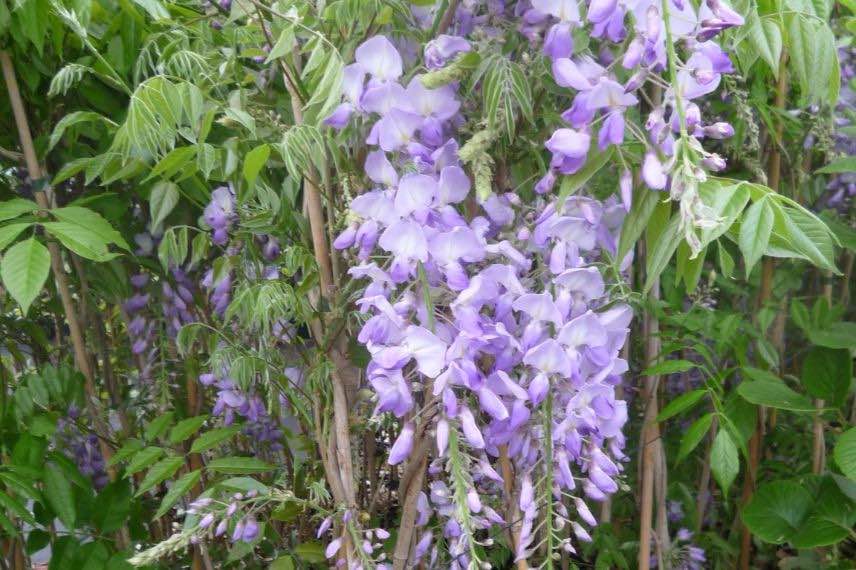 Wisteria sinensis </ em>’Caroline’
Late-spring climbers for pots
There is no need for a large garden to enjoy the benefits of climbers flowering at the end of spring. Some varieties of modest size, measuring less than 2 metres in height, can certainly brighten terraces, balconies or courtyards.
This is notably the case of the dwarf Australian wisteria Hardenbergia violacea ‘Meema’, with a width of 2 metres and a height of only 50 cm. Its voluble stems will cling to the supports at hand. If not, they will spread to form a groundcover dome.
For its part, the Clematis x cartmanii ‘Pixie’ graces us with small flowers in a white shade with a hint of green. Much more modest and stocky than others of its sisters, it stands only 80 cm high with a 60 cm spread. Being fairly frost-tender (hardiness to -4°C), it will nevertheless need to be overwintered in shelter in most of our regions. Also of modest size, the Clematis patens ‘Dancing King’ is limited to 1.5 metres in height, which makes it easy to grow in a pot.
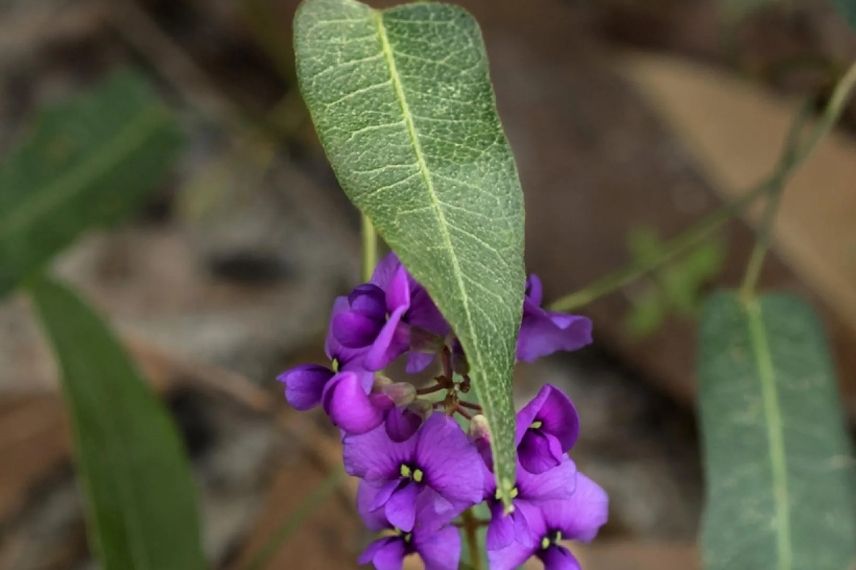
The Hardenbergia violacea ‘Meema’, little known, but interesting and compact in size
Late-spring evergreen climbing plants
Some climbing plants have the advantage of keeping their foliage year-round. They will remain ornamental even in winter and will retain ornamental qualities even after late-spring flowering.
This is the case with Stauntonia hexaphylla, a little-known plant, which offers lobed, dark-green evergreen foliage, reminiscent of the horse chestnut. Spring flowering reveals small cream-white bells tinged with violet, well scented. Hardy to -9°C, this vigorous liana can be grown in the open ground in regions with milder winters. This is a climbing plant that will add a pretty exotic touch.
Let’s again mention the small clematis ‘Pixie’, with evergreen, lobed foliage in a bright, glossy green. It should be protected from frost.
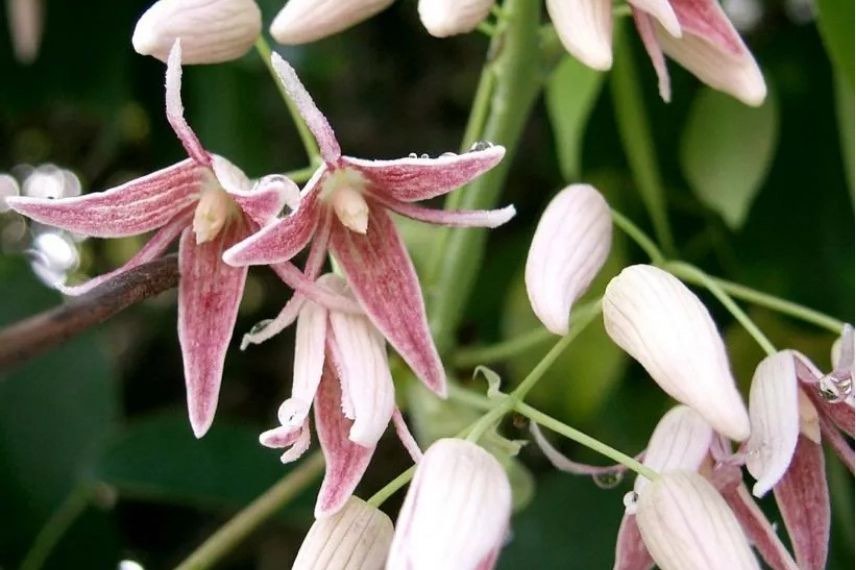
Stauntonia hexaphylla offers evergreen foliage
Some tips for a beautiful garden in late spring
In addition to opting for late-flowering climbers, a few steps will help you keep a beautiful garden into late spring.
- Don’t neglect watering the plants. In some regions, late spring is already quite warm and dry. However, a lack of water can hasten flowering or make the plants less floriferous. For this, the ideal is to have a rainwater butt, which will allow you to use the stores built up during winter and early spring to water the plants.
- Remove faded flowers to stimulate the production of new buds on your perennials, shrubs and roses. This simple gesture helps prolong flowering. Perennials can also be pinched to encourage branching and give them a denser habit: this is the ‘Chelsea Chop’ technique, traditionally practised at the end of May.
- Use annuals sown or bought in pots to fill gaps in the garden: in beds, borders, containers, rockeries, etc.
- Trim the yellowing foliage of some bulbs.
- Subscribe!
- Contents

Comments