





























How to plant the margins around a pond?
Guide to choosing suitable riverbank young plants, planting them and caring for them
Contents
Have you dreamed of a beautiful pond, welcoming to plants and biodiversity in the heart of your garden? If you’re here, it’s probably because that dream has taken shape, but you still have one final step: planting vegetation along the banks. In addition to providing a gentle transition between land and water, vegetated banks play a crucial role in stabilising the soil surrounding the pond and provide a refuge for wildlife.
However, choosing plants suited to pond banks can seem complex. Between the humidity, exposure (sun or shade), and the type of bank (natural or masonry), many factors must be considered to make the right choice.
In this article, we will explore why vegetating the banks is important, how to choose suitable plants, plant them and maintain these vegetated banks.

Why planting the banks of a pond?
An aesthetic and ecological asset
Vegetated banks allow a pond to be integrated harmoniously into a garden. With their varied foliage colours and textures, the plants soften the edges of the pond, which are often rigid, and bring a natural touch.
Ecologically, riparian plants promote biodiversity by providing habitat for local wildlife: insects, dragonflies and amphibians enjoy settling there.
A role in the management of natural riverbanks
Beyond their visual aspect, plantings play a role in preserving natural riverbanks. Dense roots of certain plants (Carex, willows, etc.) help hold the soil and limit erosion.
Vegetated banks also contribute to water management: they absorb excess moisture during heavy rainfall and reduce evaporation during dry spells. Finally, some plants, such as bulrushes or papyrus, act as natural filters, improving water quality by trapping sediments and excess nutrients.
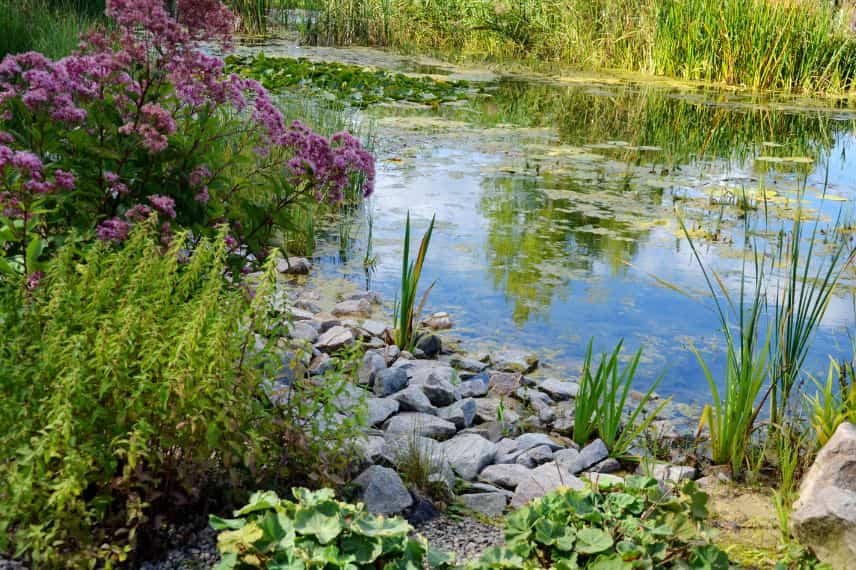
A pond with a Filipendula purpurea, a water iris and an Alchemilla mollis.
Read also
10 aquatic plants, submerged or floatingHow to choose the right plants for revegetating the banks of a pond?
Before selecting your plants, you need to assess the characteristics of your shorelines:
Choosing plants according to the type of pond
You don’t plant exactly the same plants around a natural pond as around a masonry or pre-formed pond. A natural pond generally has waterlogged banks. For this type of water body, choose perennial plants suited to wet banks, capable of stabilising the soil with their roots. Examples: rushes, bulrushes, willow, alder, etc.
Water levels can rise or fall with the seasons and rainfall. If banks are regularly flooded, opt for semi-aquatic plants on the border, such as marsh iris, the common reed, the bulrushes, which tolerate these variations while adding a touch of elegance to your pond.
On slightly raised zones away from the water, you can plant perennials that enjoy moist or well-drained soil (marsh sage, Astilbes…) and grasses (Miscanthus, Carex…).
Native and local species are to be preferred for their adaptability and low maintenance. They also support biodiversity by attracting local insects and birds. By contrast, invasive plants, such as Jussie or Japanese knotweed, should be avoided, as they disrupt the ecosystem and outcompete local species.
Take light exposure into account
When choosing plants, take into account the light-exposure zones around your pond. For example, Miscanthus and the water iris thrive best in full sun. For shaded areas, favour plants adapted to lower light levels, such as the Astilbe, the marsh forget-me-not and some Carex.
For a masonry or pre-formed pond, where the banks are not in direct contact with the water, select plants suited to wet or well-drained substrates and tolerant of ambient humidity, such as Hemerocallis, the Astilbes and some grasses.
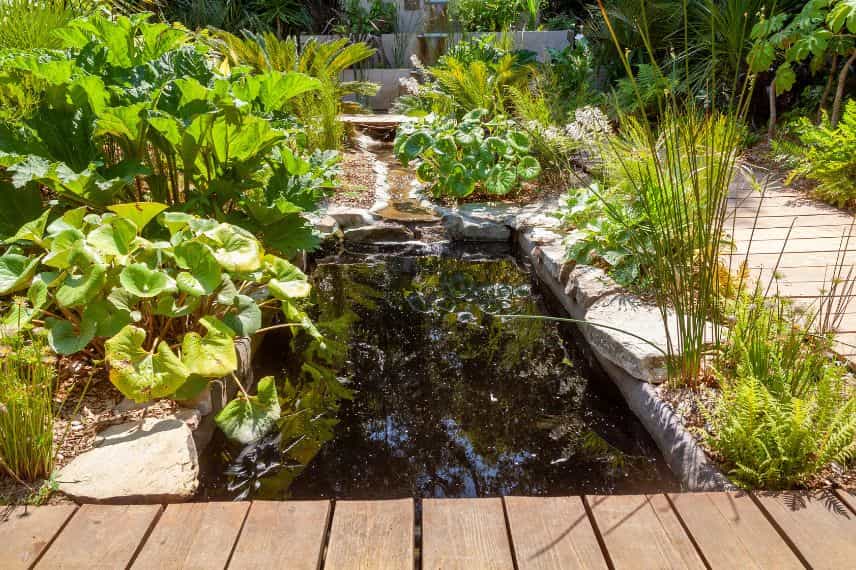
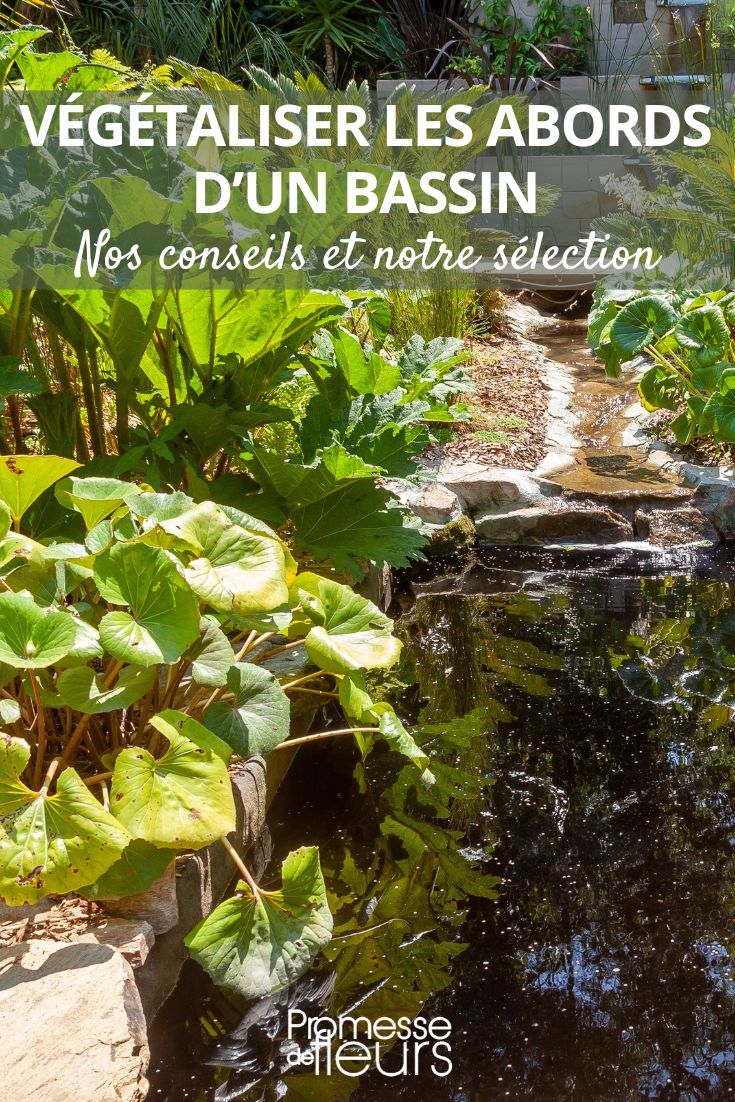
A pond surrounded by Gunnera, papyrus, ferns and Ligularia
Prioritise native species and avoid invasives
Native and local species are to be preferred for their adaptability and low maintenance. They also support biodiversity by attracting local insects and birds. By contrast, invasive plants, such as Jussie or Japanese knotweed, should be avoided, as they disrupt the ecosystem and outcompete local species.
Take light exposure into account
When choosing plants, take into account the light-exposure zones around your pond. For example, Miscanthus and the water iris thrive best in full sun. For shaded areas, favour plants adapted to lower light levels, such as the Astilbe, the marsh forget-me-not and some Carex.
Our plant recommendations for riverbanks.
Plants for natural riverbanks (wet soils)
Natural riverbanks, often wet or prone to temporary flooding, require plants able to tolerate these conditions while stabilising the soil:
- Herbaceous plants :
- Water irises : Pink, white, blue or yellow, these elegant flowers tolerate being submerged.
- Rushes (Juncus) : Ideal for wet banks, its dense roots securely anchor the soil.
- Carex: Also called sedges, they adapt perfectly to waterlogged banks and come in a range of leaf colours.
- Cattails (Typha) : Excellent at filtering water and stabilising wetlands.
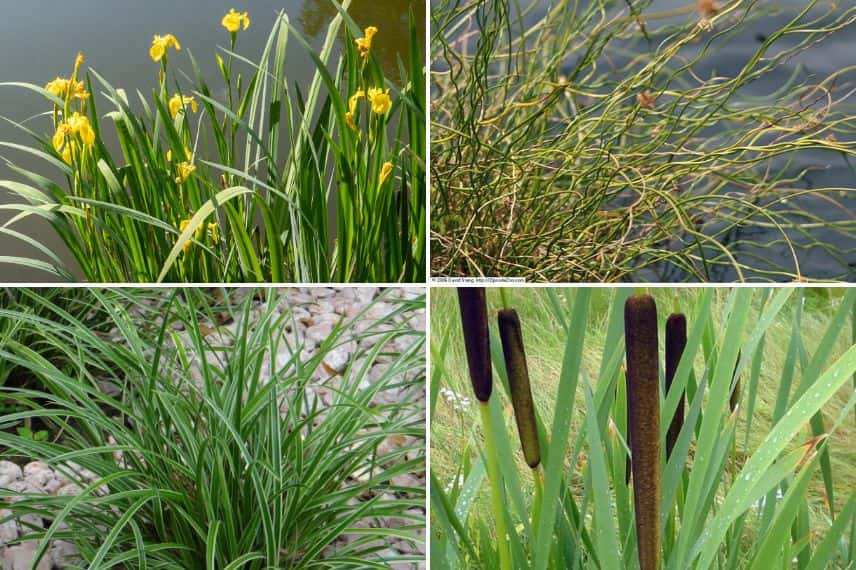
Iris pseudacorus, Juncus effusus ‘Spiralis’, Carex morrowii ‘Ice Dance’ and Typha latifolia
- Grasses and perennials :
- Miscanthus : They come in many varieties, with a range of foliage and sizes to add elegance and structure to damp riverbanks.
- The Spodiopogon sibiricus : Adds a touch of lightness with its fine leaves.
- The Acorus gramineus : A low grass that sits well with damp banks.
- The Gunnera manicata : Impressive, this giant Brazilian rhubarb makes a dramatic statement on large banks.
- Marsh forget-me-not: Its small blue flowers brighten the edges of the pond.
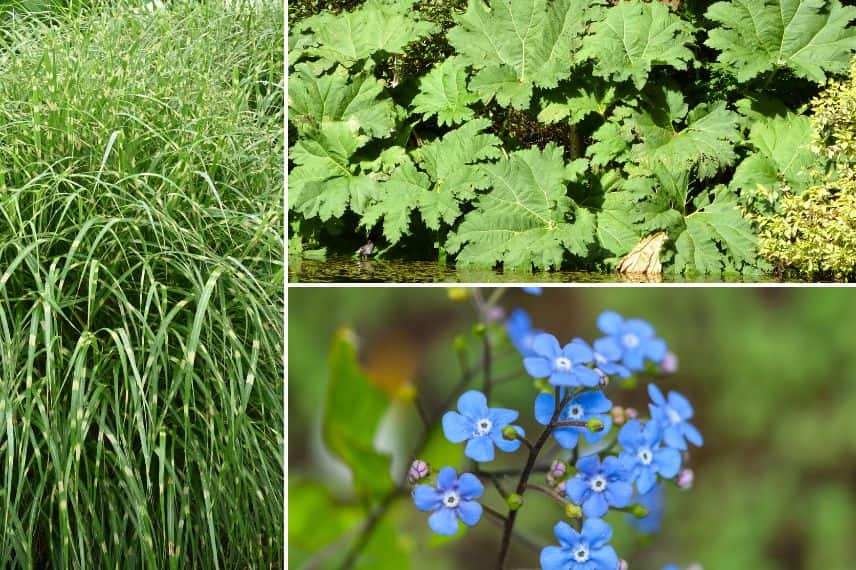
Miscanthus sinensis ‘Zebra’, Gunnera manicata and Marsh forget-me-not
- Semi-aquatic plants :
- Papyrus (Cyperus) : An exotic silhouette, ideal for areas close to water, best reserved for warm frost-free regions.
- Horsetails (Equisetum) : Very architectural, they adapt well to damp substrates.
- Common reed (Phragmites australis) : Ornamental with their feathery plumes, they add movement.
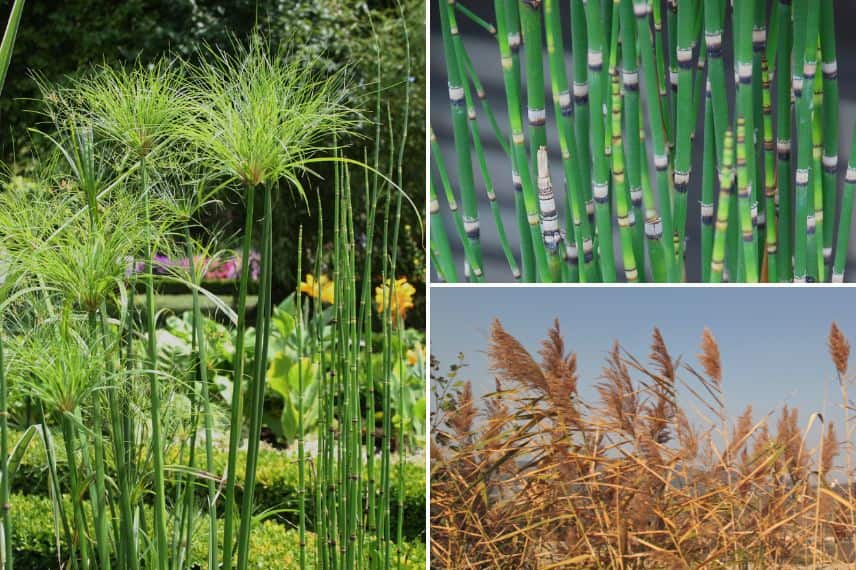
Papyrus, horsetails and common reed
Plants to install away from a natural pond or for a brick-built pond
- Ornamental grasses :
- Miscanthus : Hardy, they tolerate well-drained and damp soils. They provide vertical presence.
- Blue fescue (Festuca glauca) : Compact, it adds colour and adapts to poor substrates.
- The Acorus gramineus ‘Variegatus’ : With striped leaves, it adapts well to light soils.
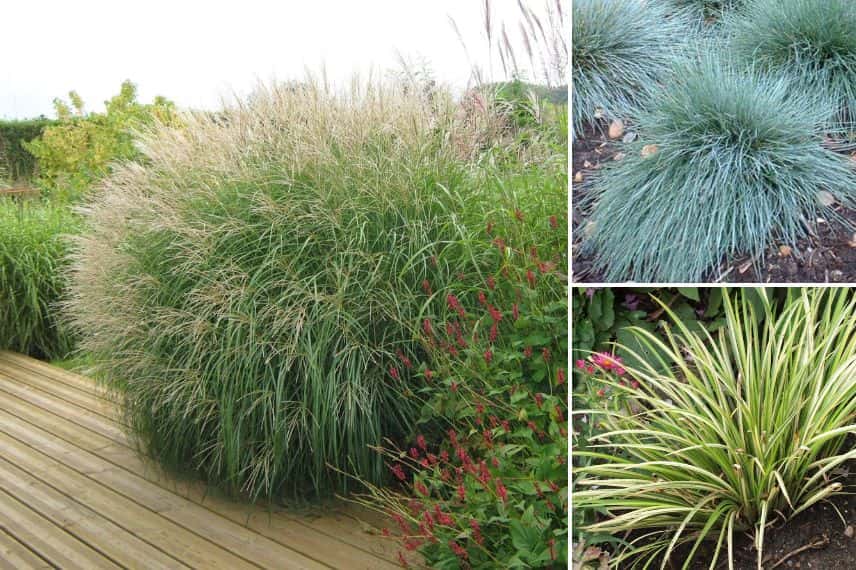
- Hardy perennials :
- Filipendula (Filipendula) : This plant, often used for damp meadows, is also comfortable in drainable soils.
- Ligularia (Ligularia) : Spectacular with its large leaves and yellow flower spikes, it tolerates damp conditions. Ligularias also establish along water edges and on damp banks.
- Alchemilla (Alchemilla mollis) : A very robust perennial with soft foliage and small green-yellow flowers, ideal for drainy and damp zones.
- Brunnera : With heart-shaped leaves and delicate blue flowers, this plant prefers cool areas.
- Hostas : Suited to shaded areas, their colourful foliage adds texture.
- Daylilies: Robust and colourful, they thrive even in challenging conditions.
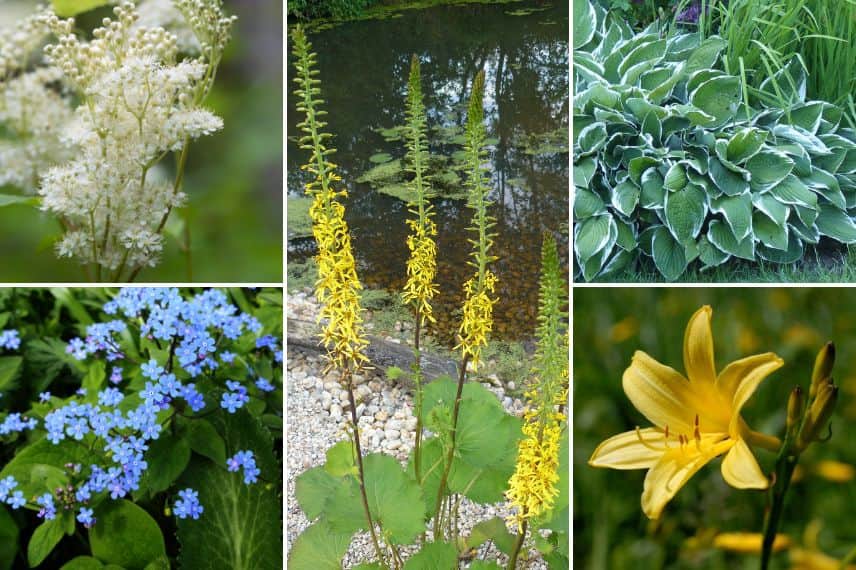
Filipendula ulmaria, Brunnera macrophylla, Ligularia stenocephala, Hosta ‘Francee’ and Hemerocallis lilioasphodelus.
Shrubs suited to riverbanks
Shrubs are particularly useful for stabilising large natural banks and adding height to the planting:
-
- Willow (Salix) : Perfect for very damp areas; its roots effectively stabilise the soil.
- Alder : Hardy shrub that improves the structure of wet soils.
- Crimson dogwood (Cornus sanguinea) : Decorative with its red branches in winter, it strengthens the banks.
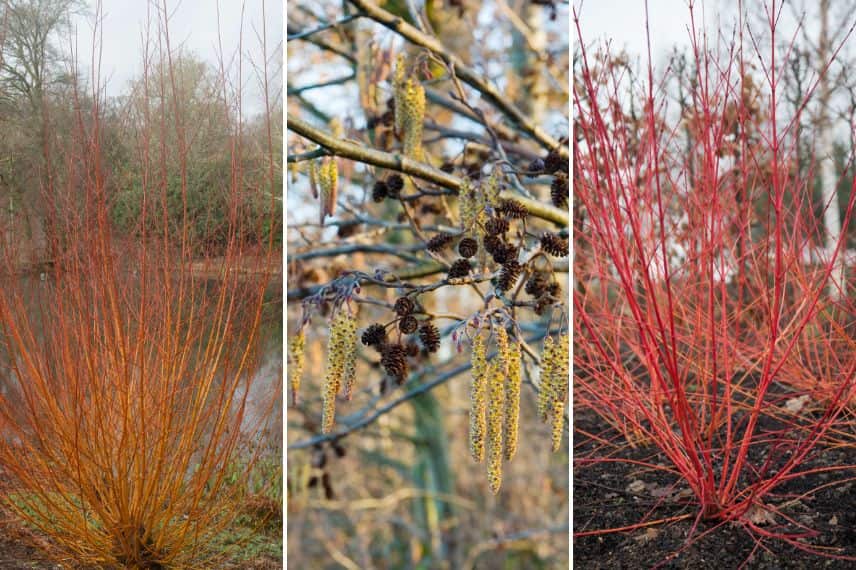
Salix alba, alder and crimson dogwood
The versatile plants
- Astilbes : Loved for their fluffy flower clusters, they add volume.
- The Lysimachia nummularia : A bright groundcover, perfect for brightening different types of banks.
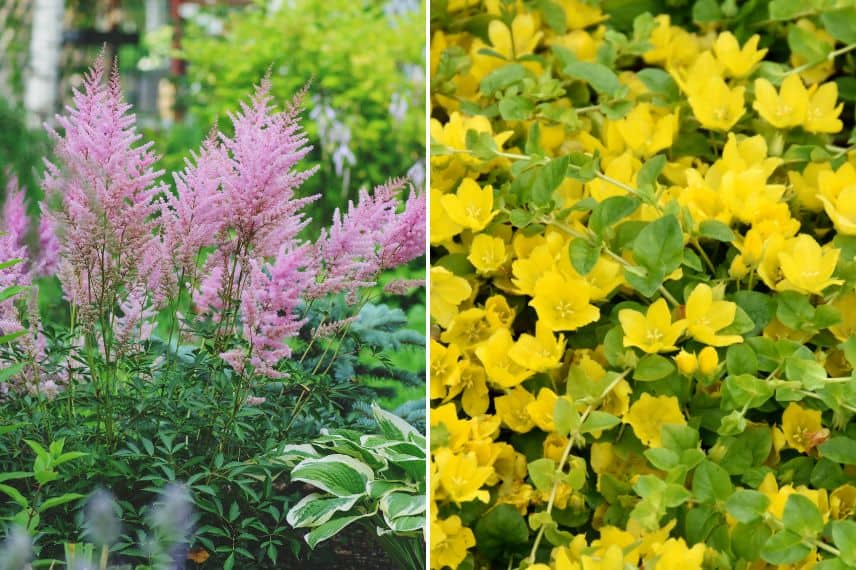
Astilbe and Lysimachia nummularia
→ Find all our riparian perennials on our site.
Steps to revegetate riverbanks.
When to intervene and plant?
- In spring: it’s the best time to plant, as mild temperatures and natural soil moisture promote rooting. Plants have the whole season to acclimatise before the arrival of the hottest weather.
- In early autumn: ideal for warm regions. Planting at this time allows roots to develop before the first frosts. Plants will then benefit from winter moisture and be ready for spring growth.
Avoid planting in midsummer or during frosts : extreme temperatures and soil drying can jeopardise plant establishment.
Bank preparation
- Clean the area : remove unwanted grasses, invasive plants and any debris that could hinder planting.
- Stabilise the banks :
- For natural banks: add stones if they are very unstable or prone to erosion. One may temporarily opt for geotextile (ideally, prefer biodegradable mulching fabrics) until plant roots take hold.
- For masonry banks: check the condition of the substrate and, if necessary, prepare a layer of topsoil to allow roots to establish themselves.
- Improve soil :
- Mix the soil with a little compost or potting compost to promote plant growth.
Planting techniques
- Organisation of zones :
- Plants near water : plant semi-aquatic species (marsh iris, papyrus…) at the immediate edge.
- Transition plants : install hardy perennials (Alstilbes…) and grasses (miscanthus, carex…) on zones slightly set back from the water.
- Stabilisation plants : place groundcover on slopes or erosion-prone areas. If you have plenty of space, favour bushes (willow, etc.).
- Baskets or planting pockets : use aquatic baskets for plants in direct contact with water to contain roots and/or prevent their spread.
- Spacing of plants : maintain a sufficient distance between each plant (about 30–50 cm depending on species) to avoid competition and encourage growth.
- Initial watering : water well after planting to eliminate air pockets and promote rooting, even for plants in moist areas.
- Mulching : for natural banks, favour mineral mulch of large calibre (mineral mulch with large particles) (gravel, slates, pebbles) which retains moisture and limits weed growth, all without decomposing too quickly in contact with water. For masonry banks, you can opt for mineral mulch or organic mulch.
How to maintain vegetated riverbanks?
- In spring :
- Remove dead leaves and debris accumulated over winter to prevent them from smothering the plants.
- Prune perennials and certain grasses (Miscanthus…).
- Prune shrubs, such as willows and Cornelian cherries, to keep them at an appropriate size.
- Add new plantings if gaps have opened up, planting new, more resilient species or to diversify the planting scheme and strengthen the local ecosystem.
- In summer :
- Water plants on masonry-edged banks or on well-draining soil during dry periods. Plants close to the water will rarely require watering, except in cases of extreme drought in the basin.
- Monitor the proliferation of invasive plants, such as reeds, and cut back excessive stems to prevent them from smothering their neighbours.
- In autumn :
- Remove dead parts of plants before winter to reduce the risk of disease.
- In winter :
- Little maintenance is required. Vegetated banks can be left to rest. However, protect young plants by mulching around their base.
- Invasive plant management:
- Regularly remove the invasive parts of certain species (horsetails, reeds, etc.)
- Prune plants that produce many seeds to limit their dispersion.
- Use planting baskets to contain the roots of plants that are too invasive.
- Mulching review:
- Restore areas where mulch has spread by adding a layer of pebbles or gravel.
- Remove the organic debris that has accumulated there.
- Subscribe!
- Contents
Comments