





























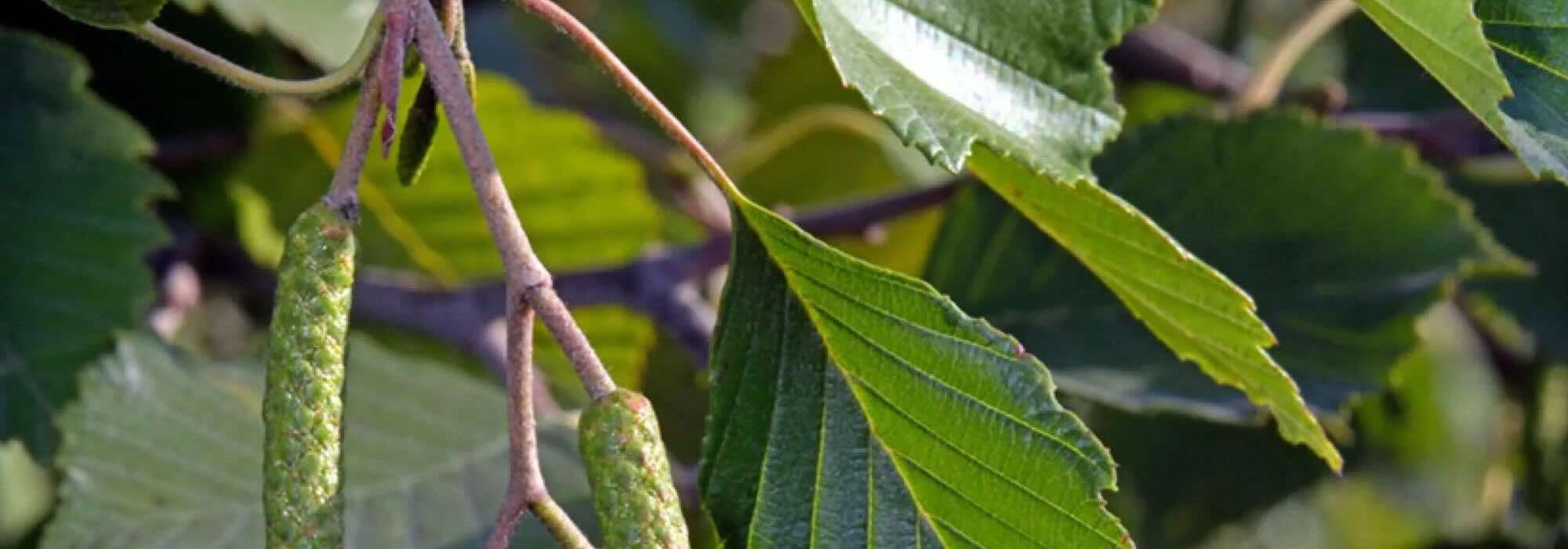
How to choose an Alder: Finding the ideal tree for your garden
Our tips
Contents
Glutinous Alder (Alnus glutinosa), White Alder (Alnus incana) or Corsican Alder, not easy to tell apart in the alder forest! The alder is a tree that combines aesthetic appeal and ecological usefulness. Renowned for its robustness and its ability to enrich the soil, the alder integrates perfectly into many types of gardens and landscape projects. With varying sizes, growth habit and foliage, it can just as easily structure a large space as vegetate a difficult area or adorn a small garden.
In this guide, choose the perfect alder according to your needs: appropriate dimensions, elegant growth habit, ornamental foliage, growing conditions and specific uses. To stabilise slopes, revegetate poor soil, or simply enhance your garden, there is an alder to suit your needs.

Choosing an alder for its dimensions
Dimensions of alders vary according to species and cultivar, allowing you to choose a tree perfectly suited to the space available. Here is a ranking of the main varieties and species according to their size.
Very small Alders (under 5 metres)
- The Alnus incana ‘Monstrosa’ is a small tree reaching 2 metres in height and 2 metres in spread.
- The Alnus glutinosa ‘Incisa’ develops a compact habit with a height of 3 to 4 metres and a width of 2 metres.
- The Alnus glutinosa ‘Greenwood‘ measures between 5 and 6 metres in height and a width of 3 metres.
Alders small to medium (between 5 and 11 metres)
- The Alnus incana ‘Pendula‘ reaches 7 metres in height and 4 metres in width.
- The Alnus glutinosa ‘Imperialis’ grows up to 9 metres tall with a spread of 3 metres.
- The Alnus glutinosa ‘Aurea’ measures 9 metres in height with a width of 4 metres.
- The Alnus glutinosa ‘Luszyn’ also reaches 9 metres in height but remains narrower with a width of 3 metres.
- The Alnus glutinosa ‘Laciniata’ is a larger tree with 10 metres in height and 5 metres wide.
- The Alnus incana ‘Laciniata’ reaches 11 metres in height with a 5 metre spread.
Botanical species: the tallest Alders
- The Alnus glutinosa can reach 20 to 25 metres in height with a width of 10 to 12 metres.
- The Alnus incana grows to 15–20 metres tall with a spread of 10–12 metres.
- The Alnus cordata is more modest, with a height of 20–25 metres and a width of 6–8 metres.
- The Alnus spaethii is a medium-sized tree that can reach 15 metres in height and 10 metres wide.
This ranking helps you choose an alder according to the space available in your garden, taking into account the space the tree will occupy when mature.
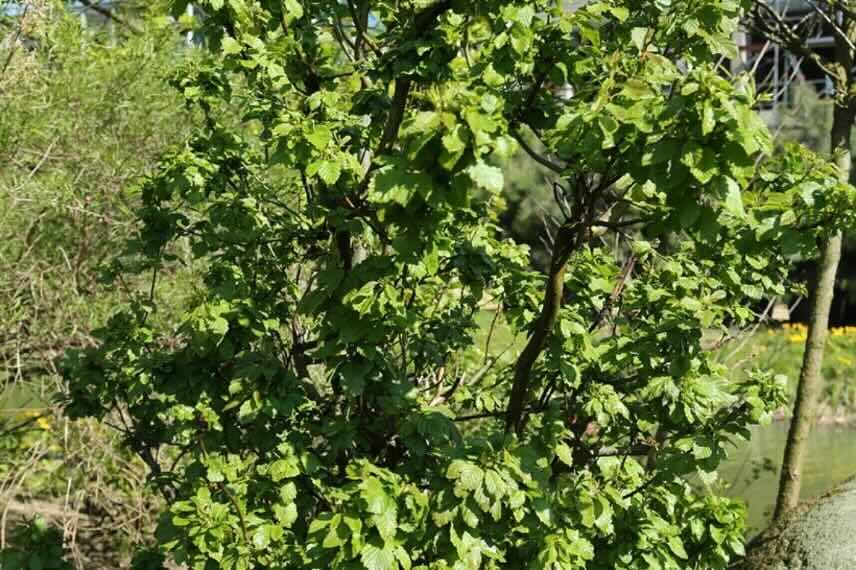
Alnus incana ‘Monstrosa’, a small tree of 2 m in height at maturity
Read also
The alder: planting and growingChoosing an alder based for its growth habit
The habit of alders, that is, the shape of their silhouette, is an essential characteristic for integrating these trees harmoniously into a space. Depending on the species and varieties, habits vary greatly, ranging from slender, conical forms to more airy or sinuate structures.
The glutinous alder (Alnus glutinosa) often offers a pyramidal silhouette marked by several slender trunks and almost horizontal branches. Its habit is regular, endowing this large tree with a strong presence.
On the other hand, Alnus incana, slightly smaller, displays a conical-to-ovoid habit, with an irregular crown and often several trunks.
Alnus cordata, for its part, is distinguished by its slender and conical habit, a silhouette elegantly elongated.
Finally, Alnus spaethii, with a crown broader than that of the Corsican alder, presents a conical and regular habit.
Some varieties are distinguished by distinctive shapes.
For example, Alnus glutinosa ‘Luszyn’ combines branches oriented upwards with a slightly spreading conical crown, while Alnus glutinosa ‘Greenwood’ charms with its tortuous habit and its sinuous structure.
Alnus incana‘Monstrosa’ forms a rounded and bushy, tortuous shrub with spreading branches from a very short trunk.
Alnus incana‘Pendula’ develops a weeping form with a straight trunk and branches that extend in graceful arches. Its secondary shoots hang down stiffly.
Finally, several varieties are characterised by a pyramidal, often airy habit, such as Alnus glutinosa ‘Imperialis’ and Alnus glutinosa ‘Incisa’. This is also the case for Alnus glutinosa ‘Laciniata’, which broadens somewhat with its drooping branches.
The habit of each alder should be considered according to the role desired in the landscape: to structure a space, to create a strong visual presence or to add a touch of originality.
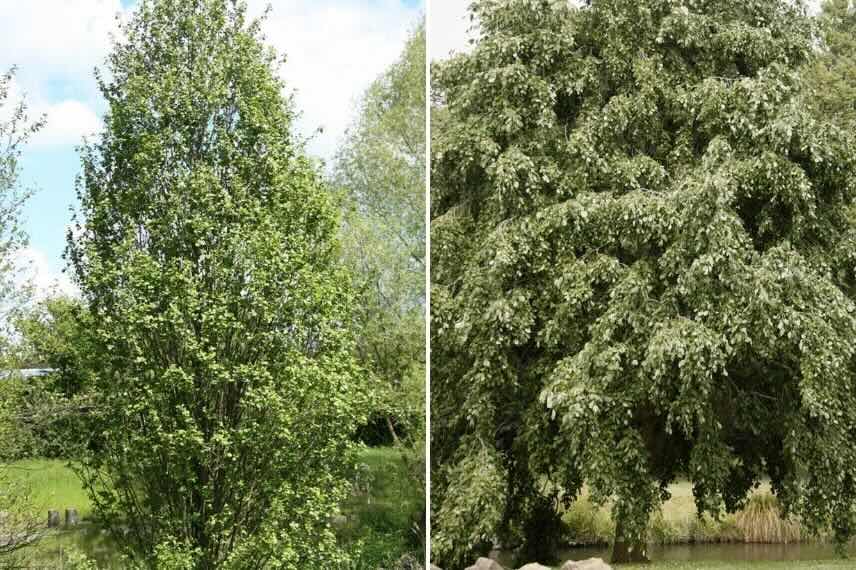
Alnus glutinosa ‘Luszyn’ with a conical habit and Alnus incana ‘Pendula’ with a pendulous habit
Choose an alder based on the colour of the foliage
A form with golden foliage in our selection: the Alnus glutinosa ‘Aurea’ has spring foliage that takes on a beautiful bright yellow-orange hue, which greens a little in summer.
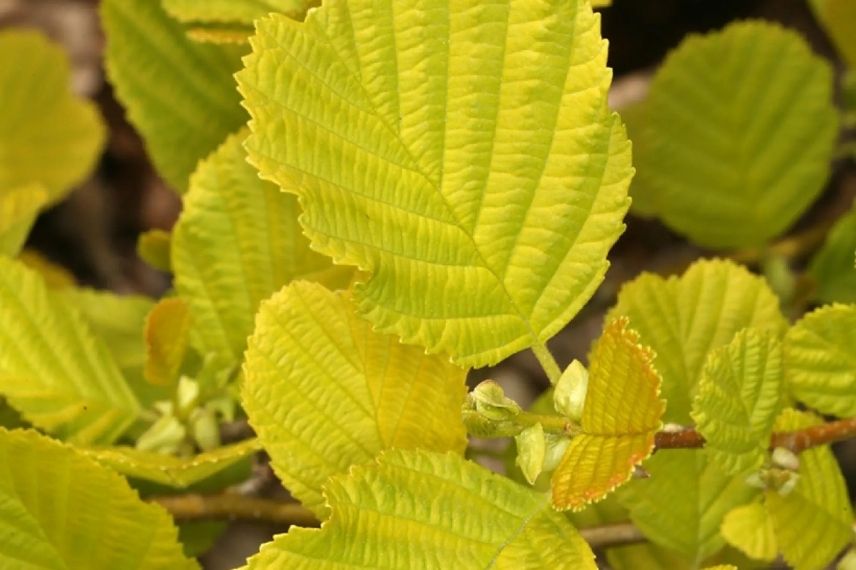
Alnus glutinosa ‘Aurea’
Choose an alder for the shape of its foliage
In general, alder foliage is alternate, entire, oval or cordate, but some cultivars feature exceptional foliage.
The Alnus glutinosa ‘Imperialis’ is remarkable for its foliage deeply incised into narrow, pointed lobes, reminiscent of the elegance of ferns. This characteristic makes it a very decorative choice, particularly for spaces where one would like to introduce a touch of lightness and refinement.
And Alnus glutinosa ‘Laciniata’, for its part, has foliage slightly smaller than that of the type species. Its leaves are deeply incised, with dentate and lanceolate lobes. Although less incised than those of the cultivar ‘Imperialis’, they give this tree a distinctive and interesting texture.
And Alnus incana ‘Laciniata’ offers laciniate foliage, characterized by dentate leaves and a fine texture. This fineness gives the tree a delicate and airy appearance.
Finally, Alnus glutinosa ‘Incisa’ stands out for its remarkable miniature foliage. Its small elliptical leaves, 2 to 4 cm long, resemble hawthorn leaves.
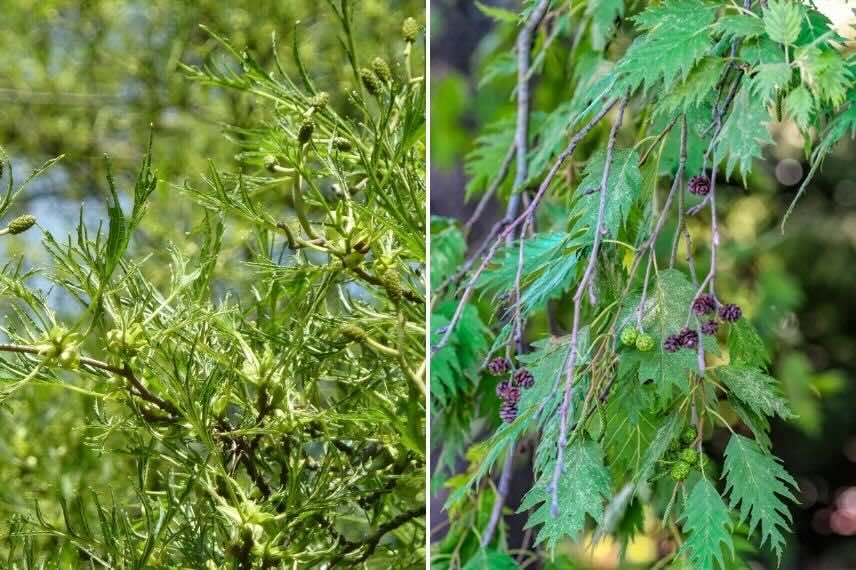
The superb foliage of Alnus glutinosa ‘Imperialis’ and Alnus incana ‘Laciniata’
Choosing an alder for its growing conditions
Alders are hardy trees that adapt to a wide range of growing conditions, but each species has its own particular preferences depending on soil type and moisture.
The glutinous alder thrives best in soil that is always cool and moist, rich in humus. It thrives even in peaty soils, poor or acidic, showing a great tolerance to difficult environments. It is a perfect choice for stabilising banks, revegetating wetlands or enriching degraded lands.
The white alder adapts to a wider range of soils. It prefers moist soils but tolerates drier soils or occasional drought periods, which makes it more versatile than the glutinous alder. It thrives in calcareous soils.
The Corsican alder tolerates dry to cool soils and, preferably, calcareous, even poor. It is more drought-tolerant than the other alders.
Choosing an alder according to its use
Alders are versatile trees, suited to multiple uses thanks to their ability to adapt to different environments and to their aesthetic and ecological qualities.
Alnus incana ‘Monstrosa’, with its compact size and dense habit, is suitable for pot cultivation. This choice is ideal for terraces or small gardens where space is limited.
When planted as solitary specimens, large specimens such as Alnus glutinosa or Alnus incana are perfect for structuring a landscape. Varieties with exceptional habit or foliage, such as ‘Imperialis’ with its cut-leaf foliage, or ‘Pendula’ with its weeping habit, add a striking visual impact as solitary trees. There too, the Alnus incana ‘Monstrosa’ is well suited.
For planting in borders, smaller alders, such as Alnus glutinosa ‘Incisa’ or ‘Greenwood’, blend well in the background, while medium-sized varieties, such as ‘Laciniata’ or ‘Luszyn’, find their place in large shrub borders.
Alders are also suitable for hedges, notably the varieties not too imposing like Alnus glutinosa ‘Aurea’. Their dense foliage allows the creation of natural screens while adding an ornamental touch.
For vegetation and erosion control of riverbanks, Alnus glutinosa is a preferred choice thanks to its robust root system and its ability to stabilise moist soils. This utilitarian role also extends to soil preparation in forests: the glutinous alder is considered a green manure by foresters, as it enriches and purifies soils thanks to its roots able to fix atmospheric nitrogen.
Alnus cordata is particularly prized for stabilising calcareous soils and revegetating poor or unstable terrains, such as urban fallows, slag heaps or derelict mines. Its extensive and ramified root system effectively holds difficult soils, offering an ecological and durable solution.
Finally, Alnus incana is a versatile species, used in isolation, as an avenue tree, or in clumps on slopes and banks to stabilise soils. It can also serve as a windbreak or planting in the less favourable corners of large gardens, thanks to its ability to adapt to somewhat harsh conditions.
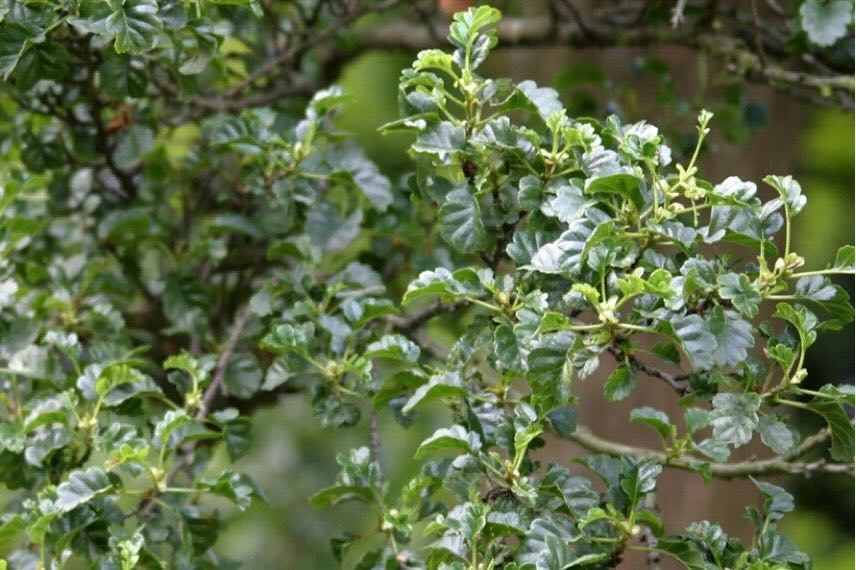
Enjoy the attractive foliage of the small Alnus glutinosa ‘Incisa’ in a border
- Subscribe!
- Contents
Comments