


























How to choose a Delphinium?
Buying guide and criteria for finding the ideal variety to suit your preferences.
Contents
Delphiniums, or larkspurs are perennial plants with colourful and architectural flowering, which are hard to miss. With their vertical flowering spikes, they brighten the garden for several weeks during the summer. There are hundreds of varieties, and it’s not always easy to choose. We therefore present here a guide to help you navigate and choose the delphiniums that suit you, according to various criteria.

Choose a Delphinium based on the colour of the flowers.
The flowering of delphiniums is one of their key ornamental assets. Indeed, their name refers to their floral buds elongated by a long spur, echoing the rostrum shape of a dolphin. It is true that the colourful flowering stems, sometimes very tall, provide structure and are, for example, essential features of English gardens. The flowers can display a range of colours, often very vibrant.
Blue Delphiniums
They are among the most popular and most admired, with their shades of blue that can be quite rare in the vegetable kingdom. In this category, we notably find the Delphinium ‘Pacific Blue Bird’ with sky-blue flower spikes topped by a white heart. The Delphinium ‘Pacific Black Knight’ offers a deep blue, rarely seen, which inevitably catches the eye. In the same vein, the Delphinium belladonna ‘Bellamosum’ produces flowers in gentian blue with a heart almost black, with glossy reflections varying with the light. Magnificent!
For less intense colours, opt for the very delicate cultivar ‘Pacific Giant Cameliard’, with its blooms of a very soft azure blue. Also note the small ‘Blue Lace’, which offers sky-blue flowers with a purple-black heart and a small black eye.
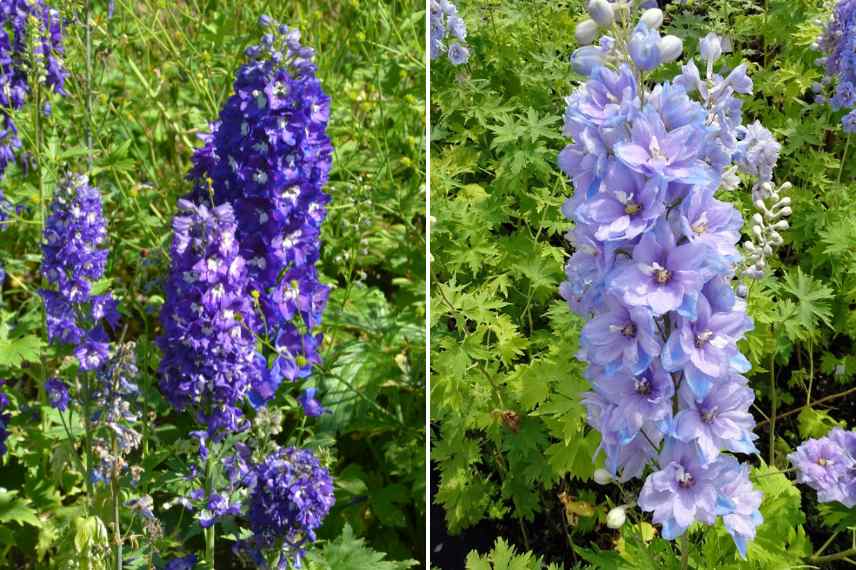
Delphinium ‘Pacific Blue Bird’ and ‘Pacific Giant Cameliard’
White Delphiniums
These are certainly the most delicate. White delphiniums are very easy to pair in the garden. If their form makes them already visibly striking, they also help highlight other flower colours or create monochromatic scenes of great refinement. This is the case with the Delphinium ‘Pacific Galahad’, with its flowers of pure white and black stamens. Also note ‘Highlander Samba’, with its double, frilly flowering, cream-white with a green centre, brushed with blue on the outer petals. Let us not forget a Delphinium cardinale, which sports an uncommon colour for these plants: a bright scarlet red, with a lighter centre and yellow stamens.
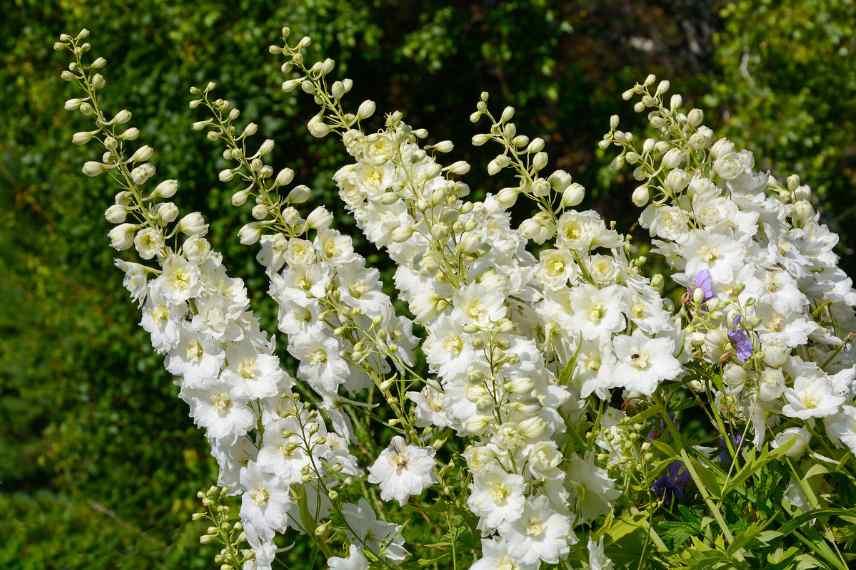
The white larkspur stems are also striking!Purple and Violet Delphiniums
These delphiniums will play with different tonalities, from the softest to the most intense. The Delphinium ‘F.W. Smith’ offers spikes of flowers in a dark blue-violet and mauve with a brown heart, nicely glossy. With ‘Misty Mauves’, the double flowering is in a soft blue mauve, which will deepen to a more intense violaceous mauve. Also note the Delphinium ‘Pacific King Arthur’, whose giant flowering stems are covered with semi-double flowers of a vivid violet-blue, illuminated by a white eye. For a lighter version, opt for ‘Highlander Cha Cha’, with its pale lilac flowers shaded with smoky violet at the heart.
[caption id="attachment_322126" align="aligncenter" width="856"]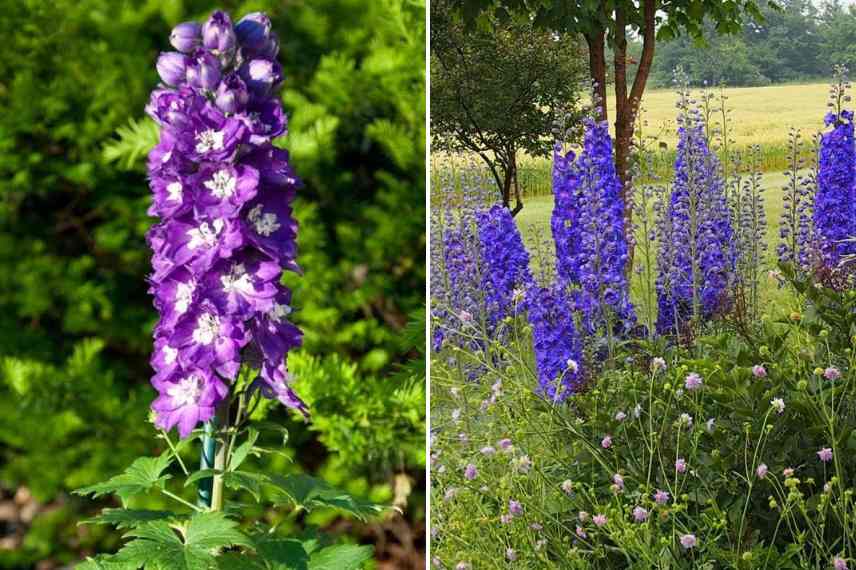 Delphiniums ‘Pacific King Arthur’ et ‘FW Smith’
Pink Delphiniums
Romantically enchanting, pink delphiniums charm us with their blooms. The Delphinium ‘Dusky Maiden’ offers a semi-double bloom, pure pink with a black heart. Very refined! On the side of the Delphinium ‘Pacific Astolat’, the very soft pink leans toward lilac. For its part, ‘Ruysii Pink Sensation’ offers very large soft pink flowers. As for ‘Strawberry Fair’, we favour it for its raspberry-coloured flowers with a white heart that contrast well.
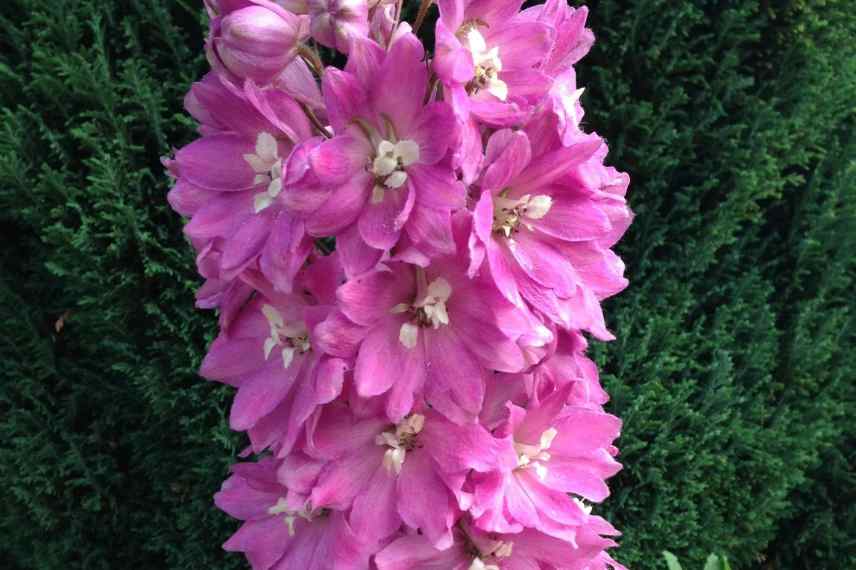
Delphinium ‘Dusky Maiden’
Two-Tone Delphiniums
These are varieties that bring a touch of originality. Let us begin with the Delphinium ‘Blue Triumphator’, which elegantly blends blue and mauve, contrasting with a white heart. The Delphinium ‘Ouvertüre’ combines blue and pink, adding a touch of mystery with its black heart. Let us not forget the original Delphinium cardinale, which displays an uncommon colour for these plants: a bright scarlet red, with a lighter centre and yellow stamens.
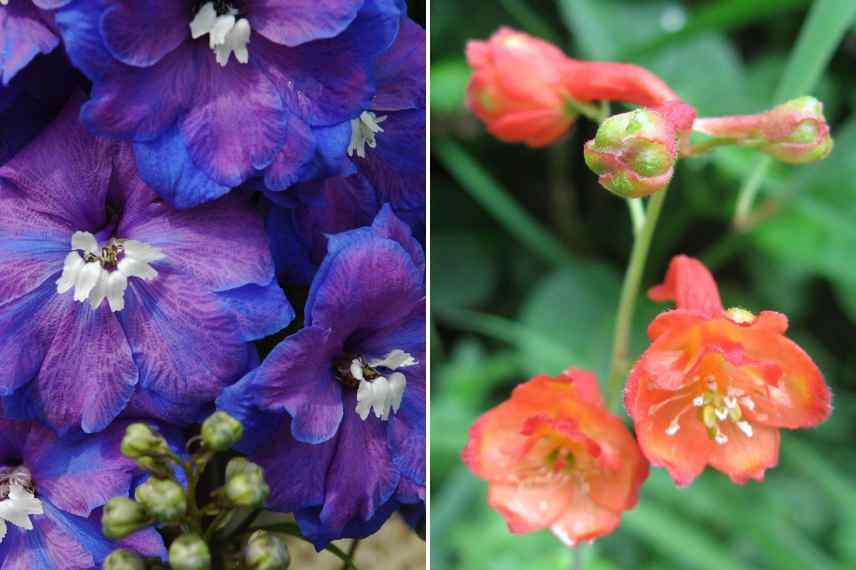
Delphinium ‘Blue Triumphator’ et Delphinium cardinale
Choose Delphinium based on the shape of the flowers.
In Delphiniums, flowers can be cup-shaped, single or double, spurred, sometimes hooded, in the shape of an elf hat.
Single flowers
They are often Delphiniums from the Belladonna group, for example the variety ‘Casablanca’, which produces cup-shaped flowers. They have panicles that are branched, slender and loose, as seen in ‘Cliveden Beauty’, whose blue flowering is very graceful. They are more wind-resistant and longer-lasting.
Let us also mention the Delphinium grandiflorum or Delphinium chinense, often grown as an annual. This compact, bushy plant bears in June–July delicate panicles of pretty single elf-hat-shaped flowers.
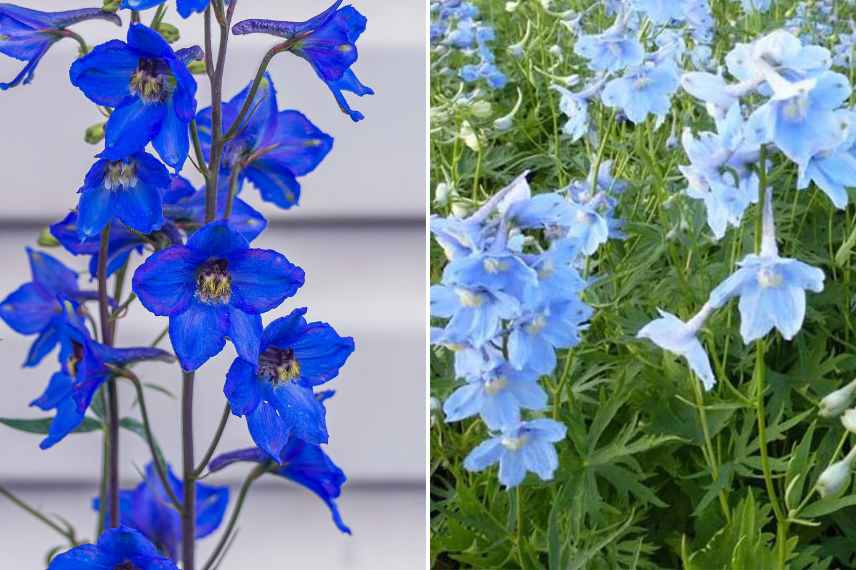 Delphinium grandiflorum and the cultivar ‘Cliveden Beauty’Double-flowered Delphiniums
These are Delphiniums whose flowers are composed of many petals, giving them extra volume. There are several varieties in the Elatum group, the most common in gardens, but also the group containing the tallest Delphiniums. The stems are rigid and thick, finishing in dense panicles and large, tightly packed flowers.
The Delphinium Delphinium ‘Pagan Purples’ is a semi-double variety. It produces flowers whose intense colour is a blend of dark blue, purple and violet, adorned with a small brown eye (tiny petals forming an eye at the centre of the flower). Also note the Delphinium elatum Delphinium elatum ‘Morning Lights’, which produces pale violet double flowers. For a truly striking flowering, discover the cultivar ‘Crystal Delight’: its very double flowers have crystal-blue petals, blooming around a tight centre, with a heart that is very pale green to white.
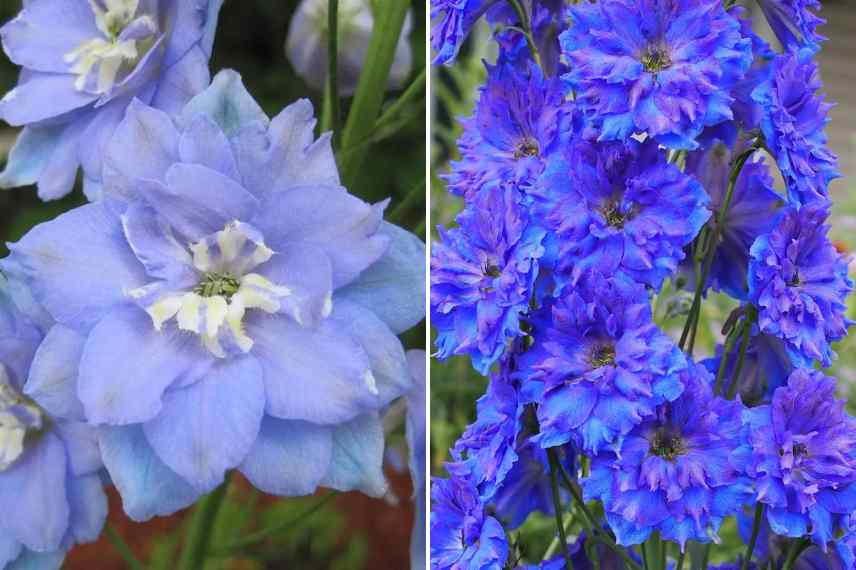 Delphiniums ‘Morning Light’ and ‘Pagan Purples’Triple Delphiniums
These are very floriferous varieties, producing panicles covered with triple and frilly flowers. Among them, we cite the Delphinium Delphinium ‘Highlander Cha Cha’, with its pale lilac colour. Also in the same series, ‘Highlander Flamenco’ offers a flowering whose purplish‑violet colour is particularly refined. Do not forget ‘Highlander Sweet Sensation’, which bears flowers that are purple on the outside, but a softer blue-mauve toward the inside. A truly original variety!
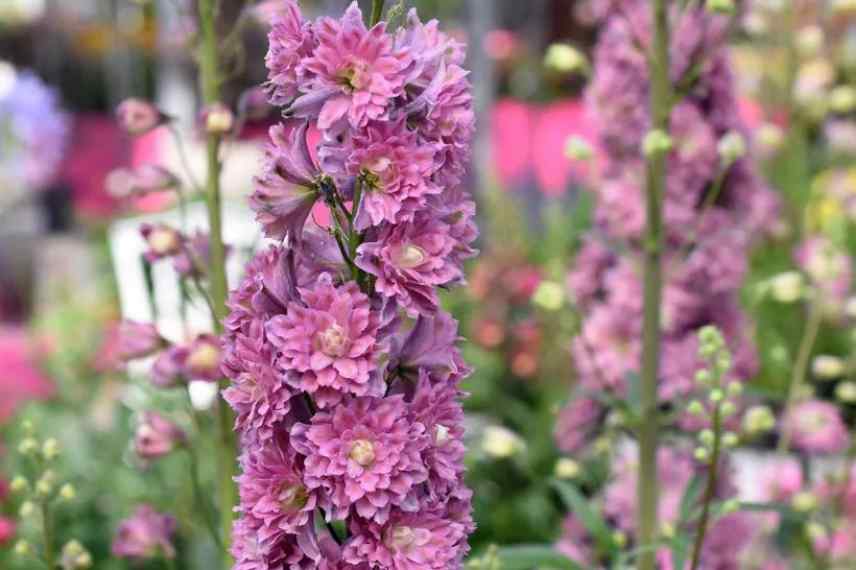 Larkspur ‘Highlander Flamenco’
Choosing a Delphinium by size and use
Delphiniums are often used to add height to the garden. But their height varies depending on the cultivar, ranging from 25 cm to nearly 2 metres.
The small varieties
The small varieties of Delphiniums grow very well in a mixed border, in pots or at the front of a border. When growing in pots, however, choose a container at least 30 cm deep to give the plant enough space to develop its root system. Dwarf varieties, which reach less than 1 metre in height, fit in very easily. They also have another welcome advantage: they require no staking, whereas staking will be essential to support the larger varieties.
These are the Delphiniums found in the Belladonna group, such as ‘Cliveden Beauty’ which reaches 70 cm in height. The Delphinium grandiflorum is also a good candidate, as it forms a small tuft of less than 50 cm in all directions. Truly miniature, the cultivar ‘Blauer Zwerg’ does not exceed 25 cm in height and produces single flowers in a bright gentian blue.
The Magic Fountains series, the dwarf version of the Pacific Hybrids, also features attractive compact specimens of small size.
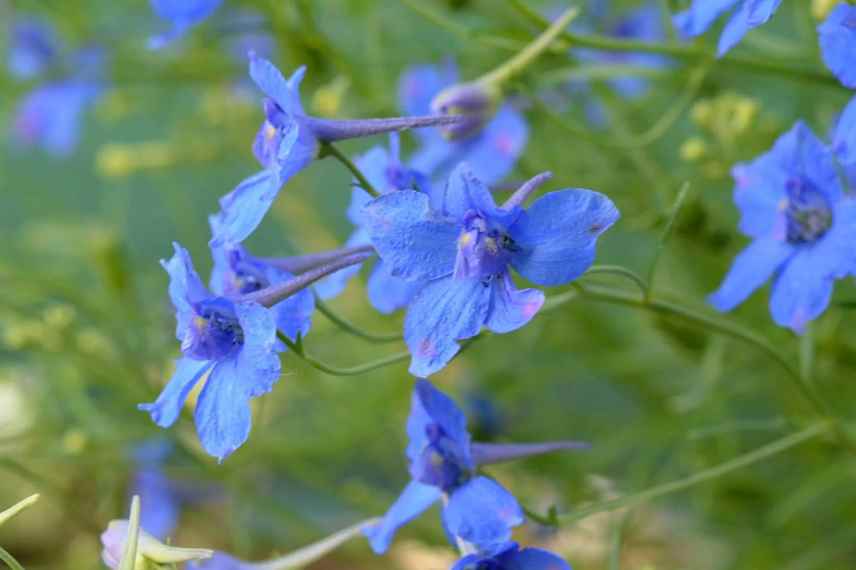
The mini cultivar ‘Blauer Zwerg’
The Giant Delphiniums
These are the tallest Delphiniums, capable of reaching 2 metres in height at maturity. But they are also the most fragile. These tall Delphiniums must be protected from wind, otherwise their long flowering stems will snap at the slightest gust or break under the weight of the numerous flowers. A position at the back of the border, ideally against a wall or another structure, will therefore be ideal.
These are Delphiniums in the Elatum group. For example, the Delphinium elatum ‘Double Innocence’, which reaches about 1.5 metres in height during its white and bright flowering. Equally tall, the Delphinium ‘Pacific giant Cameliard’ flowers in sky blue when ‘Pacific Astolat’ favours a pale lilac-purple.
Even taller are the Delphiniums ‘Pacific Black Knight’, ‘Mrs Newton Lees’ and ‘Blauwal’, reaching 2 metres in height.
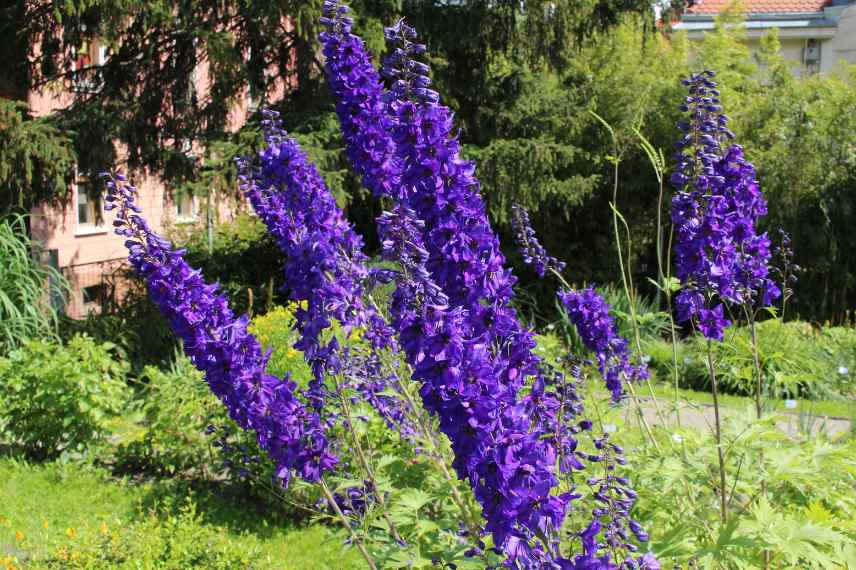
Delphinium elatum are among the tallest
Read also
How to stake a perennial plant?A few notes on Delphinium cultivation.
Delphiniums have certain cultivation requirements and take a little time to establish. They require rich, deep, well-drained soil, in a sunny position and sheltered from the wind. Maintenance is limited to watering when the surface soil is dry and to pruning the stem after flowering. Then, every 3 to 4 years, division will ensure the plant’s longevity.
These plants do not tolerate very windy sites, dry and poor soils, or, conversely, heavy, compacted soils. Most Delphiniums tolerate temperatures below -15°C, but they do not like winter humidity either.
- Subscribe!
- Contents
Comments