






























Hardy plants for cemeteries: what to plant in a pot on a grave?
Our selection
Contents
The issue is recurring when we want to flower a grave and honour our departed: which plant will be able to withstand the harsh conditions of a cemetery, where they are subjected to strong sun and wind, planted in pots or planters most of the time on mineral surfaces and often without regular maintenance or watering?
Our choice focuses on plants that are low-maintenance, unobtrusive, yet decorative all year round for some or with long flowering for others, suitable for small containers and for the demands of minimal maintenance.
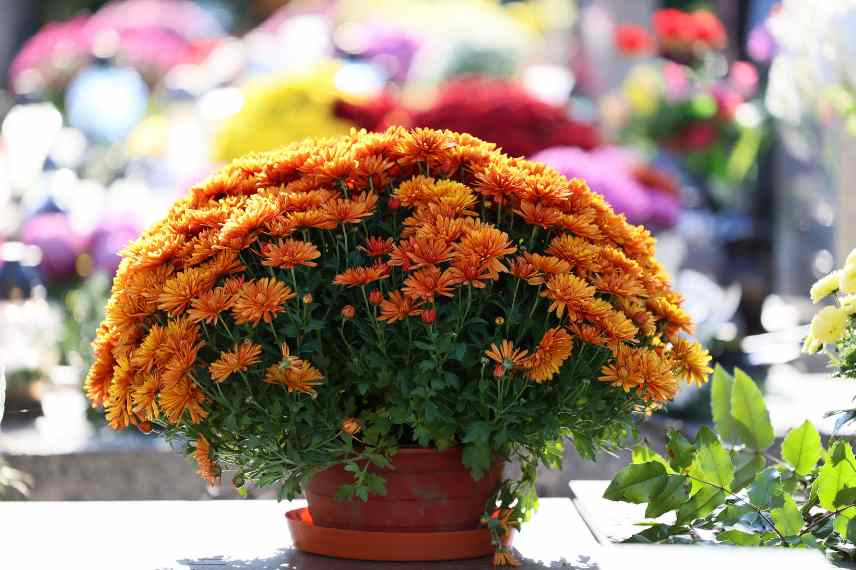
No, the sacrosanct chrysanthemums are not the panacea of cemeteries, for they die at the first frost… Let’s opt for durable plants in pots!

Ultra-resilient and drought-tolerant perennials
Some flowering perennials, hardy and very low-maintenance, are well suited to pot culture on a grave:
Erigeron karvinskianus, often called Karvinskian daisy, is a perennial that forms a multitude of small white flowers with a hint of pink. Very hardy, it thrives at the base of walls, in poor, dry soils and in full sun: it is a charming ally for a pot-grown planting on a grave, providing continuous flowering from spring to autumn. Its light habit brings life and softness to the grave, while tolerating occasional missed watering.
The garden valerian (Centranthus ruber) is the other essential in a cemetery. It’s often overlooked, but this lovely perennial with pink (to vivid) or white flowers is a hardy, low-maintenance plant, flowering for a long time if pinched, drought-tolerant, perfect for a sunlit grave. Just like Erigeron, we love its natural look, even with no regular maintenance.
Gaura is another perennial that tolerates drought well, making it ideal for cemeteries where watering is scarce. With its white or pink butterfly-shaped flowers, it adds a sense of lightness and flowers for a long period, from spring to autumn. Choose a dwarf variety for these conditions.
Periwinkle (Vinca minor) is nice in shaded corners and offer an evergreen foliage with white or blue little flowers.
Saxifraga arendsii, with its mossy cushions and spring flowers, stays discreet but charming and offers, like all rockery plants, an interesting alternative in many exposures and regions. Partial-shade varieties are advantageous in regions where rainfall will suffice for their development.
Hellebores (Helleborus niger or orientalis) will, for their part, provide a beautiful winter flowering, provided you water them sparingly or live in a region where rainfall will replace irrigation.
The hardy perennial geraniums, notably Geranium ‘Rozanne’ or the Geranium sanguineum, are also perfect in pots for their long flowering and toughness, provided you water them also, at a minimum, in midsummer.
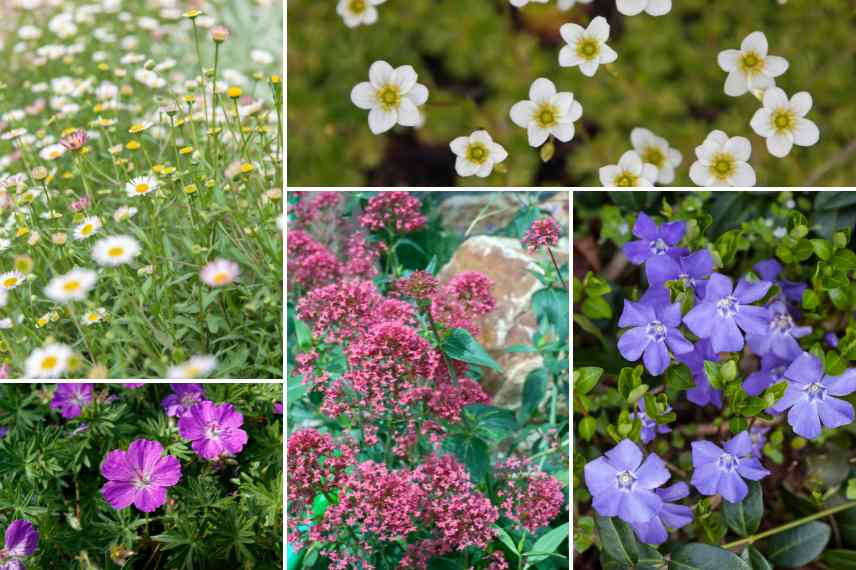
Erigeron karvinskianus, Saxifraga arendsii, Geranium sanguineum, Centranthus ruber (red valerian) and periwinkle.
Read also
8 floral arrangements for the cemeteryShrubs or bushes for evergreen foliage and/or flowering
Evergreen foliage plants provide year-round presence, a welcome addition to a cemetery. Their compact habit and resilience make them essential for pots displayed on a grave.
Heathers
To brighten a grave, the heathers are a safe bet, among the most popular plants… but not only for All Saints’ Day, the date when they are usually sold in bulk at garden centres! Their colorful flowers, their compact pot habit and their evergreen foliage ensure a strong winter display with Erica, but by mixing different varieties (Calluna and Daboecia for summer, Erica for winter), it is possible to obtain an elegant and durable pot, with little watering required. Resistant to cold as well as sun, they adapt well to small containers and require very little watering, but they require heath soil at planting. I recommend reading Virginie D.’s favourites, in “5 Heathers in pots, my little collection”, and to pair them with other plants.
Thyme
The creeping thyme (Thymus serpyllum) is a very decorative aromatic plant. Its creeping habit, evergreen foliage and discreet, but melliferous, flowering make it a plant that is both useful, understated and aesthetic. It settles readily in shallow pots, even when exposed to full sun and wind, without requiring regular maintenance.
Potentillas
Shrubby potentillas (Potentilla fruticosa) also deserve our attention to brighten a grave, provided you choose compact varieties. They offer real advantages for pot culture on a grave, especially in sunny situations. Their foliage, often semi-persistent (or evergreen in mild climates), remains decorative for much of the year. But it’s their long flowering period, from May to October, which makes them a very popular plant in cemeteries with flowers in pure white, pale yellow, pink or orange depending on the cultivars.
Potentilla for pots (potentillas for pots) tolerate full sun, poor substrates and missed watering. They display good hardiness, an excellent drought tolerance and require only light annual pruning to maintain a compact habit. The dwarf varieties such as ‘Abbotswood’ (white flowers) or ‘Pink Beauty’ are particularly well suited to small pots or grave planters.
Lonicera and Dwarf Euonymus
Finally, the Lonicera nitida dwarf form, such as ‘Purple Storm’, keeps a fine and dense foliage, perfect for a miniature topiary in a pot. Dwarf euonymus also form pretty cushions of green or variegated leaves, resistant to cold, sun and drought, and some compact Hebe, though sometimes frost-prone, can suit sheltered or temperate areas: their dense foliage provides a very ornamental texture.
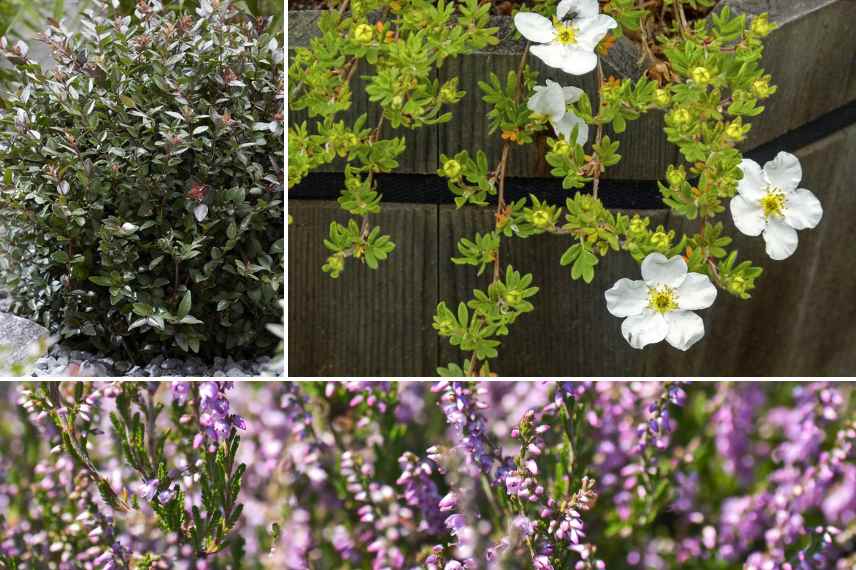
Lonicera nitida ‘Purple Storm’, Potentilla ‘Abbotswood’, and Calluna vulgaris
Spring and autumn bulbs
Spring-flowering bulbs or autumn, which naturally enter summer dormancy, are perfectly suited to cemetery pots, particularly in hot regions or when care is irregular. These plants, whose natural cycle is opposite to periods of high heat, are indeed a good choice for tombs that are watered sparingly in summer. They pair well with deciduous plants that will wake up at the same time as their dormancy.
Narcissus, crocus, muscaris, chionodoxas or botanical tulips will be planted in autumn in shallow pots. They tolerate container cultivation very well and offer a natural flowering from the end of winter. After flowering, their foliage dries naturally in spring and the bulbs go into rest for the entire summer, a period during which they do not fear either drought or high heat. Just leave the pot in place, without maintenance, until the return of the next vegetative cycle.
Colchicums and the Naples cyclamen (Cyclamen hederifolium) are perfect as autumn-flowering bulbs and tubers suited to cemeteries. They are content with a well-drained substrate. Hardy cyclamen, in particular, produce ornamental marbled foliage that persists all winter, before a summer dormancy.
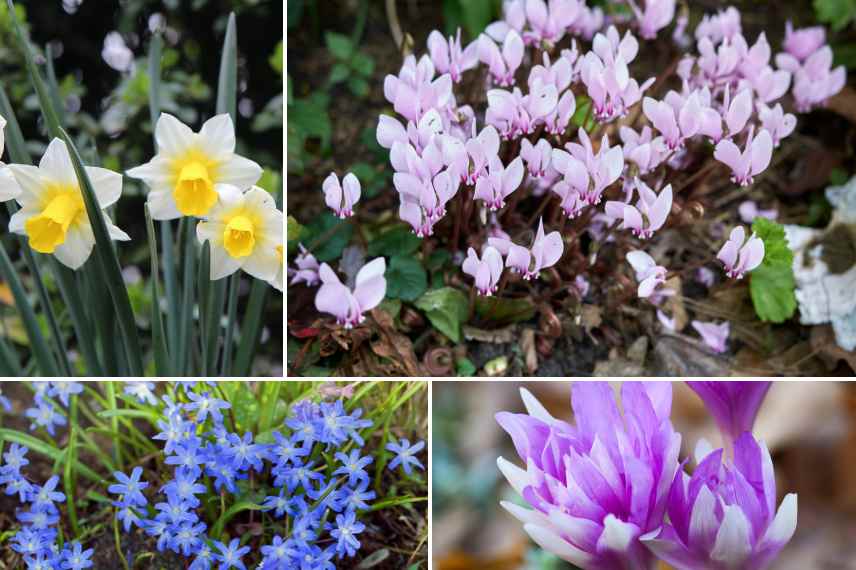
Narcissi, hardy cyclamen, Chionodoxa and colchicums
Read also
Drought-resistant plants to grow in potsFleshy and succulent plants
Hardy succulent plants, such as houseleeks (Sempervivum) or ground-cover sedums such as Sedum spurium, are perfectly suited to extreme conditions often found in cemeteries: heat, drought, containers that are usually shallow and lack irrigation. Their fleshy foliage, sometimes tinged red or blue-green, is robust and forms a graphic and structured silhouette all year round. Some sedum varieties also provide a light, colourful summer flowering, extending the visual appeal of these potted displays. In the south, compact agaves and Mangaves will also perform well.
Consider them for a change from the more traditional plants mentioned above. All these plants are, of course, particularly recommended for cemeteries subjected to significant summer heat, as in all southern regions of the country, and not in regions with high rainfall where excess water would cause them to rot.
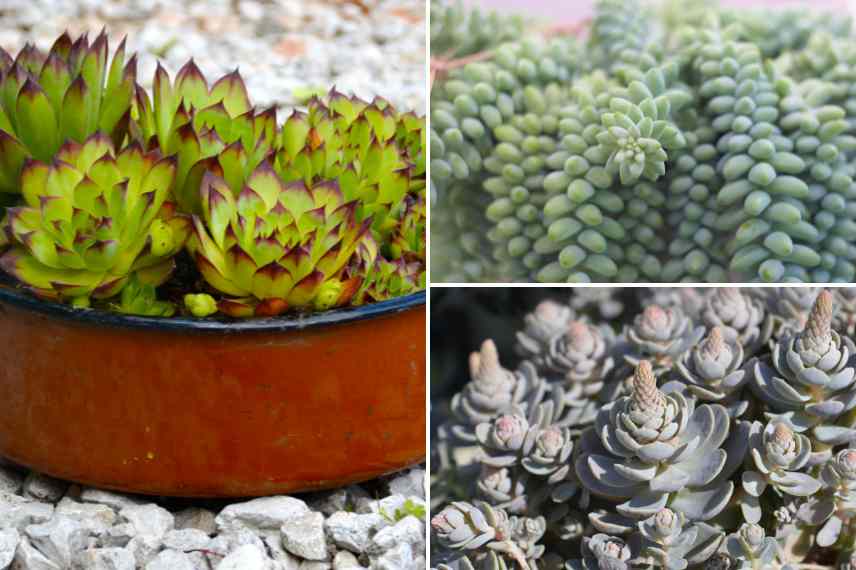
Houseleeks on the left and right, sedums
Dwarf conifers: Beware!
Garden centres often stock dwarf conifers, very tempting for cemetery planters… Be careful, because even though they tolerate growing in pots quite well in the early years, their root system, although slow to develop, ends up suffering from the cramped confines of the container, especially if watering is irregular or neglected. In addition, root overheating in a plastic or dark-coloured pot, combined with a poor potting mix, can quickly cause irreversible drying out. There are plenty of other sustainable alternatives, as we have just seen.
Pot material choice for the cemetery
One final important tip concerns the choice of pot material. It is crucial for the longevity of cemetery plantings, especially when left unattended for long periods. Constraints vary according to climate and exposure.
- In humid and oceanic regions such as Brittany or the north-west, it is best to opt for natural or glazed terracotta pots, provided they are frost-proof. Terracotta is breathable, which helps limit excess moisture around the roots, especially in winter. However, if the pot is exposed to heavy rain followed by frost, avoid plain, untreated terracotta pots, which are prone to cracking.
- In hot and dry regions, the priority is to prevent overheating of the roots. Pots made of reconstituted stone, light mineral concrete, thick terracotta or mineral fibre are well suited, as they insulate better from solar radiation. Conversely, pots made of dark plastic or black resin heat up very quickly, which burns the roots in summer, especially in full sun exposure. It is better to avoid them in these contexts.
Zinc or metal troughs overheat too quickly and cause thermal shocks. Also avoid glazed pottery that retains moisture well, but can be heavy and, above all, expensive to replace in the event of impact or theft.
Finally, whatever the material, it is essential to choose a container with drainage holes at the bottom, at least 15 to 25 cm deep depending on the plants, and ideally elevated (legs, spacers or a draining saucer) to avoid direct contact with the soil of the vault or the monument, a possible source of stagnant moisture.
- Subscribe!
- Contents
Comments