





























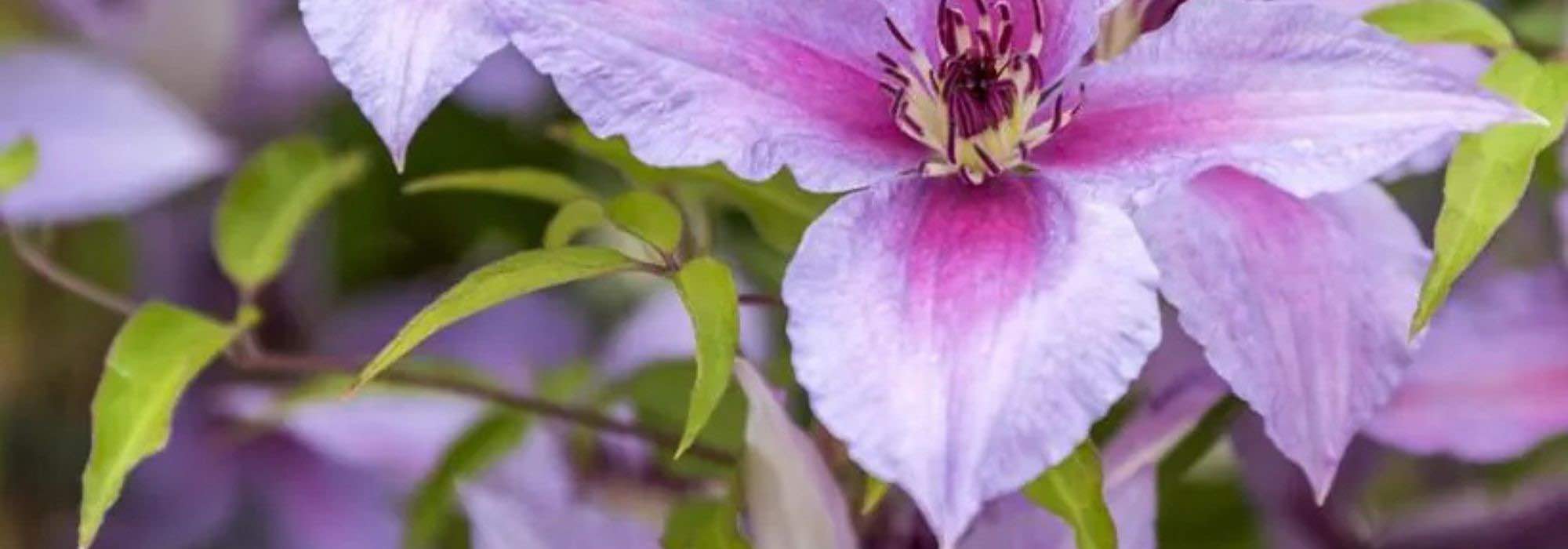
Growing purple-flowered climbing plants to brighten the garden
A charming flowering display to adorn all your garden structures
Contents
Climbing plants are essential in the garden for adding height. They are versatile, allowing you to beautify an arch or a pergola, dress up an unattractive structure or to enhance a wall. There really is something for every taste and every growing condition.
Among the flower colours we favour, purple and lilac. You may immediately think of wisterias when talking about climbing plants that bloom in these colours, but there are many others. Here are our tips for choosing climbing plants with purple or mauve flowers, based on their various attributes.

The appeal of violet and mauve flowering
Purple and mauve are cool colours. They can be very discreet in the garden, but can also help to enhance other colours, in harmony. From very pale mauve to a vivid violet, passing through shades that lean towards pink or purple, the palette is indeed fairly wide.
It’s a colour that fits equally well in romantic and countryside atmospheres as in settings that aim to be more contemporary or in exotic scenes. Parma violet, lilac, plum, violine, lavender… you will surely find a mauve or violet colour that speaks to you.
It is worth noting that violet results from mixing red and blue. In terms of symbolism, this colour has long been associated with royalty and the clergy, but also with esotericism, which contributes to it having a mysterious and refined image.
In the garden, favour sunny exposures to showcase this colour and counterbalance its sometimes rather cool and discreet side.
Paiing purple climbing plants
If you’re looking for a bit of inspiration to create a harmonious scene with a purple-flowering climber, you have several options:
- Start with a purple monochrome palette, using the full range of shades from lightest to darkest.
- Choose only pastel colours, for a garden or border with a very soft and romantic look. Wisterias and clematis, paired with pastel-coloured roses, form, for example, a combination that is always very successful.
- Opt for a pairing with its complementary colour. On the colour wheel, purple’s opposite is yellow. It is therefore a combination that works very well, whether with flowering displays or sunlit foliage.
- For a more exotic and original touch, pair purple- and mauve-flowering climbers with orange blooms. This pairing will bring dynamism to the garden.
- For a harmoniously balanced pairing, opt for a pairing with white. It helps to highlight all the other colours, including violet and mauve.
For more tips, see our article: Purple and mauve flowers: how to pair them to make them stand out?
Purple or mauve climbing plants to grow in pots
These are compact climbing plants, which will stay fairly modest in height, not exceeding 2 metres. This allows them to be grown in pots, as well as in small gardens, for example in towns. Beyond their decorative aspect, potted climbing plants can also serve as a privacy screen on a balcony or terrace. Of course, larger gardens can also adopt them.
In this category, clematis offer numerous varieties that reward us with a broad palette of mauve and purple shades. This is notably the case with Clematis ‘Proud Mary’ (1.5 metres high by 80 centimetres wide), which produces flowers with corollas displaying a pale lilac-mauve, enhanced by a purplish-red centre and a bouquet of red stamens. The Clematis ‘Guiding Promise’ also measures only 1.5 metres in height. Its purple flowers have a dark eye at the heart, almost black. Let us also mention the Clematis diversifolia ‘River Star’, with its large starry mauve flowers, which share the same dimensions.
On the roses side, let us mention ‘Princesse Sibilla de Luxembourg’, a small climbing shrub with semi-double purple flowers, contrasting with a yellow centre. The flowering exudes musky notes.
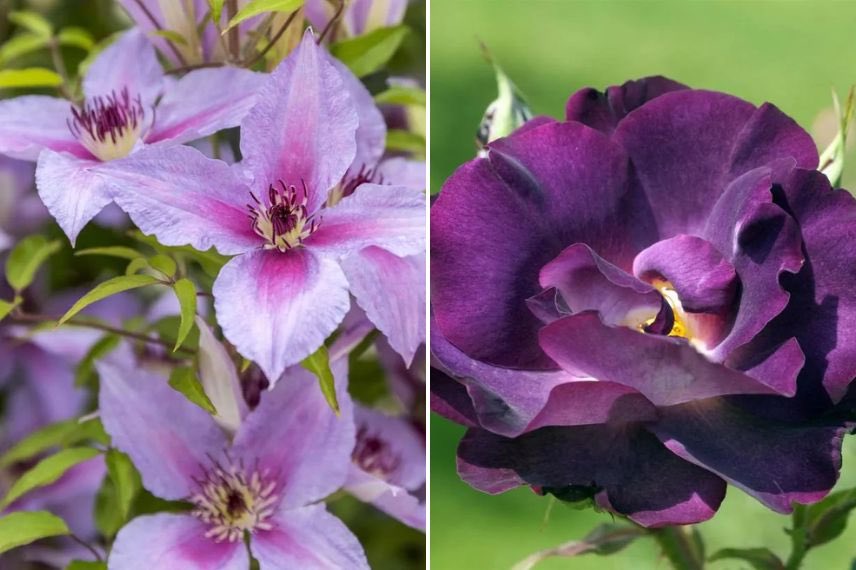
Clematis ‘Proud Mary’ and rose ‘Princesse Sibilla de Luxembourg’
Read also
7 purple flowering shrubsPurple or mauve evergreen climbing plants
Evergreen climbers have the advantage of keeping their foliage year‑round. If you are looking for a purple or mauve variety that does not shed its leaves in autumn, for example, opt for the Holboellia traversii. This is an evergreen climber still relatively little known, with spring flowering in the form of mauve-pink bell-shaped blossoms. Fragrant, this flowering diffuses notes of orange blossom. To add further decorative interest to this climber, note that the flowering is followed by fruiting in the form of small purplish-violet cylindrical fruits. Moreover, this climber is fairly hardy.
Let’s add Stauntonia purpurea, a voluble climber with spring flowering, which reveals pendulous bell-shaped flowers in a purple-violet shade. They are fragrant and accompanied by lobed evergreen leaves. This climber also produces decorative fruits after flowering. Hardy down to -10°C, it will suit many of our regions.
In regions with mild winters (not dropping below -5°C), consider Hardenbergia violacea. This climber produces purple-mauve pea flowers, surrounded by long evergreen leaves, dark green.
In favourable climates (short and mild frosts), many passionflowers can also be evergreen, such as the variety ‘Lavender Lady’. It produces large, sophisticated flowers in a pale mauve colour.
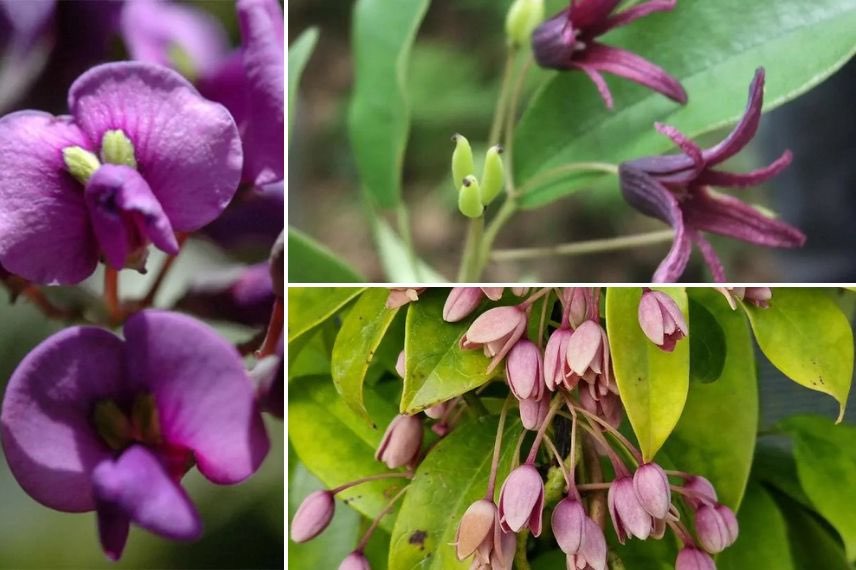
Hardenbergia violacea on the left, Stauntonia purpurea at the top and Holboellia traversii at the bottom
Purple or mauve climbing plants with early flowering
Do you want to enjoy a purple flowering right at the start of spring? No problem. Choose, for example, the Five-leaf Akebia, with its flowering in the form of clusters of flowers in a beautiful purple-violet hue, which appears from April to May.
Of course, wisterias are essential here:
- the Chinese wisteria, with its clusters of mauve-purple flowers;
- the Graceful wisteria, with mauve-purple flowering;
- the variety ‘Caroline’, whose early flowering may be repeat flowering in summer;
- ‘Prolific’, with its purple flowers splashed with white;
- ‘Flore Pleno’, with its mauve to purplish double flowering;
- the Japanese wisteria ‘Premature’, which has rapid flowering in mauve and bluish tones.
Let’s also mention the Clematis ‘Octopus’, unusual with its frilled-petaled flowers bearing a purple-violet hue. It also flowers from April. For its part, the Clematis macropetala flowers from March, with its pendant semi-double bells, ranging from lavender blue to blue-violet.
On the annual climbers front, let’s mention the Sweet pea ‘Spring Sunshine Lilac’, which produces large fragrant lilac-coloured flowers from April.
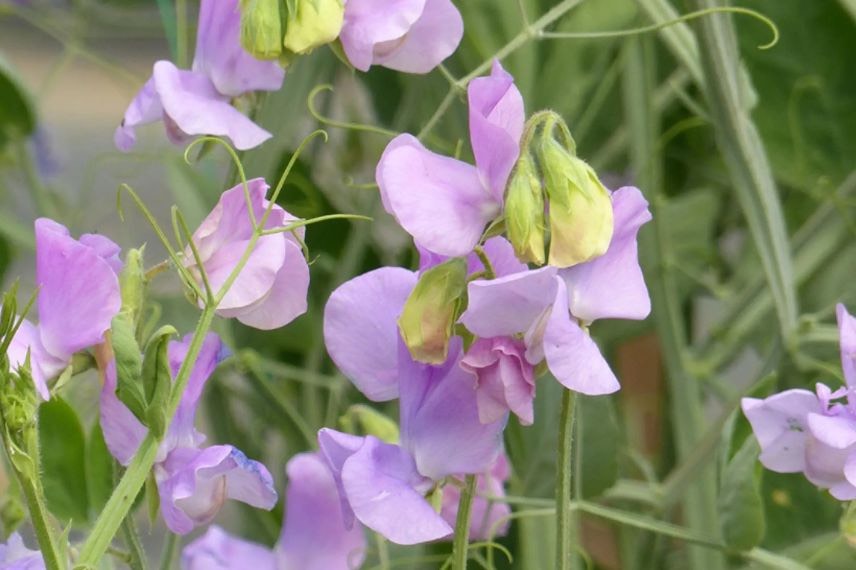
The Sweet pea ‘Spring Sunshine Lilac’
Late-flowering purple or mauve climbers.
If, on the other hand, you prefer a long flowering that lasts until the first frosts, opt for passionflowers. For example, try ‘Fata Confetto’, whose flowering is a real work of art. It comprises creamy-white tepals, sitting beneath tousled violet filaments, striped with white. The whole contrasts with a heart of yellow- and mauve-striped stamens. The flowers are scented, releasing fruity and tangy notes. Flowering begins in July and can continue until October. The same applies to the Passiflora caerulea ‘Purple Haze’, with its large purple and white flowers, or to the Passiflora incarnata, which blooms mauve.
Among roses, the climbing Perennial Blue climbing rose rewards us with repeat flowering from June to October. It produces semi-double, cup-shaped flowers, blending violet, purple, lavender and lilac.
Not to forget Solanum crispum ‘Glasnevin’, with generous, long flowering into autumn. It produces mauve star-shaped flowers with yellow centres.
On the clematis front, varieties such as ‘Lady Kyoko’ also offer a very long flowering season. This climber impresses with the shape of its flowers, double-star, formed of slender petals. Their colour is mauve veined with violet on a white background. The clematis ‘Kingfisher’ will prefer more intensity, with its vivid blue-violet flowers, which appear first in spring, then again from September to October.
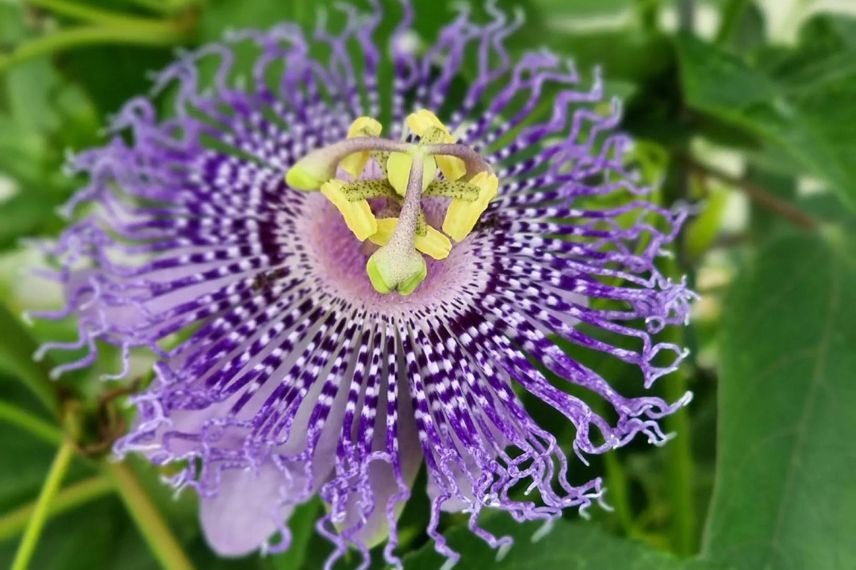
The Passiflora ‘Fata Confetto’
Purple or mauve, fragrant climbing plants.
Many purple or mauve climbers also reward us with a wonderfully fragrant flowering.
This is the case with Clematis flammula ‘Aromatica’, delightful with its star-shaped flowering in a violet-blue hue and its long cream stamens. It emits an intense fragrance, especially in the late afternoon, which justifies planting it near areas of passage. Compact in size (about 1.5 m tall by 1 m spread), it can be grown in the garden or in a pot.
For its part, the Sweet Pea ‘Cupani’ blesses us with papilionaceous bi-coloured flowers. Their powerful fragrance is regarded as unique and difficult to replicate.
Indeed, full of qualities, wisterias continue to stand out here. Notably, the Wisteria venusta ’Okayama’, whose mauve-purple clusters exhale a very complex fragrance. It blends notes of jasmine, orange blossom, caramel and honeysuckle, with a touch of camphor and clove. The Wisteria brachybotrys ‘Yokohama Fuji’ is also very fragrant, with its mauve-violet clusters and an intense, floral and spicy fragrance.
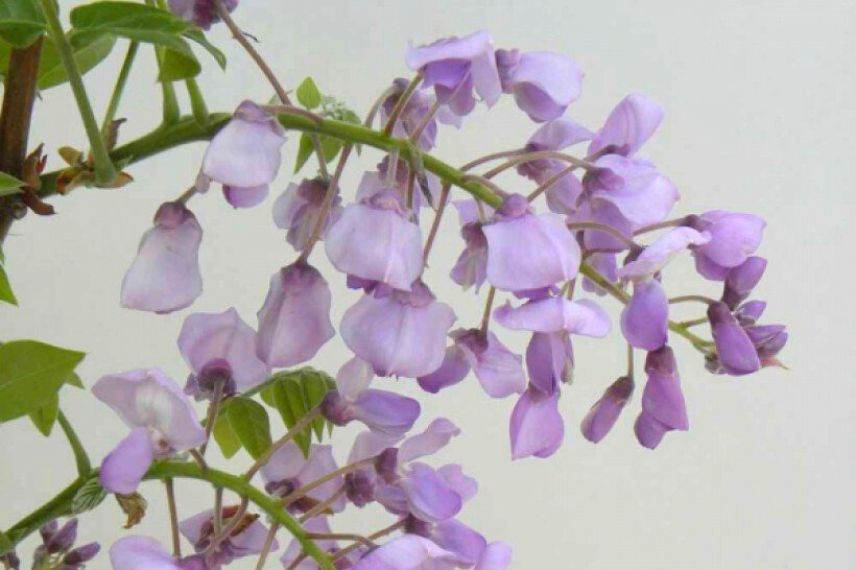
Wisteria venusta ‘Okayama’
Purple or mauve climbing plants, very hardy.
Do you live in a region with particularly harsh winters? That’s no reason to renounce climbing plants with purple flowers. Turn especially to Clematis, which show excellent resistance to severe frosts, with some varieties tolerating below -25°C. This is notably the case of the Clematis jackmanii ‘Superba’ with purple flowers or the hybrid Clematis ‘Star of India’, with purple flowers and a central carmine band.
Purple or mauve climbing plants with remarkable fruiting.
Finally, let us recall that many purple or mauve climbing plants are also interesting for their fruiting. This is the case with many wisterias, passionflowers, clematis and sweet peas. Feathery, egg-shaped and coloured, or in pod form, they undeniably add extra decorative interest.
- Subscribe!
- Contents

Comments