





























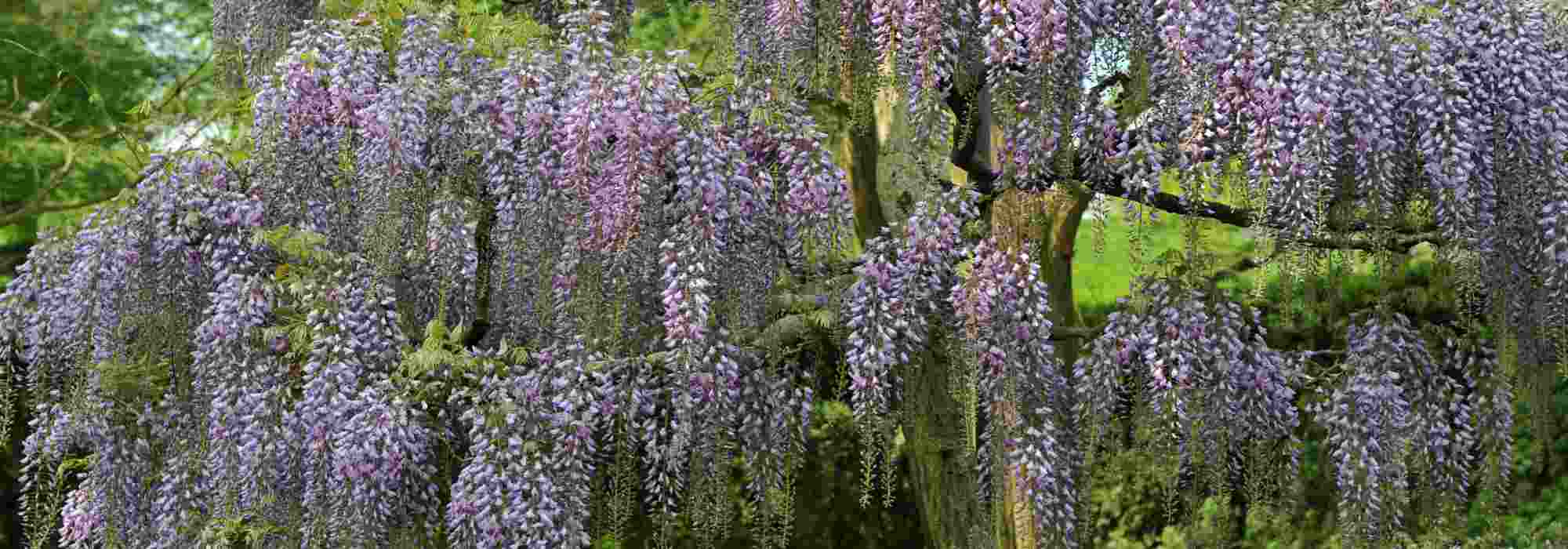
Chinese wisteria or Japanese wisteria: our guide to recognising them
According to their flowering, their silhouette or their fragrance
Contents
Wisterias are climbing plants prized for their long clusters of opulent, fragrant flowers, transforming any sufficiently sturdy supports into true cascades of foliage. For their vigour is also part of their reputation: the structures chosen to support these plants must withstand branches that can be very powerful.
Wisterias are essential climbing plants for a romantic garden, to be grown alongside roses. They will drape trellises, pergolas and other unattractive structures (walls, sheds…), with ease, provided they have good trellising.
Originating in Asia, wisterias come in several varieties. Generally, Chinese wisteria is distinguished from Japanese wisteria. What are their characteristics and how can you recognise them to make a good choice? That is what we invite you to explore in this article.
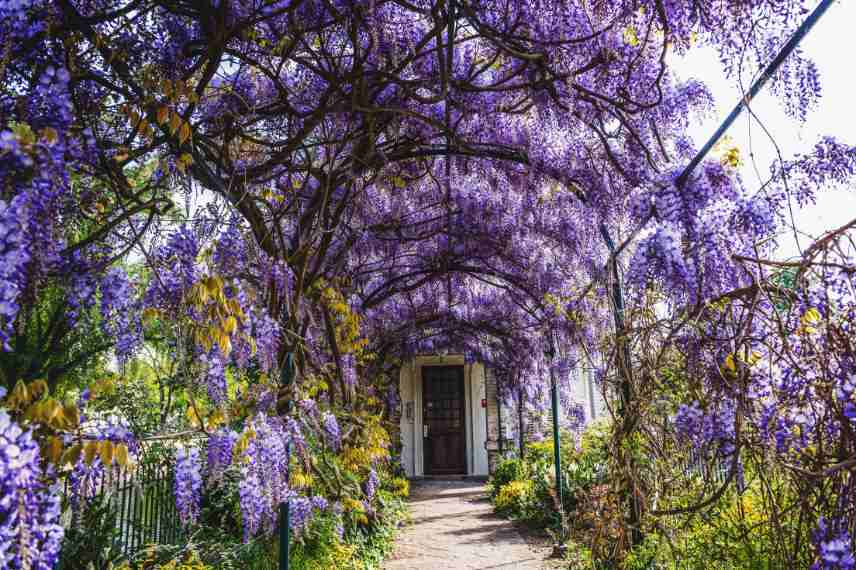
Wisterias and their profusion of flowers are spring’s delights

The two main types of wisteria: Chinese or Japanese
Wisterias all belong to the Fabaceae family, like beans, lentils or broad beans. We distinguish chiefly the Chinese wisteria (Wisteria sinensis), one of the most widespread species, and the Japanese wisteria (Wisteria floribunda). Let us also mention the American wisteria (Wisteria frutescens), although it is a much rarer species in cultivation.
Each of these species has given rise to numerous cultivars (varieties) and hybrids (cross-breeds), as illustrated by the Wisteria venusta or graceful wisteria.
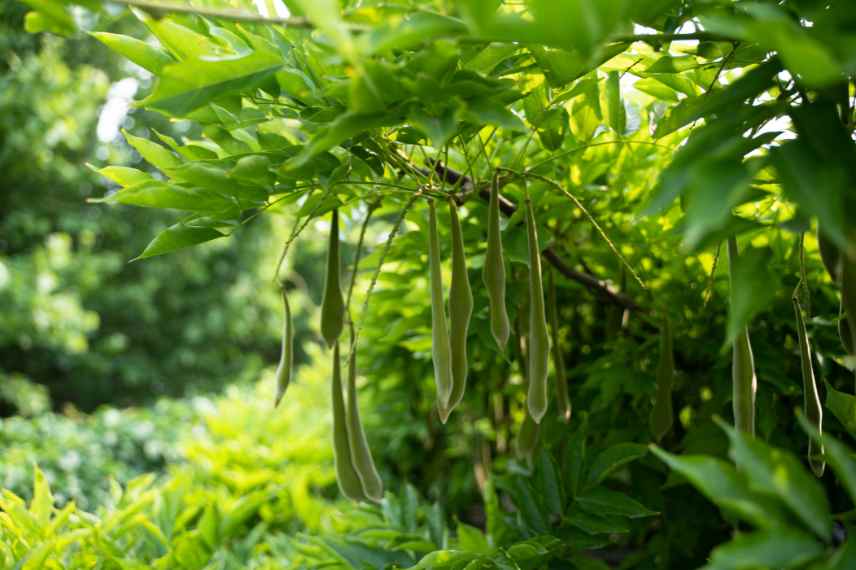
One of the common characteristics of wisterias is their fruiting in the form of pods, typical of Fabaceae
Read also
Wisteria: how to plant, prune and care?Wisterias according to their flowers
Wisterias produce beautiful clusters of flowers that can take different colours: blue (ranging from violet to mauve), pink or white.
If you’re after pink flowering, for example, opt for the Wisteria floribunda ‘Lipstick’. For a fairly soft blue-violet, turn to the Wisteria floribunda ‘Macrobotrys’. For a more intense colour and a double flowering, adopt the Wisteria sinensis ‘Flore Pleno’.
In Chinese wisteria, the flowering clusters, quite heavy and stocky, can measure up to 30 cm in length. They are smaller in American wisteria, often reaching less than 20 cm.
By contrast, Japanese wisteria offers truly spectacular clusters of flowers, capable of exceeding 50 cm in length. They are indeed longer and more slender.
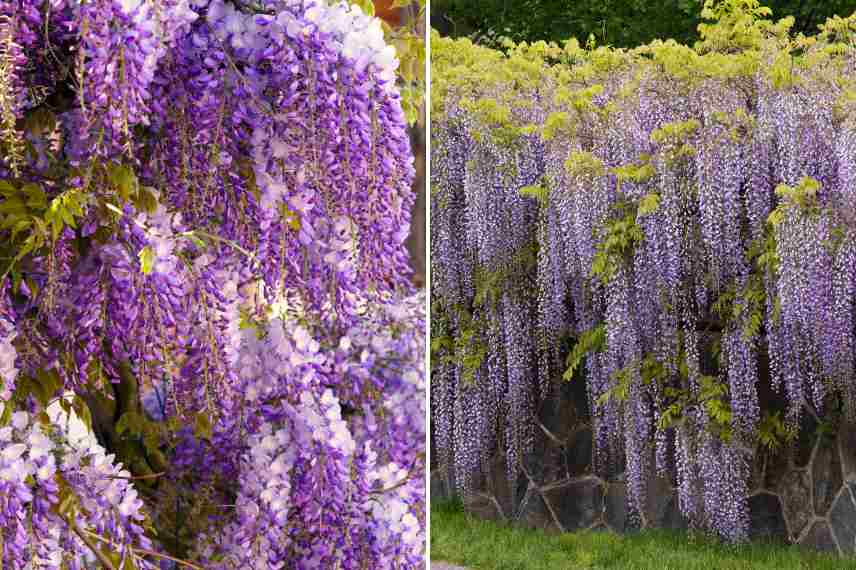
On the left, a Chinese wisteria with shorter, stockier inflorescences; on the right, a Japanese wisteria with a longer, more slender flowering
Wisterias by fragrance
The Chinese wisterias are among the most fragrant, capable of perfuming the space with their floral notes. Among the very fragrant varieties, notably Wisteria sinensis ‘Alba’, whose white flower clusters diffuse a honey fragrance. Let us also mention the Wisteria sinensis ‘Caroline’, which exudes floral, sweet and soft notes.
Less common, the Kentucky wisteria (Wisteria macrostachya ‘Clara Mack’) also diffuses a very intense grape fragrance.
Remember that a sunny exposure is necessary to enjoy a more pronounced fragrance.
For its part, the Japanese wisteria has a more subtle fragrance.

Wisteria sinensis ‘Alba’
Read also
Choosing your wisteria: buyer's guideWisterias by flowering period
Wisterias generally flower in late spring, from April to June, for about four weeks.
Chinese wisteria has a reputation for flowering more quickly than its Japanese cousin, often from the first year. Then, it flowers a little earlier. Among the earliest varieties, notable include Chinese wisteria Wisteria sinensis‘Prolific’, with its lavender-coloured clusters of flowers speckled with white, appearing from April to May. Also note Chinese wisteria ‘Blue Line’, which flowers prolifically in mid-spring, then in July and August. Chinese wisteria has one notable feature: it is repeat-flowering, that is to say it has the ability to flower multiple times, in spring and summer, whereas Japanese wisteria only flowers once in spring. The second flowering is shorter and less abundant, but still interesting.
American wisteria also has the advantage of flowering abundantly in spring, then sporadically in summer and in autumn if it is pruned.
For its part, Japanese wisteria is slower to establish itself: it may take up to three years before you can admire its first clusters of flowers. Its flowering is somewhat shorter and later (late spring).
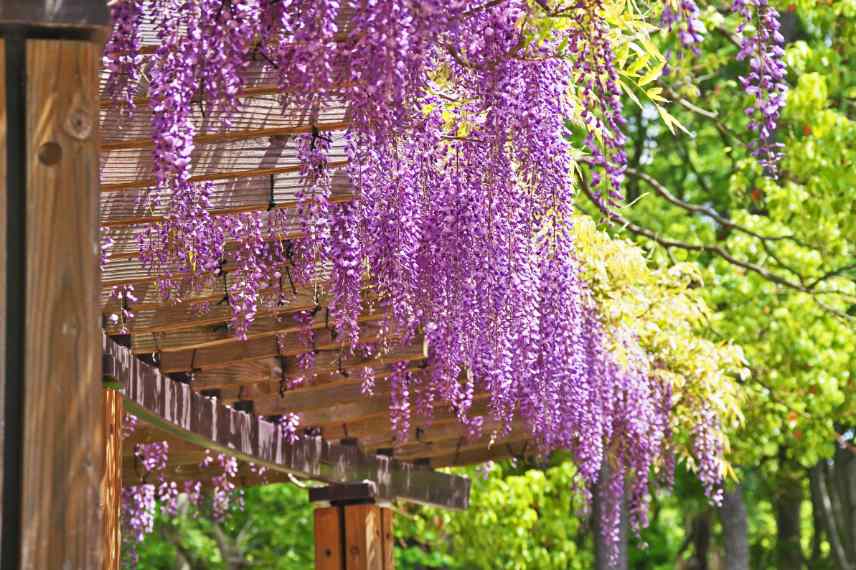
Japanese wisteria generally flowers in May or early June, later than its Chinese cousin
Wisterias by silhouette
Chinese wisteria is renowned for its rapid growth: it will therefore be able to quickly clothe garden structures by growing vertically. It can also be trained as a tree, which will take a graceful, trailing habit. It generally reaches between 10 and 15 metres in height at maturity.
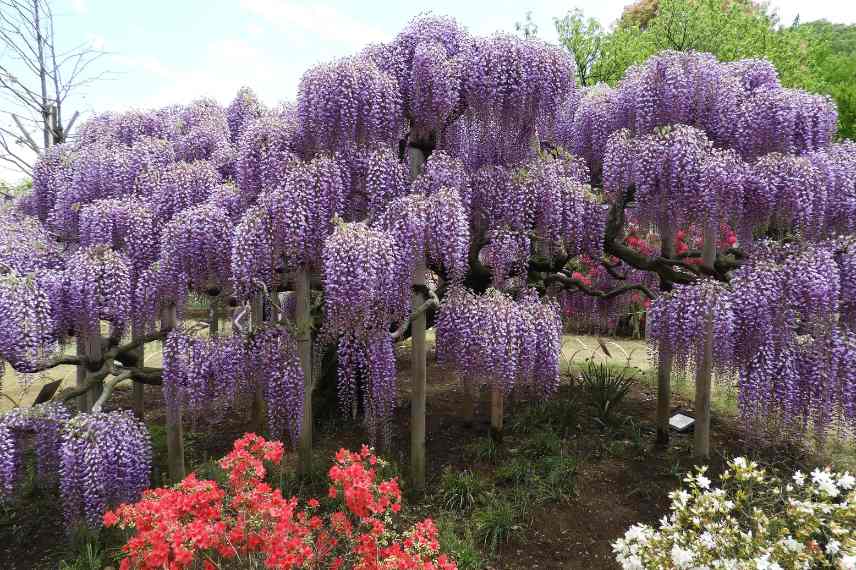
Chinese wisteria can also be grown on a stem, like a small weeping tree
Let us take the opportunity to mention a hybrid variety, which has Chinese wisteria and Japanese wisteria as parents: the Formosan wisteria (Wisteria formosa). This impressive plant can climb up to 15 metres in height with a spread of 10 metres.
Japanese wisteria are usually somewhat less exuberant. It is to these that we would recommend turning for a pot or small garden, for example. They generally reach around 8 metres in height.
Among the less vigorous varieties, we mention Wisteria venusta ‘Grande Diva Cecilia’ (3 metres in all directions), which produces generous clusters of blue-violet and white flowers. Also note the Japanese wisteria Wisteria venusta ‘Rosea’ (5 metres in height with a 3-metre spread), with its rose-coloured flowering with a mauve sheen.
For its part, American wisteria, for its part, also has a far more modest growth and a compact habit, as it does not exceed 4 metres in height and 2 to 3 metres in spread.
Another subtle difference between the two species: Chinese wisteria has twining stems that coil to the left, while Japanese wisteria has twining stems that coil to the right.
Wisterias according to their hardiness
Chinese wisteria thrives in temperate climates. Relatively hardy, it can tolerate frosts down to around -15°C. Since its flowering occurs earlier than that of its Japanese cousin, it is less hardy to the cold.
In regions with harsh winters, therefore favour Japanese wisterias, capable of withstanding frosts above -20°C.
- Subscribe!
- Contents
Comments