





























Autumn sowings under cover to extend the gardening season
What are the advantages? How to do it? Which vegetables should you sow in the vegetable garden?
Contents
Who said that in autumn there is nothing to do in the kitchen garden? Admittedly, the season is markedly calmer and the kitchen garden seems dormant. The only visits revolve around the harvests of leeks, spinach and other late vegetables. Yet it is entirely feasible to re-engage with your kitchen garden to carry out a few late-season sowings, which may need to be protected by a cover. Some vegetables will be harvested throughout winter, others will make excellent early vegetables from the first days of spring.
Discover how to carry out these autumn sowings, which vegetables to sow and how to best protect them from the cold.

Why sowing in autumn?
In autumn the garden settles down to sleep. Leaves fall as the temperatures drop. In the vegetable garden, summer crops have drawn to a close. That said, there is still plenty to do! In regions with a fairly mild climate, but also in the vegetable gardens of other climate zones, it is quite feasible to sow a few vegetables in autumn. Of course, provided you take a few precautions, because no one is immune to a cold snap, hard frosts, or even snowfall.
Indeed, Autumn is a season well suited to sowing. You may ask? First, because the soil is still warm from the long days of summer sunshine. Then, Autumn is a season when rainfall returns, so watering sessions will be unnecessary and you will let nature take its course.
In autumn, the main pest insects have deserted your vegetable garden to enter diapause. Admittedly, they are still there, often dormant in the soil or in plant debris, but at least they are completely inactive. They will not attack the newly emerged vegetable plants. It’s similar for adventive weeds. These weeds that ruin your gardening life are in vegetative rest. Thus, hoeing and weeding sessions become unnecessary.
Moreover, in autumn, these sowings that follow on from summer help to occupy the ground. Leaving bare soil in winter increases soil leaching and thus nutrient loss. A crust forms, making the soil compact and packed. Sure, you can mulch to cover your soil in winter, but sowing a few vegetables will also help prevent this compaction and erosion, by limiting runoff.
Finally, by sowing in autumn, you will be able to enjoy early vegetables at the first mild warmth of spring. Indeed, autumn sowings save time. Logically, the vegetable plants sown in autumn reach ripeness well before those sown in late winter.
Read also
Cold hardy sowing for AutumnHow to protect sowing from the cold?
Depending on the regions where you garden, autumn sowings should be accompanied by a few precautions to help them withstand the cold.
First, it is essential to choose an optimal location for sowing these sowings. To begin with, sun exposure. You must sow in a plot facing due south. Thus, your seeds will benefit from sufficient light and warmth, thanks to the winter sun’s rays. Likewise, the chosen location should be sheltered from winds and cold air currents. In regions with mild winters, these two precautions may be enough. Otherwise, you will need to plan more robust protection measures for sowing under cover.
Indeed, in regions where frosts are common, it is recommended to implement different solutions to protect your sowings from the cold:
- The winter fleece cover laid directly on the seedling beds. It has the advantage of adding a few degrees of warmth, while allowing light, air and water to pass through. Moreover, due to its lightness, it will not hinder seed germination. It can also protect seeds from the nibbling of some garden birds, such as house sparrows or wood pigeons. However, make sure to fix it firmly to the ground with boards, large stones or tent pegs. It is also advisable to remove it in case of heavy rainfall.
- The vegetable tunnel: ready-to-use, this protective tunnel effectively guards against the cold while allowing the seedlings to breathe. It consists of hoops on which either a transparent polyethylene film, or a winter fleece can be deployed. The handiest gardeners can construct their own tunnel with electrical conduits, deeply buried in the soil, and covered with a plastic sheeting, fixed to the ground with boards or stones.
-
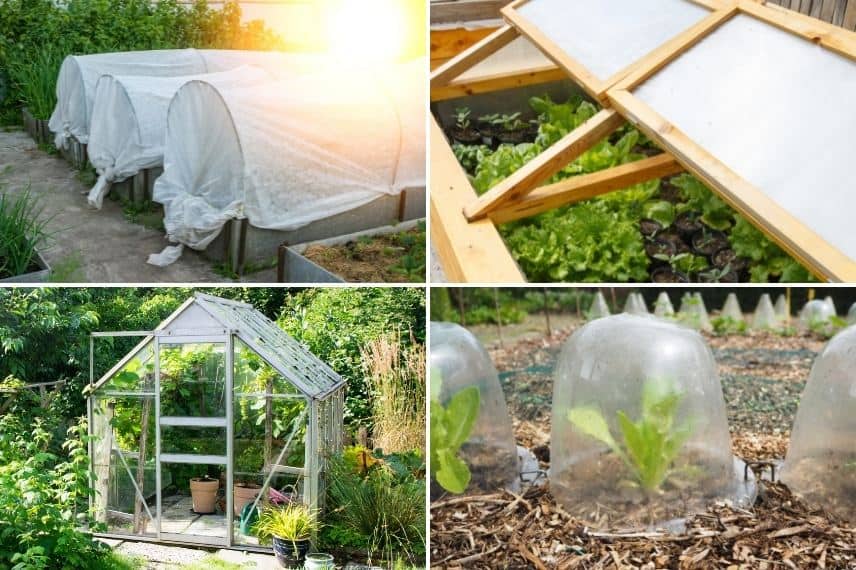
For a well-protected vegetable plot: protective tunnel, frame, greenhouse and bell jar
- The cold frame: sturdier than tunnels, the cold frame is made of boards on which a glass pane rests. Inside, sowings can be done in open ground or in seed trays. Cold frames are easy to make from an old window.
- Plastic horticultural cloches can also be used for individual sowings. However, it is more challenging for sowings laid out in rows.
- The greenhouse is ideal for the space it offers. A polycarbonate greenhouse may suffice, but the luckiest will be able to afford a glass greenhouse.
Which vegetable sowings should you carry out in autumn?
What to sow in autumn? Of course, that’s the question you’re asking yourself at this pivotal moment in your reading. The possibilities are numerous, though not all will bear fruit. But perhaps it’s worth trying, especially since you have more space in the allotment than in spring or summer.
Salad section
- Lamb’s lettuce: opt for large-seeded varieties, such as Dutch large-seeded lamb’s lettuce, or varieties highly resistant to cold such as ‘Cambrai Green’.
- Winter lettuce: select varieties such as ‘Winter Marvel’, ‘Winter Brown’, ‘Bourguignonne’…
- Romaine lettuce: ‘Winter Romaine’ resists the cold.
- Alenois cress.
- Purslane: you can sow winter purslane (Claytone de Cuba) or ‘Golden broad-leaved purslane’.
Leafy greens
- Chinese mustard or brown mustard such as ‘Red Giant’.
- Mizuna.
- Spinach, such as ‘Winter Giant’.
- Orache.
- Spring cabbages among headed cabbages (‘Pierre F1 Head’, ‘Medium Heart of Halle’, or ‘Nantes Early’), kale (‘Half-height green kale’), or Erfurt Snowball cauliflower.
Root vegetables
- Carrots such as ‘Eskimo F1’, or ‘Touchon’.
- Winter radish such as ‘Noir gros rond d’hiver’.
- Parsnip.
- Tuberous chervil.
You can also sow broad beans and round-seeded peas between October and November for a spring harvest. Choose varieties such as ‘Aguadulce with very long pods’ for broad beans, and ‘Very Early Annonay’ or ‘Petit Provençal’ for peas.
- Subscribe!
- Contents

Comments