





























Pairing ideas with Trollius
6 ideas for pairing these globular flowers
Contents
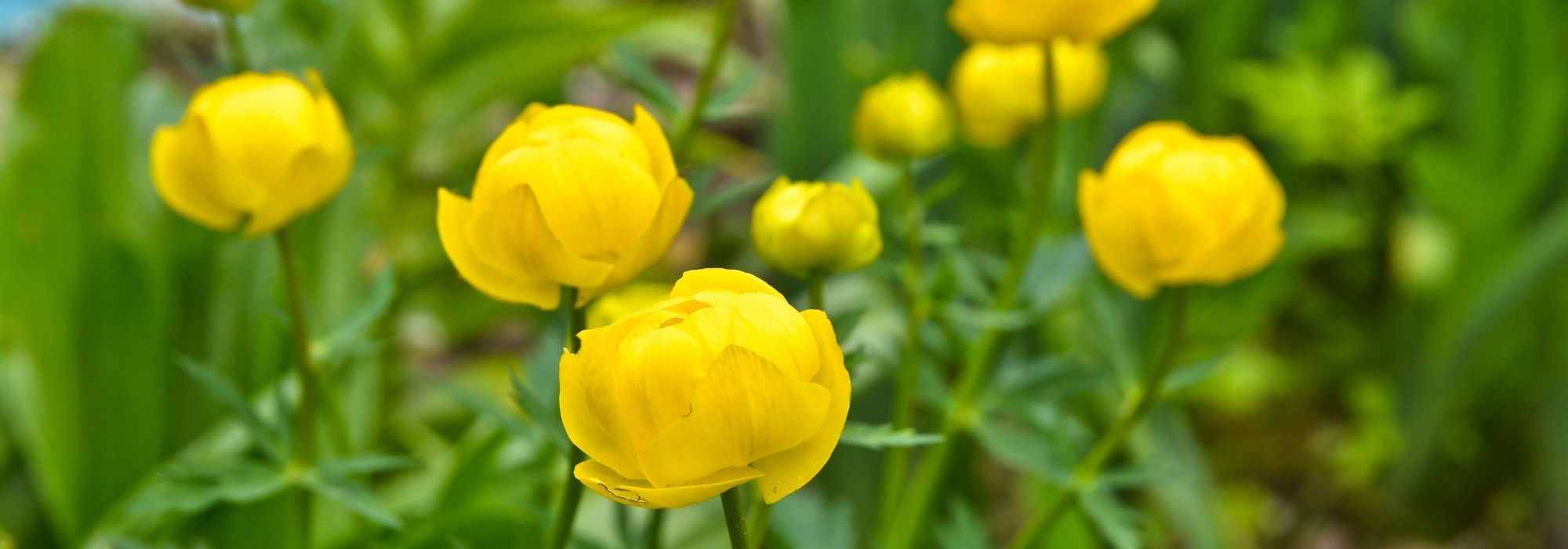
In spring, the trollius creates a stunning effect in the garden with its bright white, yellow, or orange flowers depending on the variety. This very hardy perennial requires growing in soil that does not dry out. Therefore, it can be planted near aquatic scenes, in woodlands, or in semi-shaded rockeries. The flower, reminiscent of the buttercup (particularly in the case of the European trollius), can fit into various garden styles in full sun or partial shade. For example, the trollius works wonderfully in English gardens, naturalistic gardens, as well as in cut flower gardens!
Discover our inspirations for pairing your trollius with warm hues without delay!
⇒ To learn everything about this plant with globular flowers, visit our page Trollius: planting, growing, and maintaining.

By the edge of a water feature
The troll is a perennial plant that thrives in consistently moist soils, but not excessively so. Its planting by the edge of a pond or stream is therefore quite feasible. Do note that its roots should not be completely submerged in water. With its bright colours, the troll adds a beautiful splash to damp scenes. Consider, for example, the Trollius chinensis ‘Golden Queen’ with its open cup-shaped flowers in orange-yellow. Pair this troll with other perennial plants that enjoy moisture.
In the background, install an acorus, an astilbe, or meadowsweet (Filipendula ulmaria) which are essential in a wet setting. For instance, the Acorus calamus ‘Variegatus’, a plant of wet banks par excellence, features bright bicoloured foliage, vivid green striped with cream white, and forms large, spreading clumps. For a touch of originality that is very graphic, consider the Juncus effusus ‘Spiralis’ which can be grown in heavy, moist soil and has spiralled stems. Persicarias are also effective for filling out a wet area. Like the troll, they flower in summer. We recommend a particularly floriferous variety to plant in the foreground: Persicaria affinis ‘Kabouter’. It produces floral spikes whose colour evolves over time in pale pink, red, or purple tones. The Japanese primrose Primula japonica grows perfectly in moist soil. While it boasts vibrant flowering, there are also varieties with softer colours: Primula japonica ‘Millers Crimson’, Primula japonica ‘Apple Blossom’, and Primula japonica ‘Alba’.
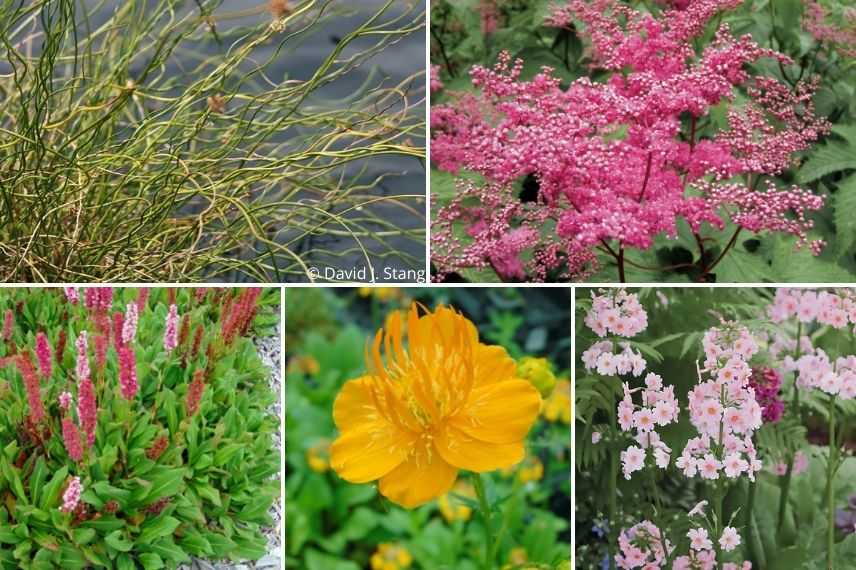
Juncus effusus ‘Spiralis’, Filipendula purpurea, Persicaria affinis ‘Kabouter’, Trollius chinensis ‘Golden Queen’ and Primula japonica ‘Apple Blossom’ (Copyright Horticolor)
Read also
Trollius: planting, growing, and careIn an English garden
The troll also integrates well into perennial borders, where the soil rarely dries out. Imagine a country-style display in shades of yellow and orange, punctuated with white. First, erect plants take their place at the back of the border. The summer flowering of a yellow lupin (Lupinus (x) polyphyllus ‘Le Chandelier’, known as Russell lupin) and the flower spikes of a white foxglove (Digitalis purpurea ‘Alba’) add verticality. Next, choose a troll species with vibrant colours, such as the Asian troll Trollius asiaticus with orange flowers or the Mountain troll Trollius europaeus with golden yellow flowers. In this scene, do not hesitate to plant the trolls in masses.
Loving moist soils, the riverside avens is an ideal companion (Geum rivale ‘Coppertone’ with copper-orange flowers or Geum rivale ‘Lionel Cox’ with sulphur-yellow inflorescences). The white meadow carnation (Lychnis flos-cuculi ‘White Robin’) lightens the display with its small laciniate flowers. Also place perennials with decorative foliage. Consider Lysimachia congestiflora ‘Persian Chocolate’, which forms a carpet of purplish-green foliage and reveals yellow flowers, or the Golden watercress with soft green and yellow leaves. Both having a groundcover habit, you will place them at the edge of the border.
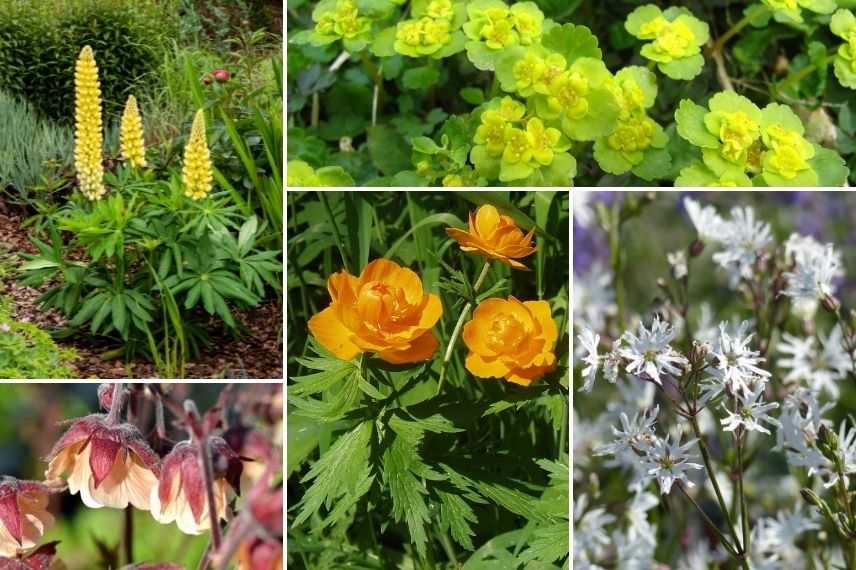
Lupinus polyphyllus ‘Le Chandelier’, Chrysosplenium alternifolium (photo OleHusby), Geum ‘Coppertone’, Trollius asiaticus (photo Wikipedia) and Lychnis flos cuculi ‘White Robin’
Discover other Trollius
View all →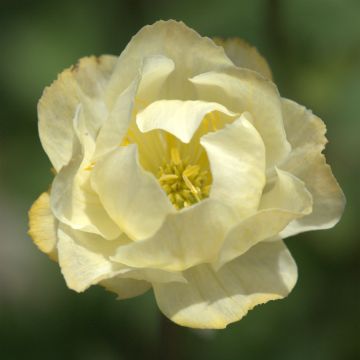
Available in 2 sizes
Available in 0 sizes
Available in 3 sizes
Available in 1 sizes
Available in 1 sizes
Available in 1 sizes
Available in 1 sizes
Available in 3 sizes
Available in 1 sizes
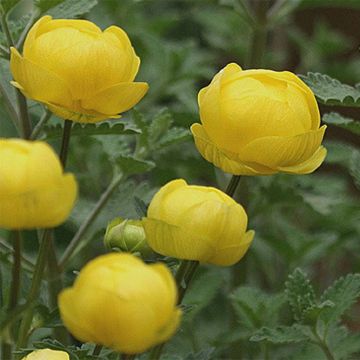
Available in 1 sizes
In a semi-shaded woodland garden
Trollius can also be planted in a slightly shaded area of the garden. Create a peaceful space under the partial shade of trees or bushes. Keep it simple by blending shades of green to inspire a relaxing atmosphere. Of course, avoid garish colours. The Trollius cultorum ‘Cheddar’, for example, produces soft cream-white flowers in spring.
To add volume, you can pair it with opulent plants, such as hostas with various foliage: blue-green for theHosta tardiana ‘Halcyon’, light green for theHosta ‘Purple Heart’, or variegated for theHosta ‘Forbidden Fruit’. Ferns, such as Clayton’s osmunda with its large light green fronds, are typical plants of woodland edges. Also consider the palmate foliage of rodgersias. For example, the variety Rodgersia pinnata ‘Bronze Peacock’ is particularly dark with bronze-brown leaves in spring, turning reddish-purple in summer, then green. In this setting, Carex elata ‘Aurea’ stands out with its tuft of long linear leaves in a very fresh green. Astrantias can take over the flowering from the ‘Cheddar’ troll (Astrantia major ‘Buckland’ or Astrantia major ‘Rosea’). Finally, small perennials like heucheras can fill in the gaps.
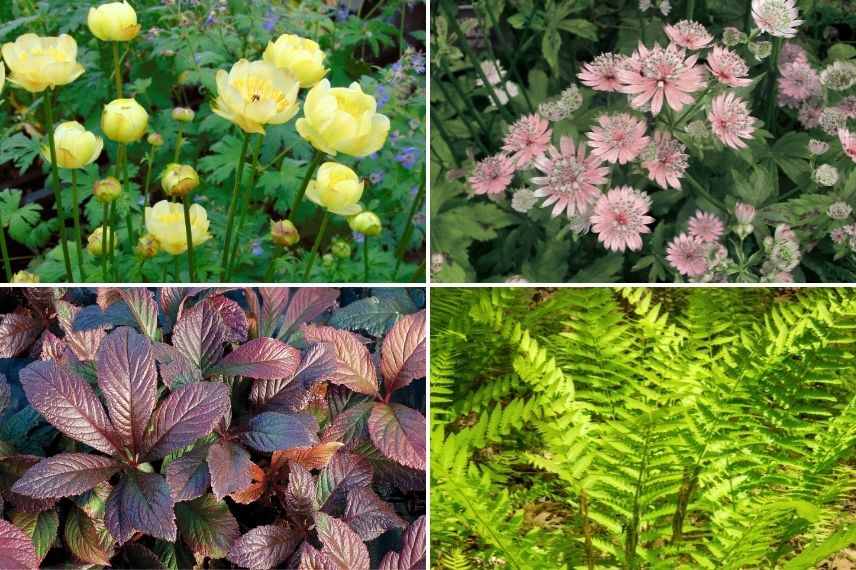
Trollius cultorum ‘Cheddar’, Astrantia major ‘Rosea’, Rodgersia pinnata ‘Bronze Peacock’ (copyright Terra Nova Products) and Osmunda claytoniana
In a brightly coloured rockery
For this association in rocky soil, choose species with successive flowerings to make this area attractive throughout several seasons. Thanks to its creeping habit, the dwarf troll or Trollius pumilus is ideal for rockeries with soil that remains slightly moist. Very hardy, this groundcover species does not exceed 15 cm in height with a spread of 20 cm. This troll flowers in spring from May to June, with a possible resurgence in September.
The lemon yellow of its single flowers pairs wonderfully with the intense blue of the Alpine Gentian, which is also very comfortable in this type of situation. To soften this striking duo, the Sagina subulata ‘Green Moss’ does its job well by covering itself with a multitude of small white flowers. Equally at home in dry or fresh soil, the Poscharsky Campanula colours the rockery until the end of summer. Then, during autumn, the Saxifraga cortusifolia ‘Black Ruby’ mixes its purple-pink flowers with the yellow heads of the Chrysogonum virginianum ‘Andre Viette’. During the winter period, hellebore and winter heather, such as Helleborus niger (x) orientalis ‘Walberton’s Rosemary’ and Erica (x) darleyensis ‘Winter Belles Tylou’ take over. Finally, after winter, it is the Pasque Flower that heralds the return of fine days with its bell-shaped purple flowers.
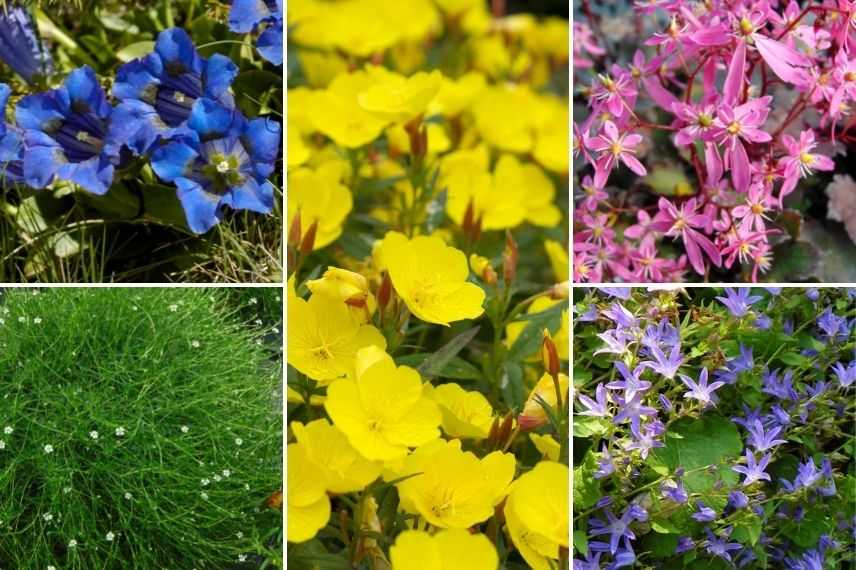
Gentiana acaulis, Trollius pumilus, Saxifraga cortusifolia ‘Black Ruby’, Sagina subulata ‘Green Moss’ and Campanula poscharskyana ‘Stella’
In a cut flower garden
Resembling the flowers of buttercup, the inflorescences of trollius have excellent vase life and can be used beautifully in cut flower arrangements. Both Trollius (x) cultorum ‘Lemon Queen’ and the globe flower (Trollius europaeus) produce round double flowers on long stems of about sixty centimetres, perfect for creating bouquets.
In a garden dedicated to cut flowers, pair your trollius with perennials for cool soil: echinacea, herbaceous peonies, and chrysanthemums. In the annual plants category, choose from cosmos, sweet peas, and marigolds. If you have enough space, grow flowering bushes. The spherical inflorescences of hydrangeas are stunning in bouquets (for example, Hydrangea macrophylla ‘Belle Séduction’). Grasses add texture to floral displays, such as foxtail barley, which is interesting for its light-looking spikes. The foliage of ivy (for example, the variegated Hedera helix ‘Little Diamond’), a small fern, and lady’s mantle can serve as a green backdrop.
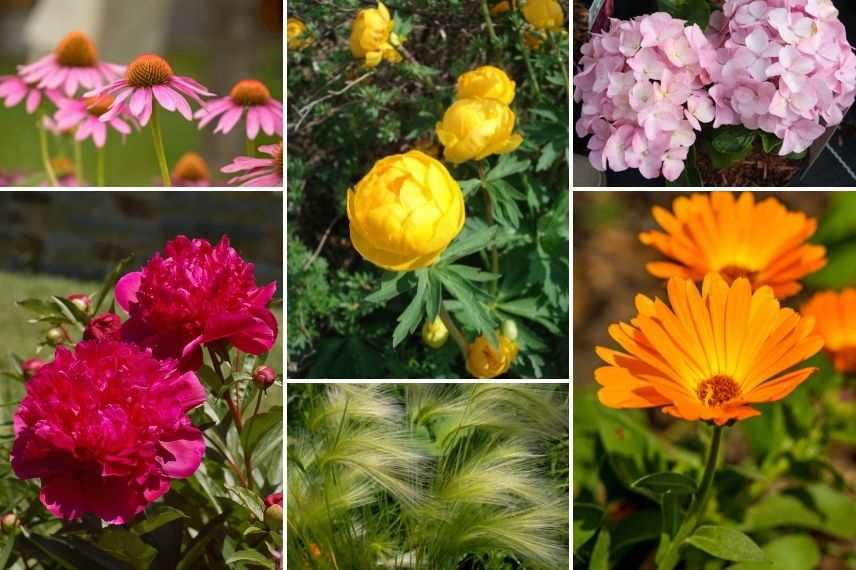
Echinacea, Trollius Europaeus, Hydrangea macrophylla ‘Belle Seduction’ (photo denolf), Paeonia lactiflora ‘Big Ben’ (photo Wikipedia), Hordeum jubatum and Calendula officinalis
In a naturalistic border
Trollius can also be used in cottage-style gardens. Fast-growing and with excellent hardiness, the Trollius ‘Alabaster’ captivates us with its natural and elegant appearance. From May to June, its tuft of finely cut light green foliage is topped with semi-double flowers in a shade ranging from cream white to pale yellow. This flowering can be enhanced alongside wild-style plants that also appreciate cool soils, such as Physostegia. Let’s mention the vigorous cultivar Physostegia virginiana ‘Vivid‘ with its lovely candy pink to mauve flowers.
In the background, the large Euphorbia palustris ‘Walenburg’s Glory’ serves as a backdrop. Green in summer, its foliage takes on orange-red hues in autumn. Original, the Primula vialii adds colour to this bucolic scene: it raises its spikes of flowers transitioning from red to mauve pink at ripeness. Low-maintenance in terms of soil, the marsh verbena attracts insects with its melliferous, airy, and light flowering. In sunny exposure, comfrey is also suitable for this bed, provided the soil does not dry out too much (for example, Symphytum ‘Goldsmith’ which shows lovely variegated foliage). Creeping, the Anemopsis californica settles in the foreground to make the most of its abundant white flowering.
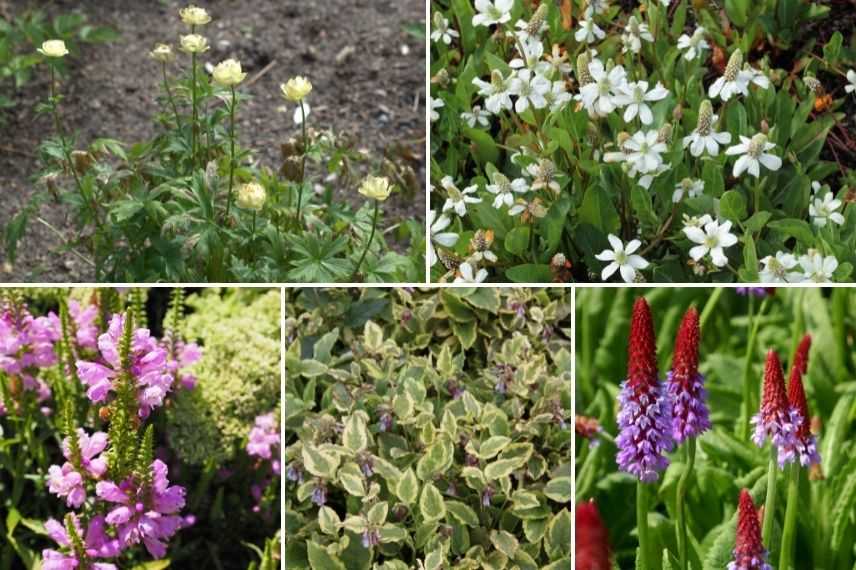
Trollius ‘Alabaster’ (photo Wikipedia), Anemopsis californica (photo Wikipedia), Physostegia virginiana ‘Vivid’ (photo F.D. Richards – Flickr), Symphytum Goldsmith and Primula vialii
- Subscribe!
- Contents
Comments