





























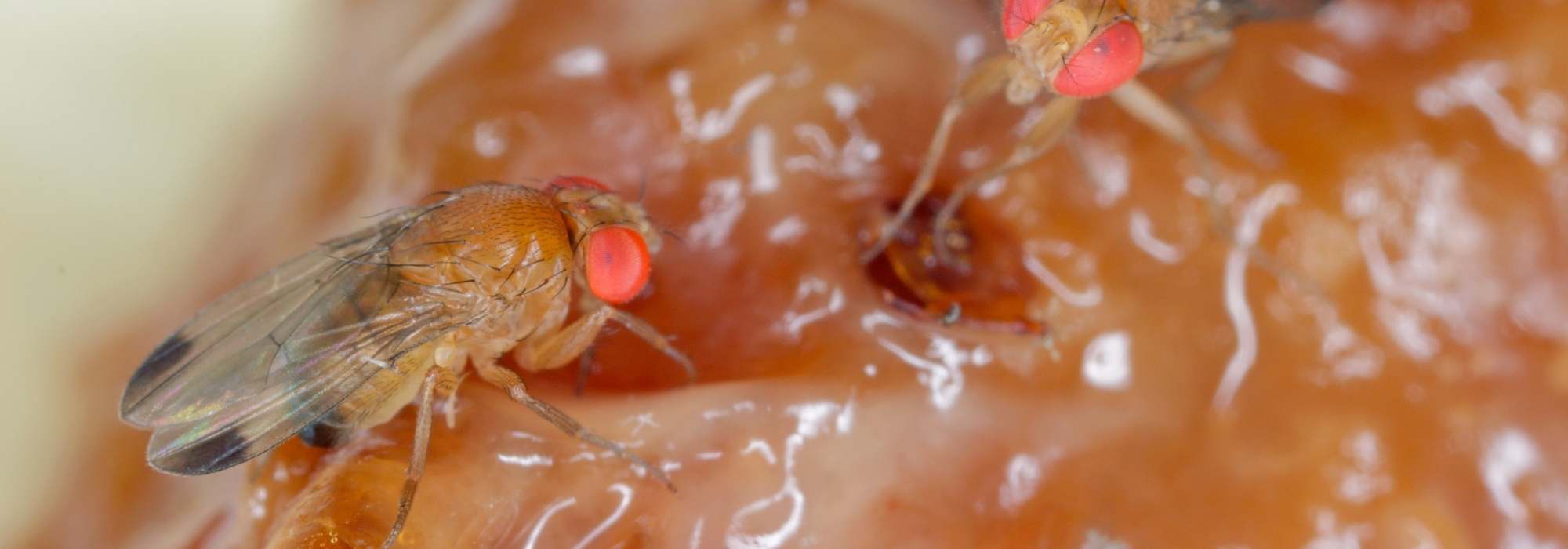
Asian fruit fly: what is this pest affecting fruit trees?
Drosophila suzukii: identification, damage and control
Contents
The cherry fly (Rhagoletis carasi) has long been well known (and dreaded) by orchardists, as it can ruin a harvest in a single season. In recent years, another dipteran, from Southeast Asia, has been attacking cherries and other fruits. This is the Spotted-wing drosophila (Drosophila suzukii), also known as the Japanese drosophila or the spotted-wing drosophila, which, since 2010, has asserted its presence in France in the most unwelcome fashion, in both the orchards of professional fruit growers and in those of amateur gardeners. Far from feeding on just cherries, this tiny fly with very rapid growth sets its sights on many other fruits.
Let us get to know this pest insect better so that we can combat it more effectively and protect our fruit trees.

How to recognise the Asian fruit fly?
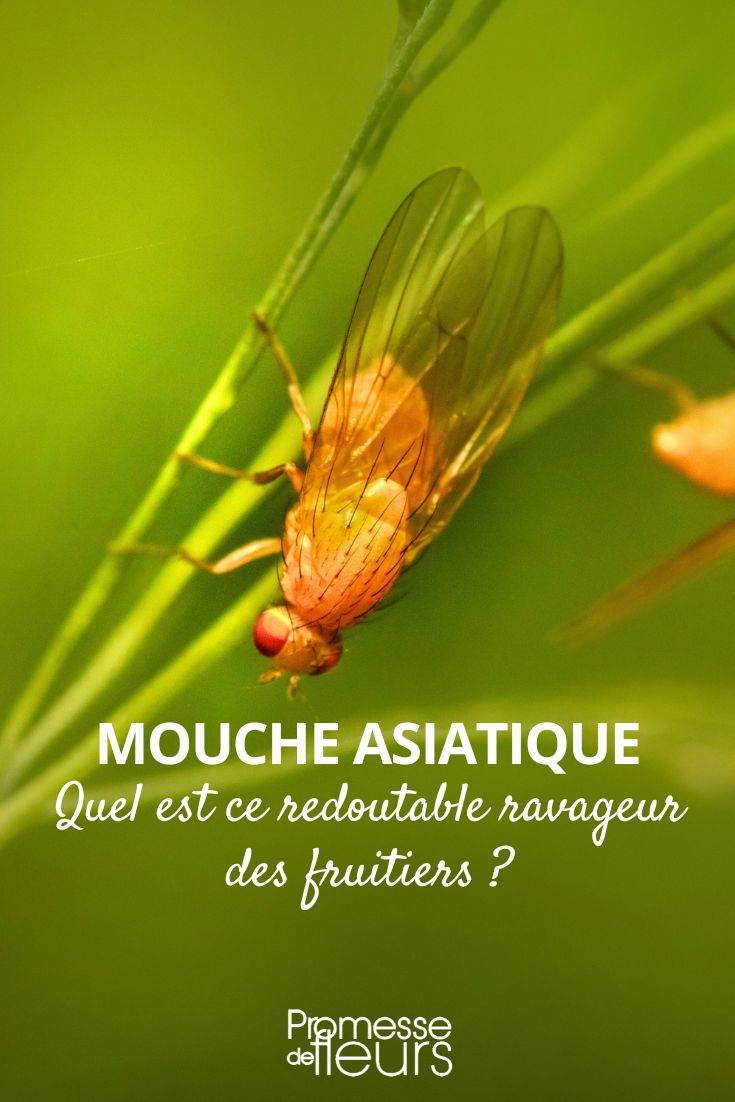
In terms of size, Drosophila suzukii may be regarded more as a tiny fly than as a true fly. Indeed, this dipteran from the family Drosophilidae measures less than 3 mm in length. This Asian fruit fly is recognisable by its light brown thorax banded with black stripes, by its red eyes, but above all by the two spots that adorn the male’s wings. These insects also bear awned antennae, i.e., bearing a lateral hair. As sexual dimorphism is very pronounced, the females do not have spots on the wings.
Larvae resemble maggots, milky white and translucent.
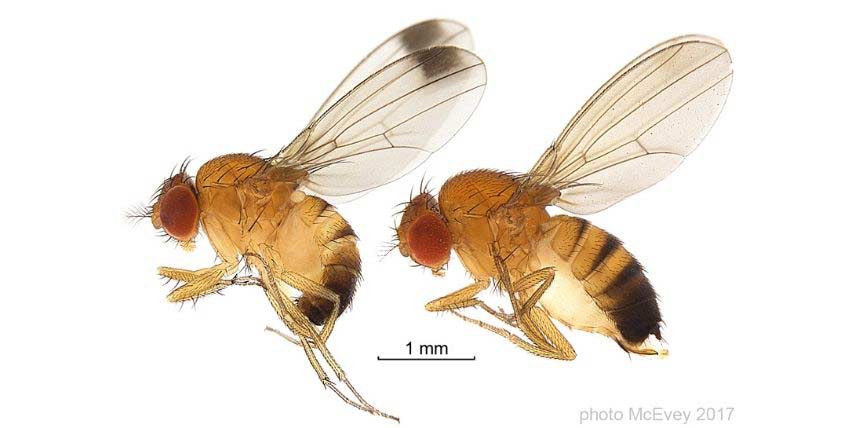
Male and female of Drosophila suzukii
Native to Japan, Korea and China, the cherry fruit fly was detected in North America in 2008, where it caused substantial damage. It then appeared in Spain and Italy in 2009, before arriving in France in 2010, initially in Corsica and then in the south. In 2011 it was reported in Lorraine and in the Paris Basin. Needless to say, this little fly has adapted remarkably well to the climate of our territory! Moreover, it displays exceptional mobility and equally exceptional adaptability through its polyphagous diet. Today, the Asian fruit fly is present across all of France, in all regions where fruit production is significant. The damage is so substantial that orchardists are forced to change their harvesting method to protect their production. Indeed, this drosophilid has a different development from its companions, in particular from the cherry fly (Rhagoletis cerasi). By contrast, it is fairly close to the vinegar fly (Drosophila melanogaster).
Life cycle
The Asian fruit fly is, to say the least, particularly invasive. Indeed, it has a very rapid development cycle! From March onwards, fertilised females emerge from diapause, i.e., their winter lethargy spent in soil or under bark. They soon begin to lay 1 to 3 eggs, milky white in colour per fruit, and 7 to 16 per day. Laying lasts several days and can reach 400 eggs. Females are equipped with a saw-shaped ovipositor that allows them to pierce the epidermis of fruits.
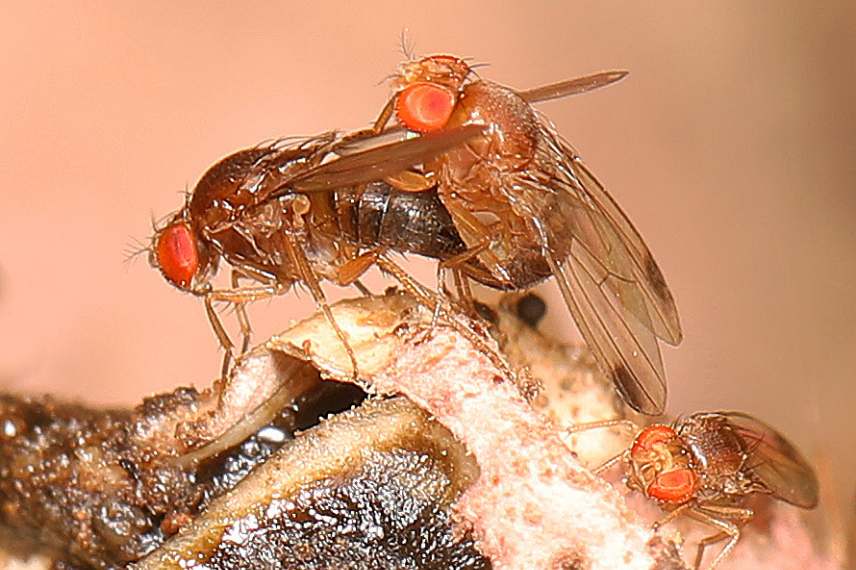
©Judy Gallagher (Wikimedia commons)
Unlike other Drosophila that favour very ripe, almost rotten fruits, these Asian fruit flies have the peculiarity of laying eggs in fresh and just-ripe fruits. The larvae develop there very rapidly, passing through three instars. They feed on the flesh of the fruits, pupate very quickly and the adult emerges just as quickly. Their life cycle rarely exceeds two weeks. Thus, depending on climate conditions, 3 to 13 generations can occur in a single season, from March to November.
In winter, only fertilised females overwinter to emerge at the very start of spring.
Damage caused by these gnats
These frugivorous fruit flies cause substantial damage in orchards where they establish themselves. First, due to their rapid growth, and also due to their polyphagous diet. Indeed, Drosophila suzukii targets small fruits with thin skins and berries such as cherries, the raspberries, the strawberries, the blueberries, the redcurrants, the blackberries… but also figs, the kiwis and kiwiberries, the persimmons, or even the prunes, the peaches and nectarines, the apricots. Not forgetting the grapes, and in particular the black ones. Fertilised females appear to have a preference for red or purple fruits, though they do not spurn others (where the impact is, however, less pronounced).
These Asian flies also highly value host plants such as the brambles, the dog-roses, the strawberry trees, the dogwoods and the elder trees.
Specifically, the larvae that hatch inside ripe fruits feed on the flesh. This flesh appears to liquefy and acidify. The fruits become soft, punctate with depressions beneath the epidermis. They eventually hollow out completely. They are unfit for consumption, with one to three larvae able to share the same fruit. Often, the affected fruits drop to the ground.
Moreover, once vulnerable, these fruits are more susceptible to attacks by fungi and other viruses.
For orchardists, depending on the species and the year, losses can reach 80–100% of the crop.
How can you control the Asian fruit fly?
Like invasive insects that have arrived from distant lands, such as the horse chestnut leaf miner, control is difficult. Indeed, these Asian fruit flies have no natural predators and are resistant to the insecticidal products commonly used by professionals. Cultural and mechanical control therefore remain the measures to guard against Drosophila suzukii (spotted-wing drosophila), which are relatively easy to implement in a small orchard or in fruiting bushes:
– The installation of insect nets with a very fine mesh is certainly the most effective solution to prevent egg-laying. These nets should be installed at least one month before fruit ripeness, in a period from March to November.
– Trapping helps identify flight periods of these Asian fruit flies, while limiting their proliferation. There are red-coloured traps, filled with an attractive solution, which capture the insects. This red trap is installed in the shade, right next to fruiting trees and bushes. This solution helps reduce egg-laying, but does not completely eliminate it. It is also possible to make your own traps using a plastic bottle with the neck cut off, half-filled with cider vinegar, an equal volume of water, a splash of fruit syrup and a few drops of washing-up liquid.
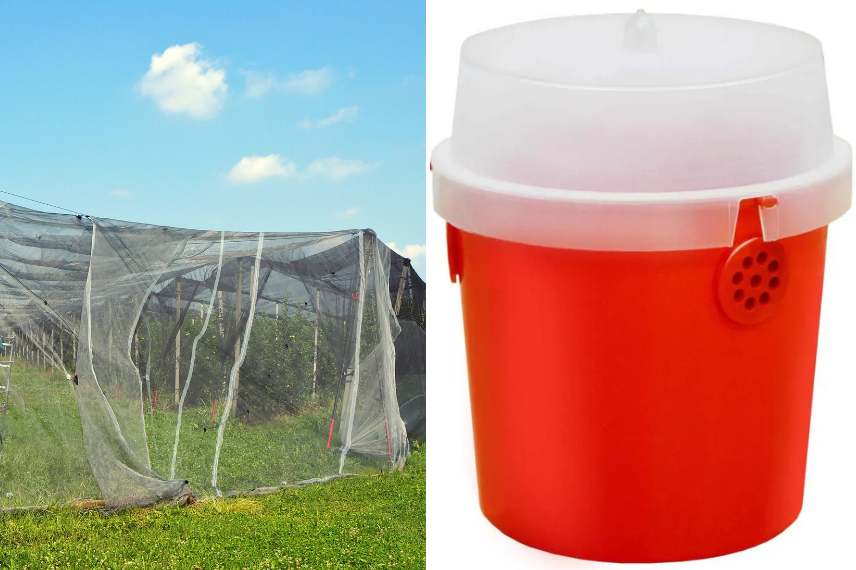
The insect nets and trapping are the simplest solutions to deploy for now
– Clay spray creates a physical barrier on the fruit, preventing oviposition. Fruits should be cleaned after harvest.
– Harvest fruit as they ripen, about every two days. It is essential to avoid leaving overripe fruit in the orchard or garden.
– Carefully collect and destroy all fruits that have fallen to the ground or rotten fruit left on the trees, as well as pruning debris, dead leaves or crop residues. It is possible to bury them under a thick layer of soil, suffocate them under a plastic sheet and seal them in a large plastic bag.
– Keep a very systematic eye on fruit storage after harvest.
– Maintain good air circulation in crops and reduce humidity around trees and fruiting bushes.
So far, parasitoids of European origin have shown limited effectiveness in the biological control of the Asian fruit fly. This is why the Sophia Agrobiotech Institute at INRAE collected in Asia specimens of an exotic wasp (Ganaspis cf. brasiliensis) capable of parasitising the larvae of the Drosophila suzukii. After numerous studies and authorisation requests, the first releases of this wasp were made in September and October 2023 on several sites in France, to evaluate the parasitoid’s effectiveness on fly populations, but also the potential impact on other species.
It is also worth noting that extensive research is ongoing to refine the lifestyle of these devastating insects, including around overwintering. It seems that Asian flies, male or female, may shelter in composters during winter, and may even continue to develop and feed there.
- Subscribe!
- Contents
Comments