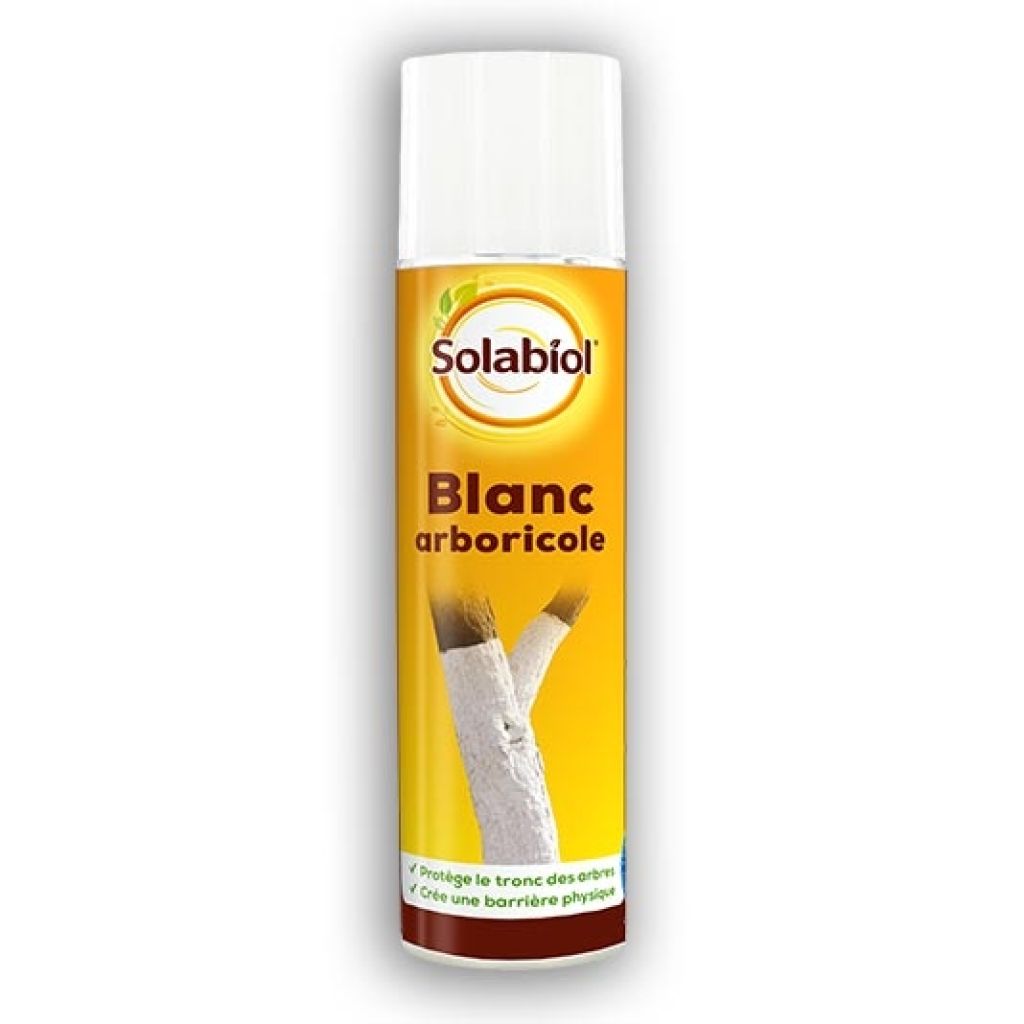
Solabiol Natural Tree Whitewash 400ml Aerosol
Solabiol Natural Tree Whitewash 400ml Aerosol
Back-to-school special offer!
Get €10 off for every €50 you spend! And get up to €40 off on a single order.
How does it work?
1. Shop your favourites
Add your favourite plants to your basket. For every €50 you spend (excluding delivery charges, store credit and the plastic-free option), you’ll receive a €10 voucher.
€50 spent = €10 voucher
€100 spent = €20 voucher
€150 spent = €30 voucher
€200 spent = €40 voucher
2. Place your order
Once your basket reaches one of the spending thresholds, place your order. You can even choose your delivery date!
3. Receive your voucher
As soon as your order has been shipped, you’ll receive an email containing your personal voucher code and its value.
4. Use it on your next order
Your voucher is valid for 90 days from the date you receive it. It can be used once only, on a new order worth at least the value of the voucher, excluding delivery charges.
Please note: Vouchers can be combined with other offers, but cannot be split or refunded.
Home or relay delivery (depending on size and destination)
Important: You may be charged customs duties by your country’s customs authorities upon delivery.
Schedule delivery date,
and select date in basket
We guarantee the quality of our plants for a full growing cycle, and will replace at our expense any plant that fails to recover under normal climatic and planting conditions.

Solabiol's ready-to-use natural tree whitewash, based on lime wash, is one of those winter treatments, sometimes called 'foundation' treatments, which have been somewhat neglected in recent years, yet their effectiveness is proven, as is their harmlessness to the environment. Applied preventatively to trunks, this treatment will save the gardener a number of problems with their trees and will help reduce the use of fungicidal and insecticidal products during the growing season. Provided in a 400 ml aerosol, this 100% natural tree whitewash is particularly easy to use, even in an organic garden. It will protect 2 to 3 trunks depending on their size.
Applied to dry bark in the heart of winter, this whitewash provides continuous and uniform protection for trunks and the base of main branches. It is composed of slaked lime (calcium di-hydroxide or hydrated lime), mixed with water. Sprayed on like paint, it forms a physico-chemical protection with recognised antiseptic properties. Tree whitewash is effective against diseases caused by pathogenic fungi such as fruit tree canker (Neonectria galligena), scab, brown rot and peach leaf curl, whose spores hide in the cracks of bark in winter. Its presence also limits the development of mosses and lichens; it suffocates and destroys the larvae of certain pests, which also find refuge in the bark. Furthermore, lime wash reduces exudation when planting standard trees. Due to its white colour, which reflects light and limits temperature variations, lime wash protects young bark and graft points from sunscald as well as from late frosts. Tree whitewash is recommended for protecting pip and stone fruit trees, ornamental trees (limes, horse chestnuts, during top-grafting operations, etc.). It is approved for use in Organic Agriculture.
METHOD OF APPLICATION / DOSE: from September to April, on ornamental and fruit trees
Wear gloves during use. First, brush the trunk so the product adheres better during application. Shake the aerosol vigorously for about ten seconds to homogenise the contents. Spray the product from about thirty centimetres away from the trunk, using short bursts, avoiding prolonged spraying, uniformly on the trunks and at the base of the main branches. After each use, clear the aerosol to ensure good subsequent use. To do this, turn the aerosol upside down and spray until no more product comes out. Reapply annually.
Store away from heat and keep away from any source of fire (pressurised container).
Uses and advantages
Technical features
Tips
Tips
This item has not been reviewed yet - be the first to leave a review about it.
Recently viewed products
Haven't found what you were looking for?
Hardiness is the lowest winter temperature a plant can endure without suffering serious damage or even dying. However, hardiness is affected by location (a sheltered area, such as a patio), protection (winter cover) and soil type (hardiness is improved by well-drained soil).
In temperate climates, pruning of spring-flowering shrubs (forsythia, spireas, etc.) should be done just after flowering.
Pruning of summer-flowering shrubs (Indian Lilac, Perovskia, etc.) can be done in winter or spring.
In cold regions as well as with frost-sensitive plants, avoid pruning too early when severe frosts may still occur.
The harvesting period indicated on our website applies to countries and regions in USDA zone 8 (France, England, Ireland, the Netherlands).
In colder areas (Scandinavia, Poland, Austria...) fruit and vegetable harvests are likely to be delayed by 3-4 weeks.
In warmer areas (Italy, Spain, Greece, etc.), harvesting will probably take place earlier, depending on weather conditions.
The sowing periods indicated on our website apply to countries and regions within USDA Zone 8 (France, UK, Ireland, Netherlands).
In colder areas (Scandinavia, Poland, Austria...), delay any outdoor sowing by 3-4 weeks, or sow under glass.
In warmer climes (Italy, Spain, Greece, etc.), bring outdoor sowing forward by a few weeks.
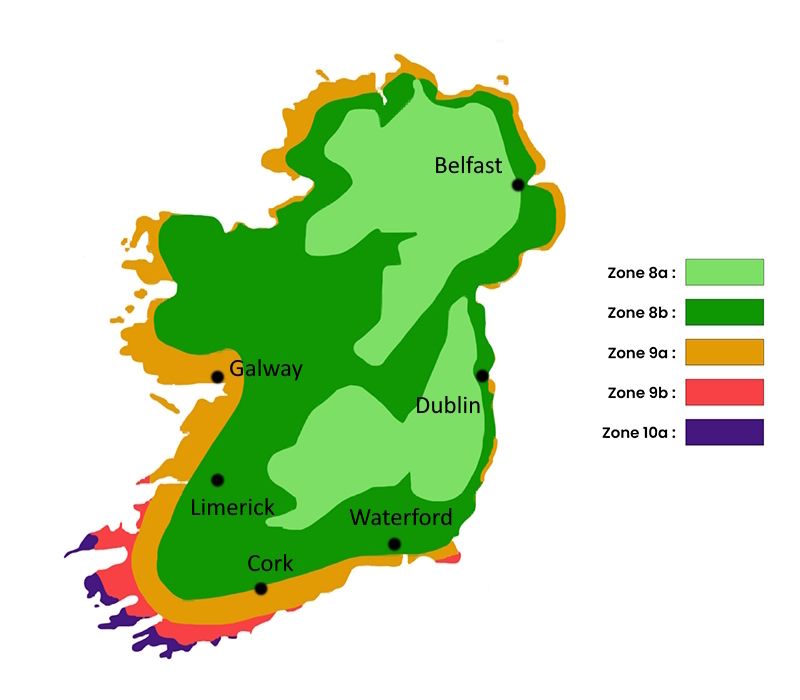
The planting period indicated on our website applies to regions in USDA Zone 9a (East Coast and Midlands: Dublin, Wexford, Waterford, Kilkenny, Portlaoise). It will vary depending on where you live:
- On the west coast and in the north-west (Galway, Limerick, Sligo, Donegal, Westport), delay planting by 1 to 2 weeks in spring and bring it forward by 1 to 2 weeks in autumn compared to the dates given, preferably choosing periods without strong winds.
- In the inland hills and plateaus (Wicklow Mountains, Macgillycuddy’s Reeks, Connemara, Killarney), it is best to plant in spring (April–May) or autumn (September–October), avoiding periods of waterlogged soil in winter and strong winds, which pose the main risk to newly planted trees in these areas.
The flowering period indicated on our website applies to regions in USDA Zone 9a, such as the East Coast and Midlands, including Dublin, Wexford, Waterford, Kilkenny and Portlaoise.
This will vary depending on where you live:
- On the west coast and in the northwest (Galway, Limerick, Sligo, Donegal and Westport), it will be delayed by one to two weeks compared to the given dates, due to stronger Atlantic winds and less spring sunshine.
- In the inland hills and plateaus (the Wicklow Mountains, the Macgillycuddy's Reeks, Connemara and Killarney), flowering will be delayed by two to three weeks. Flowering mainly occurs between May and July, with the limiting factors being less frost and more of the excessive humidity, strong winds and lack of sunshine that are characteristic of these areas.
Shipping country and language
Your country of residence may be:
Your country of residence is:
For a better user experience on our website, you can select:
Your shipping country:
-
 Austria
-
 Belgium
-
 Bosnia & Herzegovina
-
 Bulgaria
-
 Croatia
-
 Cyprus
-
 Czechia
-
 Denmark
-
 Estonia
-
 Finland
-
 France
-
 Germany
-
 Greece
-
 Hungary
-
 Iceland
-
 Ireland
-
 Italy
Italy
-
 Latvia
-
 Liechtenstein
-
 Lithuania
-
 Luxembourg
-
 Malta
Malta
-
 Netherlands
-
 Poland
-
 Portugal
-
 Romania
-
 Serbia
-
 Slovakia
-
 Slovenia
-
 Spain
Spain
-
 Sweden
-
 Switzerland
Language:
-
French
-
 English
-
Spanish
-
Italian
-
German
-
Portuguese
-
Dutch
-
Finnish
My Account
Hello
My wish lists
My cart
Log in / Register
Existing customer?
This form is protected by reCAPTCHA - the Google Privacy Policy and Terms of Service apply.
New customer?
Create an account to track your orders, access our customer service and, if you wish, make the most of our upcoming offers.