
Sow lavender Cleo-Patio Blue from February to April under bright shelter at 18–20 °C, in a shallow tray filled with a fine, free-draining compost (sowing compost + 30–40% sand or perlite); scatter the seeds on the surface, press down very lightly and cover with at most 1–2 mm of vermiculite. Light aids germination, which occurs in 14 to 21 days.
Keep the compost just moist, never waterlogged. Prick out at the 2–3 pairs of true leaf stage into 7–9 cm pots using a poor, mineral-rich mix (lightened multi-purpose compost with sand/pumice).
Pinch out the tip of the seedlings once to encourage branching, then acclimatise them gradually to the outdoors.
Planting out is done after the last frosts (mid-May):
In the ground, choose a very sunny spot (6 to 8 hours of sun per day), a chalky or neutral soil, stony and free-draining; loosen the soil to a depth of 20–25 cm, incorporate gravel or pumice if the soil is heavy, plant in a staggered pattern every 30–35 cm. Water once at planting and then space out watering significantly (allow the top 3–4 cm to dry out). Install a mineral mulch (light-coloured gravel) to limit weed emergence and keep the plant's collar dry; avoid nitrogen applications, a light feed of 'Mediterranean plant' fertiliser in spring is sufficient.
In a pot, use a wide, perforated container (20–25 cm the first year, then 30 cm), ensure drainage at the bottom and fill with a poor, stony mix (60–70% compost, 30–40% mineral material); water thoroughly then allow to dry out for 2–3 cm before watering again.
Remove faded spikes and prune lightly after flowering, then in early spring avoiding cutting into the old wood; in the first year, prune very lightly.
In winter, protect mainly from moisture: raise pots off the ground, place them against a sheltered wall; in pots, cold hardiness decreases, expect down to –10 to –12 °C when dry.
Direct sowing is possible in mild climates: sow in May directly in situ in very well-drained soil and thin to 30 cm; flowering occurs in the first season if sowing is early and cultivation is regular.
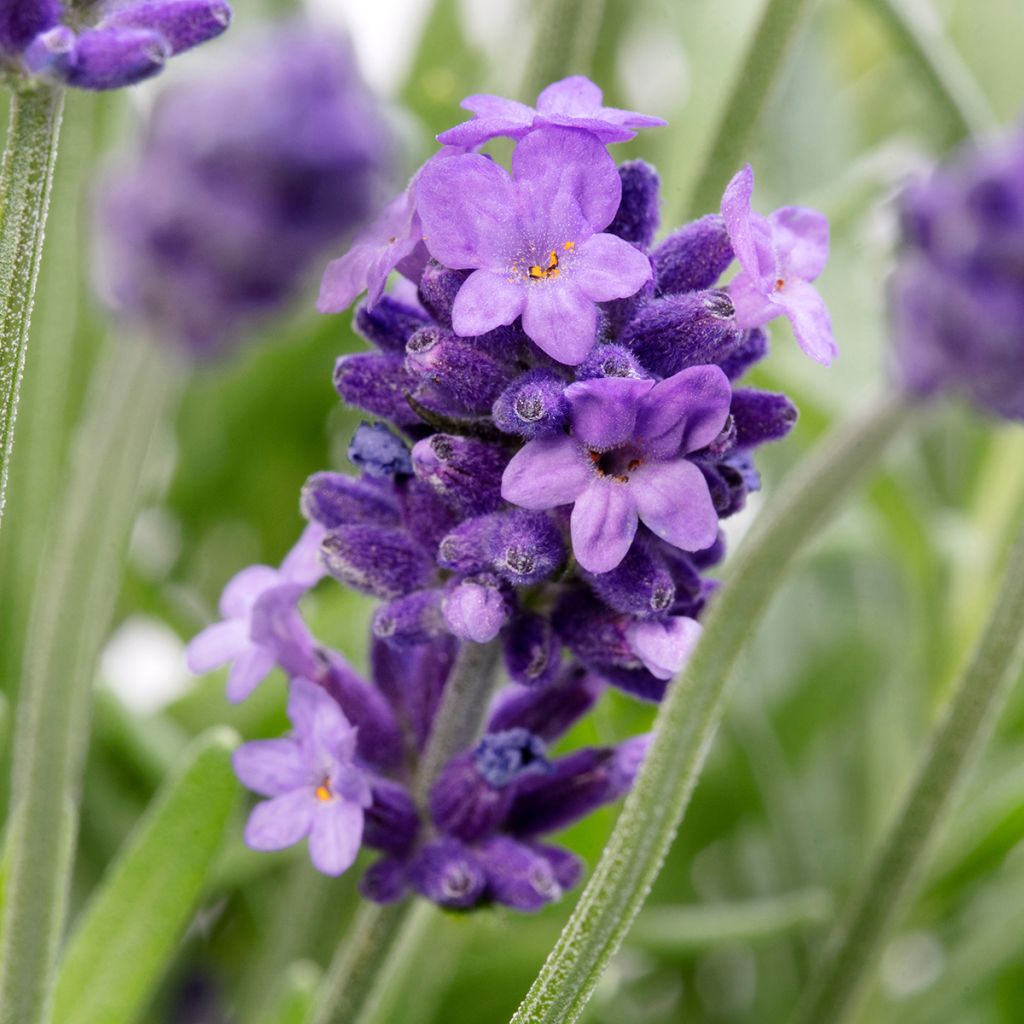
Lavandula angustifolia Cleo-Patio Blue - True Lavender
Lavandula angustifolia Cleo-Patio Blue - True Lavender
Lavandula angustifolia Cleo-Patio Blue
True Lavender, English Lavender, Garden Lavender
Back-to-school special offer!
Get €10 off for every €50 you spend! And get up to €40 off on a single order.
How does it work?
1. Shop your favourites
Add your favourite plants to your basket. For every €50 you spend (excluding delivery charges, store credit and the plastic-free option), you’ll receive a €10 voucher.
€50 spent = €10 voucher
€100 spent = €20 voucher
€150 spent = €30 voucher
€200 spent = €40 voucher
2. Place your order
Once your basket reaches one of the spending thresholds, place your order. You can even choose your delivery date!
3. Receive your voucher
As soon as your order has been shipped, you’ll receive an email containing your personal voucher code and its value.
4. Use it on your next order
Your voucher is valid for 90 days from the date you receive it. It can be used once only, on a new order worth at least the value of the voucher, excluding delivery charges.
Please note: Vouchers can be combined with other offers, but cannot be split or refunded.
Home or relay delivery (depending on size and destination)
Important: You may be charged customs duties by your country’s customs authorities upon delivery.
Schedule delivery date,
and select date in basket
This plant carries a 6 months recovery warranty
More information
We guarantee the quality of our plants for a full growing cycle, and will replace at our expense any plant that fails to recover under normal climatic and planting conditions.
Does this plant fit my garden?
Set up your Plantfit profile →
Description
The Lavender 'Cleo-Patio® Blue' (Lavandula angustifolia) is a selection of true lavender that combines the charm of blue lavender with the practicality of a variety grown from seed: its growth is rapid and regular, its habit is compact, its flowering is quick, and its lavender scent is authentic. In the garden or in a pot, this undershrub is ideal for edging a path, forming a neat, very low hedge, or scenting a sunny balcony.
Lavandula angustifolia is a plant of the Lamiaceae family. Native to the dry, calcareous slopes of the western Mediterranean up to the Balkans, this species colonises garrigues, stony hillsides, and well-drained clearings.
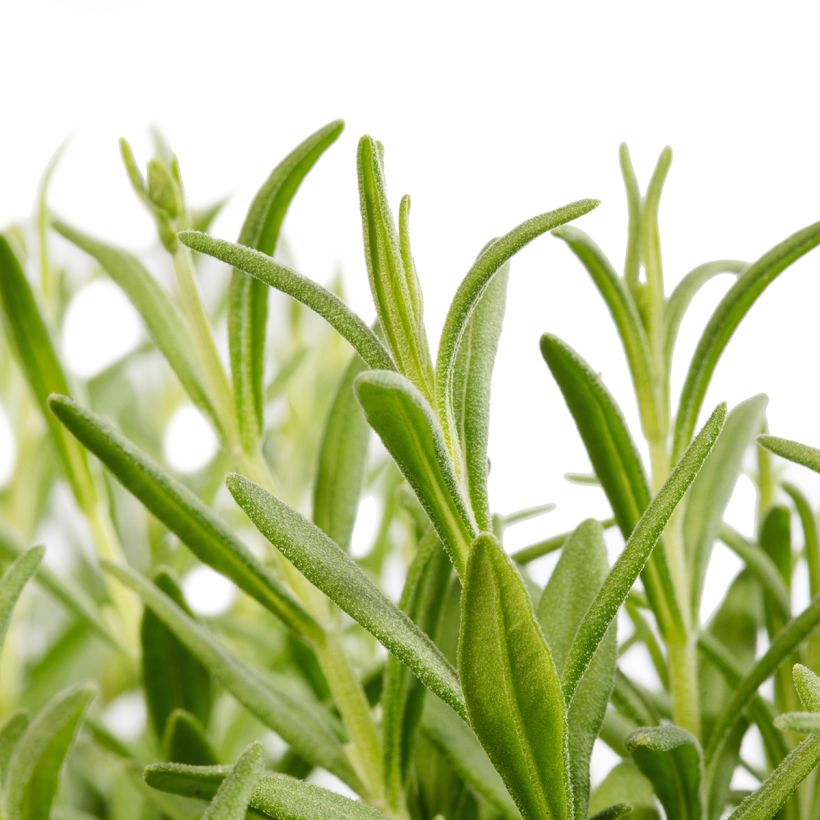
'Cleo-Patio® Blue' is a selection from sowing, interesting for its compact habit, uniformity, and flowering from the first year, even without a cold period; it differs from the typical species by a lower and more regular habit as well as quicker flowering. This perennial forms a dense clump, the base of which gradually becomes woody. In the ground, the clump reaches 25 to 35 cm in height and 30 to 40 cm in spread; in a 3 to 5-litre pot, expect 20 to 30 cm in height and width. The leaves, opposite on the stems, linear to lanceolate, measure 1.5 to 3 cm long by 2 to 5 mm wide. Grey-green in colour, they are evergreen to semi-evergreen depending on the climate, and very aromatic. Flowering occurs from June to August, with a slight rebloom possible after deadheading the spent spikes; the terminal flower spikes, 5 to 8 cm long, bear bilabiate corollas of lavender blue, with the characteristic scent. The hardiness of Cleo-Patio® Blue is comparable to that of true lavender: down to -15°C in very well-drained soil.
'Cleo-Patio® Blue' is perfect for pots and containers on a well-exposed terrace, in low borders along a path, or in a bed in a dry garden. Give it plenty of sun and a very free-draining substrate; in a pot, use a rather deep container, a compost enriched with sand or pumice, and protect the root ball during severe frosts. Pair it with perennials and shrubs for poor, dry ground: Santolina chamaecyparissus, Cistus, Helichrysum italicum, Nepeta faassenii, or ornamental grasses like Stipa tenuifolia. To create a lavender bed, you can mix it with other proven cultivars of L. angustifolia: ‘Hidcote’ (bluish violet spikes, very compact), ‘Munstead’ (blue, summer flowering, generous), ‘Alba’ (traditional, white and fragrant), or 'Loddon Pink' (pale pink and compact).
From the Alpes-de-Haute-Provence to the Ligurian hills, true lavender was long harvested in the wild for perfumery and dried flowers. A very melliferous plant, it contributes to the conservation of bees: the nectar from its flower attracts bees, which make it into one of the most renowned honeys. In Provence, the plant is distilled to obtain an essential oil highly sought after in perfumery and aromatherapy. Its many therapeutic virtues are still widely used: its essential oil has antiseptic, antispasmodic, healing, depurative, diuretic properties…
Lavandula angustifolia Cleo-Patio Blue - True Lavender in pictures
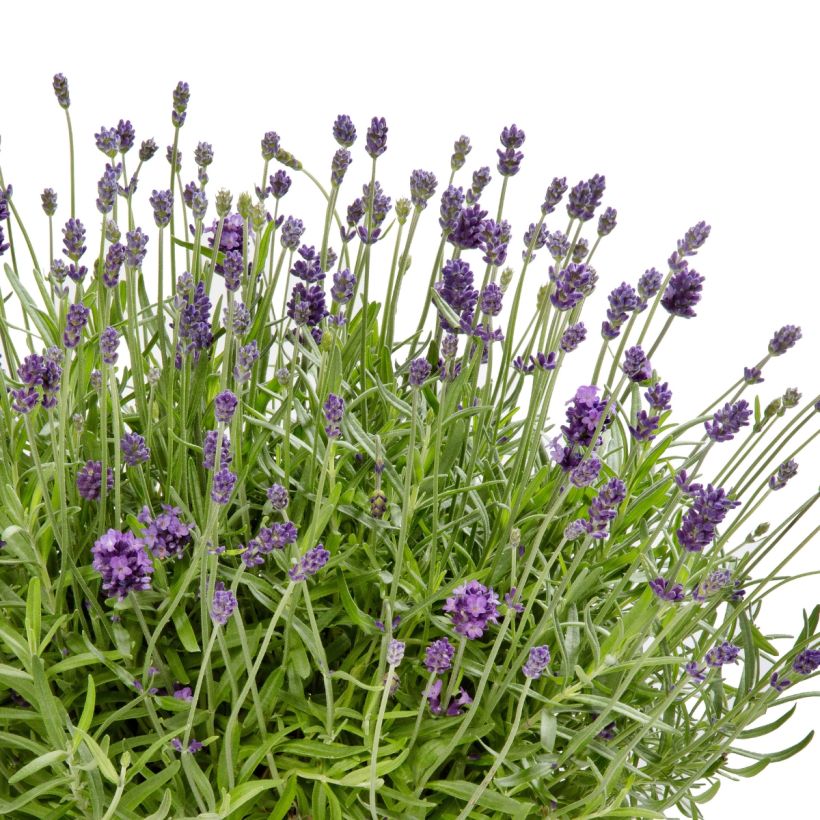
Flowering
Foliage
Plant habit
Botanical data
Lavandula
angustifolia
Cleo-Patio Blue
Lamiaceae
True Lavender, English Lavender, Garden Lavender
Lavandula angustifolia Cleo-Patio® Blue
Cultivar or hybrid
Planting and care
Sowing period
Intended location
Planting & care advice
-
-

-
-
-
-
-

-
This item has not been reviewed yet - be the first to leave a review about it.
Recently viewed products
Haven't found what you were looking for?
Hardiness is the lowest winter temperature a plant can endure without suffering serious damage or even dying. However, hardiness is affected by location (a sheltered area, such as a patio), protection (winter cover) and soil type (hardiness is improved by well-drained soil).
In temperate climates, pruning of spring-flowering shrubs (forsythia, spireas, etc.) should be done just after flowering.
Pruning of summer-flowering shrubs (Indian Lilac, Perovskia, etc.) can be done in winter or spring.
In cold regions as well as with frost-sensitive plants, avoid pruning too early when severe frosts may still occur.
The harvesting period indicated on our website applies to countries and regions in USDA zone 8 (France, England, Ireland, the Netherlands).
In colder areas (Scandinavia, Poland, Austria...) fruit and vegetable harvests are likely to be delayed by 3-4 weeks.
In warmer areas (Italy, Spain, Greece, etc.), harvesting will probably take place earlier, depending on weather conditions.
The sowing periods indicated on our website apply to countries and regions within USDA Zone 8 (France, UK, Ireland, Netherlands).
In colder areas (Scandinavia, Poland, Austria...), delay any outdoor sowing by 3-4 weeks, or sow under glass.
In warmer climes (Italy, Spain, Greece, etc.), bring outdoor sowing forward by a few weeks.
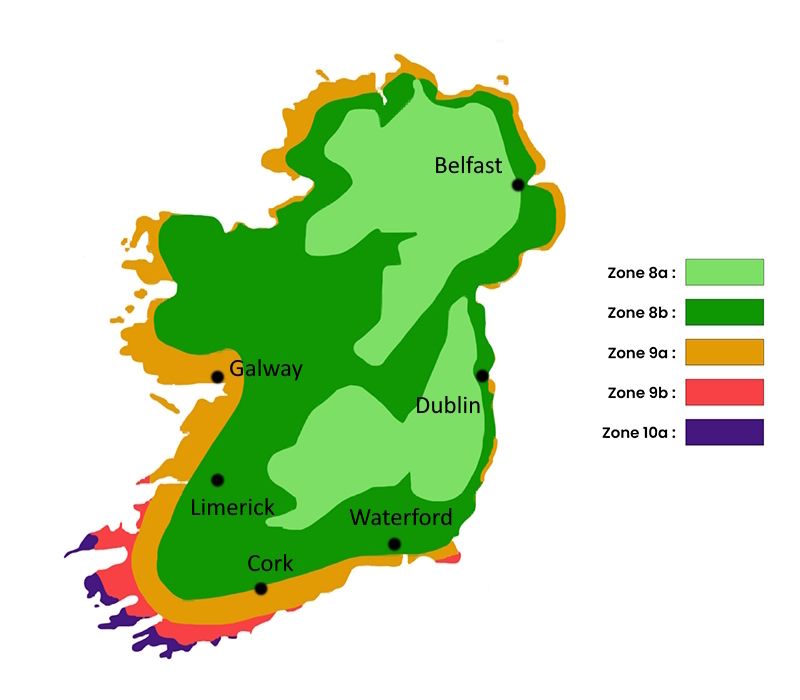
The planting period indicated on our website applies to regions in USDA Zone 9a (East Coast and Midlands: Dublin, Wexford, Waterford, Kilkenny, Portlaoise). It will vary depending on where you live:
- On the west coast and in the north-west (Galway, Limerick, Sligo, Donegal, Westport), delay planting by 1 to 2 weeks in spring and bring it forward by 1 to 2 weeks in autumn compared to the dates given, preferably choosing periods without strong winds.
- In the inland hills and plateaus (Wicklow Mountains, Macgillycuddy’s Reeks, Connemara, Killarney), it is best to plant in spring (April–May) or autumn (September–October), avoiding periods of waterlogged soil in winter and strong winds, which pose the main risk to newly planted trees in these areas.
The flowering period indicated on our website applies to regions in USDA Zone 9a, such as the East Coast and Midlands, including Dublin, Wexford, Waterford, Kilkenny and Portlaoise.
This will vary depending on where you live:
- On the west coast and in the northwest (Galway, Limerick, Sligo, Donegal and Westport), it will be delayed by one to two weeks compared to the given dates, due to stronger Atlantic winds and less spring sunshine.
- In the inland hills and plateaus (the Wicklow Mountains, the Macgillycuddy's Reeks, Connemara and Killarney), flowering will be delayed by two to three weeks. Flowering mainly occurs between May and July, with the limiting factors being less frost and more of the excessive humidity, strong winds and lack of sunshine that are characteristic of these areas.
Shipping country and language
Your country of residence may be:
Your country of residence is:
For a better user experience on our website, you can select:
Your shipping country:
-
 Austria
-
 Belgium
-
 Bosnia & Herzegovina
-
 Bulgaria
-
 Croatia
-
 Cyprus
-
 Czechia
-
 Denmark
-
 Estonia
-
 Finland
-
 France
-
 Germany
-
 Greece
-
 Hungary
-
 Iceland
-
 Ireland
-
 Italy
Italy
-
 Latvia
-
 Liechtenstein
-
 Lithuania
-
 Luxembourg
-
 Malta
Malta
-
 Netherlands
-
 Poland
-
 Portugal
-
 Romania
-
 Serbia
-
 Slovakia
-
 Slovenia
-
 Spain
Spain
-
 Sweden
-
 Switzerland
Language:
-
French
-
 English
-
Spanish
-
Italian
-
German
-
Portuguese
-
Dutch
-
Finnish
My Account
Hello
My wish lists
My cart
Log in / Register
Existing customer?
This form is protected by reCAPTCHA - the Google Privacy Policy and Terms of Service apply.
New customer?
Create an account to track your orders, access our customer service and, if you wish, make the most of our upcoming offers.