





























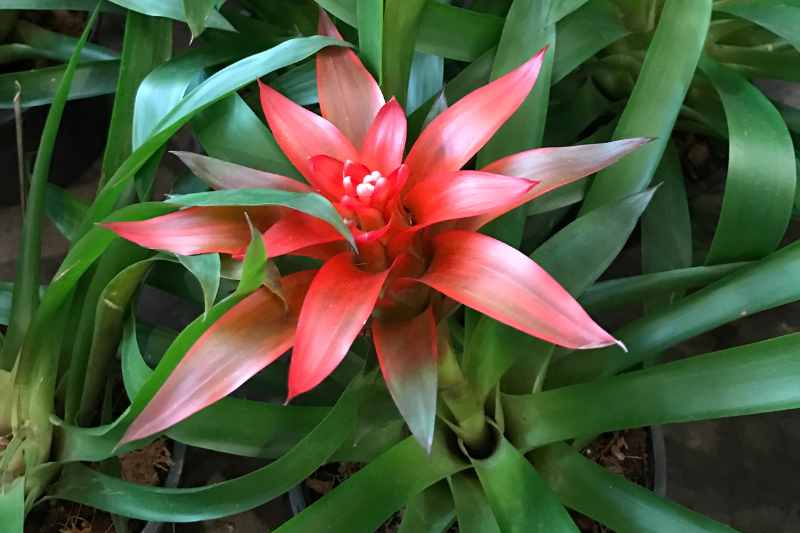
The Guzmania is a popular houseplant for its rosette of glossy leaves and its coloured bract, as with the Guzmania lingulata with red flowers which lasts several weeks. Repotting Guzmania is not a frequent task, but it can prove useful when the substrate is exhausted or the plant becomes unstable in its container. Here’s how to do it simply.
When to repot a Guzmania?
The best time is in spring, after flowering, when offsets (or suckers) appear. In urgent cases (rotting roots, mouldy substrate), you can repot at any time, avoiding periods of high heat or flowering.
Which pot to choose?
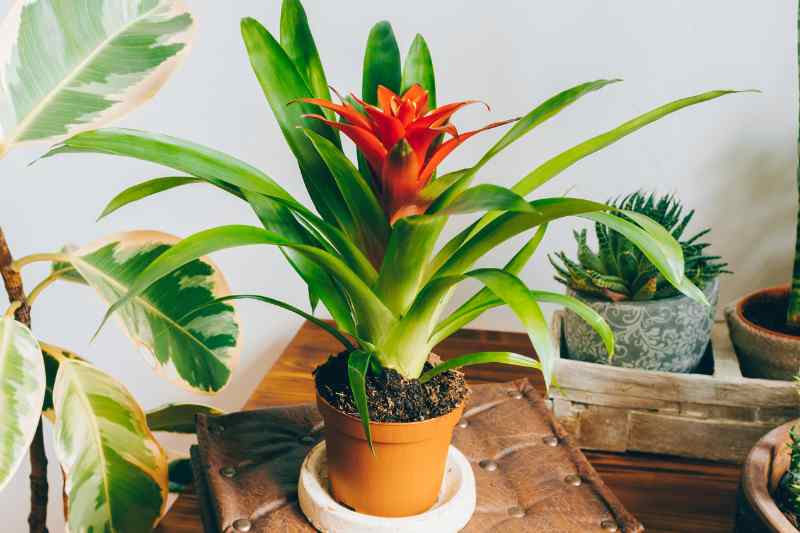
A lightweight plastic pot or unglazed terracotta pot of 12 to 15 cm in diameter is ideal for an adult Guzmania, to aid drainage while still suiting its relatively small root system. Drainage holes are essential to prevent water stagnation. A pot 2 to 4 cm larger in diameter than the old one is sufficient, as the Guzmania’s root system is not very developed.
Which substrate to use?
A very well-draining substrate is essential: mix half orchid potting mix, a quarter of coco fibre and a quarter of perlite or coarse sand.
Clay pellets at the bottom of the pot improve drainage and protect the roots from standing water.
How to repot a Guzmania ?
Equipment required
- A suitable pot with drainage holes
- A light, well-draining substrate
- Clay balls or gravel
- A sterilised knife or pruning shear
- Gardening gloves
Steps for repotting
- Prepare the new pot: place a drainage layer (clay balls) at the bottom.
- Carefully remove the plant from the old pot, taking care not to break the root ball.
- Inspect the roots: cut away any damaged or rotting parts.
- Separate the offsets if desired, to repot them individually.
- Set the Guzmania in the centre of the new pot, not burying it too deeply.
- Fill with the substrate, gently firming around the base.
- Water the Guzmania moderately; place in partial shade for a few days.
Guzmania care after repotting
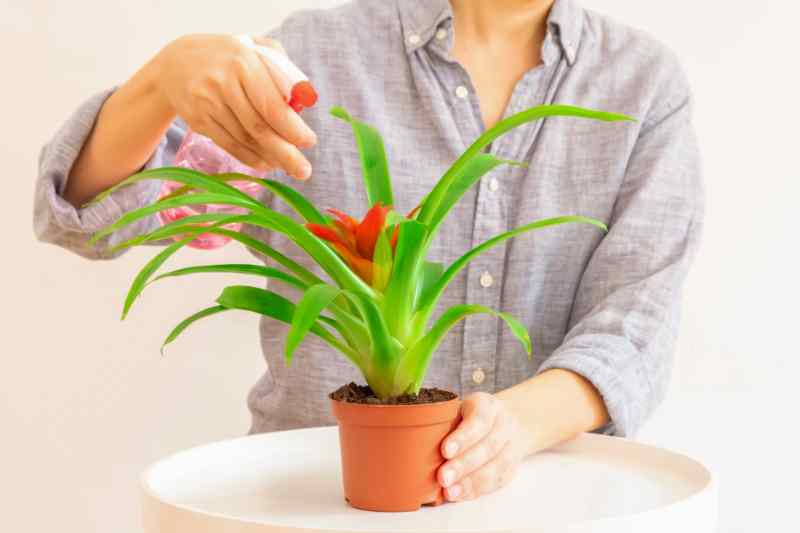
A soft light is preferable during recovery. Moderate watering, by pouring a little water into the rosette, without soaking the substrate. Providing ambient humidity (misting) aids recovery. Avoid direct bright sun and draughts for a few weeks.
Comments