
































Sometimes I think I’m a peculiar gardener… If I walk round the garden and thus the vegetable garden, at least five times a day, it’s mainly to "greet everyone", check that all is well and, in season, nose into a rose or nibble a few small fruits. Because, after all, I don’t work there that much. For one thing, I’m short of time, like everyone else, and, I must admit, I shy away from gardening in the rain (The Brittany weather—that’s life for you…) as much as in scorching heat.
My secret? It’s simple and consists of mixing organisation, method and anticipation. Just that 😉
Let me explain…
Tip No. 1: In the vegetable garden, smother rather than clear
I’ve never even tried to pick up a hoe. Given my build, it would be a lost cause and utterly ridiculous. And as there was never any question of using a motor cultivator, a real chopper for earthworms, I, from the start, began the habit of smothering the grass to create a new vegetable plot or a new border of perennials.
My method is very simple and approaches the ’lasagne’ gardening technique:
- mow very short,
- spread a good layer of compost,
- lay down one large or several medium-sized sheets of cardboard, moisten them and hold them in place with a few heavy stones,
- add on the cardboard, over the weeks, some trays of grass, dead leaves or other shredded green waste to create a temperate climate (humidity, warmth in winter, coolness in summer) conducive to worm activity.
A few months later, joy of joys: beneath the various layers I discover the cleared plot. All that remains is to remove any remaining roots (quackgrass is a stubborn weed), quickly decompact the soil and plant.
For very large areas, I also use the solarisation method of weed control. For this, I simply mow and then lay a black plastic sheet. It’s very quick, works brilliantly, but soil life is less favourable.
Tip No. 2: Plant rather than sow directly in the vegetable garden
All vegetables and aromatic herbs that can be installed as plug plants in the vegetable garden are sown indoors or under cover (a bright sunroom at our place). Well organised, I thus produce summer vegetables but also the flowers needed for three gardens—the one I tend and the vegetable plots of two couples of friends.
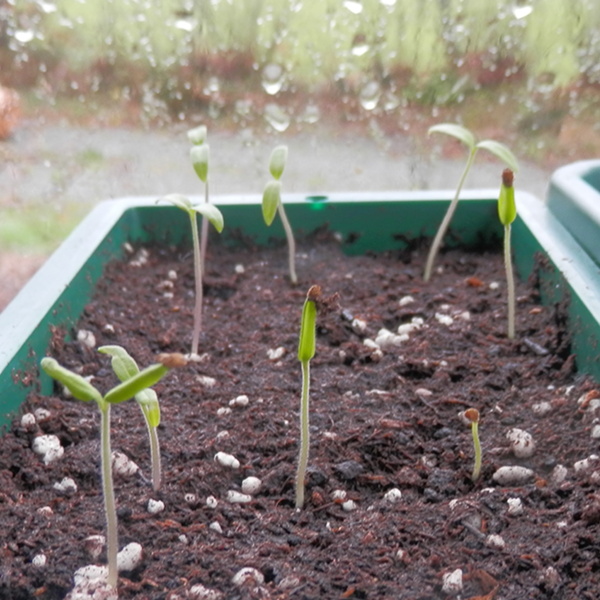
Seedlings indoors, at home... a real joy on rainy days!
It does take time, but the period of the first warm sowings coincides with the end of winter and the impatience is such that being able to touch the potting soil is simply exhilarating. And then, in the evenings and at weekends, some watch TV, others read or knit; me, from February to April, I sow…
I also sometimes buy a few plug plants when I want to try a novelty, a grafted variety, that I’ve forgotten a sowing, or that buying yet another packet of seeds seems superfluous…
This way of proceeding saves me time and effort on three levels:
- the soil doesn't need to be worked finely, a simple loosening with a fork is more than enough,
- it spares me from the chore of thinning (the spindly ones have been removed beforehand)
- I can mulch very quickly after planting which brings us to the next point…
Tip No. 3: Never leave soil bare: mulch, mulch and mulch again!
Trained in the kitchen garden by Luc Bienvenu, mulching is almost a religion here: I mulch everything, with everything and all the time because I mulch in all seasons: when the plot is occupied by a crop but also in winter when some beds lie fallow. The only obstacle to this practice is a shortage of material. In that case, I use green manures… or I collect my neighbour's clippings (his lawn, regularly weeded by hand, deserves at least four stars) or the dead leaves from my town as well as pruning chips, which are delivered to my home, often in 3 or 5 cubic metres.
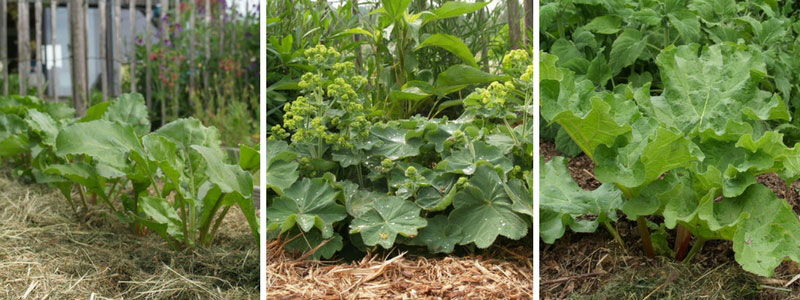
In my garden, at the foot of beets, dry grass, for alchemillas, pruning chips, and for rhubarb, a mix of dead leaves and grass.
So, indeed, there is a bit of wheelbarrow work, but this practice has many advantages, not least because it:
- limits weed growth,
- reduces the frequency of watering,
- protects the soil from the pounding of rains, nutrient leaching but also from cold in winter and drought in summer,
- improves fertility and the structure of the soil as worms and other soil organisms are nourished by the progressive decomposition of the mulches.
In short, it’s mainly the ornamental garden that keeps me busiest: mowing, edging, pruning and moving perennials (the game of musical chairs, you know?)…
So, who said the vegetable garden is a lot of work? You surely have, on your side, some lazy gardener habits or tips… Don’t hesitate to share them by leaving a comment!

Comments