





























Yellow-flowered climbing plants: they brighten the garden!
A spectacular flowering to brighten up all your garden structures
Contents
Climbing plants are ideal candidates for embellishing any kind of structure, from pergolas to walls, and even unattractive structures or aging tree trunks. Among the wide variety of plants that like to cling, almost all flower colours are represented, with yellow as an example. This colour, sometimes less loved, is not without its merits.
Here we provide our tips for choosing climbing plants with yellow flowers based on their various advantages.

The importance of yellow flowering
Yellow is undeniably a colour that brings brightness and light to the garden, as well as a real note of cheerfulness.
It is a positive shade, associated with sunshine, that can catch the eye or create beautiful contrasts in the garden, such as on the terrace or balcony.
Yellow is precious, especially as winter recedes, when colours have become rarer and life is lacking in sunlight and warmth.
Yellow comes in many shades, sometimes soft, sometimes quite vivid.
It allows you to create all kinds of scenes, from the most romantic to the most sophisticated, including naturalistic or exotic ambiences.
When it comes to colour combinations, this colour naturally works wonderfully with its opposite on the colour wheel: purple.
But it also creates a beautiful harmony with orange or red to accentuate its brightness, or with white to soften it. Let’s also mention blue, which will be highlighted, just as purple is.
In addition, yellow flowers are highly attractive to insects, which readily spot them.
Yellow climbing plants to grow in pots
Small in stature, these climbers will be ideal candidates for restricted spaces, and especially for pot growing. This means you can enjoy them even without a garden, particularly to brighten a terrace, a balcony or an inner courtyard.
On the fast-growing annuals that deliver a generous display, let’s start with dwarf nasturtiums, such as the Tropaeolum majus nanum ‘Peach Melba’ (25 cm tall by 45 cm spread). From June to October, it relentlessly produces semi-double flowers, vanilla-yellow, splashed with orange-red at the throat. This nasturtium is an ideal candidate for hanging baskets or window boxes, from which it will cascade gracefully. The same goes for ‘Cream Troika’, whose pale yellow flowers are maculated with red. An original variety with its cream-variegated foliage. It grows to 20 cm tall by 1 m spread. A little less well known than its cousins, the Canary nasturtium canary nasturtium takes on many supports. It rewards us with flowers with prominent stamens, surrounded by two notched petals, in a very bright yellow.
The sweet pea ‘Lemonade’ (80 cm tall by 30 cm spread) also enlivens the summer, with its papilionaceous flowering, displaying a sulphur-yellow. Its tendrils cling to nearby supports.
Still in compact sizes, let us mention Dipladenia ‘Diamantina Emerald Amber Star’ (80 cm tall by 40 cm spread), a semi-climbing with large yellow flowers at maturity, contrasting with a red throat. A real touch of the exotic!
On the roses’ side, the climbing variety ‘Siluetta Sunny’ can certainly be grown in pots, as it does not exceed 1.8 metres. Its semi-double flowers bear two shades of yellow and exude a light fragrance. Its pliant shoots will simply be guided along a trellis.
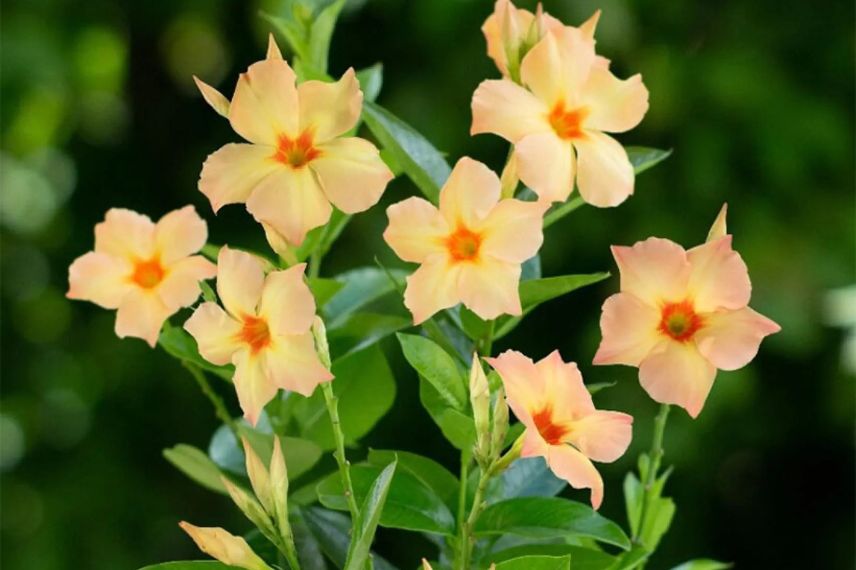
Dipladenia ‘Diamantina Emerald Amber Star’
Yellow evergreen climbers
Evergreen climbers have the advantage of not shedding their leaves in autumn. As a result, they remain ornamental in all seasons, even when not flowering. This is the case with some honeysuckles, such as the Lonicera similis var. delavayi. Vigorous, this climbing plant reaches 4 metres high by 2 metres wide. At the start of summer, it produces a profusion of flowers blending creamy yellow and white, with an intoxicating fragrance. The evergreen foliage remains in place even in winter. Also worth mentioning the Lonicera sempervirenss ‘John Clayton’ for its lovely bluish evergreen foliage, which contrasts very well with the long flowering. Appearing from May until the first frosts, it comprises slender pale-yellow tubes.
In Trachelospermum asiaticum ‘Chili & Vanilla’, the pale-yellow flowers exhale a floral, sweet fragrance, almost mouth-watering. This liana measuring 3 metres in height by 2 metres in spread keeps its leaves all year round.
The Virginia jasmine (2.5 metres in height by 1.5 metres in spread) flowers in late spring, with a possible rebloom in autumn. It displays trumpet-shaped yellow and fragrant flowers, surrounded by glossy evergreen foliage.
In Fremontodendron californicum, the early-summer yellow flowering is enhanced by the sun’s rays, which reflect in its waxy petals. A woody climber still relatively overlooked, it nevertheless has much to offer. It grows to 6 metres in height with a 4-metre spread.
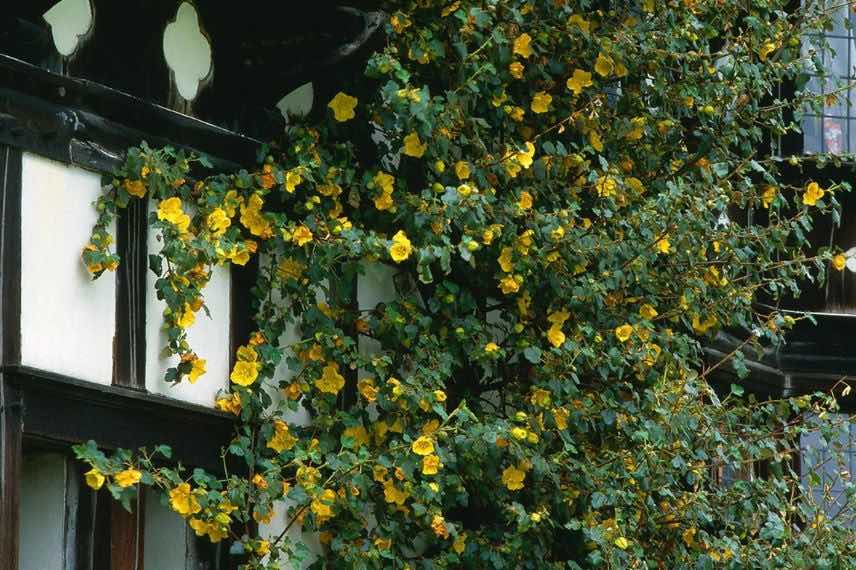
Fremontodendron californicum
Early yellow flowering
We were talking about it earlier, yellow blooms are particularly valuable in winter and spring, when the garden isn’t yet very lively and we are seeking light and warmth. To brighten this period even more, rely on primrose jasmine (Jasminum mesnyi), whose spring flowering can occur as early as February. A plant for mild climates (hardiness down to -4°C), it produces simple to semi-double flowers in a bright yellow, highlighted by dark green evergreen foliage. At maturity, expect 3 metres in all directions for this climber.
How could one not mention the winter jasmine, which inevitably brightens the entire cold season? This shrubby climber indeed produces a multitude of lemon-yellow flowers, which appear on branches still leafless. It is used trained against a wall or cascading down a low wall. If these flowers are not scented, they are nevertheless worth including in our gardens for their sunny colour and their relatively uncommon flowering period.
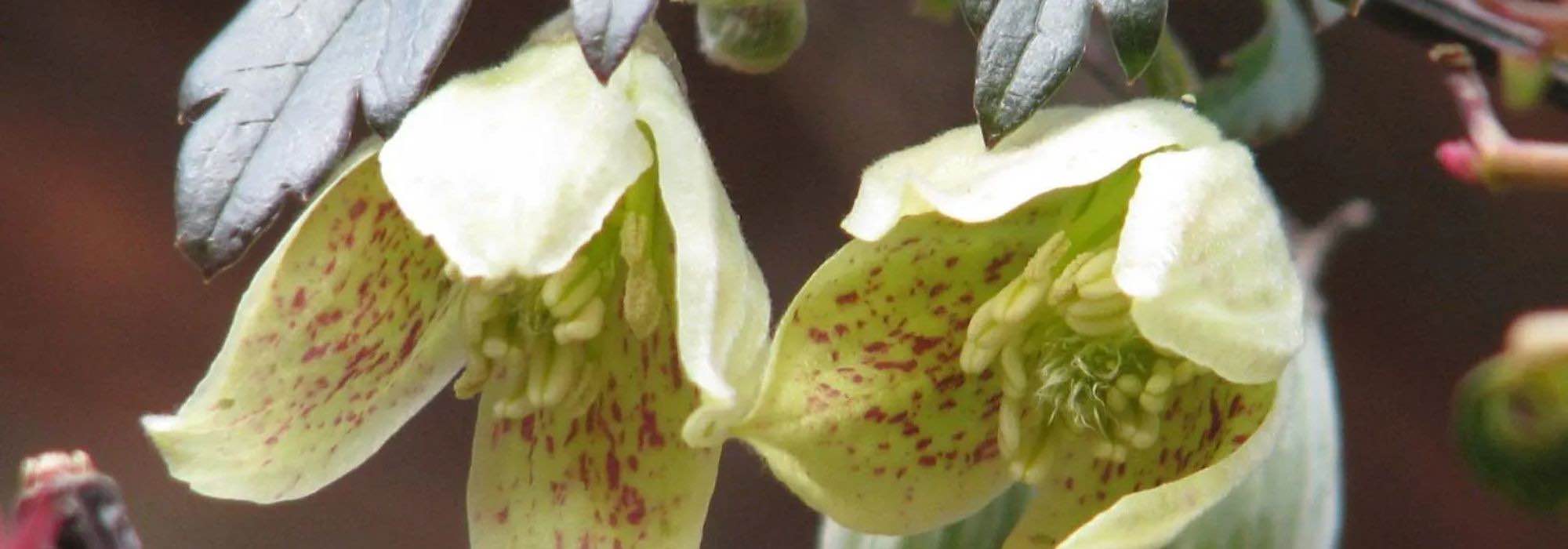
If it is also known as Christmas clematis, it is because it can flower at this time of year. Clematis cirrhosa ‘Balearica’ awaits the cold season to reveal its bell-shaped pale yellow flowers speckled with purple. An exotic-looking bloom that warms the winter. In terms of size, plan for 3 metres in height and 1.5 metres in spread. Its foliage also has the advantage of being evergreen and resembles fern fronds. An ideal candidate for dressing a wall, a trellis or a tree.
Fleurissant très tôt au printemps, l’impressionnant rosier de Banks ‘Lutea’ produit une cascade de fleurs doubles d’un coloris jaune beurre. Cette floraison dure pendant près de three weeks et can begin as early as April. Vigorous, this climber grows over 10 metres tall and will easily cover space in just a few years. It also has the advantage of being thornless.
On the rose side, other varieties flower in yellow from May. This is the case for the climbing rose ‘Golden Boy’, with pure yellow flowers, or ‘Climbing Max Golden Gate’.
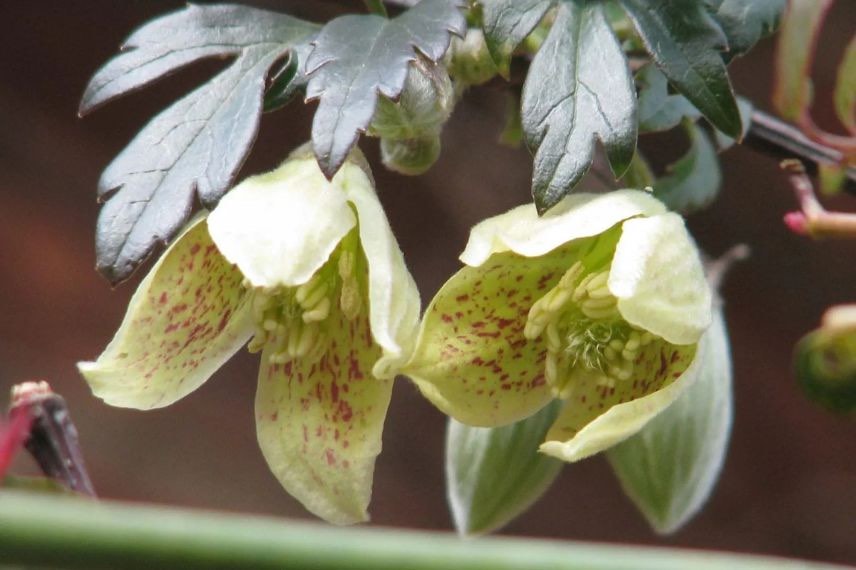
Clematis cirrhosa ‘Balearica’
Fragrant varieties
Are you looking for a climbing plant with fragrant yellow flowering? We’ve got just what you need. For example, you could adopt the Trachelospermum asiaticum ‘Ogon-Nishiki’, which is nothing if not eye-catching. It has a compact habit, broader than tall (80 cm high with a 1.5 m spread), notable for its multicoloured evergreen foliage, variegated with green, cream and red. The summer flowering appears as pale-yellow stars, exuding floral, sweet and vanilla notes reminiscent of biscuits.
The variety ‘Golden Memories’ also produces an abundance of pale-yellow flowers from late spring, exuding a suave fragrance.
Let us again mention the Lonicera similis var. delavayi, whose yellow flowering is particularly fragrant in the late afternoon.
On the rose side, ‘Malvern Hills’ by David Austin treats us to a suave and musky fragrance, very powerful. It flowers tirelessly throughout the summer, producing small double blooms in a warm coppery yellow.
Let us also mention the climbing rose ‘Golden Gate’, with its double gold-yellow flowering that exudes citrus notes.
Plants with remarkable fruiting
Following their sun-loving blooms, some climbing plants also reward us with an interesting fruiting. This is, for example, the la Clematis tangutica. This climbing plant with summer flowering produces large pendulous lemon-yellow bells for weeks. Then, the flowers give way to silver, feathery fruits, very decorative.
The same is true for Clematis serratifolia, which flowers in late summer. Its small pendulous bell-shaped flowers display pale yellow with purple anthers. They are slightly scented. Then, these are silver, silky-looking fruits that take over, to prolong the ornamental interest of this climber.
Let us also again mention mock orange ‘Chili & Vanilla’, which has the peculiarity of revealing elongated fruits reminiscent of vanilla pods or beans. They take on a red colour like chillies.
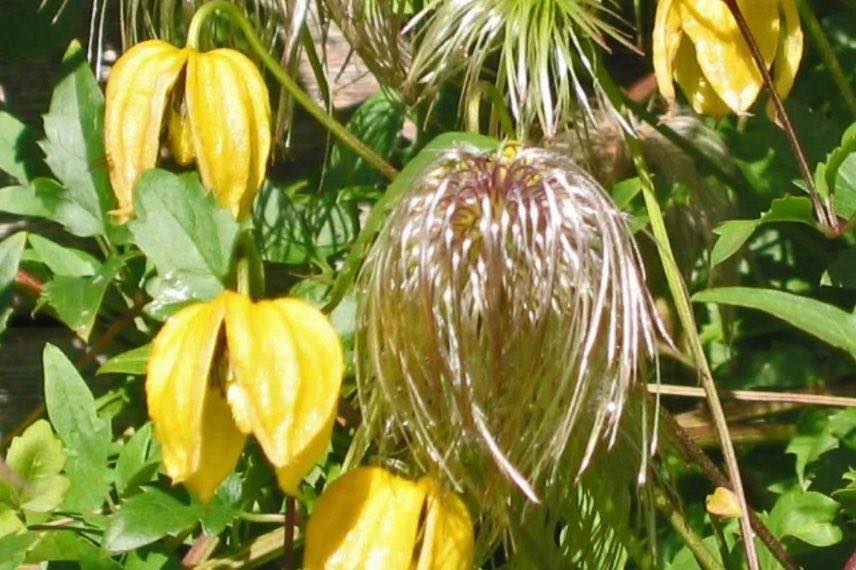
Clematis tangutica
Yellow-flowered climbers for shade
In the shade, yellow flowering displays will be all the more striking for bringing a touch of light and the missing clarity.
You can grow the beautiful Mermaid climbing rose, which flowers almost continuously from June to the first frosts. It produces large single flowers of sulphur-yellow, with a prominent centre of stamens. They emit a light fragrance. Its long canes reach up to 7 metres high with a 4-metre spread. So make space for this large climbing rose, which tolerates shade very well. The glossy dark green foliage is evergreen if the winter isn’t too harsh. Many climbing roses with yellow flowers can also be grown in partial shade. To discover more, head to our article: 5 climbing roses with yellow flowers.
- Subscribe!
- Contents
Comments