



























Which mulch to choose for Mediterranean plants?
Our tips
Contents
Mediterranean plants, such as lavender, olive trees, rockroses or rosemary, are species adapted to arid, hot and windy environments. They thrive in conditions often difficult for other types of plants, particularly thanks to their ability to resist drought and to nutrient-poor soils. However, despite their apparent robustness, these plants have specific water-management and soil-protection needs, particularly in regions where the climate is more variable or in gardens where the soil does not naturally match their native environment.
Mulching, a technique that involves covering the soil around the plants with a variety of materials, plays a key role in the care of Mediterranean plants. It fulfils several essential functions: protecting the roots from cold and heat, maintaining a constant moisture level, reducing evaporation and preventing weed growth. But the choice of mulching material is particularly important to ensure the health and longevity of plants in arid conditions.
In this article, discover our tips for choosing mulch suitable for these plants.

The specific needs of Mediterranean plants
Well-drained soils: an essential need
One of the main needs of Mediterranean plants is well-drained soil. These plants are accustomed to dry, stony soils that do not retain excess moisture. In soil that is too compact or too waterlogged, the roots can easily suffocate, causing their rotting and threatening the plant’s survival. That is why it is essential to choose mulch that does not retain too much moisture, but rather helps to improve drainage. Materials such as gravel, pebbles or pozzolana are ideal in this context.
Drought tolerance and water management
Mediterranean plants have evolved to withstand long periods of drought. Their root systems are often deep, allowing access to water deep in the soil, and their leaves are often thick or covered with tiny hairs, which reduces evapotranspiration. However, in a garden, even if they are drought-tolerant, it is important to maintain a minimum moisture in the soil, especially during periods of intense heat. A good mulch helps to retain this moisture by limiting evaporation, while avoiding excess water, a stress factor for these plants.
Thermal stability and protection of roots
The roots of Mediterranean plants need thermal stability to avoid shocks from extreme temperature fluctuations. Whether in winter or summer, a well-chosen mulch helps to protect the roots from temperature swings. During the summer, the mulch acts as a barrier against excessive heat, reducing thermal stress on the roots. In winter, it protects from the cold, even though most Mediterranean plants tolerate cooler temperatures well, provided they are not too damp.
A poor, well-aerated soil
Unlike many other garden plants, Mediterranean plants do not seek nutrient-rich soil. They perform better in poor, lightly fertilised soils, where growth is slower, but sturdier. Mulch that is too rich in organic matter, such as fresh compost or manure, can disrupt this natural balance and harm their health by promoting too rapid, fragile growth that is less drought-tolerant. In addition, it is crucial that the soil remains well-aerated to allow the roots to breathe, reinforcing the importance of an appropriate mulch.
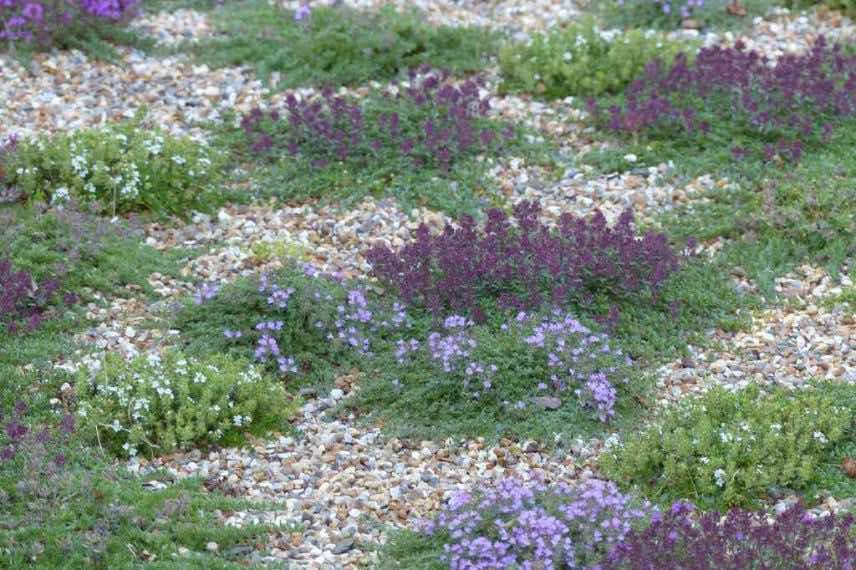
Thymes on gravel
Read also
How to create a dry exotic garden?Mineral mulch: an ideal option
Mineral mulch is particularly suited to Mediterranean plants. It provides a durable cover and helps keep soil temperatures stable.
Common mineral mulches used for Mediterranean plants include:
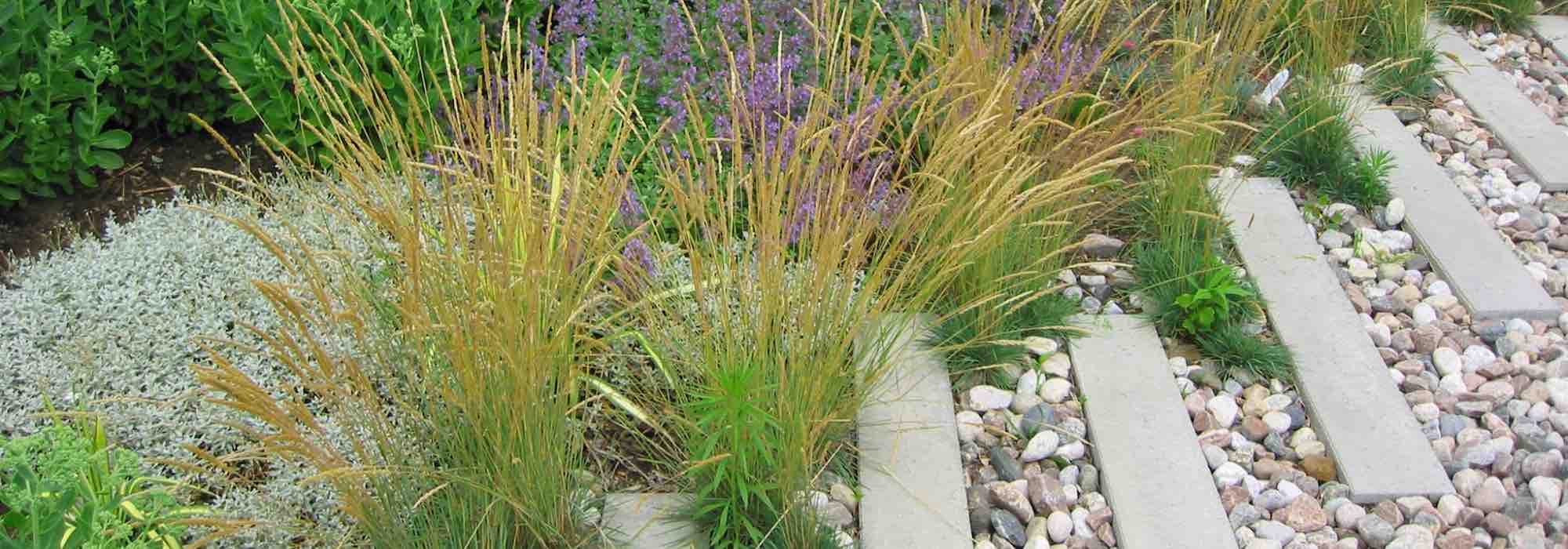
- Gravels : Small pebbles or stones are perfect for covering the soil around plants. They also help prevent soil erosion.
- Pozzolana : This volcanic material is highly prized for mulching dry gardens. Its porous structure helps to drain excess water. In addition, it regulates soil temperature well.
- Slate : Very attractive, slate helps prevent evaporation and protects plants from frost.
- Clay balls : Light, stable and recyclable, they have a long lifespan.
Mineral mulches have an insulating effect. During hot summer days, they absorb and store heat, releasing it slowly at night. This helps maintain stable temperatures at the root zone, a key factor for Mediterranean plants that prefer steady warmth. In winter, although mineral mulches are not as insulating as organic materials, they still provide adequate protection against light frosts.
Another major advantage of mineral mulches is their durability. Mineral mulches last for years without breaking down. This makes them an ideal solution for gardeners seeking a low-maintenance mulch. Once installed, mineral mulch stays in place and continues to offer its benefits, without the need for frequent renewal.
Moreover, these materials are resistant to harsh weather conditions. They do not deteriorate under wind, rain or intense sun, making them ideal for regions with hot, dry summers and wetter winters.
Mineral mulches also help maintain more stable moisture deeper in the soil. This helps roots stay cool and access water during droughts, while avoiding soil waterlogging.
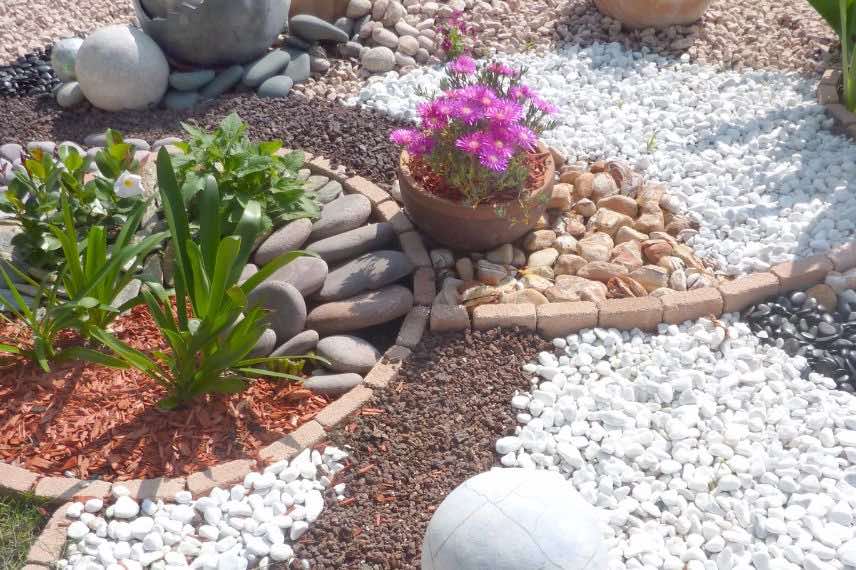
Different mineral mulches, pozzolana and gravels, and red wood bark
Suitable organic mulches: wood chips and bark
Mineral mulching is particularly recommended for Mediterranean plants, some organic mulches may also be suitable, provided they are well chosen.
Wood chips and the bark are examples of organic mulches suitable, as they decompose slowly.
Unlike organic mulches such as grass clippings or dead leaves, wood chips and bark decompose much more slowly. This means they provide fewer nutrients to the soil, which is ideal for Mediterranean plants, which thrive in poor soils. This gradual decomposition helps maintain a durable cover around plants, without needing to replace mulch frequently.
Wood chips and bark do not retain moisture excessively, making them a suitable choice for Mediterranean plants, which are less prone to rot than with other organic mulches.
Wood chips, however, dry quickly in the heat of summer. Compared with mineral mulch, organic mulch is not as effective at protecting soil from rapid evaporation in these arid conditions.
Read also
6 Mediterranean perennialsApplying mulch
Correct mulching application is as important as the choice of material. Here are a few tips to maximise the benefits of your mulching:
- Thickness: Mineral mulches can be applied in smaller quantities than organic mulches. A mulch layer of around 2–4 cm thick is sufficient. For organic mulches, 5–7 cm will help retain moisture and reduce weed growth.
- Space around trunk: avoid piling mulch directly against the base of plants or shrubs. Leave a few centimetres of space around the trunk or base of the plant to prevent moisture buildup that could promote diseases or collar rot.
- Mulching after watering: apply mulch after a good watering is good practice. This helps retain moisture in the soil for longer.
- If you are using wood chips, add a 1 cm thick layer each year and renew them entirely every 3–4 years.
- Subscribe!
- Contents
Comments