





























What to grow along a south-facing wall?
Our selection of climbing plants, shrubs and perennials that thrive on a sunny wall
Contents
The walled gardens formed by walls and house facades have spaces ripe for turning into beautiful flower beds. When these walls face south, they receive strong sunlight, often drying them out, but they store heat that can be released at night to the plants, which is particularly beneficial for frost-sensitive plants.
Not sure what to plant against your south-facing wall? We offer several ideas of plants that stand up well to this situation, including climbing plants, bushes, exotic plants and robust perennials, whether planting along the front of the house, against a large garden wall, or to hide an unsightly wall.

Pros and cons
It’s well worth using a south-facing wall whenever the opportunity arises! It benefits from maximum sun exposure, which is ideal for plants that require plenty of light and warmth, and thus provide abundant flowering. This well-exposed wall also offers excellent protection against prevailing winds, and becomes the ideal spot for tender plants and young plants.
A south-facing stone wall acts as a small natural microclimate, absorbing heat during the day and releasing it at night, which allows you to grow plants that require higher temperatures.
There are nevertheless a few drawbacks to this situation: firstly, increased dryness, due to faster evaporation of water. You would normally need to water this area more often. Plants that are not suited to it will suffer water stress, potentially even scorch in the height of summer. Thus, some plants will not be able to be grown there, as they would receive too intense sun exposure. The soil in this area along the wall is also poorer and drier.

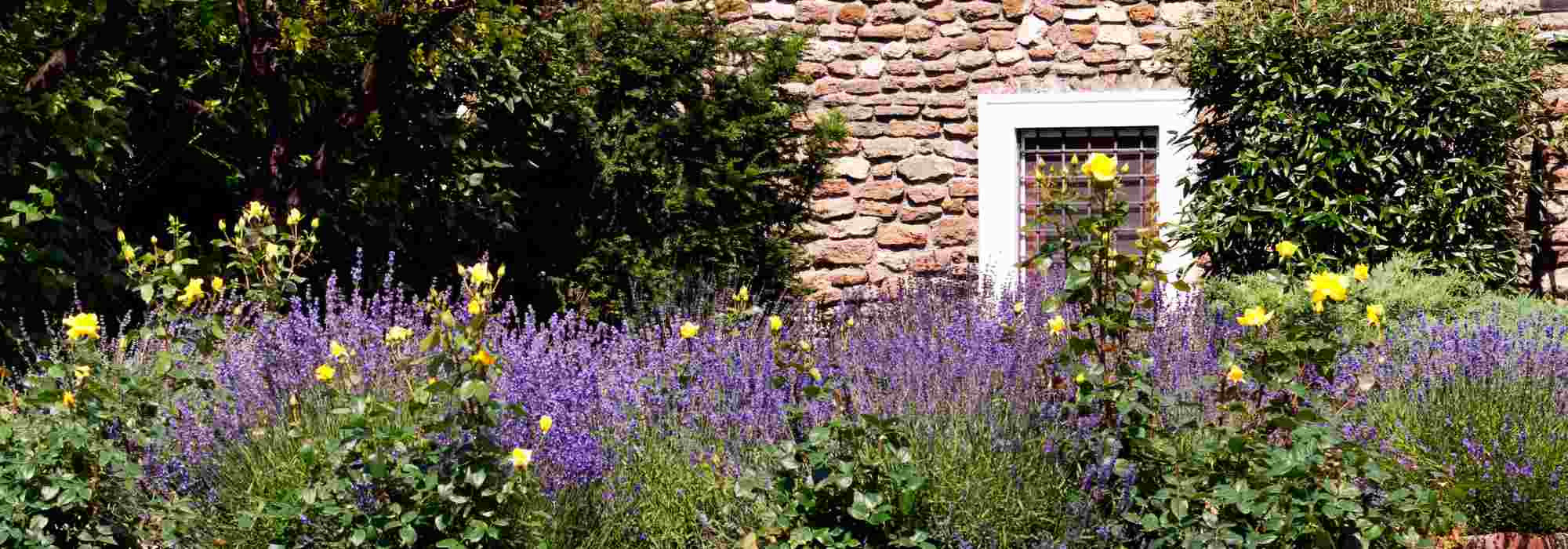
In Brittany, granite walls provide real protection, enabling exceptional flora, such as viper’s bugloss in the Kerdalo garden
Read also
Microclimates in the gardenWhich plants for a south-facing house facade?
Along a house, one always ensures not to plant bushes that are too large, whose root system could damage the drainage pipes, and we mix climbing plants with perennials of varying height so as not to obstruct the opening of the windows. Those planted closest to the wall will always receive less rainfall than the others.
Granite stone, shale and brick, besides their charm, have a particular ability to accumulate daytime heat. Light-coloured local stones reflect it back a little more, but the wall again acts as a heat sink.
We generally seek long-flowering displays on a house facade to ornament it for much of the year.
Climbing plants
On the climbing side, you can indulge in medium-sized climbing roses around an entrance, and Clematis that are not too pale and tolerate the midday sun: scarlet-flowered roses, Clematis ‘Perle d’Azur’ or ‘Nuit de Chine’. These plants need to be trained on a sturdy trellis or guided on wires, the Clematis will have their base protected from the sun’s heat by a handsome perennial or ornamental grass.
Perennials
Perennials are well-suited to withstanding the scorching sun at the base of the wall. Among those that will endure, some even without watering once established, are the handsome foliage of Helichrysum (everlastings), Santolines and euphorbias, all flowering yellow, Halimiocistus, rockroses and the shrub wallflowers such as Erysimum ‘Bowles Mauve’, valerian, and the very airy Perovskias that can mingle with lavenders, etc.
Exotic or Mediterranean
Against a wall, they will be much better protected than elsewhere. One can therefore consider planting a few: Yuccas, Cordylines, southern plants such as Westringias, the Libertias or the grevilleas, but also oleander or rosemary!
→ Also read: Flowering an entrance with climbing plants.
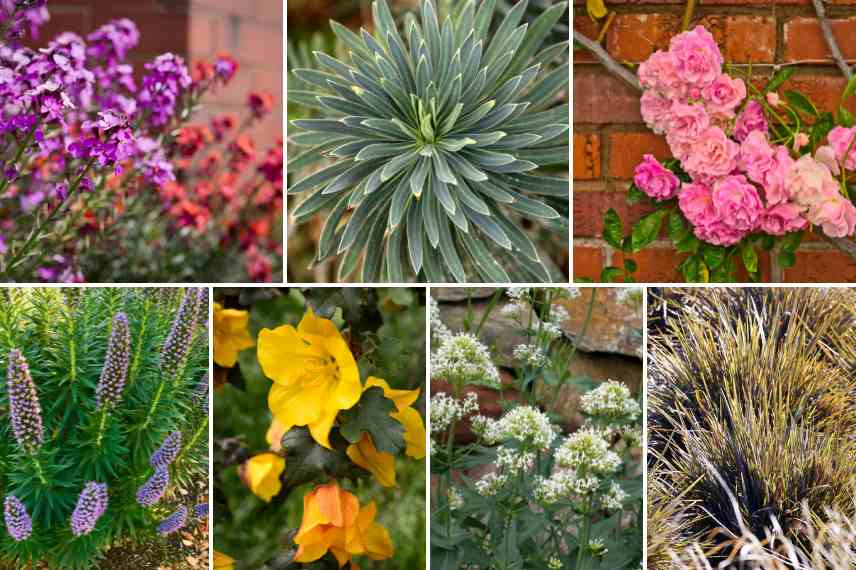
Erysimum ‘Bowles Mauve’, Euphorbia characias, Rosa ‘Super Fairy’, viper’s bugloss, Fremontodendron, Centranthus ruber ‘Alba’ et Libertia peregrinans
A large wall in the garden or a boundary wall
In the context of a fairly imposing wall, often stone, a garden boundary wall or a house gable facing the street, you should opt for plants that are much larger in scale. We will mainly use climbing plants of substantial reach such as the trumpet vine (including trumpet vine capreolata, noted for its chocolate-scented fragrance!), climbing roses and rambling roses, as well as the Virginia creeper. In mild-climate regions, the bougainvillea remains a classic yet spectacular choice, chosen in shades of purples, reds, yellows or whites. You can also opt for Pyrostegia venusta and the Tecomaria, both orange: they cover the wall with an appealing spread, reaching a width of 2 to 3 m. Everywhere else, clematis are welcome, as they allow, when you choose one species with spring flowering and another with summer flowering, to enjoy their wonderful coloured flowers for many months. Think also of the summer glycine d’été, still relatively little known, which features evergreen foliage and summer flowering.
On the shrub side, allow yourself handsome specimens such as Caryopteris, rock-roses, Ceanothus or Teucriums, but also Yuccas which will provide evergreen foliage, their striking white flowers and an interesting vertical presence, or ornamental grasses. Garrya elliptica is another wise choice, with its pristine winter bloom.

Pyrostegia venusta and white bougainvillea, Virginia creeper and wisteria
At the base, you can also plant a whole range of perennials or grasses that thrive in these wall-side conditions—Delphiniums, Delphiniums, cardoons, and spring bulbs that go dormant in summer, such as alliums. My wander through the village of Chédigny, renowned for the walls of its houses dressed with roses, will give you ideas for perennial plantings at the foot of a house.
You can also adopt, a little in the style of English borders, the idea of highlighting a pretty stone wall by mainly planting perennials at its base, thereby recreating the famous mixed borders from across the Channel. Choose a dominant colour palette to develop, as shown below, in warm tones, with echinaceas, dahlias and attractive purple foliage.
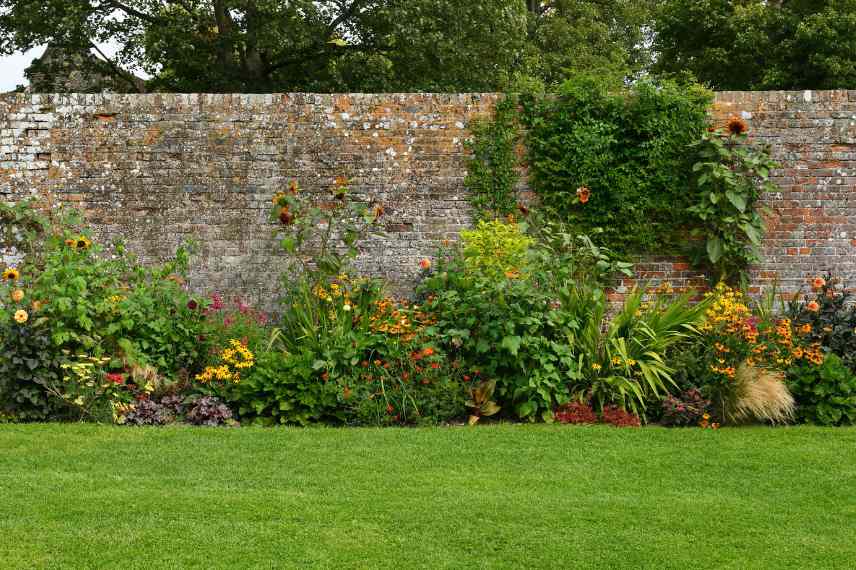 The wall acts as a protective barrier for perennials planted in a mixed-border!
Read also
What to plant at the foot of a wall?An unsightly wall to hide
The situation is quite different when it comes to covering up an unsightly wall. These are often party walls made of concrete or breeze blocks that we want to disguise with vegetation. These boundary walls between neighbouring gardens are usually not very tall. We adapt with suitable plants to dress this wall, which will soon disappear beneath climbing plants and bushes, by choosing a good proportion of evergreens. We take the opportunity to create a fairly wide border at the foot of this wall to enhance it with perennials, soft grasses and bulbs that will bring interest through the seasons.
We can install many small bushes that will thrive in the extra heat generated by this situation, such as Pittosporum which will enjoy the warmth and wind protection necessary for their development. We can also plant shrubby salvias, a fig tree, a Indigofera, a Colutea, a purple-leaved Dodonea in mild regions or a handsome Berberis elsewhere. These bushes stay modest in size or tolerate pruning, such as the Pittosporums. Punctuate, if possible, with one or two shrubs trained on a stem (why not a wisteria, a bay laurel, a privet…) or a fruit tree trained into a palmette, for a striking effect!
Have a strong hand here too with climbing plants to durably dress this wall: wisterias, jasmines (such as the Jasminum polyanthum with flowers subtly washed with pink), Solanum, Fremontodendron, honeysuckles (to be considered more in the north of the Loire, as they will cope better with this scorching sun) such as Lonicera var. delavayi, Clematis armandii, etc. And complete with a rose and perennials you like, as well as small grasses. Many will withstand the full sun on this wall, such as gaura, sedums, echinaceas, and Miscanthus.
→ Also read: 10 climbing plants for full sun, Summer bulbs with orange flowers for full sun, and Party wall: what to plant?
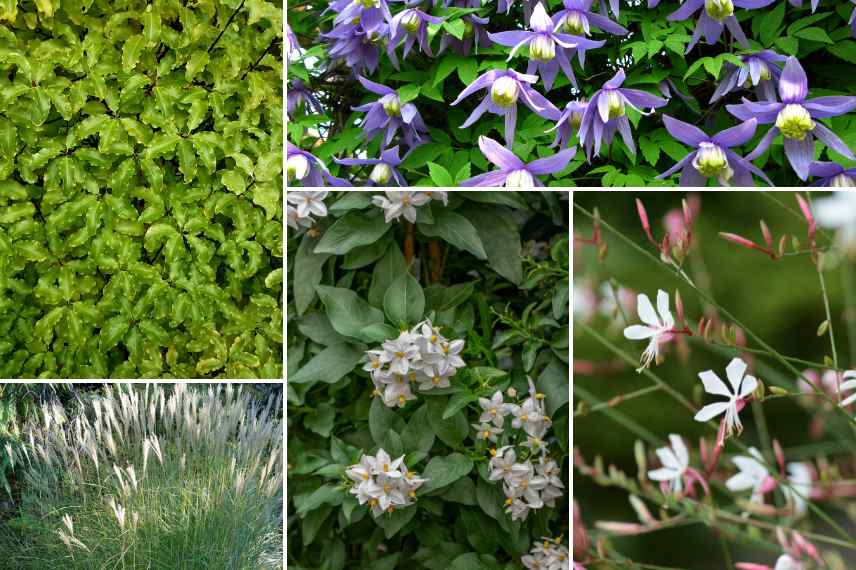
Pittosporum tenuifolium, Clematis alpina, Miscanthus sinensis, Solanum jasminoides and gaura
Planting tips near a wall in full sun
Once you’ve chosen your plants, we recommend following these tips, as the base of a wall is a very specific space, as mentioned earlier:
- If the roof overhangs considerably, move your plant 30 to 40 cm away from the base of the wall, so that the perennial, climbing plant or bush benefits from rainwater.
- Mulch the soil between the plants to protect the soil from sun exposure, keep the substrate cool and insulate the plants from winter cold.
- Regarding how climbing plants are attached to walls, follow our advice in Climbing plant: the different support systems, as some of them require more guidance than others.
- And of course, not planting them, but cultivating them in pots, citrus trees in pots are well protected in winter here and provide superb decoration in their pretty pots, often chosen in terracotta. Do consider them as well and include them among the other plants.
- Full sun dulls the colours of flowering. Choose flower colours carefully, especially for clematis and roses. Learn more at The perception of flower colour.
- Subscribe!
- Contents

Comments