





























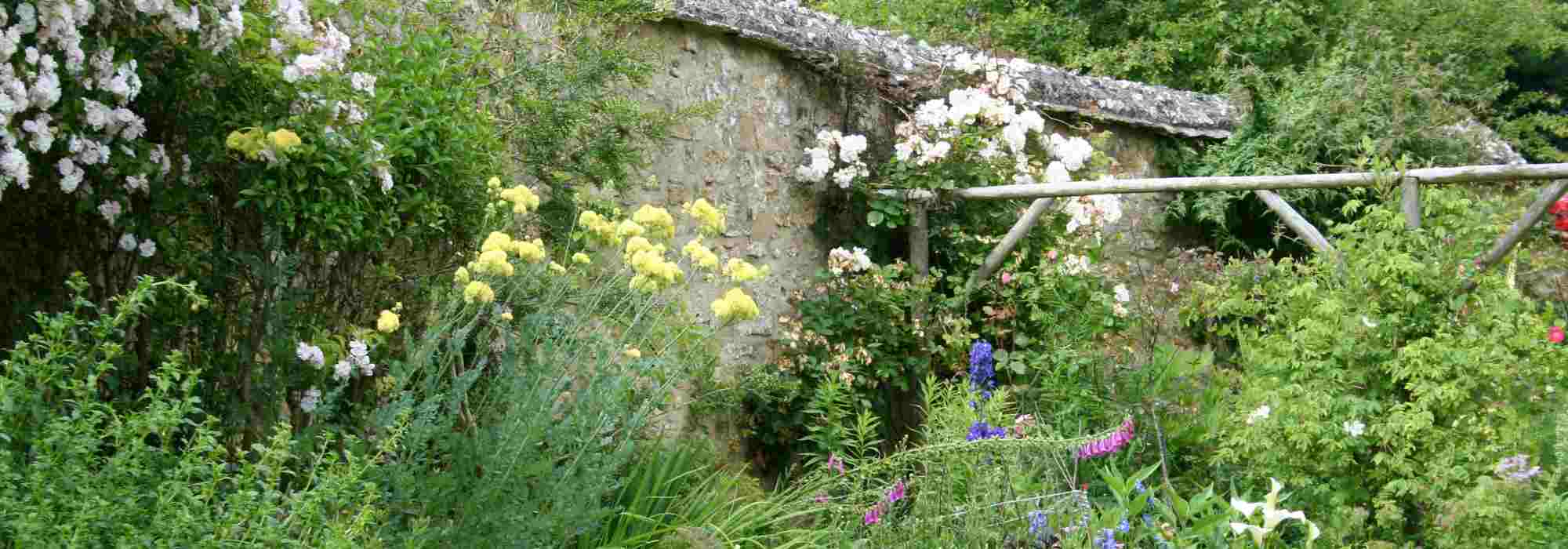
What to grow along a west-facing wall?
Our selection of shrubs, climbers and perennials
Contents
When you want to green the wall of your house or a garden wall, you often look for the most beautiful plants
A west-facing wall offers many options, it’s one of the most rewarding exposures for plants that benefit from the warmth there without suffering morning frosts.
Here are a few suggestions to dress your west-facing walls, selected from perennials, shrubs, climbing plants and grasses.
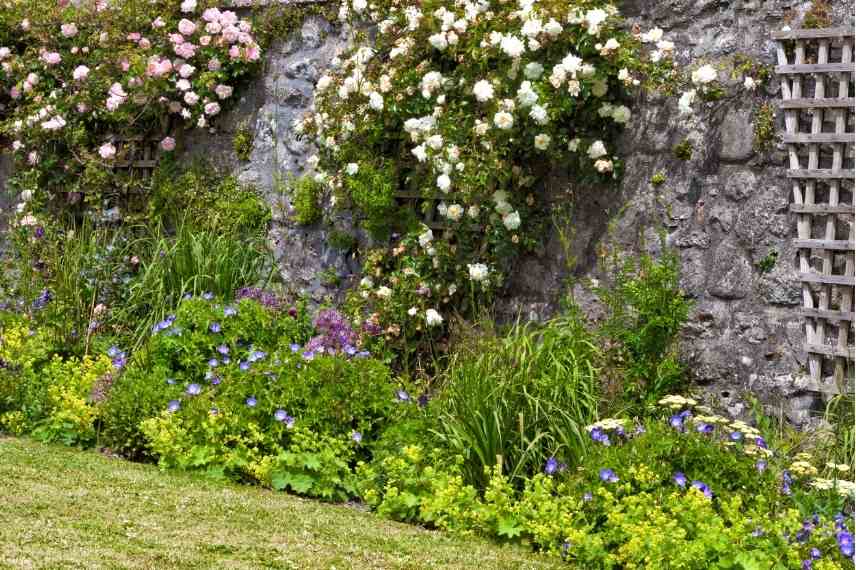
Against a stone wall, Alchemilla, hardy geraniums, irises and roses create a soft tableau

Planting conditions along a west-facing wall
West-facing walls receive sun all afternoon through to the end of the day. A little less exposed than plants at the foot of a south-facing wall, they also offer the possibility of planting a few frost-tender plants that would struggle elsewhere in the garden north of the Loire.
You’ll find nearly the same options as for a south-facing wall, with the difference that the plants we choose may be a little more tolerant of the sun, since it will be less intense in this exposure, and they will tolerate a bit more shade to develop well since they will be deprived of it in the morning. The plants that enjoy gradual sun exposure throughout the day are in fact quite numerous, even in the challenging conditions at the foot of a wall.
Your region will be a key factor in determining certain plants, as some areas experience recurring westerly winds that won’t suit the most delicate flowers and the most fragile foliage.
The mature size of the plants must be taken into account, especially for planting against the wall of the house, since space there is tighter, often close to a path in front of the building or near the lawn. Elsewhere in the garden, you can consider opening up broad borders starting from the walls, which lends itself to creating mixed borders.
Finally, the soil at the base of a wall, especially against a house, is usually poor or unfavourable. You will need to amend it in preparation for future plantings.
Read also
How to design a West-facing garden?Bushes and shrubs
By choosing shrubs with moderate growth, you can plant along a west-facing wall a handsome range of shrubs. Provided they do not obstruct the view or hinder the closing of the shutters. Dwarf shrubs are often ideal in the foreground against a house wall, but others a little taller or fuller can join them, so long as they are not placed in front of the windows of a dwelling. On boundary walls, the choice will be broader.
Some arched-habit shrubs are, moreover, stunning against a wall, giving this romantic charm to the walls of old houses: Exochorda, pure white, Buddleia alternifolia majestic on a large wall with its mauve garlands, etc.
Compact Abelias are feasible in most regions; they delight for many months with their graceful flowering and evergreen foliage. The autumn camellias (Camellia sasanqua) also find the right sun exposure and frost protection, just like several winter- or spring-flowering shrubs such as the Hamamelis or the Corylopsis.
Hydrangea paniculata and the Hydrangea quercifolia: provided you water them, they manage to grow very well along a west-facing wall. They benefit here from a little more freshness when you mulch well at their base, and for the most part remain of medium size, both in height and spread, perfect for greening this spot. Planted in bulk, they are spectacular in full bloom.
Think hardy shrubs such as Photinia and laurustinus, which also enjoy a west-facing exposure and are not daunted by a wall’s base.
The Garrya elliptica, this evergreen American shrub rarely seen in our gardens, dresses a brick wall magnificently, with its white pendulous inflorescences standing out beautifully from January to March. It grows to a height of between 2 and 3 m and spreads.
Weigela, Deutzia, Mexican orange blossom, Pittosporum, all wind-tolerant shrubs will also be able to thrive for many years in soil at the foot of a west-facing wall.
As you can see, there are no shortage of shrubs to choose from, this list being not exhaustive!
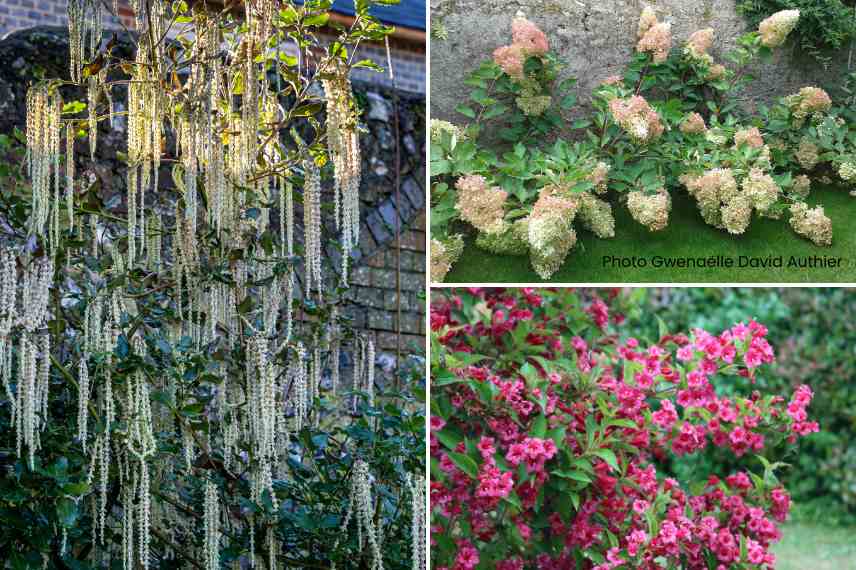
Garrya elliptica, Hydrangea paniculata ‘Phantom’ and Weigelia florida
Among smaller shrubs, which can also fit into a narrow border at the base of a wall, there are once again many possibilities, from lavender to Helianthemums, through sages or rosemary. We take advantage of the wall’s warmth to plant a few hardier plants that will be well protected here, such as the Euryops, the Echium, the Ajania, the veronicas (Hebe), the Loquat, among others…
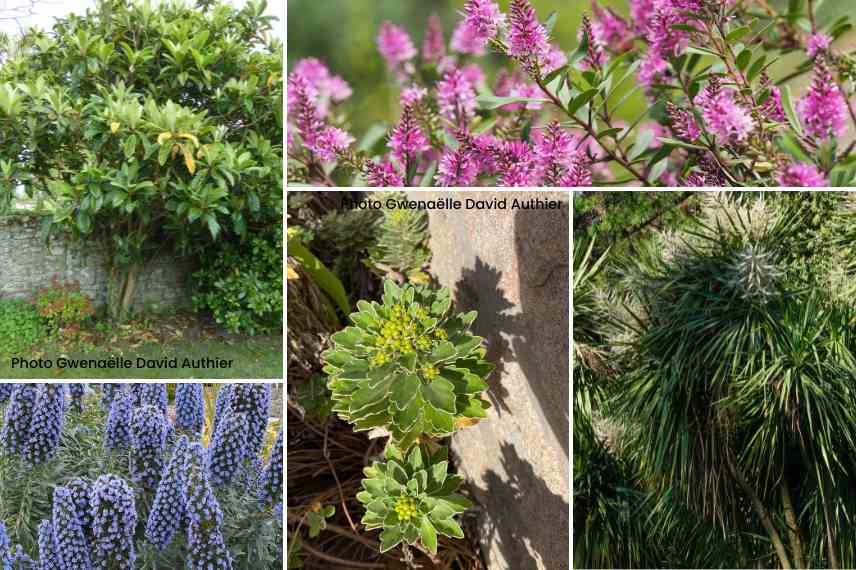
Loquat, shrubby Veronica, Madeira viper’s-bugloss, Pacific Chrysanthemum and Cordyline australis
And of course, all bush roses and shrub roses will find an ideal exposure, plenty of sun, on a west-facing aspect.
Climbing plants
Depending on wall size and whether it’s the wall of the main house or a shorter outbuilding, or a garden boundary wall, one chooses climbing plants with varying degrees of coverage and moderate growth. Make sure they have a support to climb on and well-drained soil.
Wisterias
Against a west-facing wall, wisterias make superb climbing plants, avoiding freezes and abrupt thaws that threaten their buds in some winters. You can safely plant them along a wall, whether it’s the house wall or a taller or shorter wall in the garden. Simply choose a variety suited to its vigour and, above all, provide an appropriate support system.
Clematis
If they can also be installed along a south-facing wall, clematis find an ideal place on a west-facing aspect, especially at the base of the wall. One can pair them with a perennial in front to provide the shade they appreciate at their base.
Many worry about full sun, but honeysuckles will develop harmoniously at the base of a wall on a west-facing aspect in all regions except southern gardens. Choose an evergreen or deciduous variety depending on whether you want to completely mask a wall or not, and check its spread against your wall area. They suit romantic and rustic settings and offer divine fragrances in the evening.
Hops
It is also well suited to this west-facing exposure, at the foot of a tall wall such as a house gable, as it can quickly cover a wide area of the wall with its bright flowering. Select compact varieties such as ‘Prima Donna’.
Kiwi, with its handsome rounded leaves, is also an option to consider: it can transform an unsightly wall or climb nicely on a boundary wall tall enough when trained as an espalier. Also opt for a compact variety such as ‘Monty’.
Hardenbergia violacea, a beautiful climbing plant with violet flowers that bloom in winter and early spring, will add grace to your walls up to 3 m high, in mild regions sheltered from cold winds during this season. Even if the west exposure protects it from the frosts it fears, take care to mulch its root zone well in the first years and thereafter, as it appreciates soil that remains cool (non-calcareous).
Climbing roses
Completely hardy, and like many deciduous clematis, climbing roses are evidently a charming option, especially against old stone houses. Options are almost endless: choose scented roses for a romantic atmosphere or around entrances, roses in pastel tones (white, pink, peach), or, conversely, vibrant colours from yellows, oranges to scarlet red depending on the mood sought in this part of the garden.
And also: many jasmines for their fragrances, passion flowers or Akebia longeracemosa.
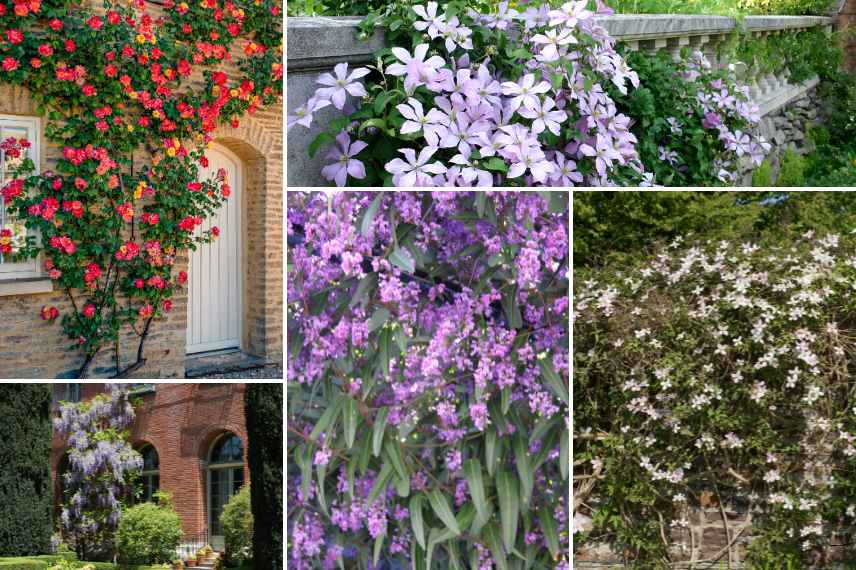
Climbing rose, clematis with summer or spring flowering, wisteria and Hardenbergia violacea
Perennials
We can really grow here again all plants suited to partial shade, or even full sun : Alchemilla, hardy geraniums, hollyhocks and their hybrids with the Alcalthea for an English garden, or more architectural plants for a more contemporary garden: medium-height grasses, Eremurus, Melianthus, etc. Finally, for an exotically inspired garden, don’t hesitate to plant a few Hemerocallis, acanthus and Euphorbia.
Iris, agapanthus, peonies, shrubby salvias will also thrive there. A shrub peony finds this sheltered position particularly helpful for establishing itself in its first years. Arums can thrive in wall-side planting when the soil has been well prepared and is well-drained and remains cool in summer.
The Tropaeolum tuberosum, or tuberous nasturtium, will be perfect at the foot of a small wall or low garden wall, offering its orange trumpet-shaped flowers in autumn to brighten the garden at a time when flowering begins to thin.
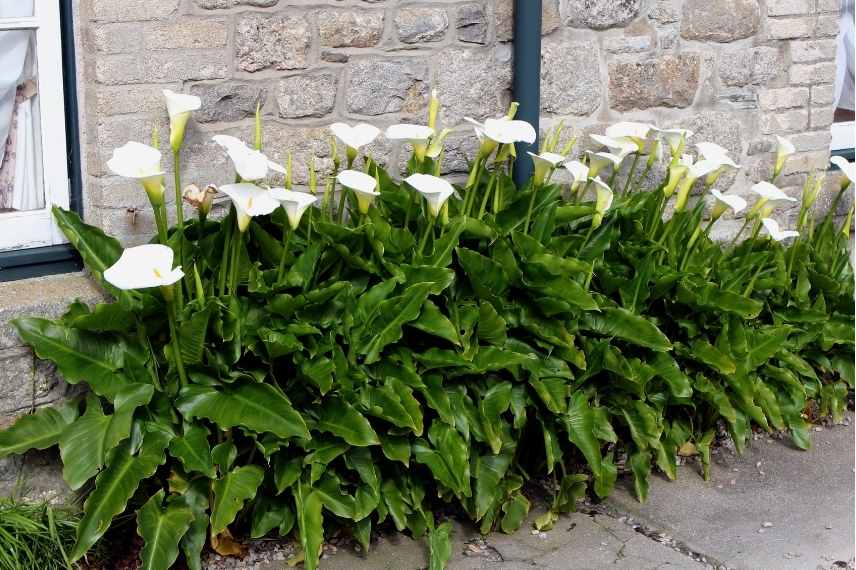 Arums thrive here between the house wall and the paved driveway
Other plants: grasses, bulbs…
Plant spring bulbs in abundance! Beside a west-facing stone wall, botanical bulbs exude plenty of charm: tulips, daffodils, alliums and the Peruvian squill, and in fact many bulbs, including summer bulbs, will enjoy the heat of a west-facing exposure.
Chosen for being small or of medium size, the grasses bind the various perennials and shrubs along the west-facing wall, adding lightness: Pennisetum, compact Miscanthus, Stipas, or small Panicum will be ideal.
Plants to avoid and what not to do
If we favour all plants recommended for full sun or partial shade, there are some we will avoid, notably because of their root system near house walls that could cause structural problems to foundations or pipes. Some bamboos with highly invasive root systems can quickly spread into spaces and damage walls. These are not plants to consider here. If you want a touch of visual interest, some Miscanthus will be preferred, or horsetail, always charming at the base of a wall.
Think carefully about a plant’s mature size. It isn’t always easy to picture a plant at full maturity, but you must refer to the provided dimensions, whether you consult a book, look online or, better still, ask a nursery professional. Phormiums are often planted too close to houses, and must then be continually pruned, removing their lower foliage… it’s a bit of a shame. If you have a path running along your house, opt for compact plants with a rounded habit or an upright form. Similarly, if space is limited, avoid a bush with an overly spreading habit, such as Viburnum plicatum, for example.
Make sure you calculate carefully before digging the planting hole for bushes (coppiced, on a stem, it doesn’t matter), to avoid ending up with a plant whose growth is constrained by the wall.
Last tip: avoid certain climbing plants that can damage gutters on walls that have them, such as some strangler wisterias or plants whose eventual height you hadn’t checked. Redirect your choice toward lighter climbing plants such as passionflowers or ipomoeas. Gutters will need to be kept clear in the case of deciduous plants that shed a lot of foliage onto them.
- Subscribe!
- Contents
Comments