





























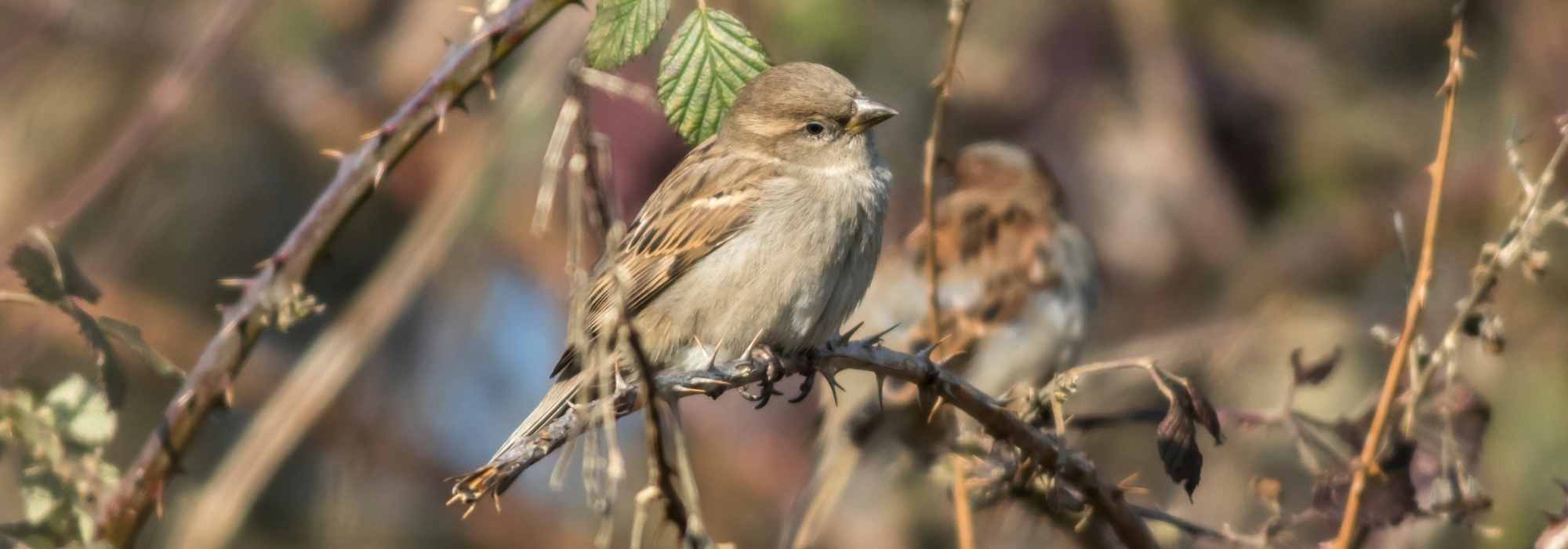
The house sparrow: a bane for gardeners?
Identification, behaviour and diet of house sparrows
Contents
There is one bird that divides opinion, and that is the house sparrow (Passer domesticus). Indeed, some gardeners detest this cheeky little passerine, while others appreciate its presence, often noisy, in their environment. For the house sparrow belongs to that category of birds that adapts to all environments. We meet it just as much in towns, pecking at a few forgotten crumbs, on cafe terraces or public squares, just a few tens of centimetres from our feet, as in the countryside, both in gardens and cultivated fields. And if you have a chicken coop, they descend on the feeders shamelessly, right under your hens’ noses.
Discover everything you need to know to better understand the house sparrow, a garden bird more often derided than appreciated.
The house sparrow, a bird in danger of extinction?
House sparrows on the brink of extinction, a question that really makes you sit up and take notice! How can this tiny passerine disappear when we all have memories of flocks sweeping across public squares, urban parks, the roofs of heritage monuments… as well as private gardens, farmers’ cultivated fields… Who hasn’t been bothered by this cheeky bird that almost nicks food from your table on a café terrace?
Yet, a finding has stood since the 2000s: House sparrows are disappearing more and more from major European cities. According to the LPO (League for the Protection of Birds), 73% of Parisian house sparrows are believed to have disappeared between 2003 and 2016. And the trend has only intensified in recent years. In rural milieu, the house sparrow resists a little better, but a decline in the population is still visible.
How can we explain the decline of this population of birds? In cities, it is essentially the disappearance of nesting sites (crevices in old houses, holes under tiles, tree hollows…) and an unbalanced diet that causes the decline of house sparrows. Indeed, in cities, house sparrows have a human-provided diet, too fatty for them, low in animal protein. In the countryside, it is mainly pesticidal pressure, predation and the occupation of territory by other species such as the Turkish turtle-doves and wood pigeons that impact house sparrow populations.
So are we going to see this small bird, so common, disappear from our surroundings to the point that we barely notice it is less present?
How to recognise a house sparrow?
The house sparrow is a fairly stocky, sturdy passerine in the family Passeridae. The male and female show a different appearance: while both have brownish to dark chestnut plumage striped with black, the male has a black throat, cheeks and chest, the malar area and abdomen dirty white and a grey crown, whereas the female appears duller. She does, however, sport a cream eyebrow, a sign of coquettish charm! The male beak is darker than the female’s.
The house sparrow is fairly similar to the tree sparrow (Passer montanus) which lives more in rural areas populated with orchards and copses. In Corsica, one is more likely to encounter the cisalpine sparrow (Passer italiae), native to Italy. The house sparrow also blends easily with the dunnock (Prunella modularis), a small solitary bird that often roams the gardens of towns and villages, very tree-lined and punctuated with hedgerows.
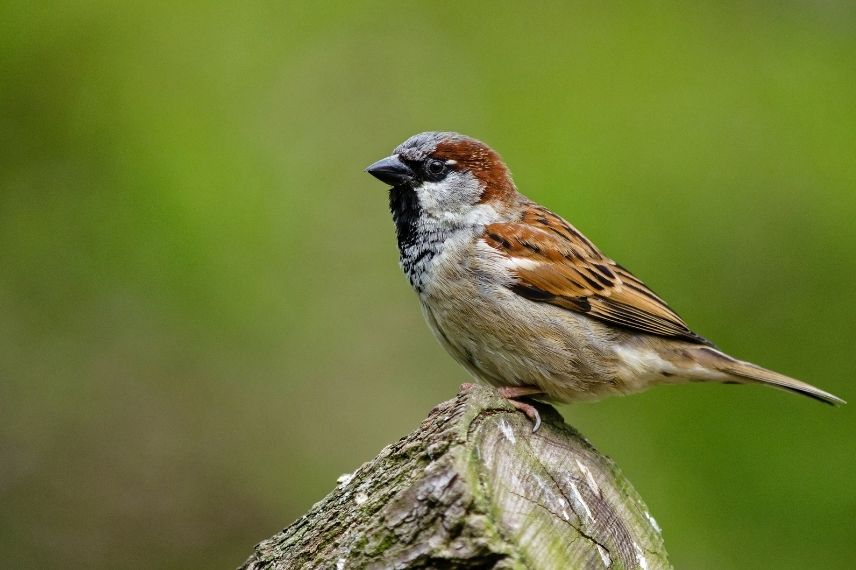
The male house sparrow is less drab than the female
Measuring 14 to 16 cm in length, the house sparrow weighs about 25 to 32 g. Its call is quite recognisable, resembling a ‘cheep’. And when they are in a flock, they quickly become very noisy, even irritating, as their calls are repeated ad infinitum. Moreover, the house sparrow lives in close proximity to humans, in colonies of dozens of individuals.
Life history, reproduction and habitat of sparrows
Sedentary, almost home-loving – these are the traits that best describe house sparrows.
A sedentary and gregarious bird
Indeed, this bird often spends its entire life where it was born. And, in addition to these two characteristics, the house sparrows are particularly gregarious. Sparrows move only in groups; they live together, sleep together, bask in the sun together, protect themselves from predators such as the European sparrowhawk together, feed together, swooping onto seeded grain fields or young shoots. It is also together that they come to raid seeds from hen houses… For house sparrows are highly dependent on humans for their food.
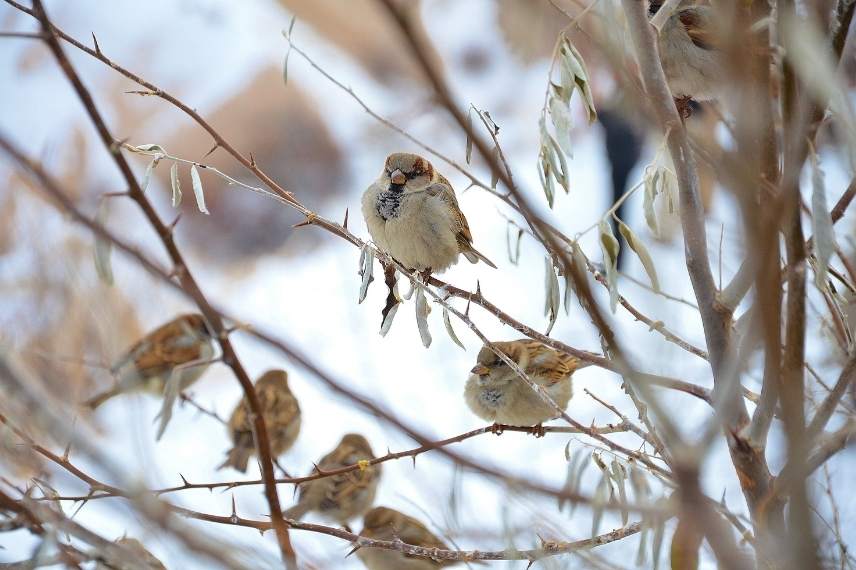
Very gregarious, house sparrows live only in groups
All year round, but especially in autumn and winter, they settle in trees, hedges, climbing plants, on walls, under roofs, to roost for the night. And their presence can be very noisy, in the mornings and evenings.
Prolific breeding
The courtship season, which begins in January, is also noisy!
Several males literally scream, display themselves and fight around a single female. But the pair remains monogamous throughout the season, and beyond.
Once the female is fertilised, the male sets to building the nest in a cavity, a crevice, a hole, under a roof, in a building, in a wall, sometimes even in a swallow’s nest or a street lamp. The nest is made of twigs, grass stems and dry leaves, to which a few feathers and horsehair are added.
The female lays 2 to 8 eggs, incubated alternately by the male and the female. The young stay in the nest for about a fortnight, fed by both parents on insects, then on seeds regurgitated by them.
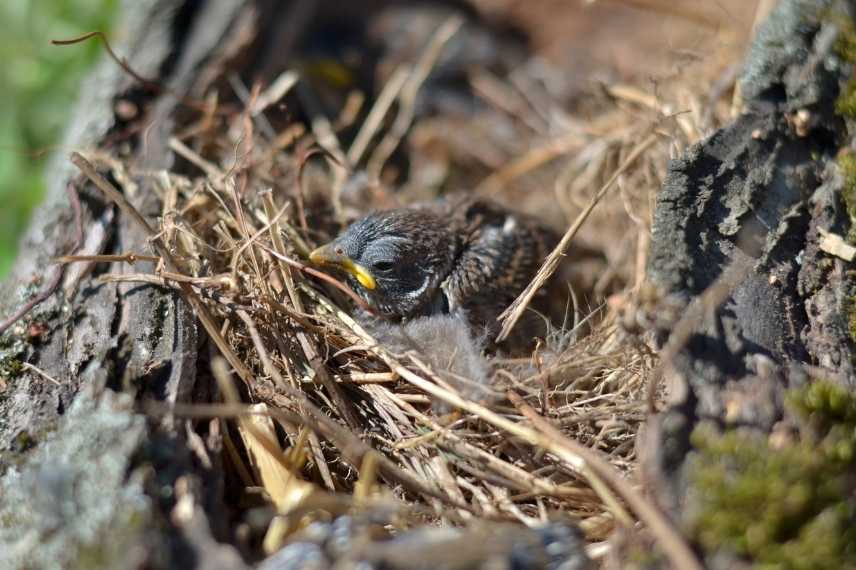
House sparrows build a simple nest in a cavity or hole
Three to four broods can occur during a single season, from March to September.
Read also
How to protect fruit trees from birds?What do house sparrows feed on?
The house sparrow has a very varied diet that could be described as omnivorous. In towns, its diet is downright anthropic, as it often feeds on crumbs and other foods discarded by humans.
In the countryside, it’s a little different. Even if they do not turn up their noses at what they find around human dwellings: chicken seeds, dog food, grain in silos… They may even visit open dumps… Nevertheless, house sparrows can also draw their food from home gardens, for they relish tender young lettuce shoots, peas, the buds and flower buds, freshly sown seeds, ripe fruits… And many gardeners are not fond of this pilfering.
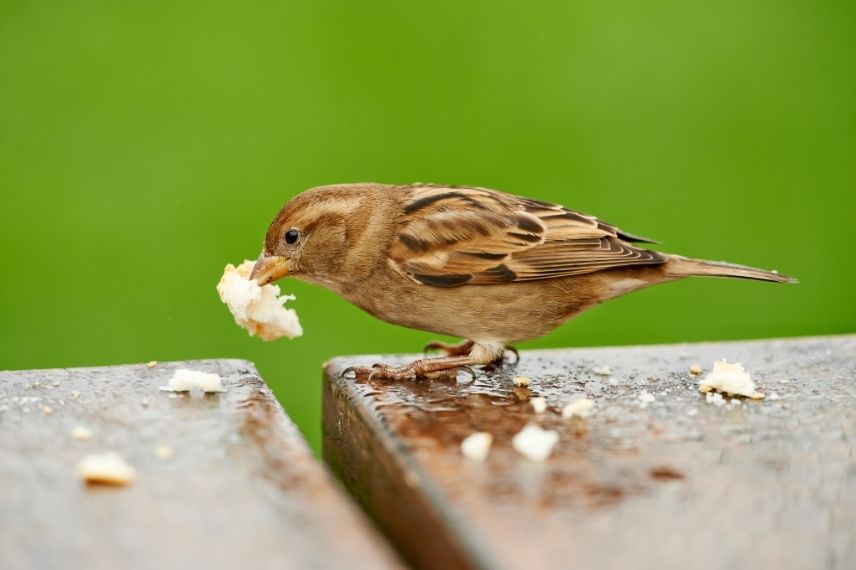
The house sparrow has an omnivorous diet
However, at the same time, house sparrows can prove to be formidable insect-eaters, especially during the breeding season, to feed the nestlings. Under their beaks may thus perish crane-fly larvae (tipules) and butterfly larvae, spiders, flower chafer larvae and beetles, grasshoppers, dipterans… Some of these prey are even caught in flight and swallowed whole. And if a house sparrow comes across a colony of aphids, it is likely to deal with them with gusto.
In winter, they frequent the feeders. But they often content themselves with scraps left by other birds, such as blue tits or European greenfinches.
All things considered, in the garden the house sparrow can be both a proud ally and an effective pest!
How can you deter them from your garden to protect your crops?
If sparrows don’t bother you except in your garden, if you can’t stand their incessant chirping any longer, if you want to protect your crops from sparrows’ voracious appetite, several solutions can be implemented. Not miracle cures against an opportunistic, cheeky and tenacious bird, they can help limit damage:
- Place occasionally, in your vegetable garden or orchard, deterrents that combine noise and movement. Old CDs, tin cans and strips of aluminium foil will be hung from stakes or attached to branches. At the slightest breeze they will move and scare away sparrows. It may be wise to install them not all year round, but only at critical moments of sowing, the emergence of shoots, and fruiting… and don’t hesitate to move them around.
- Place one or two bamboo wind chimes at various spots in the garden
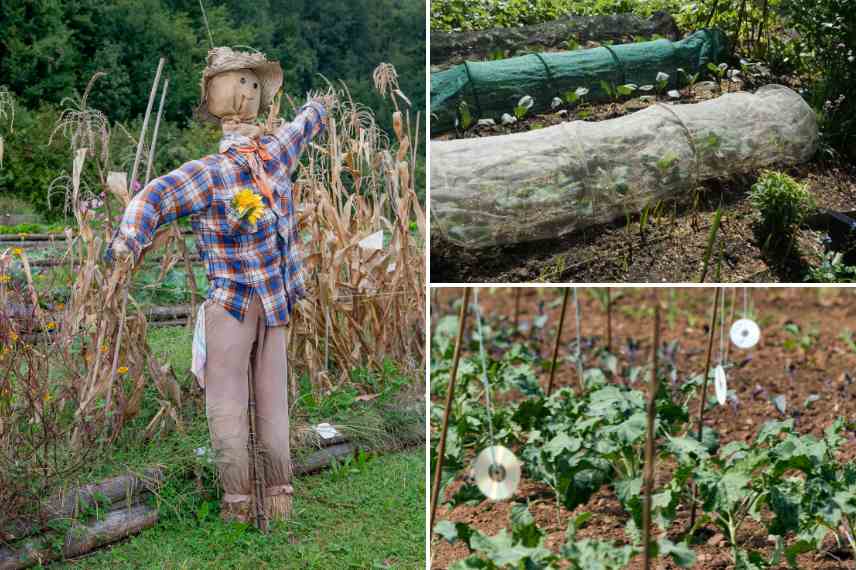
There are various ways to deter sparrows from the garden
- Install a scarecrow and move it regularly. To prevent the birds from getting used to it, dress it in movable clothes, such as a scarf or a hat with ribbons
- Place protective tunnels over your seedlings or cloches over your transplanted plants
- Protect vulnerable crops with protective nets laid over hoops and anchored to the ground with pegs. Daily checks are essential to ensure no bird is trapped in them.
- Get a commercially available deterrent, a visual, audible or ultrasonic one. Fake birds of prey can deter sparrows for a while, but they quickly cotton on to the trick.
- Subscribe!
- Contents
Comments