





























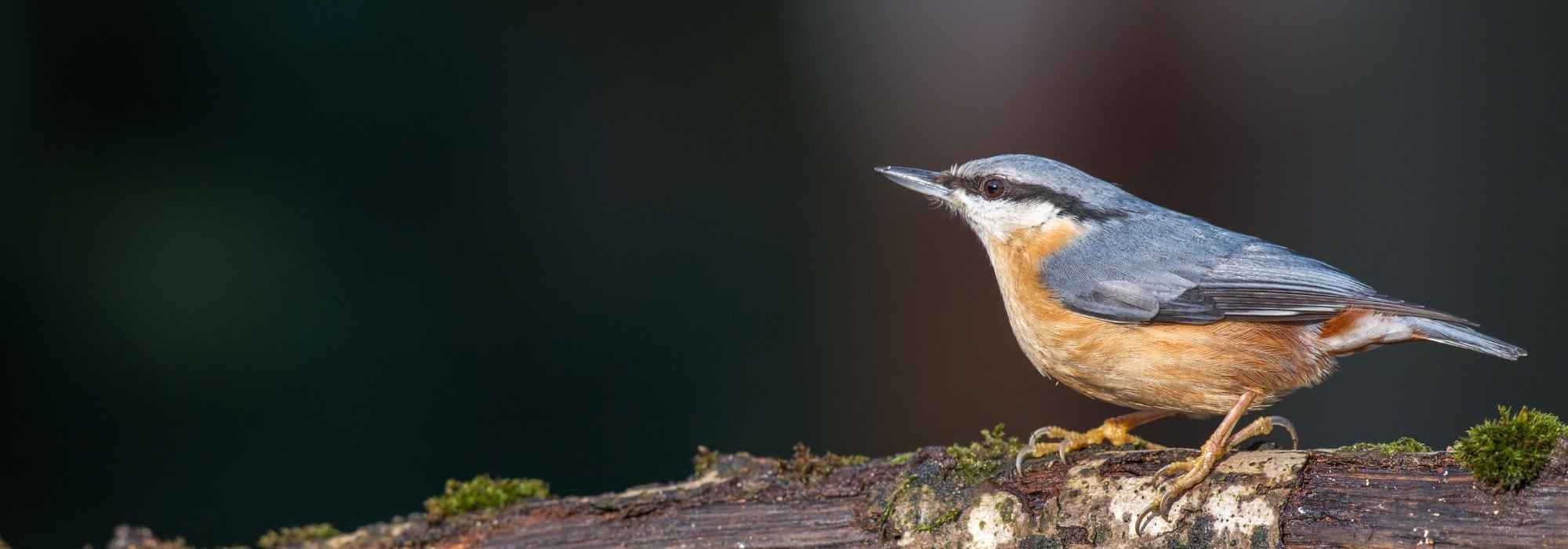
Eurasian Nuthatch: how to attract this bird to the garden?
Identification, behaviour and diet of this acrobatic passerine
Contents
Acrobatic, agile, alert… Three adjectives that admirably describe the European nuthatch (Sitta europea), a passerine that climbs up and down tree trunks and branches, head downwards. It is, moreover, one of the few European birds to move in this way. The European nuthatch is also a woodland bird, rather noisy, recognisable by its plumage and the shape of its body.
Very common in deciduous forests, wooded areas and parks, it proves very useful in the garden during the summer months. And in winter, it is not uncommon to see it frequenting feeders.
Discover everything you need to know about the European nuthatch, from its behaviour to its diet, to better welcome it in your garden.
Further reading : The alarming decline of birds: a warning for all living beings.
How to recognise the Eurasian nuthatch?
The Eurasian nuthatch (Sitta europea). Right from the outset, this small passerine, about the size of a blue tit, is bound to catch the eye! The Eurasian nuthatch belongs to the family Sittidae, which contains only nuthatches! Around thirty species of these climbing and cavity-nesting birds are found worldwide. In our latitudes, only the Eurasian nuthatch can be observed, and it owes its name to its ability to seal the entrance to its nest with mud. “Torchepot” therefore refers to its masonry skills, turning path soil into wattle and daub.
Beyond this characteristic, the Eurasian nuthatch is a small bird with an easily recognisable appearance. Its body appears compact yet slender, a feature explained by a long and broad head, a short tail and, most notably, an absent neck. As for its beak, it is long, pointed and strong.
The Eurasian nuthatch is also recognisable by its colourful plumage. The back, wings and tail are blue-grey, the underside of the body from pale fawn to orange-brown. The underside of the head is white-grey. With the black eye-stripe across its eyes, the Eurasian nuthatch also has something of a pirate’s look.
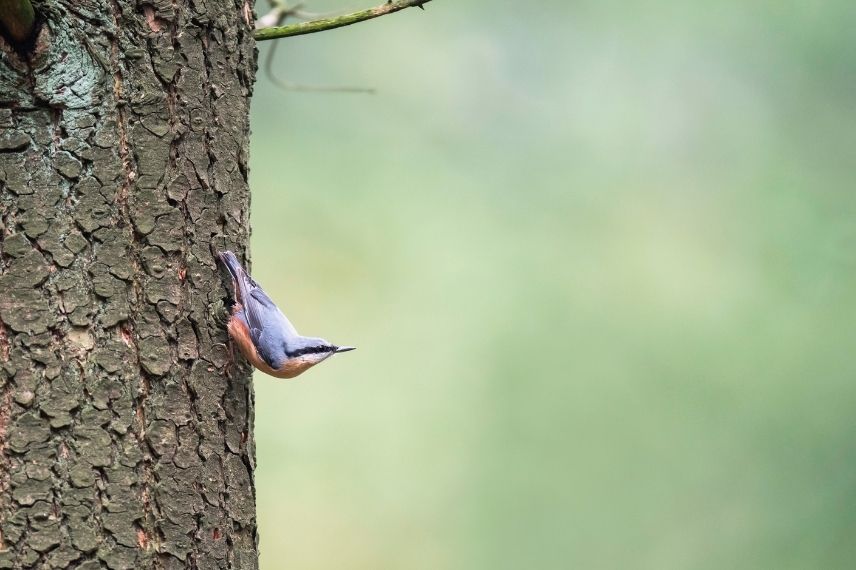
The Eurasian nuthatch is a small acrobatic bird
Our small passerine’s alerting call also signals its presence with a particularly loud and piercing song, punctuated by repeated ‘twit’ notes, rather high-pitched.
But what certainly makes the Eurasian nuthatch distinctive is its way of moving. On the ground, it hops continually. And, perched, it runs up and down tree trunks. Only the woodpecker is capable of climbing the length of trees, but the nuthatch goes further, descending head first. As you can see, it’s a true acrobat!
Read also
What do the birds in our gardens eat?Life history, reproduction and habitat of the Eurasian Nuthatch
European nuthatch is a wholly sedentary bird, staying within its immediate surroundings where it knows how to find food. It can even be very territorial, especially during the breeding season. The slightest intruder will be driven off with vigour, even aggression. Outside the breeding season, it can group together to live more gregariously, but only within family.
Where do European nuthatches live?
As a woodland species, the European nuthatch lives in wooded, open habitats, such as deciduous forests or mixed forests. It can also frequent large parks in urban settings, or old orchards or large hedges. What mainly attracts it are old trees or large, mature trees where it can find cavities to establish its nest. It is also in these old trees that it can find its food. The ideal spot for nuthatches remains the old oak woodland.
If you live near a forest or if your garden has large trees, keep an ear out. There is a good chance you’ll hear the European nuthatch singing. You could even try installing a closed nest box with a 32 mm entrance hole, usually offered for great tits.
A few words on reproduction and nesting
Besides being rather home-loving, the European nuthatch is monogamous. Male and female stay close to each other. The breeding season runs from April to May. After the courtship display, the female gets to building her nest. And that takes time! Between two and four weeks, during which she searches for the ideal cavity, fills it with wood shavings and bark, leaves, then seals the entrance with mud she collects from the ground. This precaution is essential to ensure the safety of the nestlings, as with mud, she reduces the entrance hole, preventing woodpeckers or jackdaws from taking over the nest. It is often in old woodpecker nests that she builds hers.
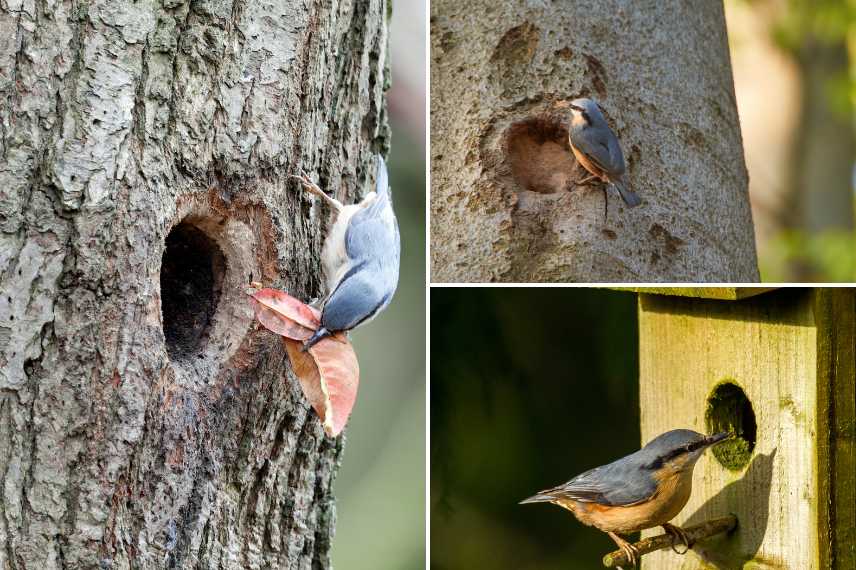
Cavernicolous, the European nuthatch nests in a tree cavity or a closed nesting box
When everything is ready, the female European nuthatch lays 5 to 9 white eggs speckled with reddish-brown which she incubates for 13 to 18 days. Then the chicks, she continues to brood them. As for the male, that is when he intervenes by feeding the youngsters, a task also undertaken by the mother. In total, the fledglings stay in the nest for around thirty days, which explains why nuthatches only raise one brood per year.
What do nuthatches feed on?
The Eurasian nuthatch is an insectivorous and granivorous bird. It all depends on the season! At the first warmth of spring, it goes in search of insects. And it is particularly swift, carefully inspecting every nook, crevice and interstice of tree bark. It even descends from its perch to feed on the ground. And all the entomofauna is on the menu: phytophagous insects, beetles and scarab beetles, spiders, ants, dipterans, lepidopterans… In other words, it could feast on tortricid moths, pine processionary caterpillars or any other insect that feeds on leaves, from spring to the end of summer. Moreover, nestlings cry out for food in the nest.
From autumn onward and through winter, the Eurasian nuthatch changes its diet to become granivorous. It therefore sets its sights on seeds of all kinds, including pine, spruce, maple, hornbeam…, acorns, hazelnuts, and walnuts. It may also content itself with a few buds or berries. Or even cocoons and chrysalises of some Lepidoptera.
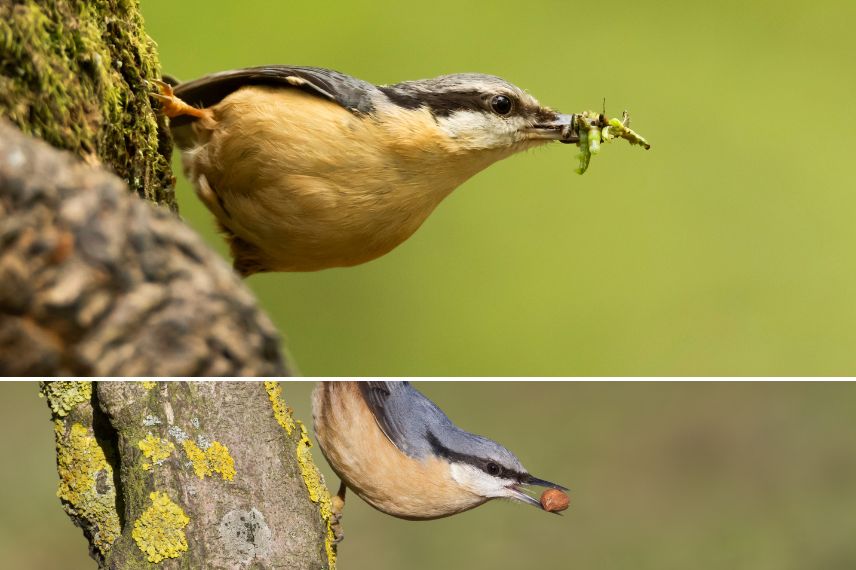
Depending on the season, the Eurasian nuthatch is insectivorous or granivorous
With its sharp beak, the Eurasian nuthatch is able to crack the toughest shells to reach the fruit. Specifically, it wedges the object of its appetite in a crevice of bark and it hammers the shell with its beak.
The Eurasian nuthatch is also a provident bird that caches food for lean periods, under bark or on the ground.
And inevitably, it will be drawn to the garden’s winter feeding stations, where it readily follows the titmice. However, it is not always very sharing. So it’s best to have multiple feeding sites.
Is it possible to grow it in the garden?
Welcoming a nuthatch to your garden is entirely possible. In winter, it often visits bird feeders. But, unlike blue-tits or European greenfinches, it doesn’t linger there. Indeed, it will take a seed and crack it open on a branch away from the feeder. To increase your chances of seeing nuthatches around your feeders, you should primarily offer them sunflower seeds, as well as hazelnuts, peanuts, and a variety of nuts they love. No need to crack them; they will crack them themselves! Just place them in a galvanised silo feeder so they can retrieve them easily.
As for the ideal garden for nuthatches, it should consist of large, mature deciduous trees with rough, fissured bark, dotted with holes and interstices. It also loves hazel trees, where it knows it can feed. It is also very attracted to old orchards where the older trees host a wealth of insects, sometimes pests.

Nuthatches readily frequent bird feeders, especially if they are filled with sunflower seeds, peanuts, and nuts
If your garden is located near a wood, there is a good chance that, during the warmer season, the nuthatch will visit it in search of some insects to peck at.
- Subscribe!
- Contents
Comments