






























Cicadas, southern insects with a distinctive summer song heard in gardens
All about this insect from the south of France
Contents
Ah, the cicadas’ song! “The cicada, having sung all summer, found herself utterly destitute when the north wind came: not a single morsel of fly or grub“… This fable has certainly lulled many of our childhoods. Yet these lines contain errors, probably due to La Fontaine’s unfamiliarity with cicadas, and, more generally, the public’s. Indeed, the cicada never feeds on insects, nor does it subsist in winter. As for its relations with the ant, they are no more idyllic than in the fable! Be that as it may, the cicada is a southern French insect, emblematic, that lights up our summers with its distinctive song, recognisable above all, a touch noisy, repetitive, even irksome to some. But who is really behind this cicadas’ song? What is its mode of life and the life cycle of the cicada, that southern insect?
Discover everything you need to know to identify and understand the cicada in order to better protect it.

Who are they?
Cicadas are insects of the order Hemiptera and the family Cicadidae. We distinguish about fifteen species in France, classified among three subfamilies: Cicadinae, Tibicinae and Cicadettinae. If the majority of cicadas are found in the south of France and Corsica, a few, rarer, can move northwards across the territory. However, they are much less conspicuous. For example, the mountain cicada (Cicadetta montana) is found in almost the entire territory.
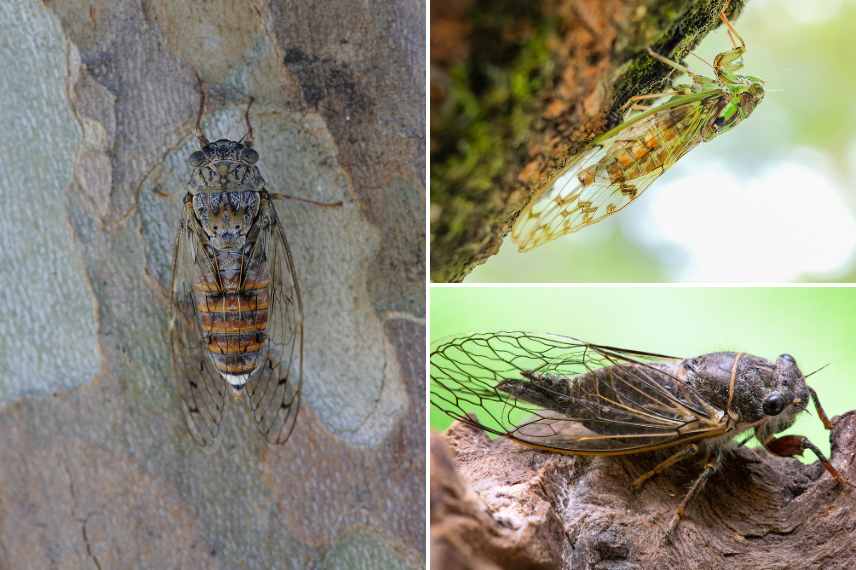
The three most common cicada species: Lyristes prebejus, Cicada orni and Cicadatra atra (in clockwise order)
In France, the most common cicadas (and the loudest!) number three:
- Lyristes prebejus (the plebeian cicada): 35 mm long; the body is black, underside ochre-beige
- Cicada orni (the grey cicada): averaging 28 mm in length; it is brown-black and green, coated with greyish pruine
- Cicadatra atra (the black cicada): smaller, it measures 19 mm. It is black on the dorsum, brownish underneath. Two black markings can be seen toward the apex of the forewings.
Read also
7 Mediterranean treesThe cicadas' life cycle
Cicadas, you hear them more than you see them! Indeed, not only are they utterly discreet due to the camouflage with the vegetation on which they establish themselves, and their ability to detect our presence at the slightest approach, but moreover their presence “on land” is quite rapid. During their life, cicadas alternately lead subterranean and above-ground lives.
When you hear cicadas ‘singing’, roughly from mid-June to mid-August, the mating period is in full swing. Once fertilised, females lay their eggs in nests dug into stems, into small branches, or in tree bark, using an ovipositor, a tool that is both a piercing instrument and an egg-laying organ. After hatc hing, the first-stage larvae fall to the ground to burrow there. Thereafter begins their underground life which can last several years. The larvae dig individual galleries and feed on sap from the roots.
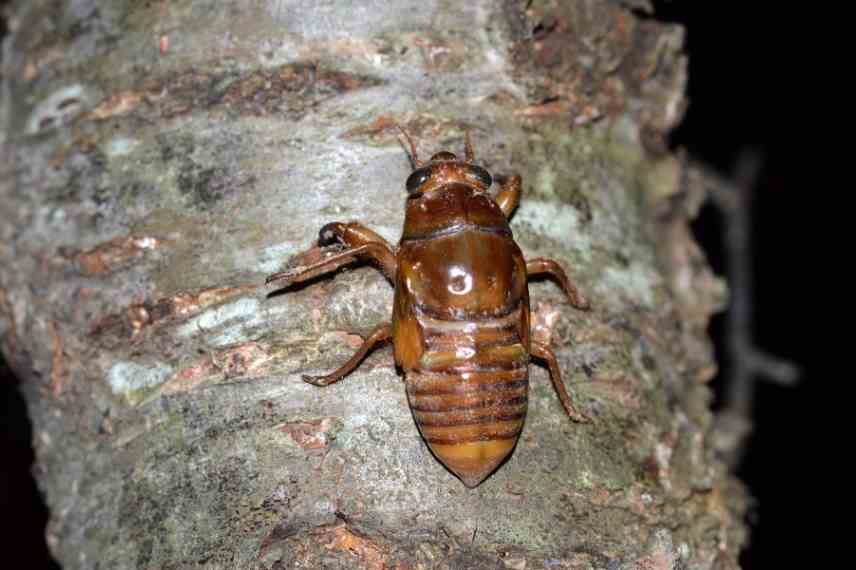
Cicada larva in imaginal molt
After five molts, the larva rises to the surface to become a cicada nymph, above ground, on a branch or a rock. This imaginal molt (the final molt of an insect before its transition to the adult state) which can last several hours outside, makes the larvae particularly vulnerable. And predators are numerous among ants, birds, grasshoppers, praying mantises, spiders…
When the molt is finished, the imago (adult cicada) goes about its business. Time is short! Three weeks to reproduce and lay eggs… before disappearing.
The mystery of the cicada's 'song'
Let’s get straight to the point! The cicada doesn’t sing; it cymbalises. Indeed, cicadas possess an organ dedicated solely to this function: the cymbal organ, consisting of curved plates of cuticle, rather rigid, which are compressed and released by an internal muscle. These movements, at a rate of around 300 to 900 per second, are the source of the cicada’s song, which sounds more like a crack than the stridulation of crickets. This “song” is furthermore amplified by the cicada’s abdomen, which pushes the viscera into the hindmost segments of its body in order to amplify it.
Next comes the question of the purpose of this cymbalisation. Note that only the males emit these sounds… It is simply a nuptial call that the females hear. Drawn by its vocalisations, the female joins the singing male. After copulation, a male can fertilise several other females.
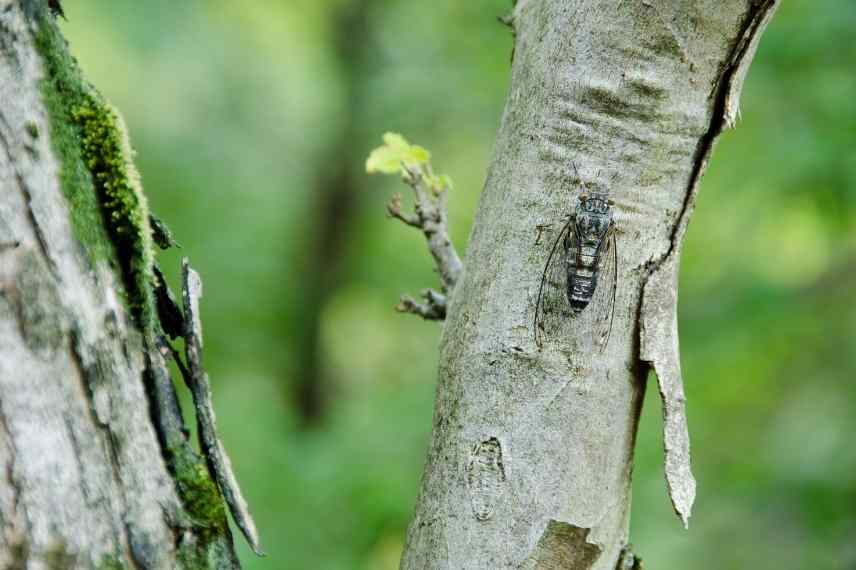
A cicada cymbalising
Note, however, that the male only sings when the temperature is sufficiently high, generally around 25°C. Depending on the weather conditions, he may sing all day. Cicada and summer heat are therefore inseparable.
What is the cicada's role in the garden?
As with all insects, cicadas have a role to play in the ecosystem. And to be clear, they are by no means pests. Indeed, cicadas are piercing-sucking insects that feed on the sap of plants, but, unlike scale insects, aphids, true bugs, and other thrips, they are not detrimental to plants. These punctures are very fine, and above all not cankered. Cicadas do not damage plants.
By contrast, their larvae can be beneficial. By digging for several years in the soil where they grow, they aerate it, loosen it, crack and fracture soil particles. They are therefore valuable subterranean helpers.
Cicadas also contribute to the balance of the garden and nature. Their song indeed attracts birds or reptiles such as lizards that feed on them, consuming other parasitic insects in the process.
Cicadas: insects in danger?
As with many other insects, cicadas are experiencing an alarming decline. Several causes seem to have been identified by entomologists. To begin with, the reduction of garrigue and maquis areas, hills and slopes, in favour of vineyards and other Mediterranean crops. For example, the cottony cicada (Tibicina tomentosa), which was very common in Provence about a hundred years ago, has all but disappeared.
Fires are also among the causes of cicadas’ decline. Given that their life cycle extends over at least two years, a fire affects not only the adults but also the nymphs, and this extends over several years.
Climate warming is not without consequences, as it destroys many eggs and nymphs. Not to mention the adults who suffer from the heat: males sing less, and reproduction is delayed.
Finally, the eggs laid in the bark of trees can travel far and end up in regions with a less forgiving climate, carried by the transport of a tree such as the olive tree from south to north, or by fruit crates. In recent days, cicada songs have even been detected in Paris, notably in the Neuilly district, where they have been heard. If these travelling cicadas are to spend their summer in Paris, they will not survive the winter. Nor do the nymphs that will emerge have much chance of surviving.
That is why, in your garden, it is always possible to do a small thing for biodiversity and save the cicadas that circle around your home:
- Keep loose soil under trees to allow any potential nymphs to burrow into the soil
- Leave wild patches under trees
- Do not dig the soil too deeply under trees to avoid destroying the nymphs
- Do not compact the soil so they can burrow in
- Plant Mediterranean species that are beneficial if you are in the south: olive trees, pine trees and other conifers, strawberry trees…
- Subscribe!
- Contents
Comments