






























Spathiphyllum: care throughout the seasons
All our tips for keeping a moonflower healthy
Contents
Spathiphyllum is a beautiful green plant, nicely named ‘peace lily’, native to the tropical forests of Central and South America, in the Araceae family. It is primarily valued as an indoor plant. Renowned for its air-purifying abilities, it is especially appreciated for its deep green foliage and its white inflorescences of rare elegance. Relatively easy to care for, it tends to droop at the slightest lapse in watering. But with no long-term consequences, as it’s a hardy plant!
However, to keep it looking splendid year after year, it’s not enough to give it a drink of water from time to time. You need to understand its biological rhythm, aligned with the seasons, to provide it with appropriate care. We guide you through its care across four seasons.

Spring, the time to wake up
Spring is a key season for most indoor plants. Your Spathiphyllum is no exception! It’s the moment when the plant comes out of its winter torpor, stimulated by the longer days and the gradual rise in temperatures.
Resuming watering and fertilisation
- After reducing watering in winter, it’s time to resume more regular watering. In spring, it’s advisable to water twice a week, allowing the top layer of the potting compost to dry between waterings. Your preference will be for soft water, at room temperature.
- After the winter dieting months, the Spathiphyllum is certainly hungry! From March, you can feed your plant with a liquid fertiliser for flowering plants. This fertiliser, balanced at N-P-K (10-10-10), is perfect for supporting both foliage growth and the appearance of flowers. Start with a diluted dose to avoid burning the newly grown roots.
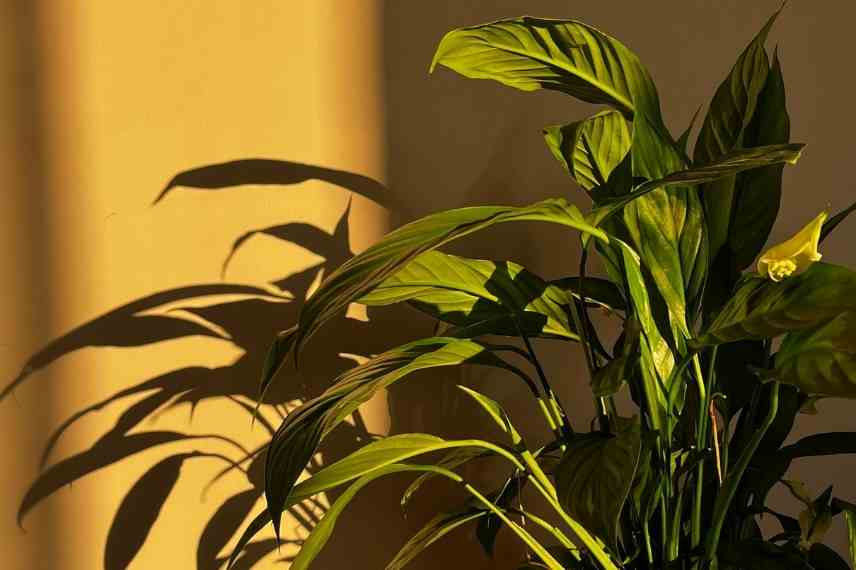 In spring, regular water and fertiliser inputs resume
Repotting
Every two to three years, in March or April, your plant will probably feel cramped for space. If you see roots escaping through the drainage holes or water passing through the pot without being absorbed, it’s a signal:
- Choose a pot slightly larger, about 2–3 cm in extra diameter. Too much space would promote water stagnation and root rot.
- Spathiphyllum prefers rich yet well-draining soils. A mix formed of 60% potting compost for houseplants, 20% turf (or coconut fibre) and 20% perlite is ideal.
Propagation by division
Spring is also the ideal time for division, which can be done during repotting. If your clump is very dense, remove the plant from the pot and gently separate the rootstocks, ensuring that each section has roots and at least three leaves. It is the simplest method to propagate your plants for free.
Summer, the season of all dangers
In summer, your peace lily is thriving, but it is also particularly vulnerable to water stress and sunburn. That’s why it needs a few simple care tips.
Finding the ideal location
Contrary to common belief, the peace lily does not like darkness. It needs bright light, but never direct sun. In summer, sun behind a window can act like a magnifying glass and burn the foliage in a few hours. If you had placed your plant near a window during the darker seasons, it’s time to move it 2 or 3 metres from a south-facing window, or behind a light sheer curtain.
Watering
If we dared to compare, one might say that the Spathiphyllum has a real knack for acting! Indeed, when it’s thirsty, its leaves droop completely, giving the impression that it’s at death’s door! But a little water and it perks up again. To avoid this bedraggled look, it’s best to water regularly, especially in summer.
- In summer, during heatwaves, watering can be up to two or three times a week.
- Water generously until it flows from the bottom, but never leave water standing in the saucer for more than 30 minutes. Standing water can suffocate the roots.
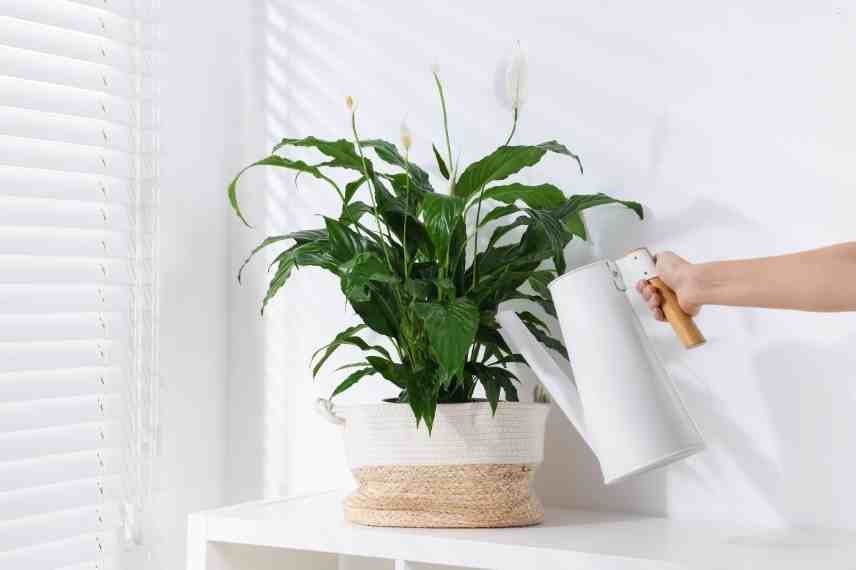
In summer, during heatwaves, watering can be up to two or three times a week
Managing humidity
The peace lily is a tropical plant that struggles with our homes’ air being too dry. To compensate, two techniques help increase humidity:
- Basin watering: place the pot on a bed of clay pellets kept in water, without the bottom of the pot touching the water.
- Misting: spray the leaves with rainwater or demineralised water. The limescale in tap water leaves unsightly white marks and eventually clogs the pores of the leaves. However, avoid wetting the flowers.
Fertilising
Fertilising continues as in spring, at a rate of twice a month.
Autumn: we slow things down!
As autumn approaches, the days shorten. The Spathiphyllum gently enters dormancy. This is a transitional period during which vigilance remains essential.
Reducing water and fertiliser inputs
As temperatures cool, photosynthesis slows. Your task is to progressively reduce the frequency of watering. Let the potting mix dry on the top two centimetres of the surface before watering again. By the end of October, stop fertiliser inputs entirely.
The battle against dust
Dust accumulates on the broad leaves of the Spathiphyllum, blocking light and promoting the establishment of parasitic pests. However, dusting is an often neglected step, year-round, and even more in autumn, a period when indoor air becomes less well-ventilated. It is essential.
- Take a soft, damp cloth
- Support each leaf from underneath with your hand
- Gently wipe the surface. This boosts the plant’s ability to purify your air by absorbing pollutants such as formaldehyde.
Pest monitoring
With the return of heating in late autumn, the air dries out, which attracts red spider mites, almost invisible to the naked eye, and the mealybugs. If you see fine webs between the stems or small cottony masses, act quickly with a mix of water, black soap and vegetable oil.
Read also
How to propagate Spathiphyllum?Winter, the resting period
Winter is the most perilous season. Paradoxically, it is often due to an excess of care or water that plants succumb.
Temperature management
Spathiphyllum dislikes cold drafts, so avoid placing it near an external door. But it hates dry heat even more, too dry. The proximity of a heat source such as a radiator or a fireplace will cause the tips of the leaves to turn brown. Try to place it in a room where the temperature ranges between 16°C and 21°C.
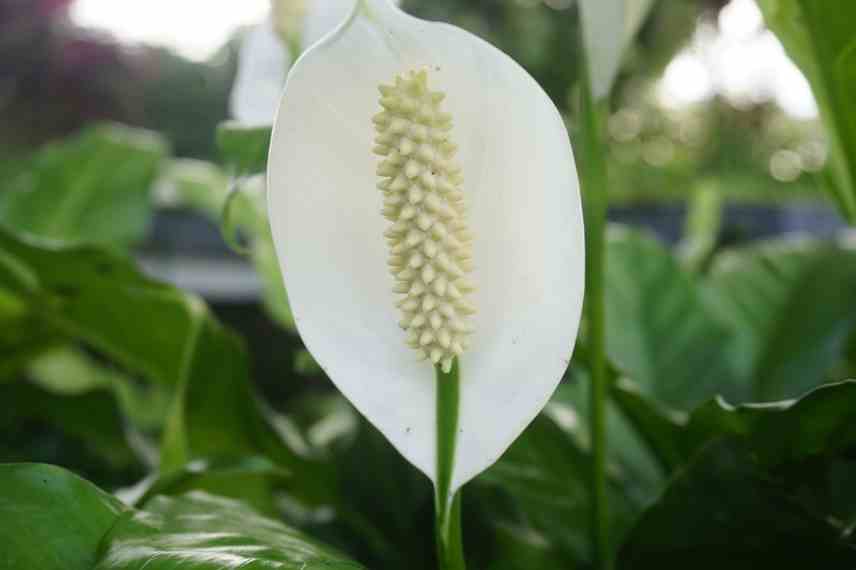
The absence of flowers indicates that your plant is likely not getting enough light or has not had its winter rest period in a cool place.
Light
In winter, the sun is low and not very strong. You can therefore move your plant closer to windows, even south-facing ones, as the risk of scorching is virtually nil. The more light it receives in winter, the more likely it is to bloom early in the following spring. If you combine light and temperature, it is possible to place your moonflower in a bedroom.
Watering
In winter, the plant hardly drinks. A watering every 10 to 15 days is usually enough. Touch the potting mix: if it is still damp to the touch, do not water. Overwatering in winter is the number one cause of collar rot.
Signs to look out for
- Leaf tips turning brown: it’s a sign of insufficient humidity in the air or water that is too hard. Increase the humidity;
- Leaves turning yellow: it’s often a sign of overwatering or a lack of nutrients. If the lower leaves yellow one by one, it’s simply the natural ageing cycle;
- Absence of flowers: your plant is probably lacking light or has not had its winter rest period in cool conditions. A little ‘stress’, with a little less water and light, at the start of spring can trigger flowering;
- Presence of green flowers: this is not a disease! The Spathiphyllum flower is actually a modified leaf, called a spathe. At the end of its life, it returns to its natural green colour to carry out photosynthesis before wilting. Cut it off at the base to save the plant’s energy.
- Subscribe!
- Contents
Comments