





























Shade tree: go with Catalpa for a cool, elegant garden
Discover, plant and care for this majestic tree with exotic charm
Contents
Summer is often associated with heat and long sunny days, which can turn your garden into a real furnace. If you dream of a natural cool spot, Catalpa is the tree you need. With its dense, lush foliage, its exotic flowers and its majestic habit, it is the perfect ally for creating shade while adding a decorative touch. Native to North America, the common Catalpa or Catalpa bignonioides has long attracted gardeners and landscape designers thanks to its rapid growth and adaptability.
→ Discover why this tree deserves a prime spot in your garden.
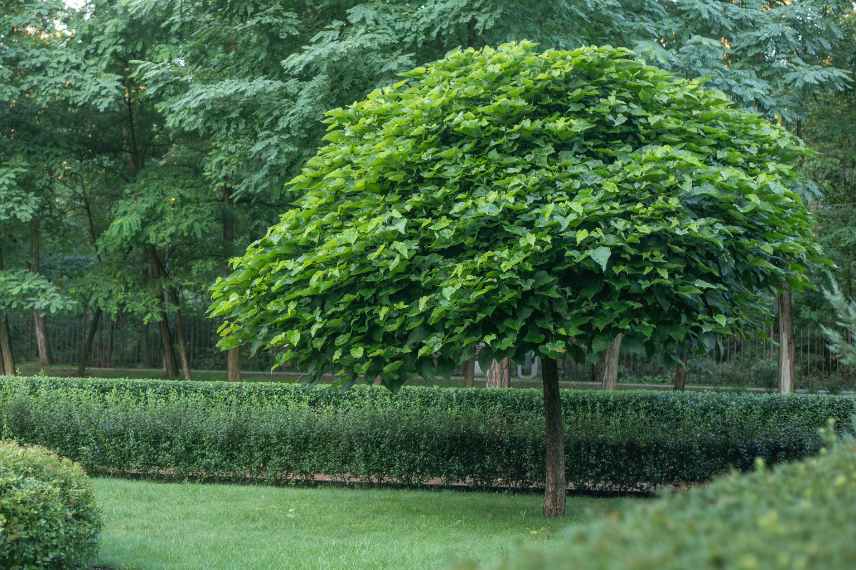
The characteristic shape of the crown on a young Catalpa

Catalpa in a nutshell
Origins and general characteristics
The Catalpa is a deciduous tree belonging to the Bignoniaceae family. The origin of the common Catalpa traces back to the forests of North America, where it grows naturally in moist and temperate areas. Introduced in Europe in the 18th century, it is today widely planted in parks and gardens.
There are three main Catalpa species:
- Catalpa bignonioides – also known as common Catalpa or Bean Tree. It is the most widespread in our regions.
- Catalpa speciosa – known as elegant Catalpa, larger and more robust, suited to large spaces.
- Catalpa ovata — known as Chinese Catalpa.
These trees can reach between 10 and 15 metres in height and spread 6 to 10 metres wide, forming a broad, rounded crown.
→ If you would like to know more about Catalpa, read our family sheet on the topic: Catalpa — planting, pruning and maintenance.
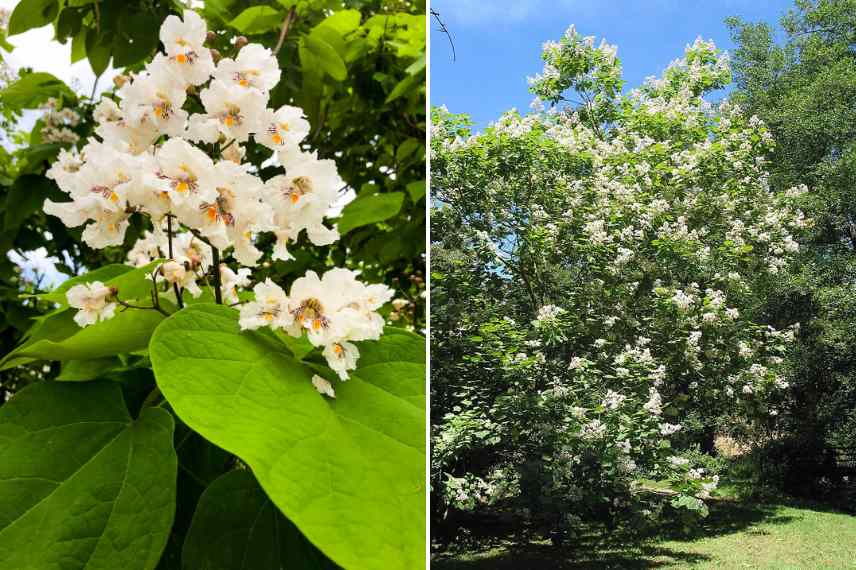
Catalpa bignonioides and speciosa ©Jean-Pol Grandmont Wikimedia Commons
Description of Catalpa
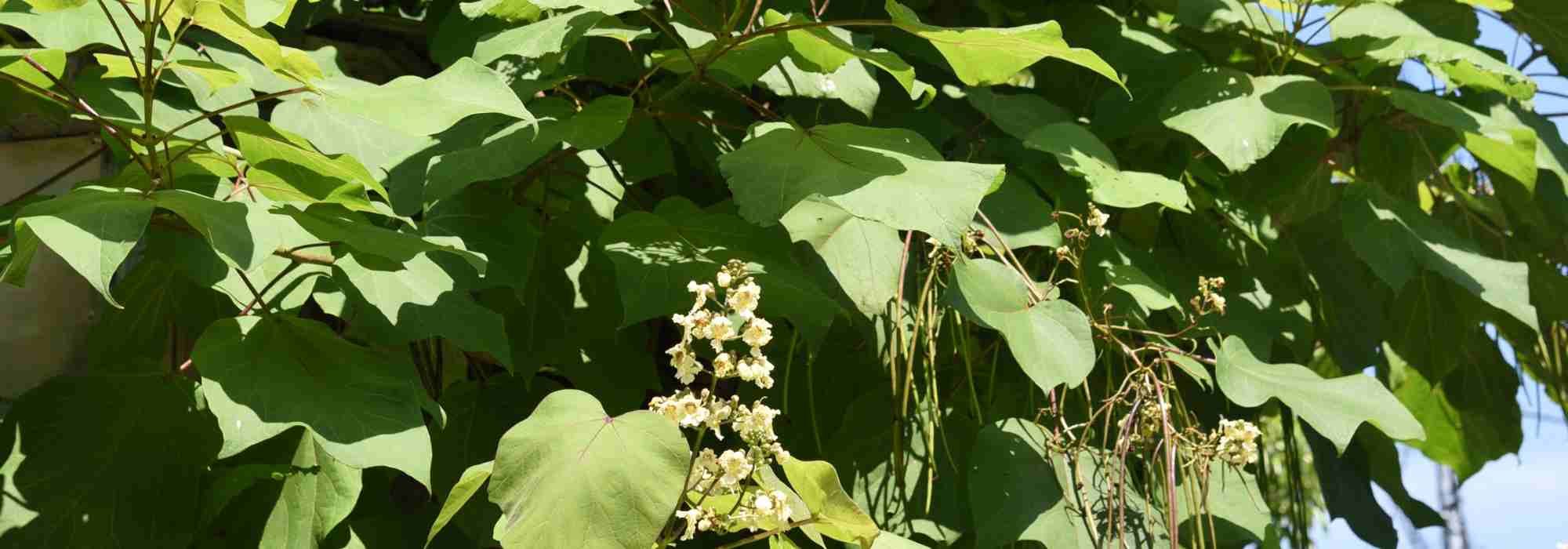
The Catalpa is distinguished by its large heart-shaped leaves, sometimes up to 30 cm long. In summer, they form a dense canopy that provides thick, refreshing shade. The Catalpa’s flowering is a sight to behold: in June and July, it bears clusters of white flowers delicately speckled with yellow and purple. These trumpet-shaped flowers recall the Catalpa’s kinship with trumpet vines.
After flowering, the tree produces long and slender pods resembling giant beans. These pods, which can reach 40 cm long, often remain on the tree until winter, adding a decorative touch even outside the growing season.
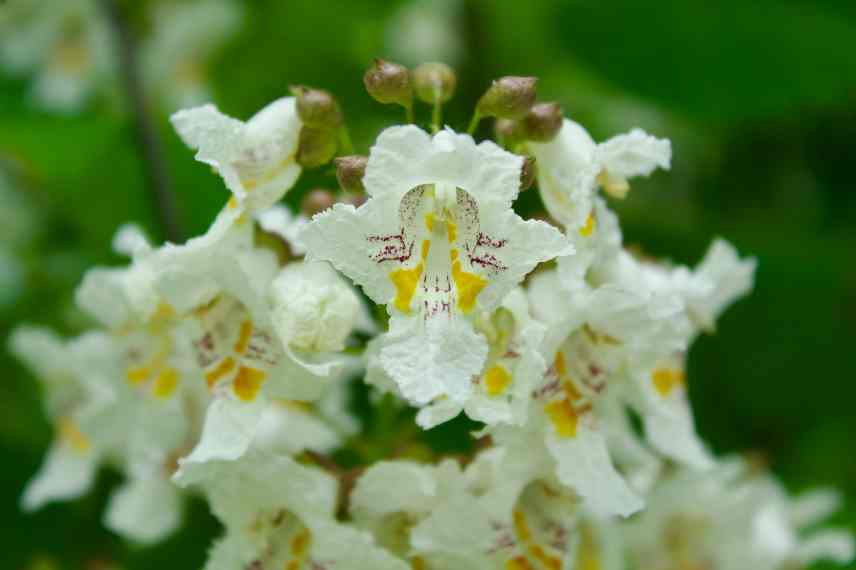
A tropical-worthy flowering!
The finest Catalpa cultivars
If the basic species is already impressive, several cultivars offer interesting aesthetic variations:
- Catalpa bignonioides ‘Aurea’ : this cultivar is distinguished by its golden-yellow foliage in spring, which becomes light green in summer. It is perfect for brightening a corner of the garden. Height: 7–8 metres.
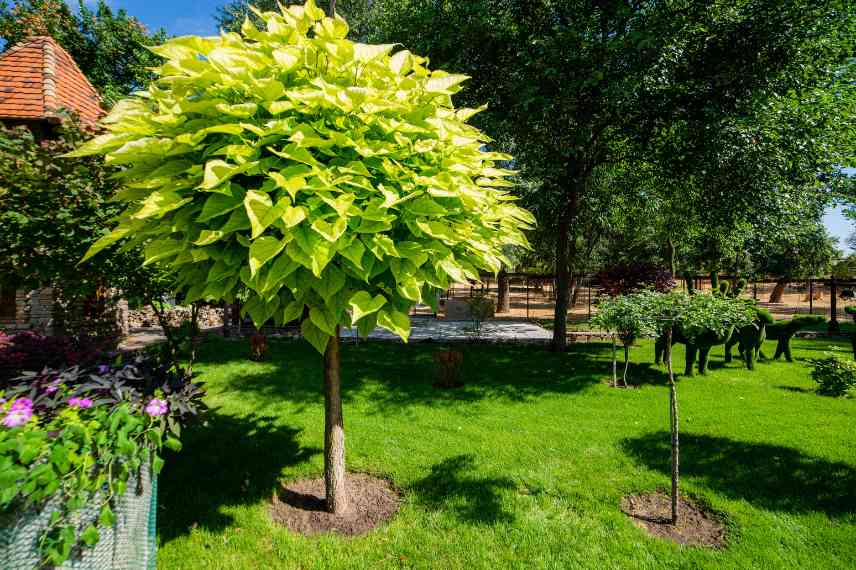
- Catalpa bignonioides ‘Nana’ : more compact, this ball-shaped Catalpa reaches only 4 to 6 metres in height. It is ideal for small gardens or for planting in urban lines. Its growth is moderate and it naturally maintains a spherical shape without requiring significant pruning.
- Catalpa speciosa ‘Pulverulenta’ : this Catalpa is an ornamental tree with original green leaves speckled with white. Height 4 m with a spread of 6 m.
- Catalpa erubescens ‘Purpurea’ : this unique cultivar features purple leaves when they first appear in spring, offering a striking contrast with the green summer foliage. It is a large tree that will reach a height of 10 m with a comparable width.
- Catalpa ovata ‘Slender Silhouette’ : this variety is easily recognised by its narrow habit, almost columnar, quite different from other cultivars that tend to spread in width with age. 6 metres tall by 2 metres wide.
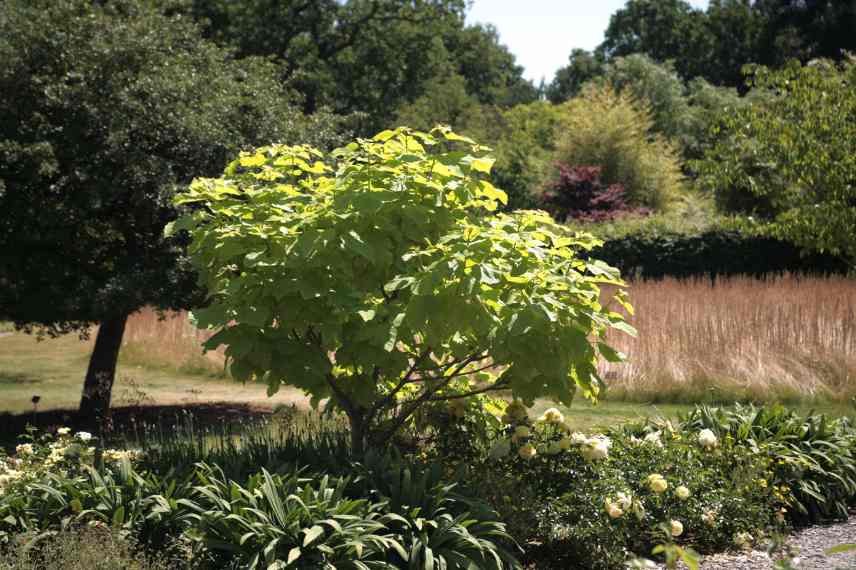 A young specimen of Catalpa bignonioides ‘Aurea’
Read also
Trees and bushes with large leavesWhy planting a Catalpa in the garden?
Aesthetic asset for the garden
Catalpa is primarily an ornamental tree that catches the eye. Its majestic growth habit and its large leaves make it a natural focal point. Planted as a specimen, it quickly becomes a centerpiece in a landscaped garden. Its exotic appearance and its pendulous pods give it a unique charm.
Ideal shade tree
With its broad, dense foliage, the Catalpa is an excellent choice for creating shade (see next point). It is perfect for creating a relaxing summer space, providing effective protection from the burning sun. In just a few years, it develops a wide crown capable of covering a substantial area.
Hardiness and easy maintenance
Catalpa is prized for its robustness. It tolerates temperatures down to -20°C and adapts to various soil types, including poor or slightly calcareous soils. It is also relatively disease resistant, which makes it an excellent choice for novice gardeners.
Catalpa’s ecological benefits
Catalpa is a valuable ally for biodiversity. Its flowers attract numerous pollinators, such as bees and butterflies. By creating a microclimate under its branches, it also promotes the growth of other plants nearby and contributes to the balance of the garden’s ecosystem.
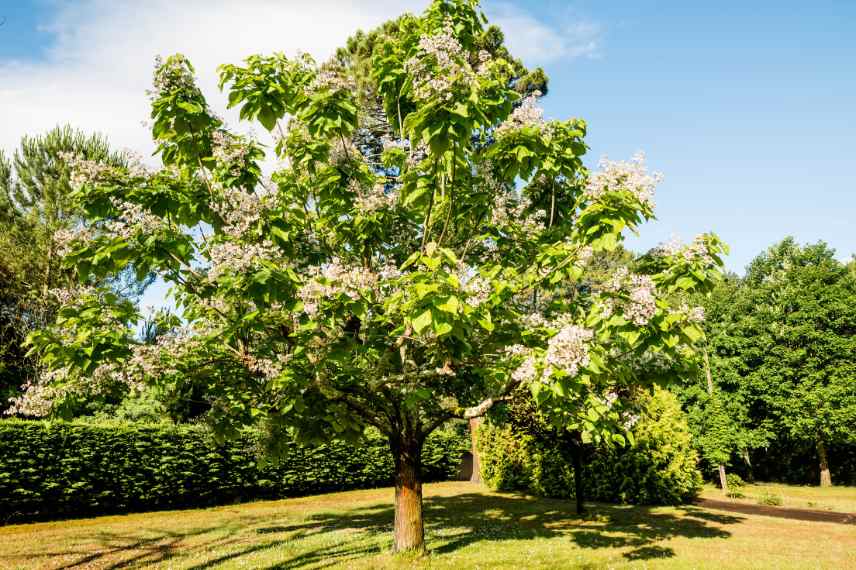
The Catalpa provides very pleasant shade in midsummer
Catalpa is a wonderful shade tree
The Catalpa is often regarded as one of the best shade trees, and there’s good reason for that. With its large heart-shaped leaves, which can reach up to 30 cm in length, it provides dense, effective plant cover against the sun’s rays. In midsummer, when the heat is at its peak, sheltering under a Catalpa allows you to enjoy a natural cooling spot, far from the sun’s fierce heat.
From its early years of growth, the Catalpa develops a broad rounded crown that extends generously. Unlike other trees that require several decades to provide substantial shade, the Catalpa quickly reaches its mature size in just 10 to 15 years (height between 10 and 15 metres, with a crown spread of 6 to 10 metres). This rapid growth makes it a particularly attractive choice for new gardens, where one wishes to create a shaded space quickly.
A true leafy umbrella
The density of its foliage creates a natural barrier against heat, making the Catalpa an excellent living parasol. It is ideal for creating a resting area in the garden. The broad leaves filter light without completely obstructing it, creating a light, dappled shade that lets a pleasant breeze through.
This type of shade is particularly appreciated for:
- Relaxation corners : perfect for creating an outdoor reading or nap area.
- Children’s play areas : providing shade over swings or sandpits offers effective protection from sunburn.
- Natural terraces : rather than installing a pergola or an artificial parasol, the Catalpa provides a durable and aesthetically pleasing solution.
An adaptation to different environments
The Catalpa adapts equally well to small as well as large gardens. In a modest-sized garden, a Catalpa bignonioides ‘Nana’ (ball form) offers compact shade without taking up too much space. For larger spaces, a Catalpa speciosa or bignonioides planted in the ground forms an ample canopy that can shade large areas, creating an almost Mediterranean effect.
In addition to providing shade, the Catalpa fosters a cooler atmosphere thanks to the transpiration of its leaves. By releasing moisture into the air, it helps to reduce the ambient temperature around it, creating a pleasant microclimate throughout the garden.
Read also
How to pair Catalpa?How to plant and care for Catalpa?
Planting period
The best time to plant a Catalpa is in autumn, when temperatures are mild and soil moisture promotes rooting. However, spring planting is also possible, provided regular watering is maintained during the first few weeks.
Planting tips
- Location: choose a sunny spot or lightly shaded area. The Catalpa needs space to develop fully.
- Soil: it prefers deep, cool and well-drained soils.
- Planting: dig a hole twice as wide as the root ball and mix the soil with compost to encourage establishment. Water thoroughly after planting.
WARNING!
It is recommended to plant a Catalpa at least 8 to 10 metres from a house or building. Although the Catalpa’s roots are not as aggressive as those of other trees, they spread widely near the surface and can, over time, lift paving slabs or damage shallow foundations. This distance also allows the tree to develop its crown fully without risk to walls or roofs.
For compact varieties such as Catalpa bignonioides ‘Nana’ (ball-shaped form), a distance of 4 to 6 metres may suffice.
Regular maintenance
Maintenance of the Catalpa is straightforward:
- Pruning: light pruning at the end of winter helps maintain a good shape and remove dead branches.
- Watering: during dry spells, water occasionally, especially young trees.
- Protection: monitor aphids in spring, though the tree is rarely seriously affected.
Landscape design ideas with Catalpa
Association with other plants
The Catalpa pairs well with flowering bushes or perennials. Around its base, you can plant hydrangeas, camellias, rhododendrons which will benefit from the light shade of its leaves. Not forgetting woodland perennials: hostas, heucheras, ferns, Japanese anemones…
Use in parks and large green spaces
In large spaces, the Catalpa is often planted in rows to line walkways. It can also be used as a solitary tree in the centre of a lawn, where its silhouette will stand out magnificently.
x
- Subscribe!
- Contents
Comments