






























Second home: what to plant in pots, tubs and planters?
Ideas for container-grown plants for a holiday home.
Contents
Plantings in pots, troughs and window boxes are increasingly problematic compared with in-ground plantings in holiday homes or second homes. Without regular watering, they suffer far more from the heat in summer. But when you have a hard outdoor area, such as a paved space, or a terrace, it’s nice to have a few container plants to brighten the surroundings of the house or for al fresco meals in the warmer season!
So, Which plants to use for planters and pots that will have to cope with your absence? Here are some water-wise plant ideas that will tolerate very infrequent watering in a holiday home.
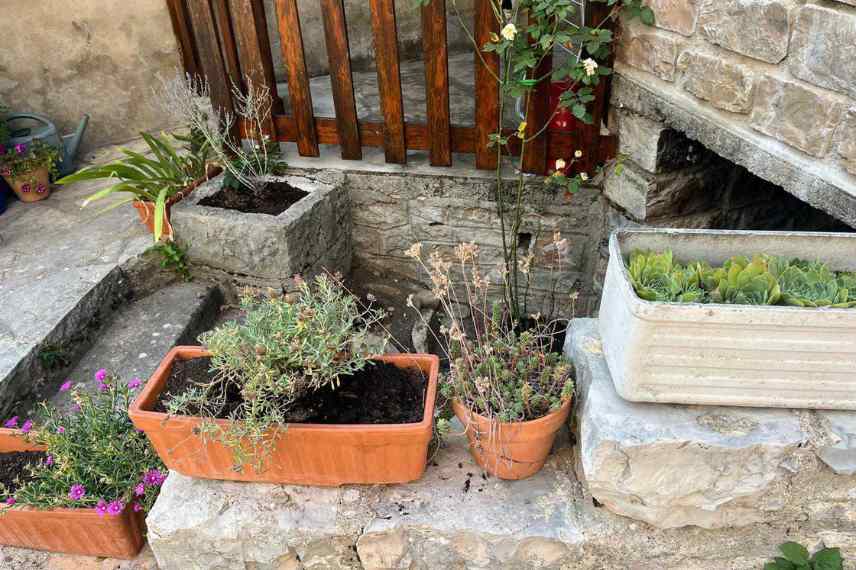
A row of planters and pots at the entrance to a holiday home, with hardy plants, often with grey-green or fleshy foliage, such as Delosperma, sempervivums and sedums (© Dorothée Bousquet)
The Challenge of Window Boxes in a Holiday Home
By choice or necessity, you may find yourself in a holiday home garden planting plants entirely in pots. This small pot garden is often stunning when the pots and planters are coordinated in colour or material. But it faces two major challenges:
– shallow containers and a limited substrate: plants have no choice but to adopt strategies to cope with a small volume of soil. The ideal, when you want to surround yourself with planters or pots, is to choose the deepest possible ones to accommodate a wider range of plants.
– Watering: unless you have an automatic irrigation system, plants only receive water from the sky… when it happens to fall, depending on the region. And with climate change, water shortage is arriving earlier and earlier in the season, sometimes at a moment when you do not yet return to your holiday home and the plants need it. Therefore, unless you have a residence in Brittany or the Cotentin (which may be the two places in France where rainfall is still reliable), if you visit your holiday region infrequently, you will favour plants that require little or no watering.
Remember that a holiday home is a place you often visit in the nicer months, or mainly in summer. So these plants should mostly have a summer appeal or a late-spring appeal, or be evergreen.
Generally avoid tropical styles, where broad-leaved plants typically require a lot of cool conditions.
Read also
Designing a second home gardenPlants suitable for low- or no-water requirements in pots.
For a second home garden or a holiday retreat, look to rockery perennials and drought-tolerant perennials, commonly used in dry gardens. They can be classified into five categories:
1. Rockery plants
Since they thrive in poor, stony soils, these plants—also suited to gravel gardens and even able to grow in rubble or on walls—will fare better in a holiday-home planter. Take great care to drain the substrate well with a layer of gravel. These plants are typically low-growing or prostrate:
♥ Our favourites: Corsican spurges, the Erigeron, like a light mist of white and pink flowers, numerous campanulas such as Campanula muralis, Iberis sempervirens, the Phlox subulata (moss phlox), the Spanish thrift, the creeping gypsophila, the Hypericum ‘Olympicum’ bursting with yellow blooms in spring, etc.
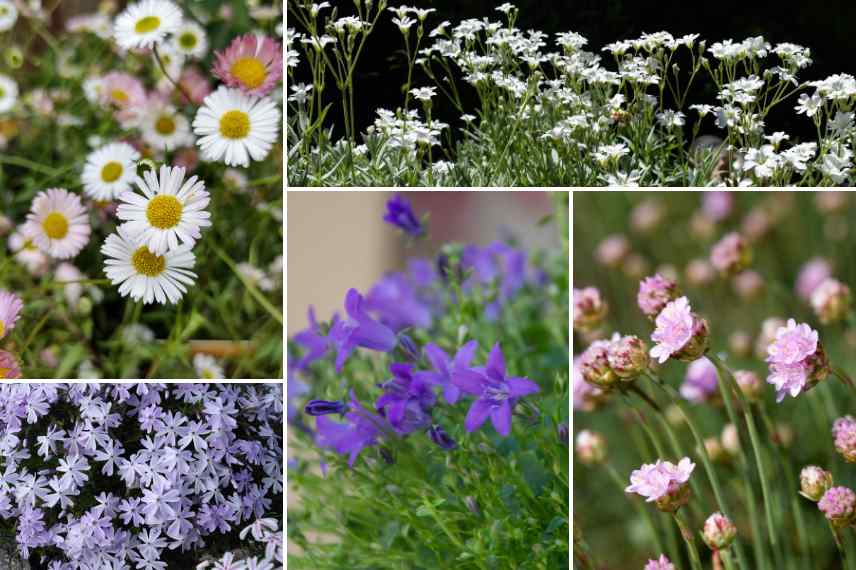
Erigeron, creeping gypsophila, Phlox subulata ‘Emerald Cushion Blue’, Campanula muralis and Armeria maritima
2. Blue-green or grey foliage plants
These are often the hardiest against sun exposure when their foliage has also adapted, becoming very fine, or even almost invisible. Many also have aromatic foliage. There are somewhat taller perennials to add volume to pots:
♥ Our favourites: numerous varieties of Artemisia, lavenders, Perovskia and Helichrysum (curry plant), Santolina, and the Cerastium (silver carpet). Lychnis will also grow well in pots (watch their self-seeding, though easier to manage in pots). Also consider the Achillea ptarmica, pure white, and the rather rare Jacobinia, with orange-red flowers, which tolerate long sunny days.
The aromatic herbs such as compact rosemary or thyme are excellent companions to this group, flowering graciously in spring with one or two flushes in the year!
We can also mention here the fescues, forming blue-tinted cushions around 30 cm tall, ideal for contemporary gardens but truly versatile in other garden styles.
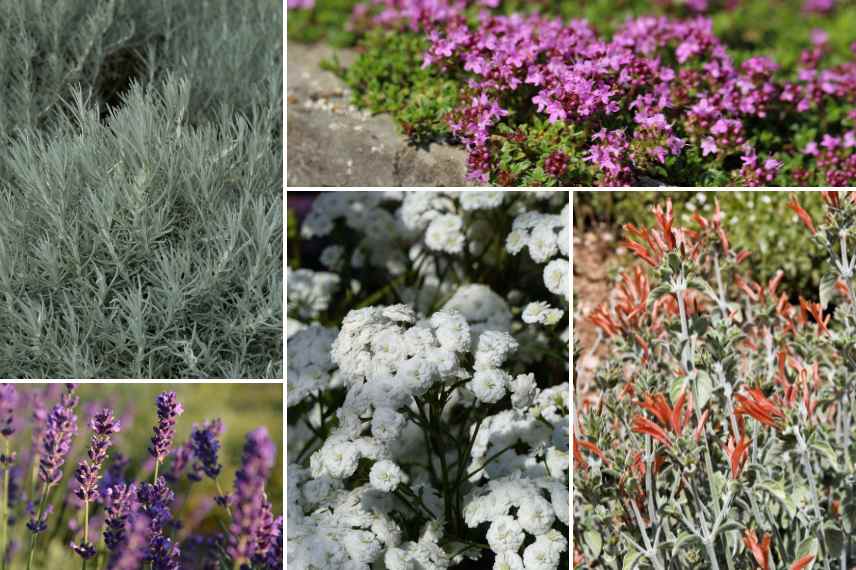
Helichrysum italicum, Thymus serpyllum, lavender, Achillea ptarmica and Jacobinia suberecta
3. Succulent plants
Chosen for their fleshy or spiny foliage, these are tough cookies that will not fail in container plantings and other stone troughs. They store water or have leaves adapted to limit evaporation.
♥ Our favourites: Aloes, Sempervivum (hens and chicks), Sedum reflexum, Sedum spectabile, Delosperma, all compact Agave in milder regions, etc.
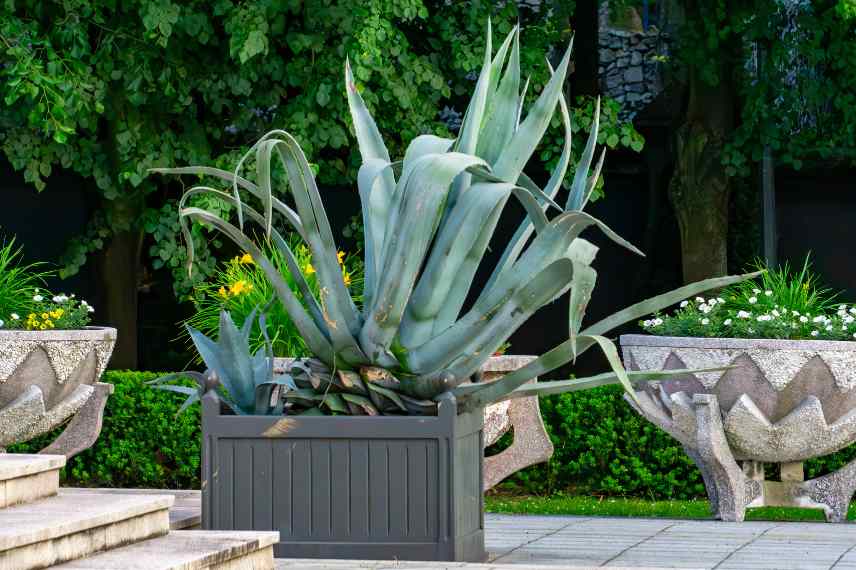
An agave
4. Xerophyte plants and drought-tolerant vegetation
All these plants, whether soft perennials or shrub-type, have great potential to withstand prolonged drought. However, like the plants mentioned just before, they require a suitable growing medium (see below).
In pots, planters or stone troughs, also pair Gazania and Osteospermum, which offer lovely, long-lasting flowers all summer.
Among the must-haves for larger pots, rely on very ornamental perennials that shrug off the lack of water: small Gaura, Verbena bonariensis (Buenos Aires Verbena) chosen compact like the cultivar ‘Lollipop’, and of course the shrubby sages and Aster alpinus.
N.B.: note that these plants can also be suitable for balconies of seaside apartments, for example, which receive virtually no water due to the balcony layout.
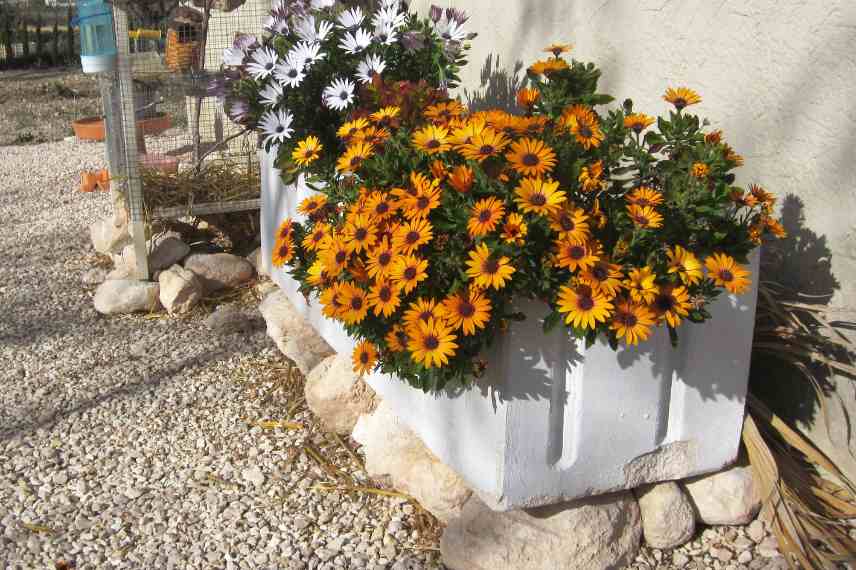
Osteospermum
5. Spring bulbs
For spring, small bulbs that go dormant for the summer are good allies for second homes, especially those from steppe or arid regions, such as crocuses, Muscari, Ipheion, and botanical tulips… Usually, spring rains are enough for these frugal little plants to delight the eye from early spring.
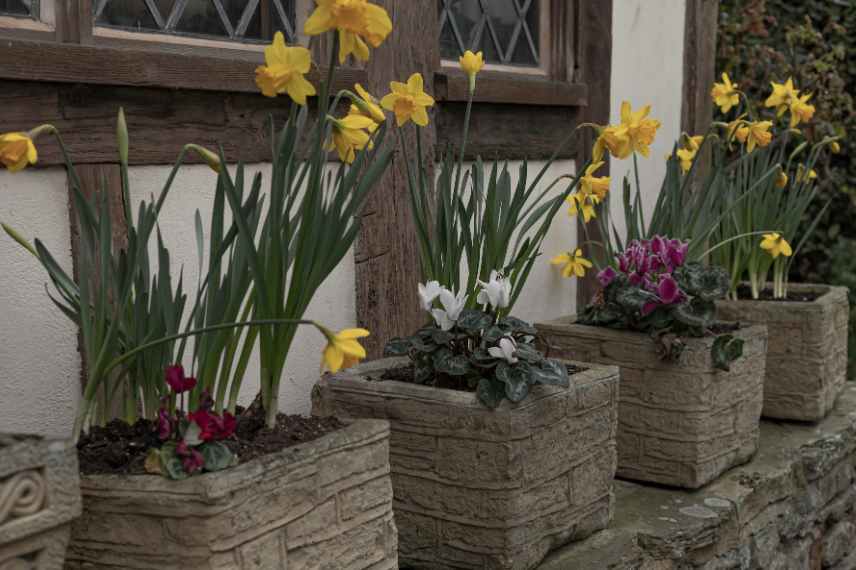
Cyclamen and daffodils
Our tips to make it work!
Nothing is more frustrating than watching plants we’ve carefully chosen and planted become completely dried out, just fit for the compost. To keep potted plantings thriving when you’re away, there’s no secret—there are several essential tips:
- Plant all the plants mentioned above in a home-made, ultra-draining soil mix, namely, with a good proportion (between a third and a half) of filtering materials such as gravel, pouzzolane, perlite or expanded clay pellets. A potting mix specially formulated for Mediterranean plants will be well suited. Without drainage (or without a drainage hole at the bottom of the pot), this type of plant has its roots sitting in water, which is not at all suitable.
- Choose a larger container: in a holiday home, when possible, opt for slightly larger pots to give them more soil volume at their disposal and thus better manage the water reserve. It also helps them to establish themselves more readily from the start. Large plants in the long term, such as agaves for example, should preferably be planted in large tubs or pots.
- Choose the right materials: favour glazed terracotta pots, which allow better humidity regulation, or stone troughs, which retain coolness well.
- Group your pots together when possible, as you would do when you go on holiday at home: this helps protect them. Avoid placing them in full afternoon sun when you are away for several weeks in summer.
- Don’t over-fertilise: anyway, these plants don’t really need it! Adding fertiliser would, on the contrary, send the wrong signal to the plants before your departure.
- On arrival at your holiday home, carry out a gradual watering: don’t drown the plants after a long absence, but rehydrate them gradually (see our article on watering plants during and after a drought).
For more on drainage, read our article: All about soil drainage in the garden.
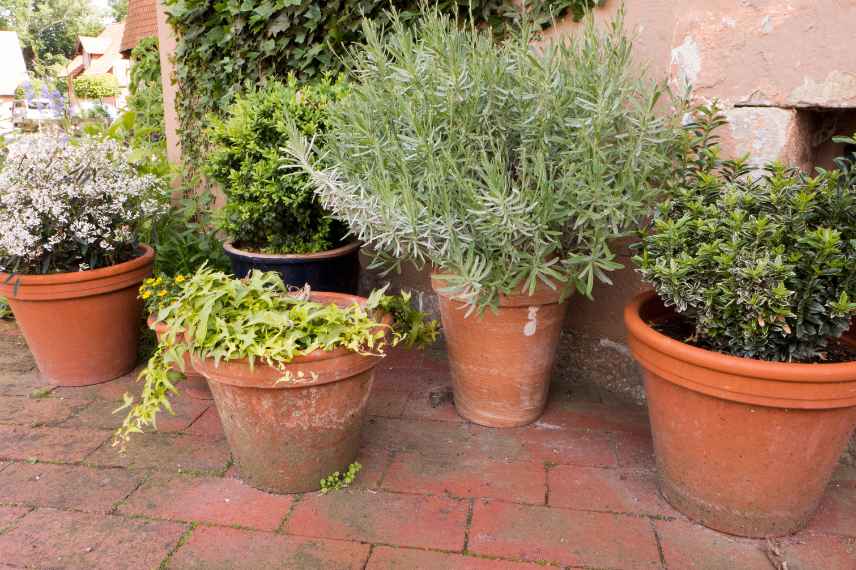
Grouping plants together and placing them in a partly shaded area protects them from heat
- Subscribe!
- Contents
Comments