





























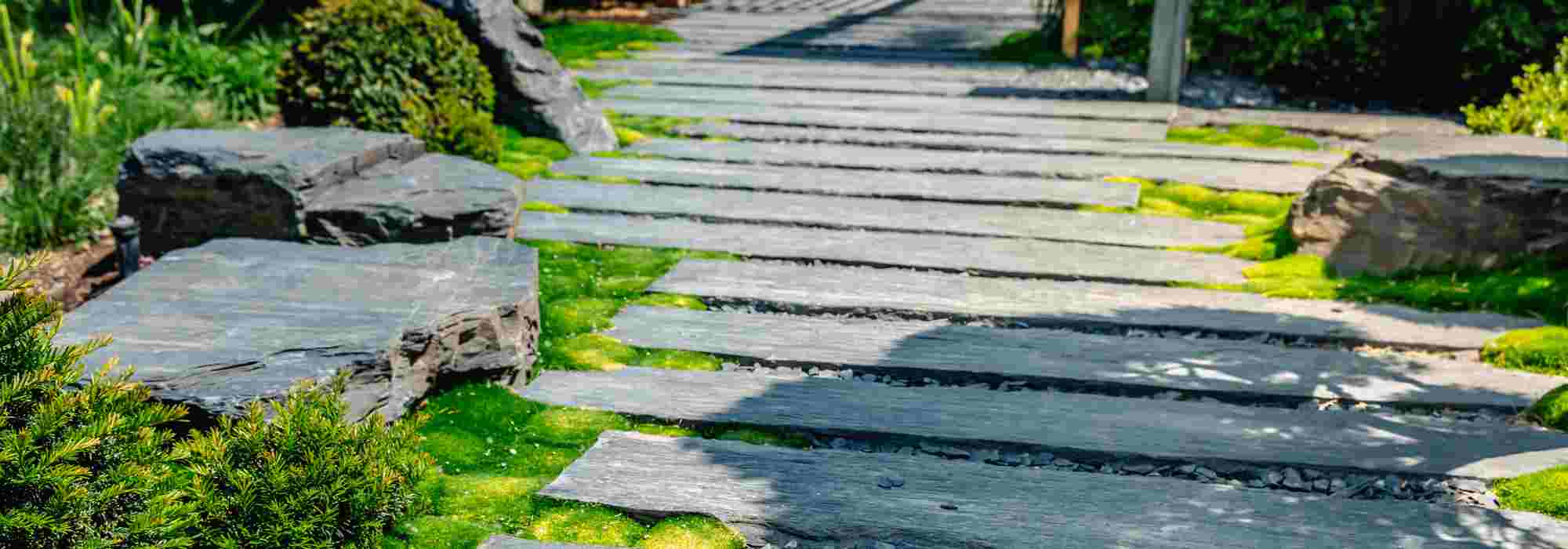
Shale and slate in garden design: ideas and inspirations
Shale and slate, natural stones that enhance our gardens
Contents
Among the materials prized by landscape designers for their rugged, distinctive look are slate and schist (or shale). Their dark colour with a bluish sheen works wonders in certain garden schemes and in the regions from which these sedimentary rocks are quarried. They prove just as at home in contemporary gardens as in Japanese gardens.
Discover the enormous potential of these distinctive minerals, sometimes poorly used in our outdoor spaces, and how they manage to elevate hardscape spaces while also blending subtly into planting beds.
Schist or shale, a regional material
Shale is a well-known material in French western gardens, including my beloved Anjou region where the production of Trélazé slate has long given Maine-et-Loire its reputation. But schist deposits are found in other production basins, such as the Armorican Massif, the Central Massif, or the Pyrenees. With the deposits no longer active in France except in a few local small-scale productions, almost all schist sold by landscapers is now of Spanish or Portuguese origin.
Slate, which is sometimes mistaken for schist, is a form of schist, more usually used as a roofing material.
These two materials are differentiated by other characteristics:
– Schist is a sedimentary rock that has a more foliated structure, often containing iron ore which gives it a rusty appearance, sometimes taking reddish hues: this is then called oxidised schist. It is a rock that splits into sheets. It is more fragile than slate and flakes more easily, but its raw appearance and its warm colours make it a highly sought-after material for landscaping.
– Slate is a metamorphic rock derived from schist, but it is more homogeneous, finer and more resistant. It splits into smooth and regular slabs, which makes it ideal for roofing. Its colour ranges from bluish-grey to deep black, with occasional green or violet reflections. Unlike schist, it is less porous and more water-resistant, which explains its use in roofing.
I will address in this article the two materials, with however a greater emphasis on shale.
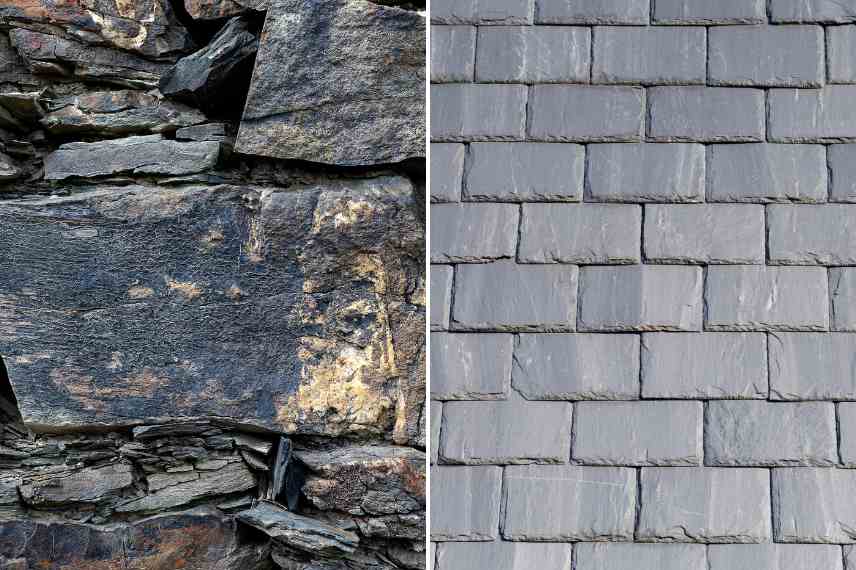
Schist and slate: two materials, one and the same universe
Advantages and disadvantages of shale
The main advantages of shale are worth noting, but it has a few small drawbacks to be aware of if you’re planning to embark on a garden project:
Advantages
- It possesses genuine elegance with unique iridescent reflections
- The shale and its rusty appearance, with the presence of iron ore, present grey or blue-grey colours; slate ranges in shades from blue-grey to green or purple, sometimes almost black; rain darkens the hue further
- Non-rotting: unlike timber constructions and structures, it lasts well over time
- Durability is a major asset: it is a solid rock
- Its rough, natural appearance, interesting in its natural state, but it can be worked and its texture can change to a polished or honed finish
- Frost-resistant: shale and slate do not crack over time if well maintained
- Matte finish, particularly on shale, less glossy than slate
- Eco-friendly when extracted locally
Disadvantages
- Cost: shale is among the most expensive materials in landscaping, so plan according to the scale of the project (simple structure or large paving area, for example). Expect between €50 and €150 per m² for shale paving, depending on thickness and origin (imported calibrated slabs will be between €50 and €80 per m² at the entry level)
- Dark colour makes it unsuitable for south-facing terraces, which can heat up in strong sun (avoid for south-facing terraces)
- Weight: the largest pieces of shale are very heavy, and you will need help for installation
- Frost resistance: shale is generally frost-resistant if of good quality and well laid. However, its porosity can pose problems in the event of intense, repeated frost, especially if poorly maintained or poorly drained. It is therefore advisable to choose dense, low-porosity shales for cold regions, and ensure good drainage to prevent water from accumulating in cracks.
- It must be impregnated (by saturating with water) before installation to prevent it from crumbling or drawing water from the soil in certain applications where it is in direct contact with earth or water; a water-repellent treatment can be applied to enhance its durability.
- Slate is slippery as a surface when polished
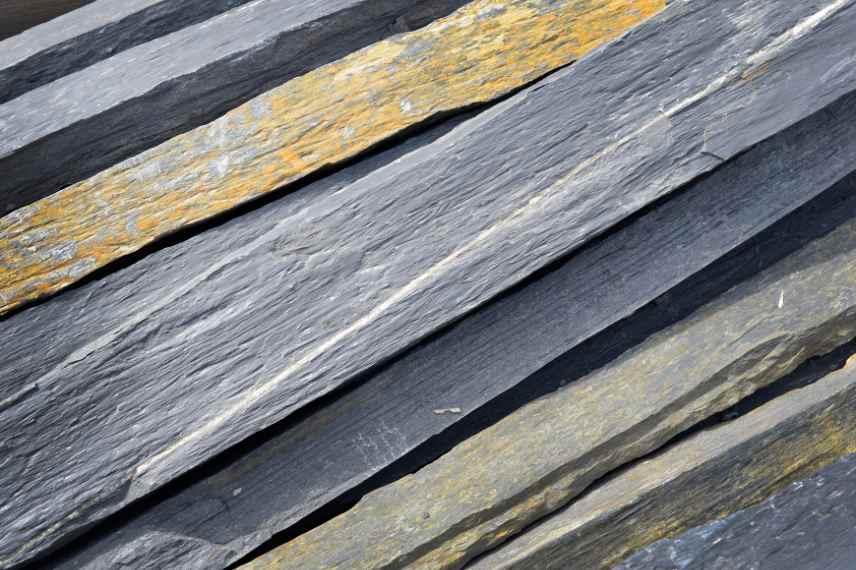
Shale with its grey-to-rust colours makes it a unique material in the landscape
What type of garden is it for?
Slate is widely used in Brittany and the western part of France, and can readily feature in other environments.
A basic rule, as in landscaping, is to stay as close as possible to and faithful to the region’s codes and the built environment to ensure visual harmony and a smooth transition between the home and the garden. Homes with slate roofs are therefore particularly well-suited to this, while brick or stone are more appropriate for houses with tile roofs.
Here are the garden styles most receptive to slate:
- in a contemporary garden: the dark aspect, the anthracite undertone and the cool colour of slate pair very well with the minimalist atmosphere of a modern garden with straight lines. Regular cuts in large slabs and polished slate are to be preferred to heighten the minimalist atmosphere.
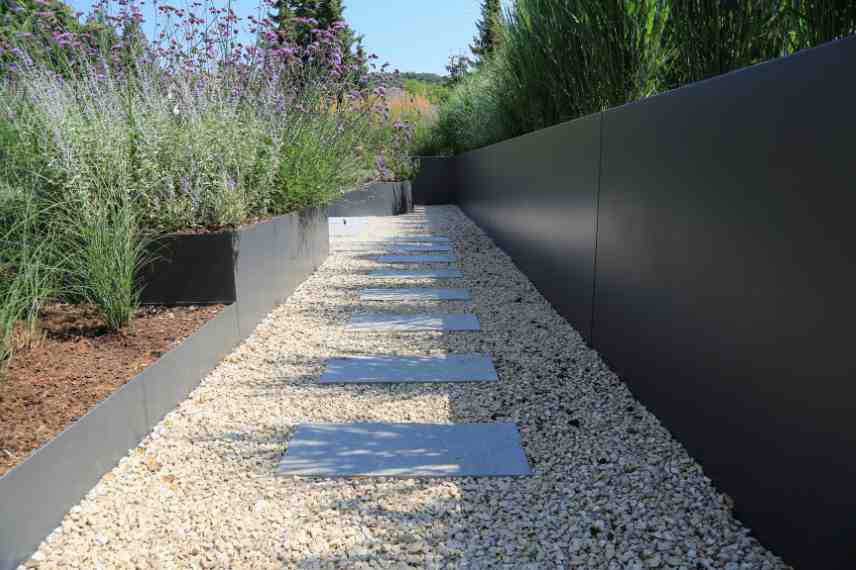
Rectilinear slate slabs rhythmically line this path in a modernist-inspired garden
- in a Japanese garden : though traditionally linked to stone, slate can easily be integrated into a design inspired by Japanese aesthetics. The mineral being one of the essential components of the garden, it blends in remarkably and nicely highlights the conifers. Crushed slate can, for example, replace the dark pebbles often used in certain scenes.
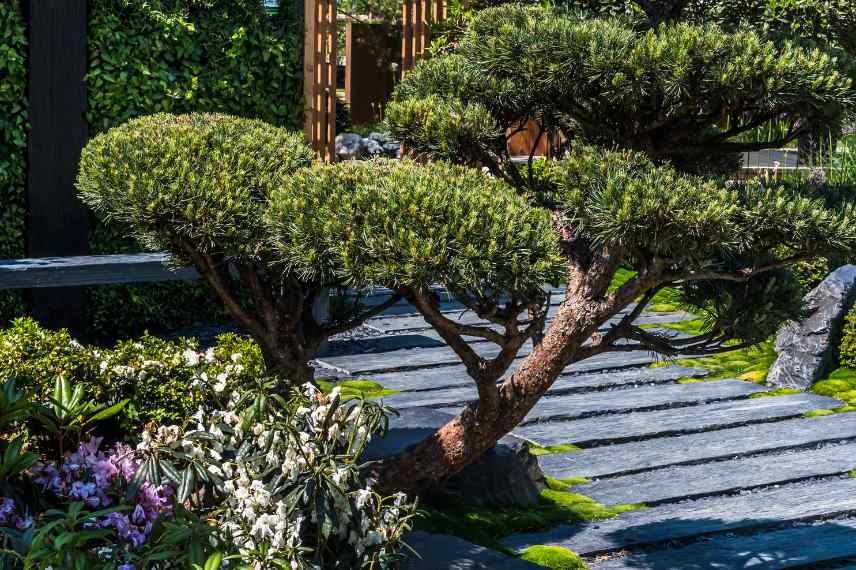
The mineral touch of the Japanese garden can be designed with the bluish slate
- in a classic garden: Loire Valley gardens, with houses built in tuffeau, are often enhanced with slate in their pavings or paths. A combination that always works for these two local materials.
- in a scree garden : slate and slate are good companions, bringing more mineral to differentiating flat areas, such as with Japanese stepping stones or rough slabs, positioned along a path. This type of composition can also be considered on certain rocky parts of a mountain garden.
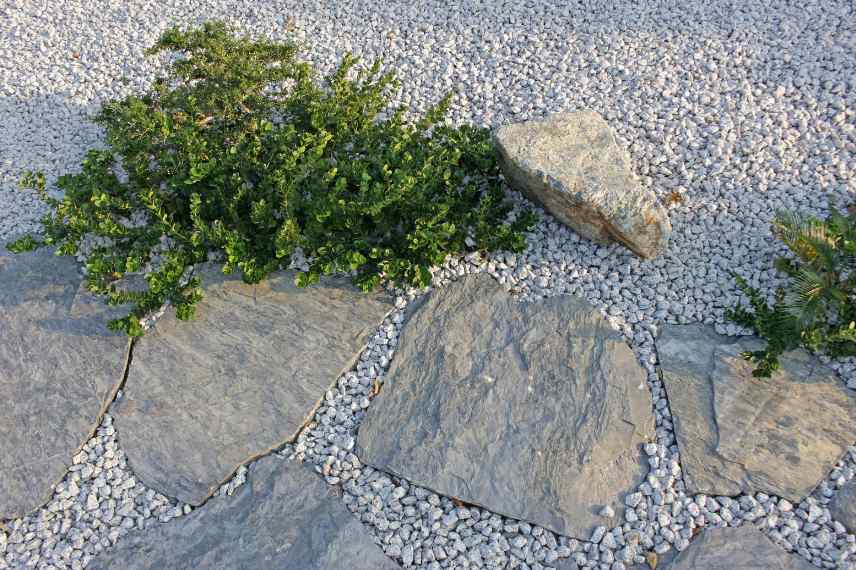
Slate slabs accompany the lighter gravel
- in a monochrome garden : particularly in a white garden or a blue garden. Slate underlines the blue of the flowering or foliage, and highlights all the whites of the white garden.
- in a exotic garden : the broad expanses of dark stone evoke imagery of distant islands, such as Bali, Hawaii or Polynesia. If one wishes to infuse an exotic air into a garden composed of tropical species or in a jungle garden, handsome slate pieces are ideal, scattered here and there among luxuriant plants, or used to complement blocks of rough stone.
- in a mediterranean garden : with its warm tones, slate integrates perfectly with dry and mineral gardens, in harmony with lavender, rosemary and olive trees.
- Finally, slate is interesting in a large garden, it allows you to compose one or two different atmospheres in one of the garden’s sub-sections.
Uses of shale and slate in landscaping
They have numerous uses as landscape decoration, just like stone or wood in the garden.
For those seeking an exceptional material, schist and slate are certainly among the most aesthetically pleasing options. But they must be used judiciously, avoiding a total mineral look, often offered as a white-and-grey two-tone, and adopted by some landscape designers in France. They should, on the contrary, be integrated in a restrained way to enhance them, always respecting the garden’s style.
Raw, schist is a material prized for very modern and contemporary landscaping, but it also lends itself well to a rural context, even montane. Finally, schist is used either vertically or horizontally, when slate is laid flat.
These materials are therefore not reserved only for Brittany and the western part of France, nor as mere cladding, as we will see in these various examples:
To structure areas of the garden
Pickets 1 to 2 m high, schist slats, stones, privacy screens in a mineral-style lattice… schist integrates subtly into outdoor spaces to create sub-spaces. This use is one of the most common, but should be considered subtly and sparingly to avoid visuals that are too rigid or not sufficiently linked to the vegetation.
As a boundary
Large slabs of schist are also sometimes used as boundary markers. As in this example they can be integrated in addition to an existing palisade, along a long linear run to create a rhythm break, or use schist pickets for a more open separation.
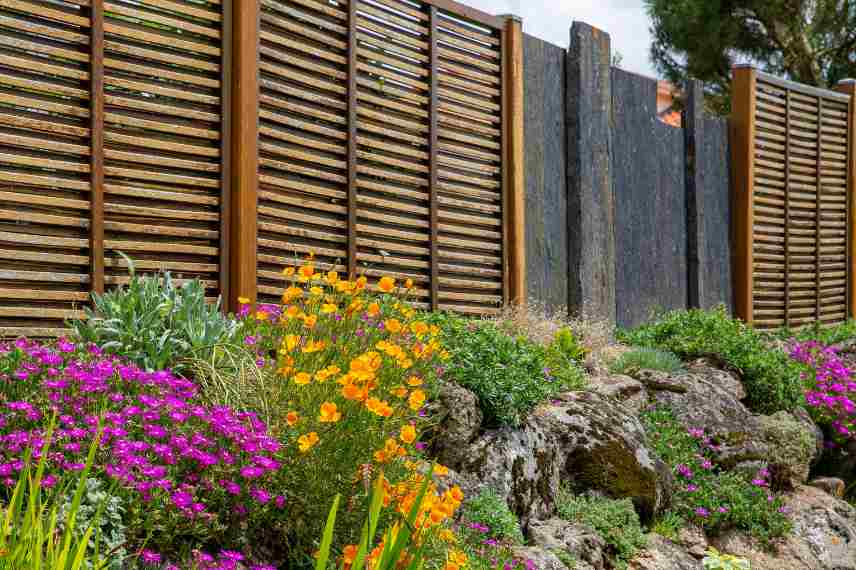
A wood-and-slate slab duo to fence a house
As edging
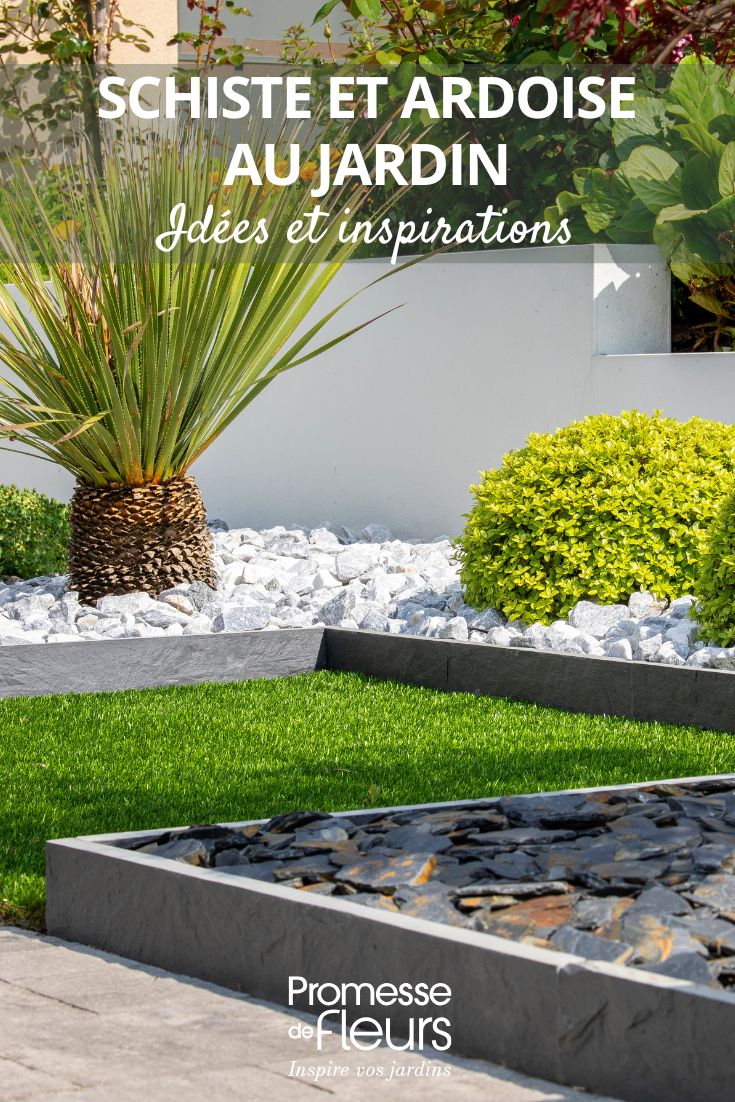
We use palings or schist slats, or split slabs to form edging boards of varying heights, depending on the bed’s footprint or as a boundary between lawn and gravel.
For the construction of low walls
If certain regions are familiar with building schist low walls, as in Anjou, one can reproduce this handsome heritage example in other gardens, provided the layout style suits.
For landscape masonry
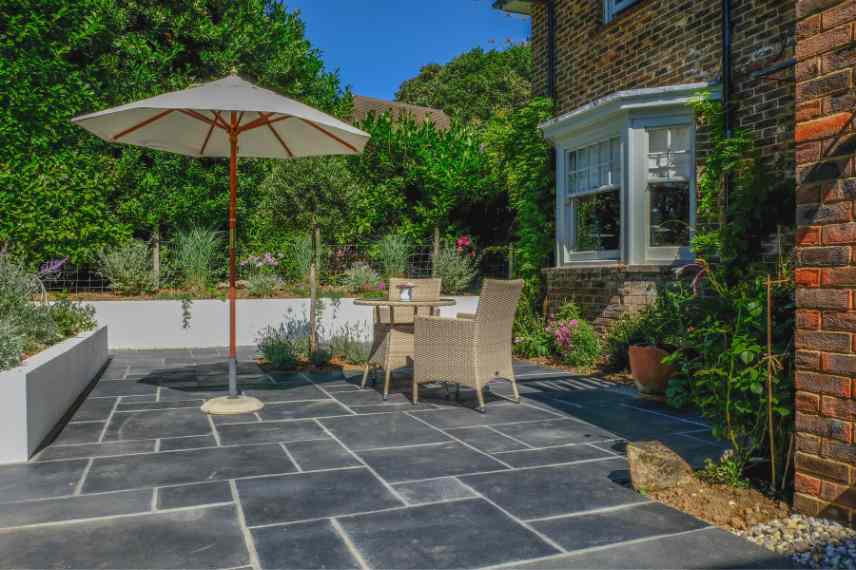
Paving for terraces, but also for the creation of steps, or around ponds, slate and schist allow the production of surfaces or zones that are highly decorative.
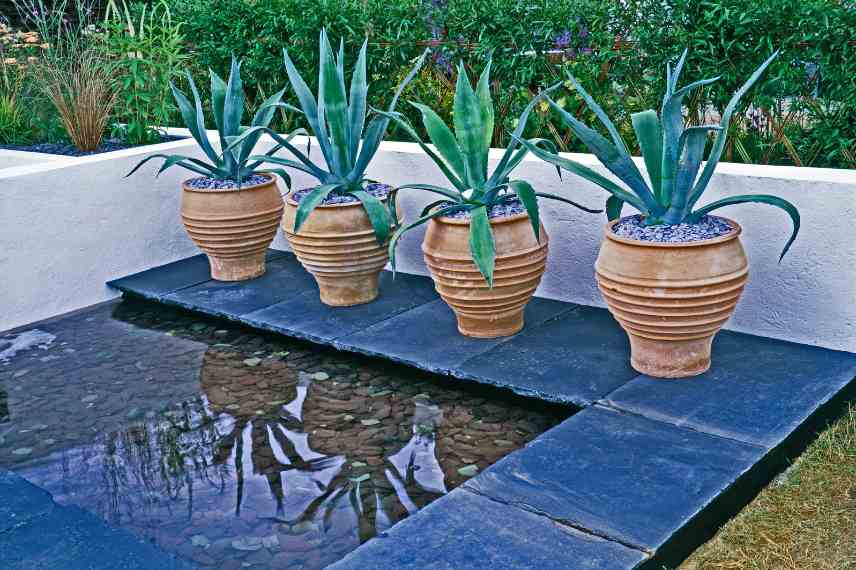
They are often used to border ponds or create cascades, thanks to their water resistance and natural aesthetics, as in this example:
To form pathways
Slabs or stepping stones or schist slats positioned in pairs with timber landscape sleepers or railway sleepers are effective for marking walkways in a garden. You can also combine schist with a light local stone.
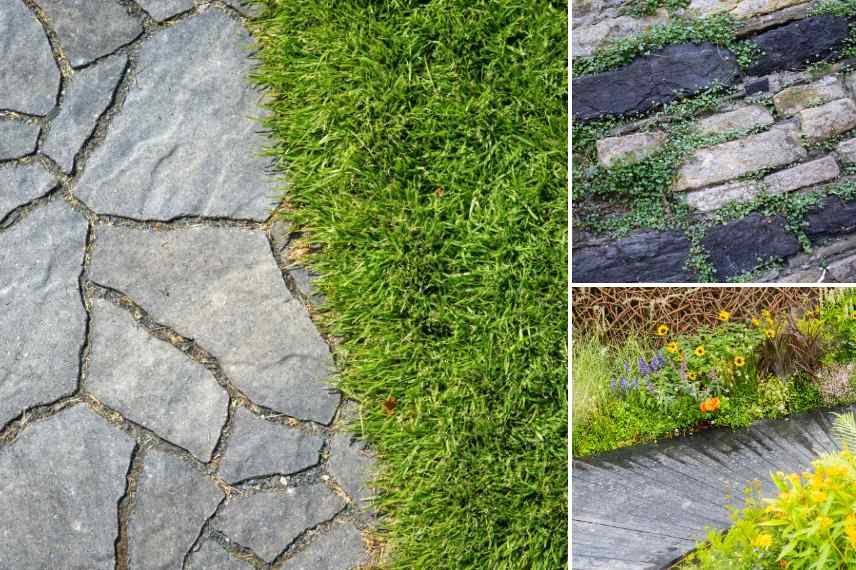
Left: opus incertum paving; top right, paired with granite; bottom right, in a full path
For earth-retaining structures
Using schist as a retaining material is another idea to consider, as here in a vineyard, but it can be reproduced for embankment retaining walls, for example.
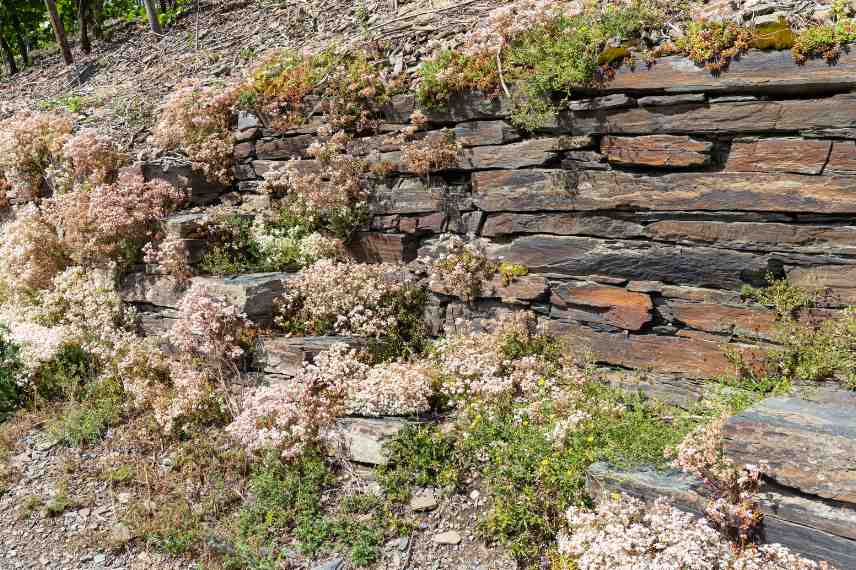
Schist is a good mineral choice for creating retaining structures
As a mineral mulch
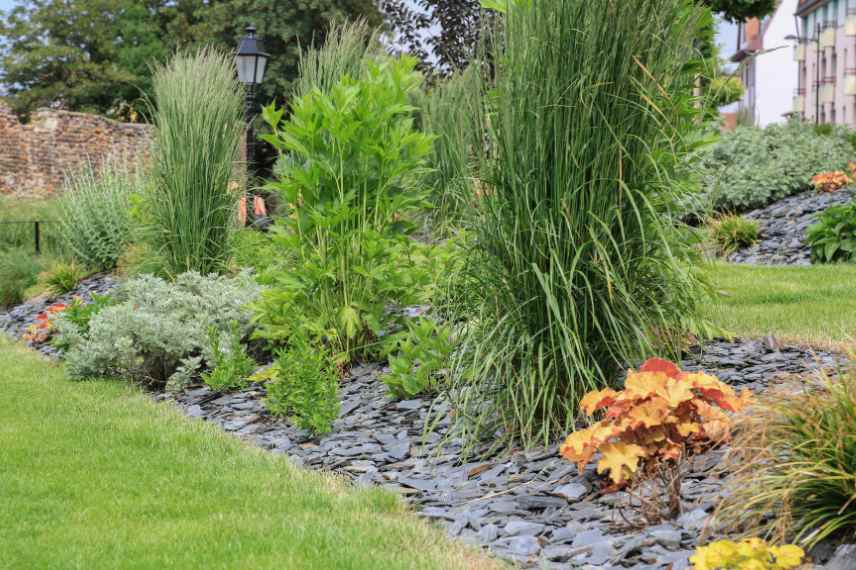
Slate is among the mineral mulches often offered in garden centres. Sold as chips, it suits plant beds in dry soil (as there is no organic decomposition enriching the soil). So be mindful of its use according to your plant palette, which should not suffer. Also beware of the often risky attempts to have mineral mulches coexist on the same surface…
The slate mulch (crushed slate) at the base of hydrangeas to blue them: true or false?
Slate, even when crushed, does not acidify the soil sufficiently nor release aluminium in meaningful amounts to blue hydrangeas. It is the pH that must be below 6 to obtain and maintain blue hydrangeas.
In the vegetable garden
Slate labels, though costly, are one of the nicest ways to present your plants or herbs. You can make them yourself when you have a few slates tucked away in a corner of the garden or shed. See Ingrid’s tips in How to make your own plant labels?
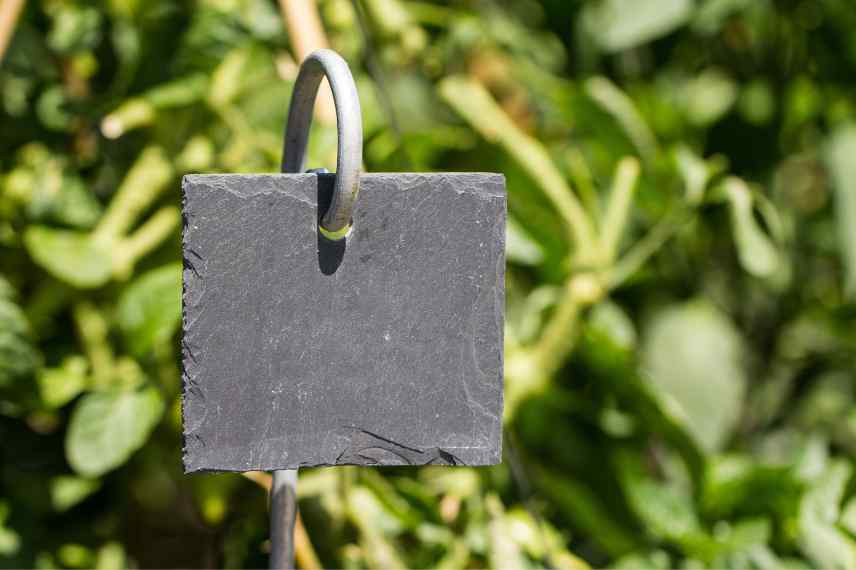
The slate label, a must for well-kept gardens!
Good companion plants
Schist and slate, with their bold colours, really stand out on very lush green backdrops, where the foliage takes centre stage. For blue, and its hues up to blue-grey when paired with green, this is one of the colour combinations that really works in the garden, whether you favour a contemporary style or, for example, a white monochrome garden.
Sticking with a botanical theme, feel free to use it near succulent plants: they emphasise the shapes and colours of the succulents, especially in dry gardens or rockeries.
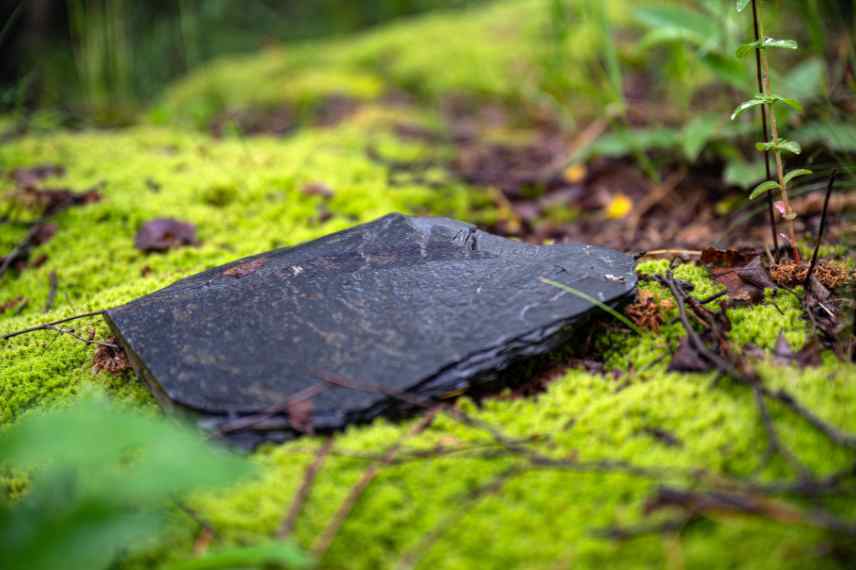
Slate and moss also make a great pairing, the enveloping, soft texture of the moss contrasting with the matte and apparently cold nature of the mineral. The yellow-green colour of the moss makes a perfect backdrop to the slate’s midnight blue, and thus suits shadowy corners.
Beware of combinations often (too) seen in schemes with white pebbles, well known to some so-called landscape designers. The pairing feels unnatural, lacking charm, and does not do justice to this beautiful material.
Wood, from chestnut to exotic timbers like teak, used either as seating or as cladding on a built structure, instantly warms the area. Brick orange also forms a beautiful harmony with the bluish-purple colour of the schist, like two complementary colours on the colour wheel.
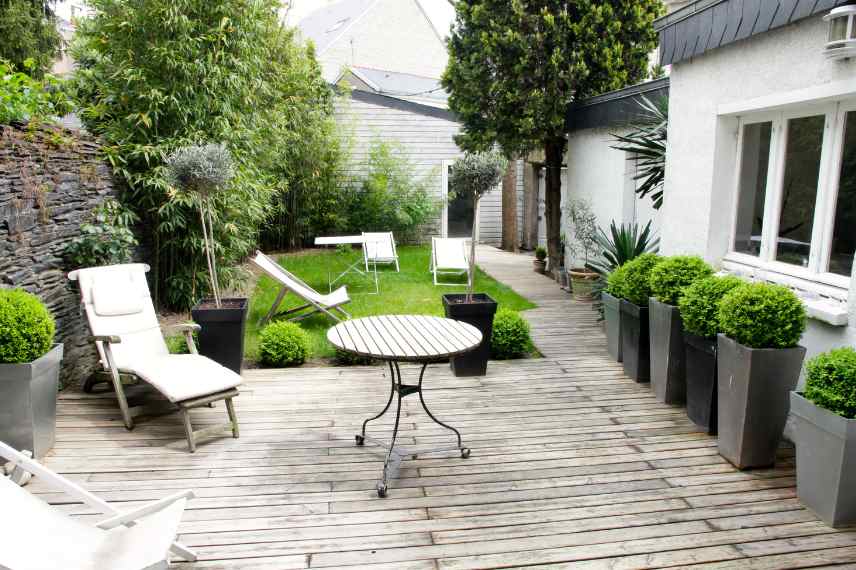
Finally, to complete a terrace in an environment with a slate-clad wall, for example, opt for large planters or tubs in anthracite. The alchemy is perfect and well balanced!
- Subscribe!
- Contents
Comments