





























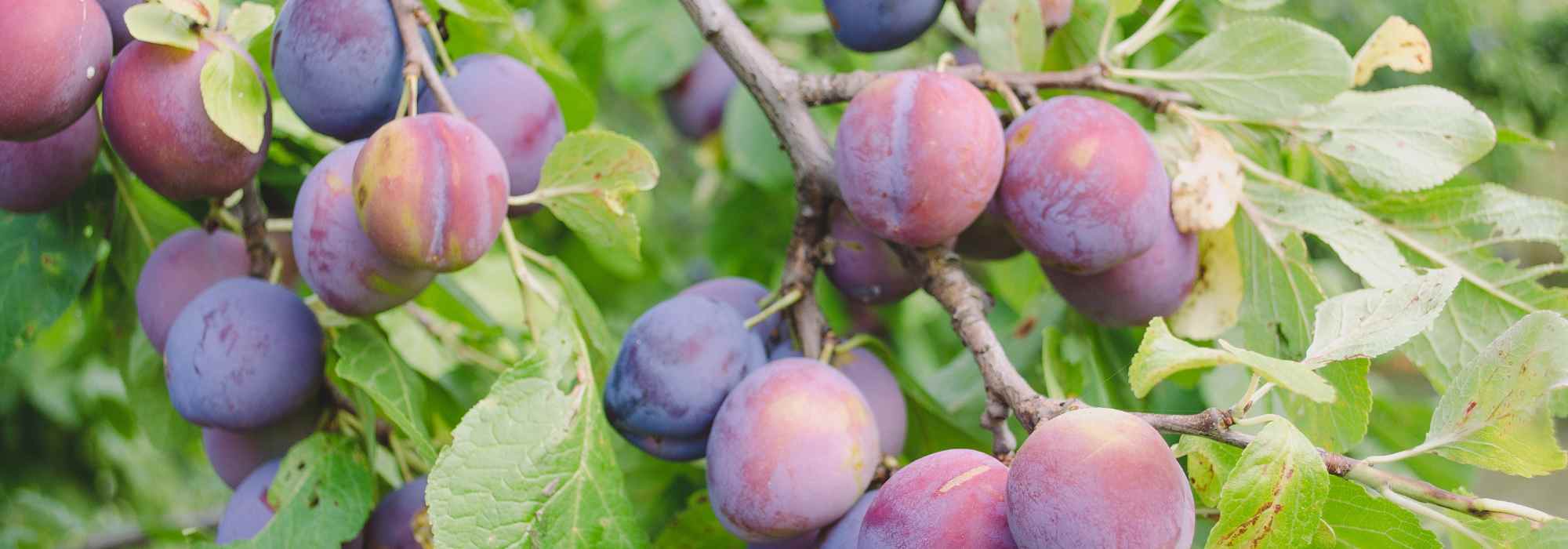
Plum tree: how to choose the right variety?
Buying guide to select the most suitable plum trees for your garden
Contents
Very common in gardens and orchards, the plum tree (Prunus domestica) is a hardy fruit tree in all French climates, up to 1,000 m above sea level. Relatively adaptable and easy to grow, it grows in all soil types, including slightly acidic or slightly calcareous soils, provided they are light, fertile, rather cool and deep, and above all well-drained. Obviously it needs sun and a site well sheltered from cold winds to protect its flowering from late spring frosts. Even if plum trees are not among the fruit trees most sensitive to these frosts. Particularly vigorous, the plum tree also offers a beautiful range of fruits in colours and flavours quite different. As for its abundant white flowering, it is a true delight in spring.
If you fancy giving in to the charm, vigour and productivity of the plum tree, we offer our buying guide to help you choose the best variety according to different criteria.
Further reading: Plum tree, mirabelle plum tree: planting, pruning, harvest

Depending on variety and its use.
The genus Prunus domestica comprises around 400 different species. In other words, there is a wide choice. But the first criterion for choosing a plum tree seems quite evident: the variety and, by extension, how the harvested fruit will be used. And in this regard, it often comes down to taste!
Among plum trees, there are:
- The Reine-Claude : these are round plums, with a fine flavour, usually very sweet. These plums are perfect for eating at table, fresh, but they can also be used in jams and preserves. The variety ‘Dorée ou Verte’ certainly produces one of the most delicious Reine-Claude plums, with its epidermis turning green to gold, its flesh firm, very juicy, very sweet. It is a plum of excellent flavour. The Reine-Claude ‘D’Althan’ also stands out as a delicious prune, with a fine, juicy, very fragrant flesh. It is a large round plum, slightly flattened, with an epidermis at the base yellow with a pink and purple overprint.
- The mirabelle : these are plums the size of a large cherry, with firm and sweet flesh, very fragrant, perfect in pies, cakes and eau-de-vie. Hard to pass up the ‘Mirabelle de Metz’ with a fine and truly fragrant flesh, or the Mirabelle de Nancy’, larger but less sweet than the previous. The original variety ‘Ruby®’ produces Mirabelles with a red epidermis and very sweet dark flesh
- The quetsche or “Damson plum” : these are oval plums with a pruinose epidermis, purple or blue-black, and with firm flesh, not very juicy, but very sweet. These plums are perfect for drying or for inclusion in compotes, jams, preserves… The ‘Alsace Damson’ offers fruits that are both sweet and tart. As for the plums of the ‘Blanche de Létricourt’, they are excellent for pies and drying. As for the ‘Belle de Louvain’, it is a plum of fine calibre, really suited to making jams. It is also a late-flowering variety, therefore less prone to spring frosts.
- Prune varieties : the variety of ‘Prune d’Ente’ is certainly the most used for dried fruit, but one could also mention ‘Perdrigon’, known for supplying Pistoles de Bignoles, very reputed dried plums.
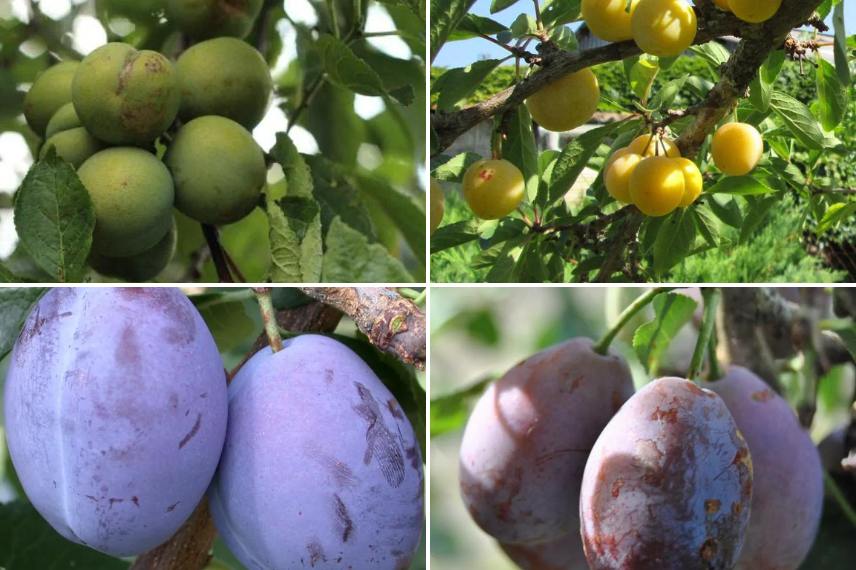 Some of the most delicious plum varieties: ‘Green or Golden Reine-Claude’, ‘Mirabelle de Metz’, ‘Alsace Damson’ and ‘Prune d’Ente’
Finally, if you are looking for plum trees renowned for the flavour of their fruit, it is impossible to overlook some unclassifiable varieties: the prunier ‘des Béjoinnières’ produces plums of medium size, quite close to mirabelles, all at once sweet, juicy and perfumed, very versatile in use. The dark red plums of the variety ‘Anna Spath’ are also delicious, juicy and with a firm flesh, perfect for all uses.
Depending on the planting region
The plum tree is a relatively hardy fruit tree (down to -25°C) but its flowering can suffer from spring frosts. The plum trees best suited to continental climates and to mountain climates are certainly the Damascus plums, widely grown in the northeast of France and Belgium. Thus, varieties such as ‘Belle de Louvain’, ‘Quetsche d’Alsace’, ‘Belle de Thuin’ or even the ‘Bleue de Belgique’ with its fruit having blue, thin skin, and a flesh that is melting, juicy and sweet are certainly the best suited for planting in a region with a cold climate. Similarly, the plum ‘Altesse Double’ which produces Italian plums, flowers late, which allows it to withstand the spring frosts. Obviously, in the northern and eastern regions with a continental climate, Nancy and Metz mirabelles are prominent.
Further south, other plum trees with earlier flowering will be preferred. Thus, the plum ‘Reine-Claude de Bavay’ offers large, round fruits with sweet and fragrant flesh that are harvested in mid-September. But it is a plum tree that fears the cold, so it should be grown in regions with a mild climate. Overall, Queen Claude plum trees are more commonly planted in the southwest. Thus, the plum ‘Queen Victoria’ appreciates warm locations such as slopes. It is a productive but not very vigorous plum that bears fruits with pale red skin and firm, sweet flesh, with a slight hint of acidity. The plums of ‘Reine-Claude d’Oullins’ come to ripeness between July and August. Moderately sweet but juicy, they are suitable for canning and jam.
As for Japanese plum trees, they are particularly suited to cultivation in mild-climate regions thanks to their early flowering. The ‘Golden Japan’ produces large fruits bright yellow with sweet, soft and juicy flesh in mid-July. As for ‘Black Amber’, it offers large plums with almost black skin and amber flesh, very aromatic, from the end of July.
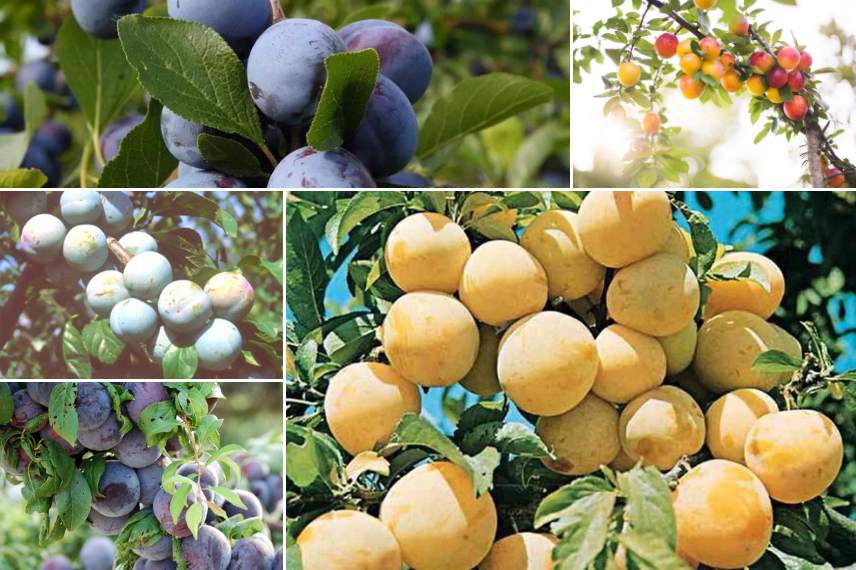
In the north and east, the ‘Bleue de Belgique’ or the ‘Mirabelle de Nancy’, in the south, the ‘Reine-Claude de Bavay’, the ‘Reine-Claude d’Oullins’ and ‘Black Amber’
Based on their disease resistance.
Relatively hardy compared with other fruit trees, plum trees can nevertheless be prone to a number of diseases, including the brown rot, the rust, the bacterial canker, or the dreaded Sharka virus. In terms of pests, it’s mainly the codling moth that attacks its fruit. Nevertheless, some plum trees are recognised for their increased resistance to certain diseases. Thus, the plum ‘Des Béjonnières’ is known for its fruits being little infested by worms and other pests, while plum ‘President’ with large rounded fruits, dark red-violet skin, very crisp and thus ideal for prunes, is reputed for its very high resistance to diseases.
Nancy mirabelle or the ‘Green Gage’ are recognised for their resistance to brown rot. The plum ‘Quetsche Altesse Simple’, also named ‘Namur Prune’, also benefits from excellent hardiness and thus good resistance to fungal diseases. Just like the plum ‘Quetsche Stanley’ whose large violet fruits are perfect for making prunes.
For more information: Diseases and pests of the plum tree
In line with productivity
Among plum trees, some are champions of productivity. Starting with the Nancy and Metz mirabelle plum trees. The plum tree ‘Monsieur Hâtif’ also yields fine harvests of plums in the beautiful pruinose purple colour from mid-July. The only drawback of this plum tree is the fluctuating and irregular yield. The ancient variety ‘Blanche de Létricourt’ is also ranked among the most productive varieties, and, moreover, disease-resistant. ‘Sainte-Catherine’ is also an ancient plum tree variety, which yields the famous Tours flowering prune. Its fruits are yellow-gold, sweet and honeyed, very fragrant. Already growing in Louis XVI’s kitchen garden, this plum tree yields abundant harvests at the end of August.
→ Find other ancient and local plum varieties: a sustainable and flavoursome choice.
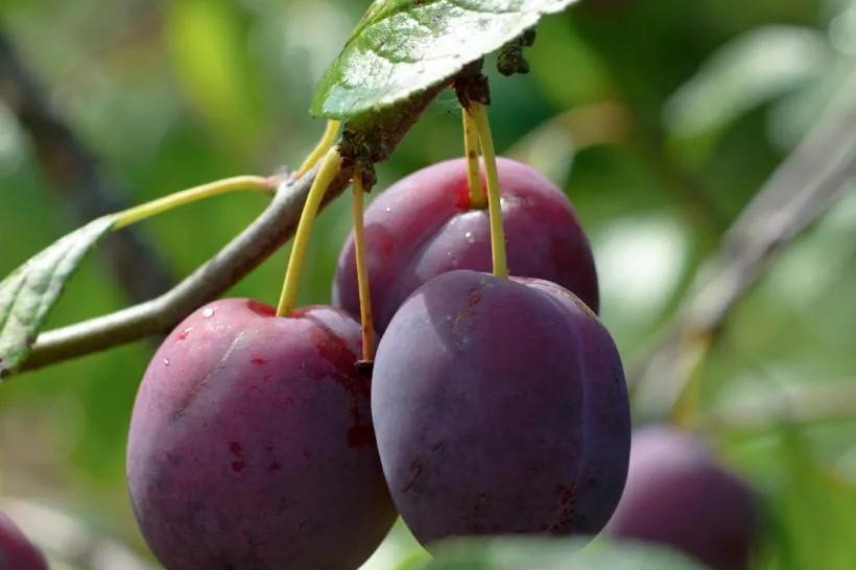
The variety ‘Monsieur Hâtif’ is recognised for its precocity, productivity and disease resistance
Self-fertile variety or not?
Many plum trees are self-fertile, meaning that pollination will occur on the same tree. A single tree is enough to bear fruit. Thus, among self-fertile plum trees, one can cite ‘Anna Spath’, ‘Belle de Louvain’, ‘Bleue de Belgique’, ‘Ente’, ‘Quetsche d’Alsace’, ‘Blanche de Létricourt’, ‘Reine-Claude de Bavay’, ‘Reine-Claude d’Oullins’, ‘Queen Victoria’… ‘Des Béjonnières’, ‘Perdigon’ are partially self-fertile, but production will always be better, by cross-pollination, if these plum trees are planted alongside another variety.
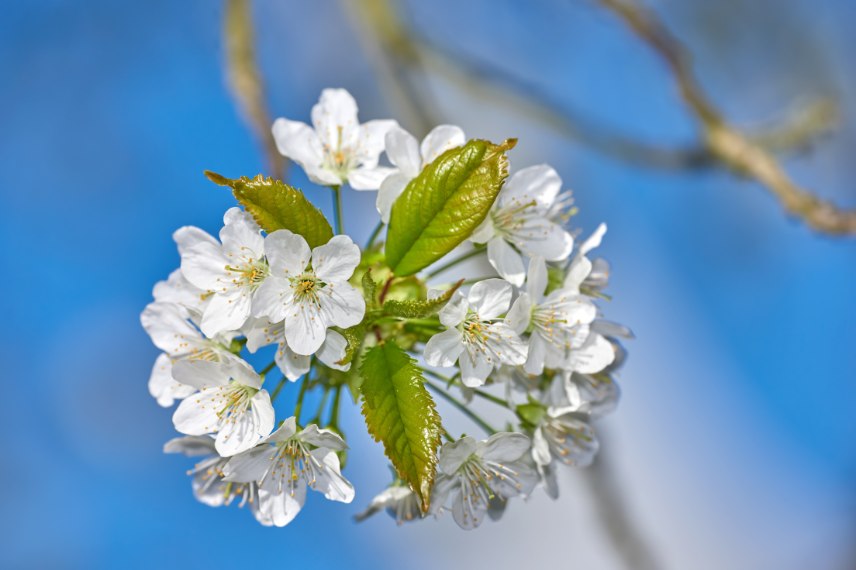
Plum flowers
On the other hand, other plum trees such as ‘Président’ or ‘D’Althan’ are clearly self-sterile. Therefore, you must plant beside them pollinator plum trees, among which one can highlight the ‘Reine-Claude d’Oullins’, the ‘Reine-Claude violette’, the ‘Reine-Claude dorée’. Be that as it may, we advise you to read our descriptions carefully to choose the right pollinator.
- Subscribe!
- Contents
Comments