





























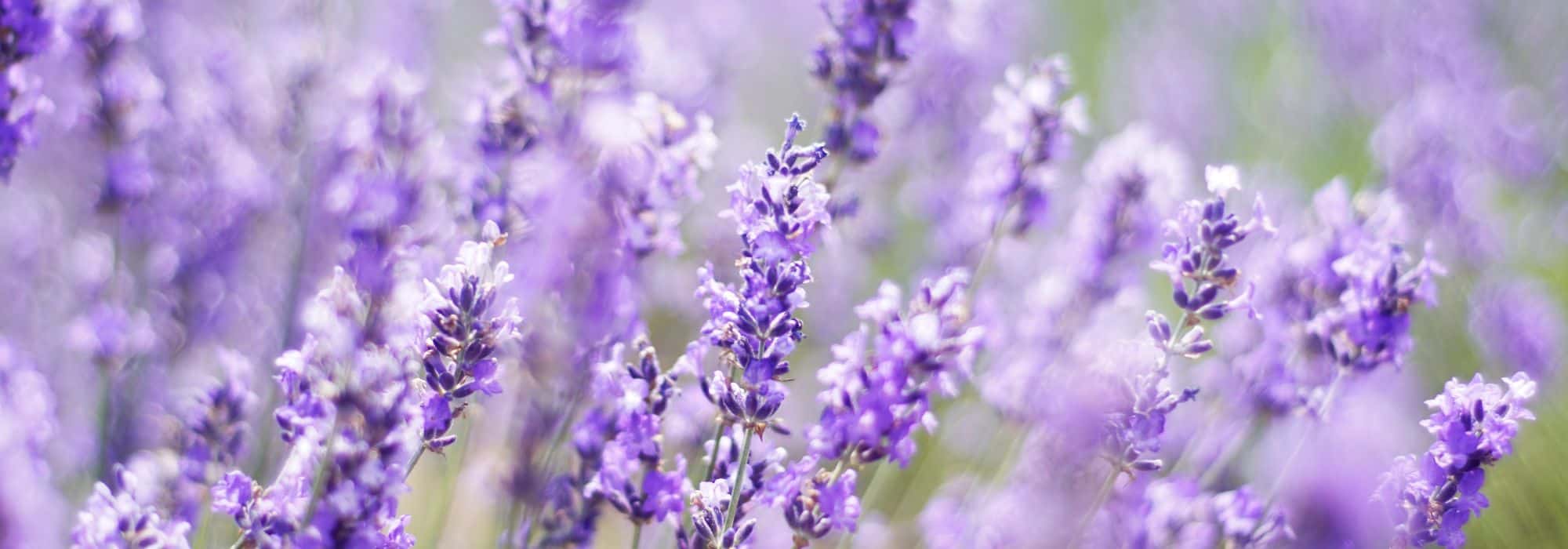
Planting lavender along borders to give structure to your beds
Spacing, harmony and structure in the garden
Contents
Do you dream of planting lavender along the edge of your border to enjoy its enchanting scent, its abundant flowering and its neat, compact silhouette? To ensure this iconic plant of the south thrives fully, but without crowding its neighbours, you need to anticipate its growth from planting. Discover our tips for planting lavender, adjusting spacing and how to integrate it with the other plants in a border.

Why choosing lavender to give structure to a flower border?
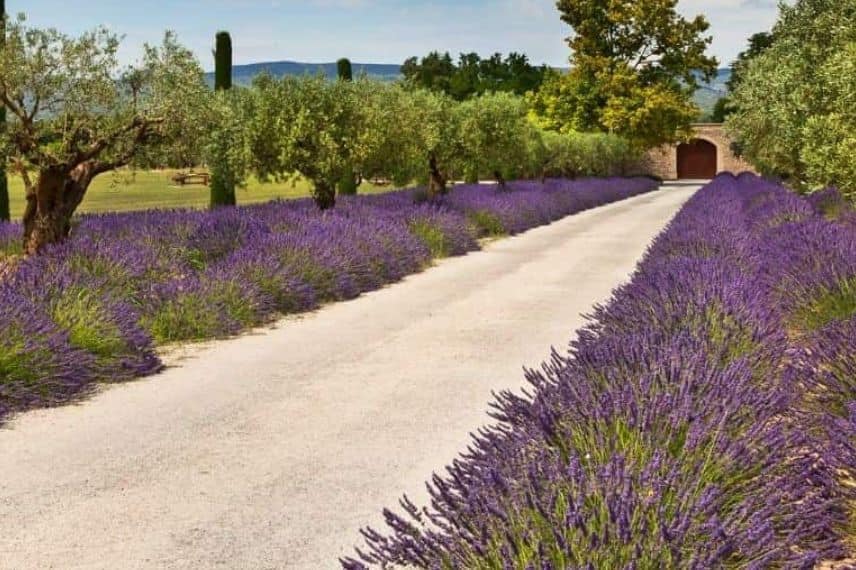
Lavender naturally forms small, rounded spheres, with evergreen and aromatic foliage. It therefore creates an attractive border that remains present year-round, even when not in bloom. Its regular habit provides a strong visual structure, ideal for emphasising the contours of a border or for defining its lines.
Its flowering, often blue or purple depending on the variety, attracts bees and other pollinators for several months, while adding a Mediterranean touch full of charm. And what of its enchanting fragrance? Using lavender as a border combines aesthetics, fragrance and biodiversity.
Did you know? There are white-flowered varieties, such as the variety ‘Arctic Snow’, but also pink-flowered ones at ‘Rosea’.
Read also
Lavender: the best varieties for potsGet to know lavender well before planting it along a border.
Before breaking out the spade to plant lavender as a border, you first need to understand its requirements and growth. Because lavender tends to spread year after year… and it can eventually crowd out its neighbours if you don’t take its mature size into account! And depending on the variety, the mature size varies considerably.
- Dwarf varieties, such as the white lavender ‘Silbermöwe’ or ‘Montagnac Purple’, measure about 30 to 40 cm in height with a spread of 40 to 50 cm.
- Lavandins and certain true lavenders, such as Lavandula angustifolia ‘Hidcote’ or ‘Phenomenal® Niko’ reach 70 to 90 cm in height and 70 cm to 1 m in width.
- Butterfly lavenders (Lavandula stoechas), more sensitive to cold, form cushions of 40 to 60 cm in diameter, but require a very well-drained soil and a mild climate to age well.
So start by choosing the variety that best fits the space you have available, to prevent lavender from taking over the other perennials. Also favour a variety suited to your climate and soil: lavender loves full sun and well-drained soil, as it dislikes stagnant moisture.
Spacing lavender plants: an essential step
Spacing between two lavender plants
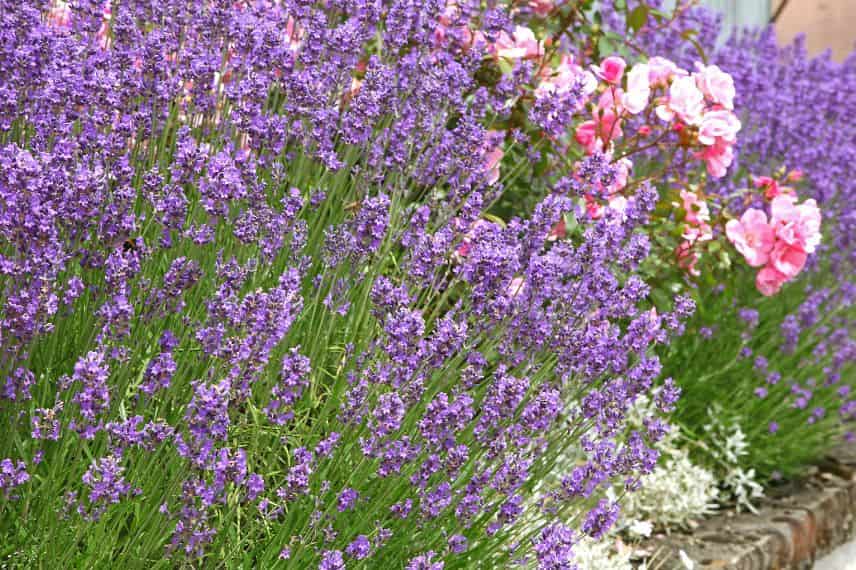
As we have just seen, you will need to leave space between your lavender plants. Too close, the plants may crowd each other, dry poorly after rain, and become leggy due to lack of light. Too far apart, the border effect will be lost. Here are a few benchmarks for spacing adapted to the varieties:
- Dwarf lavender: space 40 to 50 cm apart.
- Lavandin: leave 60 to 80 cm between two plants.
- Butterfly lavender: 30 to 50 cm spacing, depending on the variety.
This spacing allows each crown to develop fully, while ensuring good airflow, essential for preventing fungal diseases.
Good to know: if you want to create a very dense border effect, subtract 10 cm from the values above.
Also remember to leave a little space in the border so you can prune your lavender once a year, just after flowering. Without pruning, it tends to bare itself, become unbalanced and age poorly. Especially since lavender branches are easily broken if you walk on them.
Spacing between lavender and other border plants
When lavender coexists with other perennials or grasses in a border, the spacing should take into account the full width of both plants.
A simple rule is to add half the full width of each plant to determine the minimum space to keep between them.
Example:
A lavender 60 cm wide has as a neighbour an echinacea of 50 cm:
(60 ÷ 2) + (50 ÷ 2) = 30 + 25 = 55 cm apart between the two plants.
This method helps preserve the volumes of each species without them competing with one another. This calculation also applies to delicate grasses.
Which border plants pair well with lavender?
Planting lavender in a border requires selecting companions that are compatible in terms of watering, exposure and soil type. It prefers well-drained, poor, dry soil in summer, and full sun. For a border that lasts, favour plants that share these same requirements:
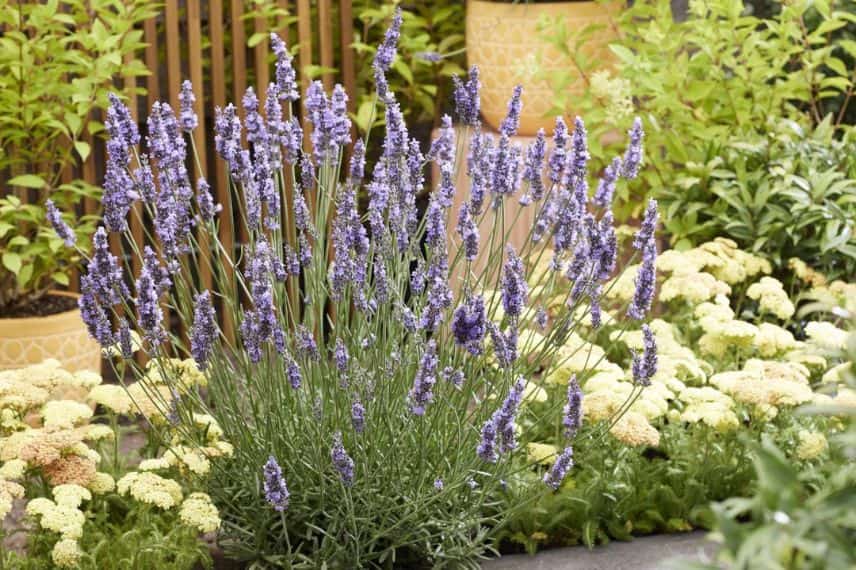
- The yarrows: their colourful summer flowering and display complements lavender.
- The Santolinas and Artemisias: grey foliage reminiscent of lavender and a fine texture, perfect for harmony.
- The Coneflowers and Heleniums: tall blooms that rise above lavender, perfect for adding height to the border.
- The Perovskias: lavender-blue flowering that is similar, to be used as a backdrop in a border to add volume.
- The Gauras: delicate blooms borne on long, dancing stems that bring a touch of movement and spontaneity, provided you give them enough space.
- The Grasses: for example a Pennisetum to bring lightness and movement against the solidity of lavender.
The idea is to create contrasts of shapes and textures, without crowding the space.
Tip: Leave gaps that are bare or mulched between plants to help the border breathe, particularly in slightly wetter regions, and to provide enough space to ease maintenance and pruning.
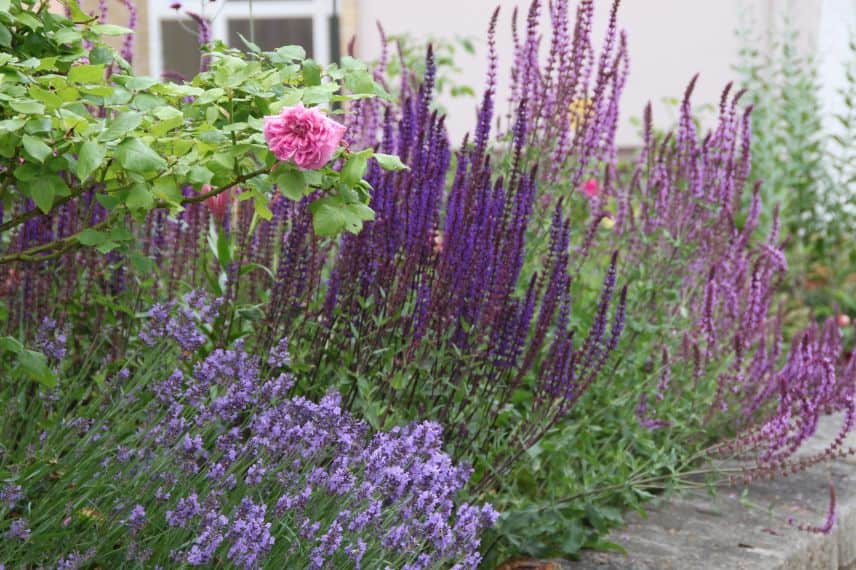
Maintaining your lavender border to preserve the structure of the flower bed
There you go, your lavender border is now planted and you can proudly admire it. Just remember to look after your lavenders: a pruning each year after flowering helps to maintain a nice rounded shape and prevent the plants from becoming bare at the base. In a border, this pruning is important, as it helps to keep a neat shape and a well-structured bed.
Also ensure that the roots of neighbouring perennials do not encroach too much on those of the lavender, which appreciates a certain tranquillity. A light hoeing or a mineral mulch (gravel, slate) or some organic mulches (bark and chips only) can help limit competition from weeds, while enhancing the dry look of the display.
- Subscribe!
- Contents
Comments