





























Invasive agaves: a practical guide to getting rid of them
Prevention, method and tips
Contents
Agaves are beautiful succulent perennials with striking foliage. Originating from Mexico, they are warm, sun-loving garden plants that will inevitably add a touch of exotica. They are ideal candidates for dry and Mediterranean-style gardens.
But some agaves can also easily spread and become hard to control.
So let’s look at how to prevent problems and how to remove invasive agaves effectively.
For more on growing agaves, discover our guide Agave: planting, growing and care.

Which varieties of agaves are invasive?
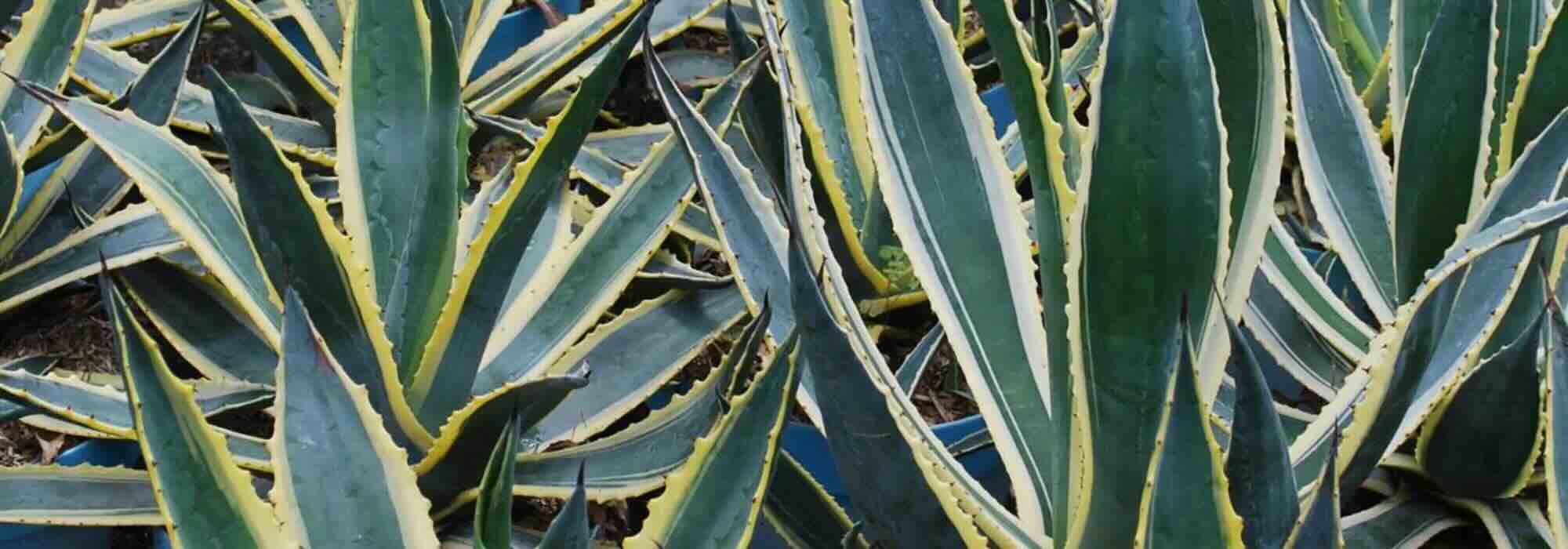
The Agavaceae genus includes nearly 200 species and cultivars. While many agaves have a modest silhouette, not exceeding 1.3 metres, others are more spectacular, as exemplified by Agave americana and its cultivars such as ‘Variegata’, or also Agave salmiana. These are usually the most invasive. They can reach more than 3 metres in all directions.
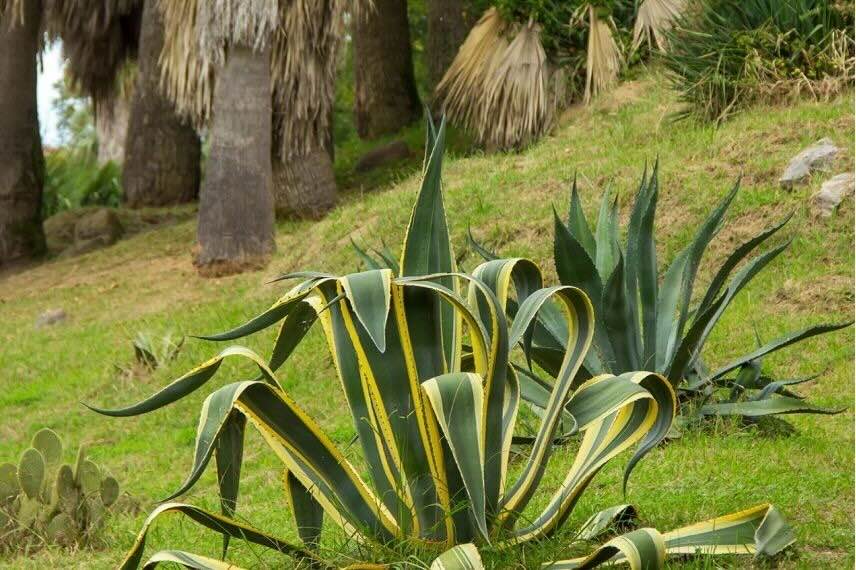
Agave americana ‘Variegata’
Read also
Choosing an agaveHow do agaves multiply?
Agaves are capable of living for several decades. Their lifespan ends in a final flourish with spectacular flowering, before the rosette dies. They are succulent plants with slow growth, but as they mature they produce numerous offsets to ensure their propagation. This is the ability to generate many new plants that first makes the plant potentially invasive. The Agave americana can notably produce baby plants up to 2 metres from its base. More rarely, but possible: bulblets on the plant’s flowering spike or on the leaves can also participate in its dispersal.
Agaves are undemanding plants, perfectly adapted to arid conditions, including water shortage and scorching sun. They grow in poor soils, very sandy, calcareous or stony. This is another reason they can be invasive: they face less competition due to the harsh growing conditions they thrive on.
Mediterranean regions thus offer agaves these ideal living conditions, with coastal dunes, sandy beaches, rocky shores and cliffs. As a result, Agave americana has naturalised there, spreading beyond the boundaries of gardens. It becomes an invasive plant, competing with local species that grow less quickly and impacting the biodiversity of the area, notably in natural habitats. It forms truly impenetrable barriers due to its spiny leaves.
It poses problems particularly in France, in Occitanie and the PACA region. In the Calanques National Park, agaves are regarded as invasive exotic plants, alongside the prickly pear cactus or witch’s claw. The spread of agaves is also monitored in the south-west regions, notably in the Pyrenees, but also in the Massif Central.
Finally, the agave has few natural predators and is not susceptible to disease.
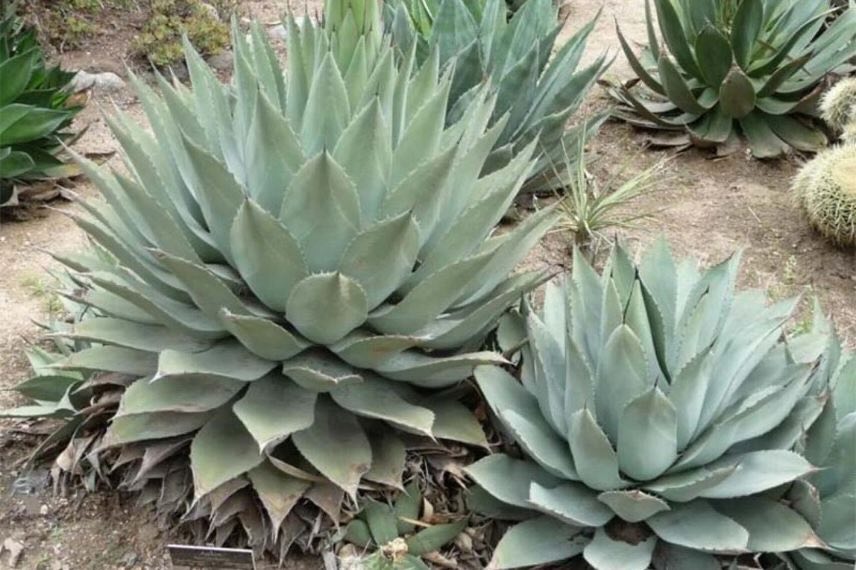
The Agave readily produces offsets (Agave havardiana)
Prevent the spread of agaves
There are several methods to help prevent the sometimes invasive side of agaves.
- Choose compact-growing varieties, easier to control. For example, opt for the Agave victoriae reginae, for the Agave potatorum ‘Kichiokan’ or for the small Agave pygmae ‘Dragon Toes’.
- Prefer growing in a pot or a large container rather than growing directly in open ground. With less space available, the agave will inevitably be less invasive and less prolific in terms of its offsets.
- Remove offsets as they appear. This will naturally limit the plant’s growth. For this, have a spade. Lift the offset to access the roots linking it to the parent plant. Using a pruning shear, cut these roots. You can place this sucker in a pot if you wish to obtain new plants, or take it to the tip if you don’t want to keep it. Obviously, never deposit it in nature, where it could easily re-root. Regularly repeat the operation to limit the plant’s spread.
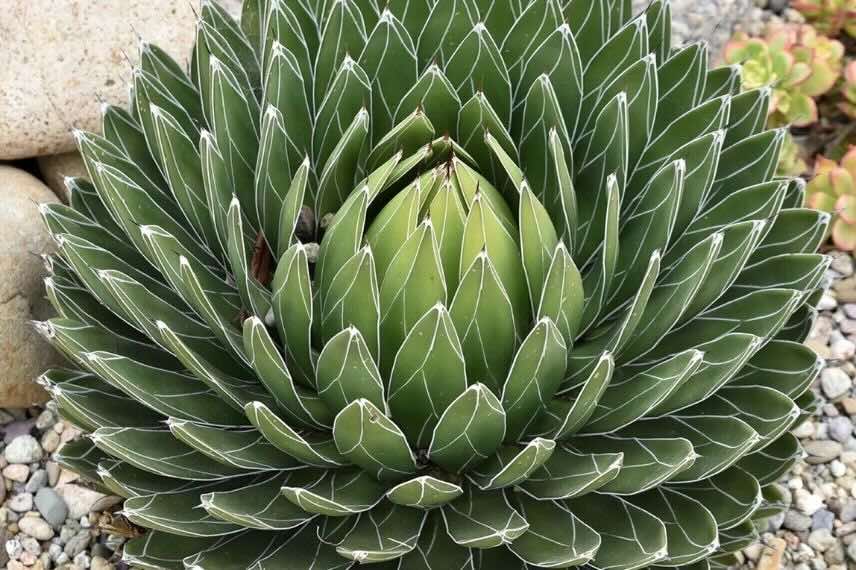
Agave victoriae reginae, compact-growing
Read also
7 Agaves: the most beautiful varietiesNaturally remove overly invasive agaves.
There aren’t 50 ways to get rid of invasive agaves: manual removal (or mechanical removal) is the most effective and natural.
To do this, equip yourself with:
- a pruning shear or a hand saw, depending on the size of the agave;
- a spade;
- thick clothing and gloves, as well as goggles to protect you from the thorns.
- Start by cutting the leaves from the largest agaves to make removal easier.
- Then cut the plant as close to the ground as possible at the base of its trunk.
- Finally, using the spade, dig around the stump to access the roots. Cut them carefully so that the plant can be removed in its entirety. Make sure all underground parts have been removed.
For areas that are heavily colonised, mechanical uprooting using a mini digger may be employed.
Another tip is to encourage the plant to flower to multiply, and thus die without having to remove it from the soil. To achieve this, simply cut off all the leaves of the agave. If flowering begins, then cut the flowering spike before it produces fruits enabling its reproduction.
As always, we discourage using chemical treatments to try to eliminate an invasive agave. On the one hand, they will be ineffective on this succulent plant with thick, leathery foliage. On the other hand, they contribute to soil pollution and impact biodiversity as well as human health.
- Subscribe!
- Contents

Comments