





























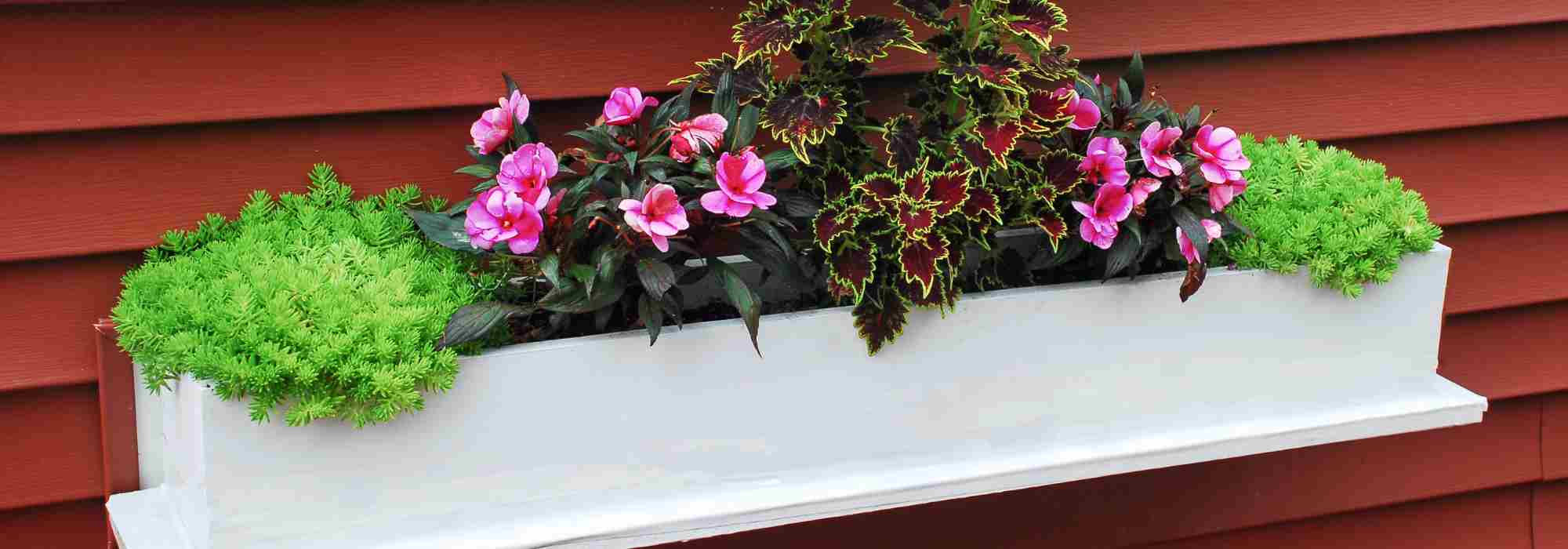
Ideal plants for a narrow planter: our best options
Ornamental or edible plants, even in a small space
Contents
You don’t need a patch of ground or a large garden to grow plants. Many varieties can indeed be grown in containers. Window boxes are among the most common and they allow for a range of uses: dressing up window sills, brightening a courtyard, defining a pathway, brightening up a low wall, etc.
However, this growing method has certain specifics, and not all plants will be suited. Here we offer a range of ideas for creating beautiful window boxes to suit your to your preferences and your growing conditions.

What are the main constraints to take into account?
Container growing is inevitably more demanding than growing in the ground. The space available for plants is far more limited, whether in width or depth. Plants will therefore be more restricted in their development, which is why it is essential to choose plants with compact growth. Dwarf varieties are particularly good candidates.
Since space is limited, plants also have less room to develop their root system. The chosen plants should therefore have a shallow root system.
Container-grown plants will have soil that dries out more quickly, since evaporation is favoured. It is therefore advisable to avoid plants with very high water needs, especially in full sun (or alternatively, plan a container with a water reservoir or a sufficiently deep saucer).
Finally, container-grown plants are naturally less hardy in the cold. If you cannot bring your container indoors for the cold season, be sure to choose hardy plants.
On the other hand, this choice has advantages too. There are very few preparations to make before planting. Moreover, the container can be moved very easily to suit your desires and the seasons.
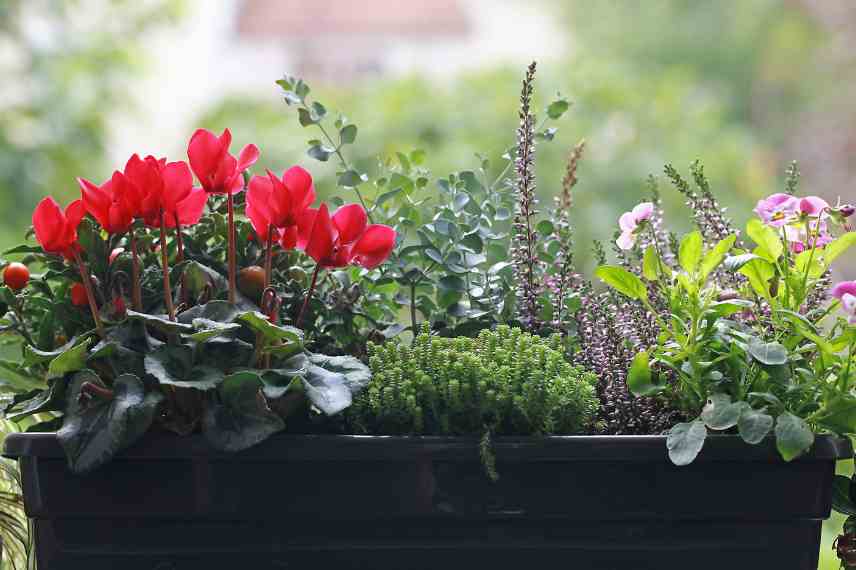
Tailor your planting: cyclamens and heathers are ideal for long-lasting blooms in a small window box
Read also
How to succeed with your window boxes?Take other growing conditions into account
We regularly emphasise that to choose the right plant, it is essential to know its cultivation conditions. Beyond the fact that container gardening has its own particularities, you also need to take into account :
- Exposure (filtered, sunny, semi-shaded, breezy, rain-sheltered…);
- Weather conditions (very harsh winters, dry summers, high humidity…).
Also consider the objectives you have for making your choice: a planter that looks good all year round, a planter that doesn’t require watering, a planter for cooking, etc.
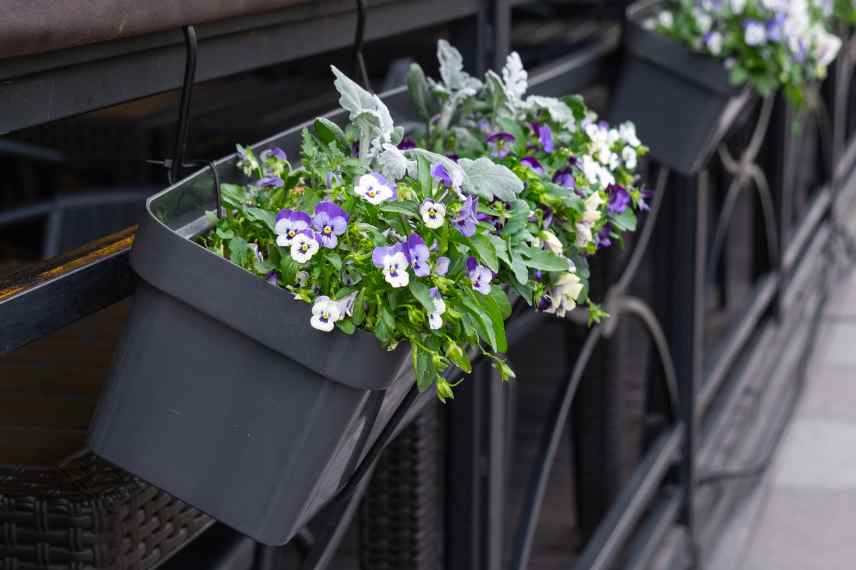
In partial shade, pansies to brighten late winter and spring!
Choosing a suitable planter
The final step is to choose the right container.
First, its length will depend on how many plants you want to grow and their reach at ripeness.
Next, in terms of materials, each has its advantages and disadvantages. Plastic is inexpensive to buy, available in a wide range of models and more insulating. Conversely, terracotta lets the substrate breathe more readily, but it will require more watering. It is also more fragile and heavier: something to consider if you’re growing on a windowsill or balcony. Wood is natural and breathable, but requires regular maintenance.
For most plants, choose a planter with drainage holes at the bottom. This will allow water to drain away without stagnating around the roots, or risk root rot.
When planting, ensure you install a drainage layer at the bottom of the planter, at least 3 to 5 cm deep. Use gravel or expanded clay balls.
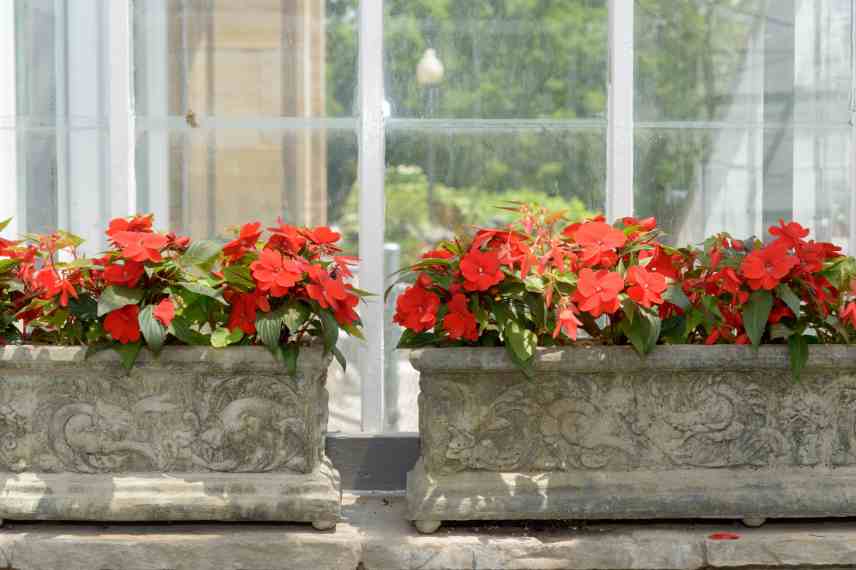
Stone planters, very attractive but expensive, are best placed on the ground
Read also
Create a spring planter: 7 ideasThe best plants to growing in a narrow planter
Here are some ideas and inspiration for a beautiful plant container. Note that provided the plants share the same growing conditions and spacing in line with their mature spread is respected, you can pair them together without any problems.
A drought-tolerant planter for sunny exposure
Looking to build a maintenance-free planter that won’t require daily watering in summer? Go for houseleeks and Sedum. These hardy succulents are, above all, the queens of resilience. They tolerate full sun, drought and cold just as well, making them ideal for a no-fuss planter. Their compact, low-growing forms allow them to develop even in small spaces and in shallow soil. These plants come in many varieties, all with evergreen foliage, often vividly coloured. Their flowering is also charming.
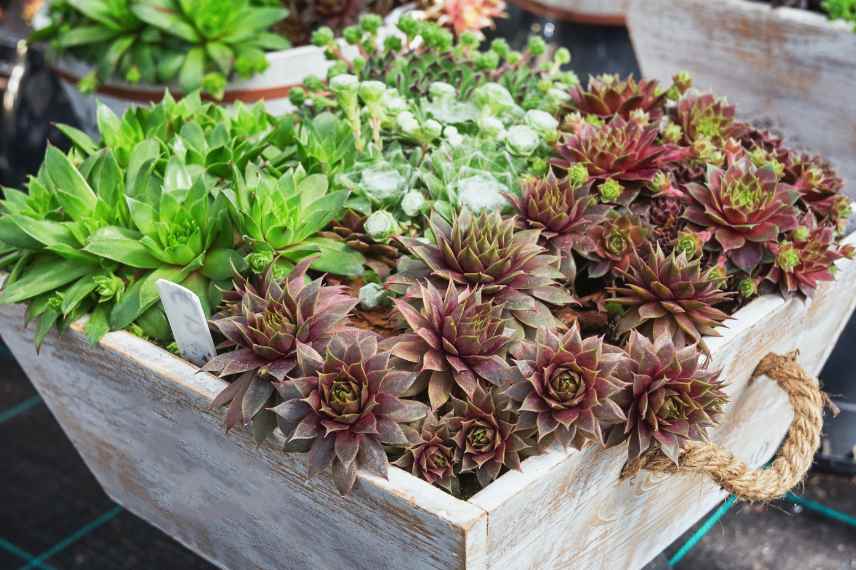 In full sun, opt for succulent plants
If you can bring your planter indoors over winter, you can also rely on succulents such as small agaves, dwarf Yucca or a miniature prickly pear.
Another idea? Go for Mediterranean shrubs: santolines, lavenders or heathers, Helichrysum or Helianthemums.
These plants require well-drained soil, even if poor in nutrients. Place this planter in a warm, sunny exposure.
An edible planter to combine practicality with pleasure
Why not combine practicality with pleasure by creating an edible-plant planter? Many varieties can indeed be grown there. On the Mediterranean side, the smallest varieties of thyme, rosemary or oregano will be ideal and perennial. They require a sunny exposure.
Basil, tarragon, chives and lemon balm can also be included and will enhance your dishes all summer.
For a planter in a shadier exposure, choose parsley, coriander or ramsons. Sorrel can also be very decorative, as shown by Rumex sanguineus with its striking red veins.
We do advise avoiding mint in a narrow planter: it would quickly take over the space.
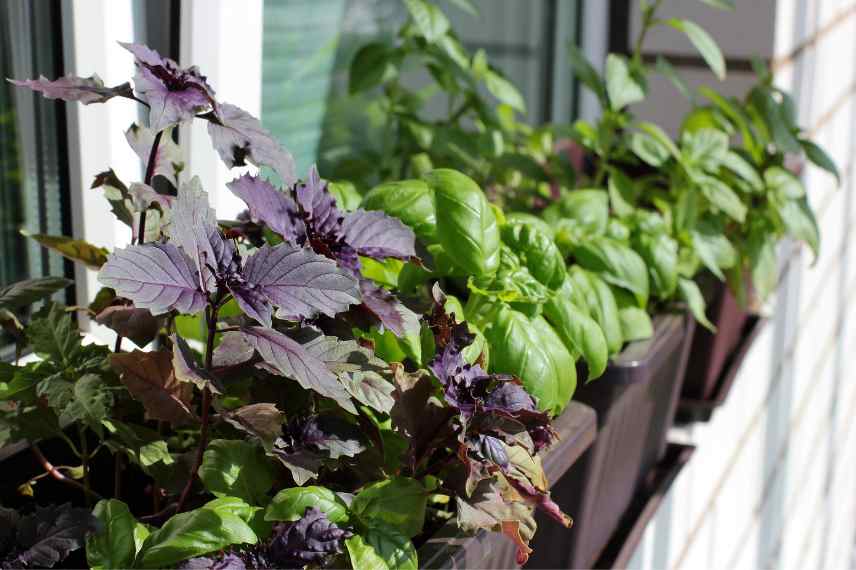 Basil grows well in a planter, provided it is well watered and exposed to sun
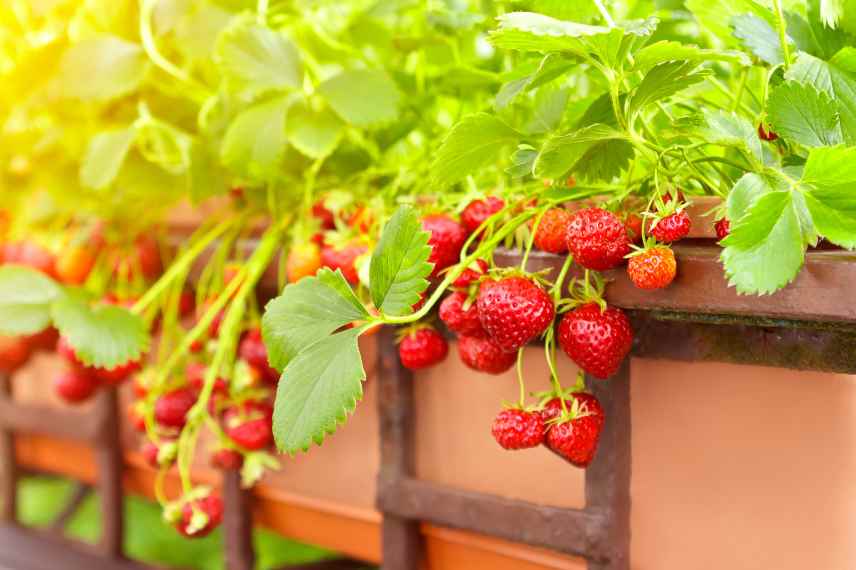
Why not grow small fruits, such as strawberries? They suit container culture very well. Do have a look at our article: Growing strawberries on the balcony.
Provide them with well-drained soil, preferably rich in organic matter. Plan regular watering as soon as the soil dries out (except for Mediterranean plants, which cope better with drought).
A flowering bulb planter almost year-round
Bulb plants brighten a planter quickly. By choosing them well, you can enjoy flowering almost all year round. Moreover, they come back faithfully every year.
To wake up after winter, you’ll have plenty of spring bulbs to choose from, which often bloom very early. Examples include snowdrops, daffodils, Muscari, tulips and Crocus. In a narrow planter, favour dwarf varieties. Remember to mix species by planting at different heights to stagger the flowering over several weeks. For example, tulips are planted deeper than narcissi.
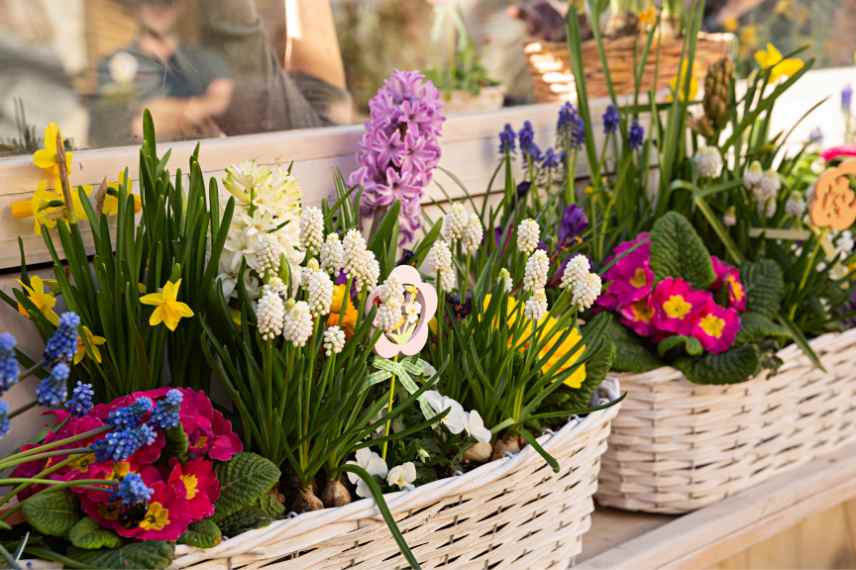 Small bulbs are undoubtedly the ideal plants for small planters
For a summer planter, think of dwarf dahlias, dwarf Alstroemerias and begonias.
Small varieties of Allium also lend themselves well to container growing and will be ideal to bridge spring and summer flowering. To succeed, read our article: How to plant alliums in pots or planters?
And for autumn, turn to Cyclamen and saffron crocus.
To keep the planter lively after flowering ends, don’t hesitate to add a few perennials, such as wallflowers or geraniums. You can also opt for small evergreen grasses.
A hanging planter for a striking visual effect
If you want to create a beautiful cascading effect with a hanging planter, no problem. In a semi-shaded exposure, a small ivy and a Fuchsia will be perfect. In brighter sun, nasturtium will give you a long-lasting colourful flowering. Of course, trailing pansies and violas are also must-haves.
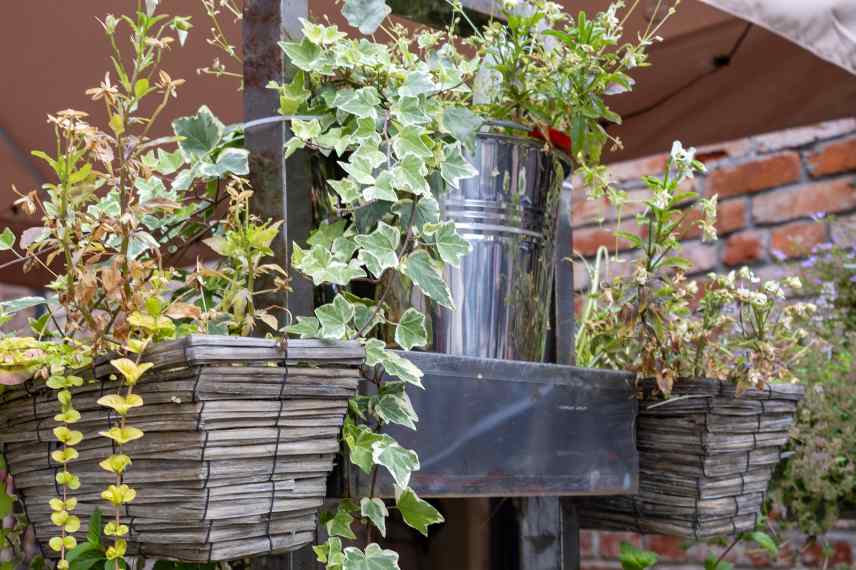 Ivy, perfect for hanging
This planter will be ideal on a windowsill or on top of a low wall. Gwenaëlle gives you a few examples in How to dress a balcony railing?
Care for plants grown in a narrow window box
To keep a beautiful window box, a few care steps are required.
Water regularly, as soon as the soil feels dry on the surface when you test it with the tip of your finger. As we’ve noted, when grown in pots, the potting mix dries out much more quickly. To help conserve moisture and space out watering, don’t hesitate to install an organic mulch on the soil, based on RCW or plant pods.
Prune the plants after flowering and remove any damaged parts. Also remove dead leaves as they appear.
If you have chosen less hardy plants, you will need to bring them indoors for the winter or grow them as annuals. This choice lets you change the look each year and create new displays in your window box.
In spring, don’t hesitate to feed with suitable fertilisers. There are fertilisers specifically for window boxes and pots. Since plants grow in a confined container, nutrients will indeed be used up more quickly.
- Subscribe!
- Contents
Comments