






























How to successfully plant and care Buenos Aires verbena?
All our tips!
Contents
Buenos Aires verbena (Verbena bonariensis) is a perennial plant, with an airy and architectural habit, highly prized for enlivening a natural garden or structuring a flowering border. It stands out for its generous flowering, its light habit and its ability to self-seed naturally. Easy to grow, this melliferous plant attracts many pollinators and requires little maintenance once well established. Discover our tips for successful planting and maintenance of Buenos Aires verbena.
When should Buenos Aires verbena be planted?
Planting Buenos Aires verbena is ideally done in spring, between April and June, when soil is sufficiently warmed and frost risk is avoided. This period, with mild temperatures, promotes rapid growth and allows the plant to establish well to face the heat of the following summer. In mild climates, early autumn planting remains possible, provided you ensure good soil drainage, as this verbena dislikes excess moisture.
Avoid planting verbena during frosts or periods of extreme heat.
Read also
Verbena: planting, pruning and careWhere to plant Buenos Aires verbena?
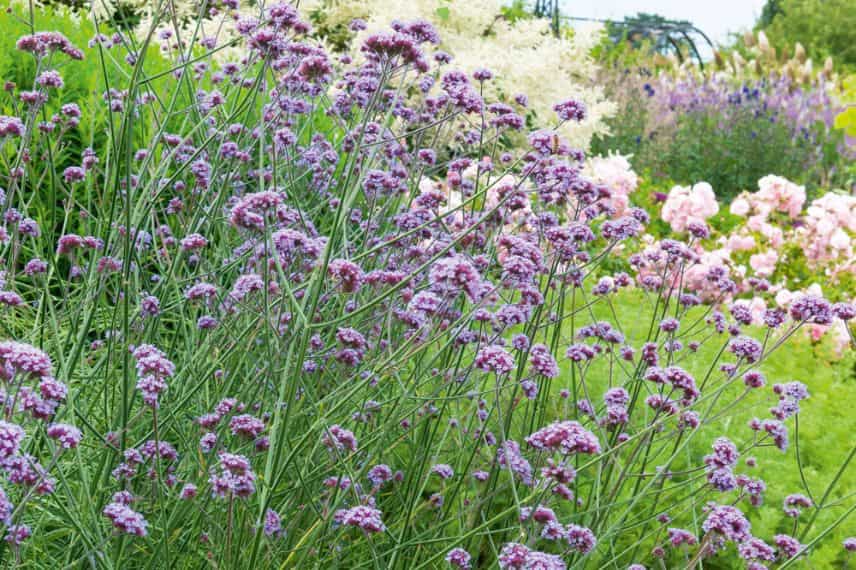
Verbena bonariensis loves full sun : choose a south- or west-facing site, well exposed and sheltered from strong winds, as its long stems can snap in gusts.
It prefers light, well-drained and rather dry soils, even poor ones. Soils that are too rich would encourage foliage at the expense of flowering. It also fears heavy, clayey and damp soils.
It is a perfect plant for perennial borders, dry gardens, rockeries or sunny borders. It also naturally fits into a natural prairie-style garden, where it pairs well with grasses or with country garden plants such as gauras, echinaceas or sages.

The Verbena bonariensis in a border
How to plant Buenos Aires verbena?
Planting in the garden
Planting Buenos Aires Verbena is easy, provided you follow a few steps:
- Choose a sunny, sheltered location, protected from strong winds, in a border, a rock garden or a dry garden.
- Prepare a light soil by loosening it. Note that Verbena likes well-drained soils. If your soil is heavy, add sand or gravel and compost to lighten it.
- Dig a hole twice as wide as the root ball. If you are planting several Buenos Aires verbenas, space the plants about 40 cm apart to allow them to grow freely.
- Place the root ball in the hole. The collar (the base of the stem) should remain at soil level. Backfill gently with soil, then lightly firm with your hand.
- Water well to remove air pockets around the roots and encourage establishment. Then, Buenos Aires Verbena tolerates drought well: water only during the first weeks if the weather is dry, then let nature take its course.
- Young plants require a little vigilance at first: weed around, and if needed, install a small stake if the wind is strong.
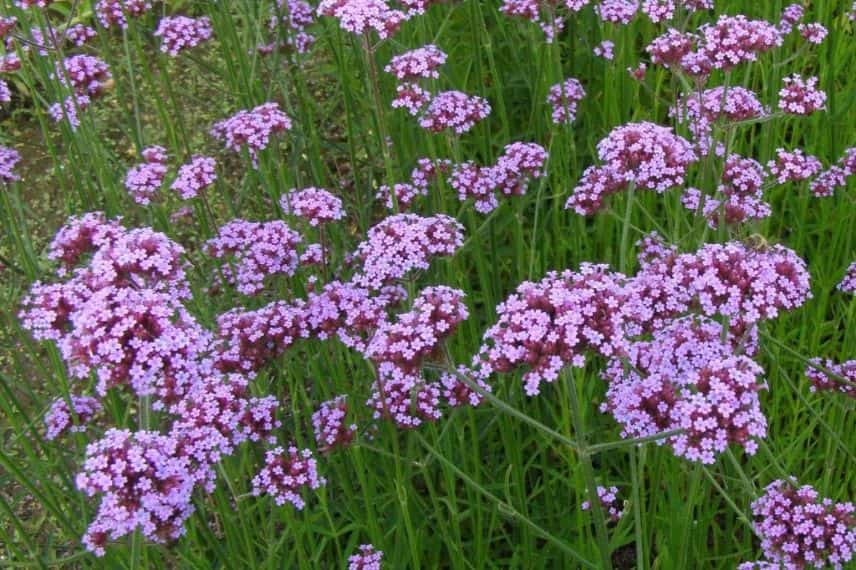
Verbena bonariensis
Planting in pots
Buenos Aires Verbena, the classic form (Verbena bonariensis), grows to 1.2–1.8 m tall, which can make pot cultivation somewhat challenging. Fortunately, dwarf, more compact varieties offer an excellent alternative for balcony pots, terraces or gardens with limited space:
- Verbena bonariensis ‘Lollipop’: does not exceed 60 cm in height. It retains the airy charm of the type species, but with a compact silhouette, ideal for containers.
- Verbena bonariensis ‘Vanity’: floriferous and bushy, it reaches around 75 cm tall. Perfect in a large pot or tub.
- Verbena bonariensis ‘Cloud’: a compact 60 cm tall variety, very floriferous, with good persistence, even in pots.
How to plant the dwarf verbena in a pot?
- Choose a large pot (at least 30 cm deep), with a drainage hole in the bottom to prevent waterlogging.
- Place a layer of clay pebbles or gravel at the bottom of the pot, to ensure good drainage.
- Use a light, well-drained growing medium: mix potting compost for flowering plants with well-rotted compost and a little sand.
- Plant the verbena ensuring the collar (base of the stem) remains level with the top of the pot. Top up with compost and firm gently, then water copiously after planting.
- Place the pot in full sun, sheltered from strong winds if possible.
- Water regularly, but not excessively : allow the surface of the growing medium to dry between waterings. Note that in pots, the plant needs more care than when grown in the ground.
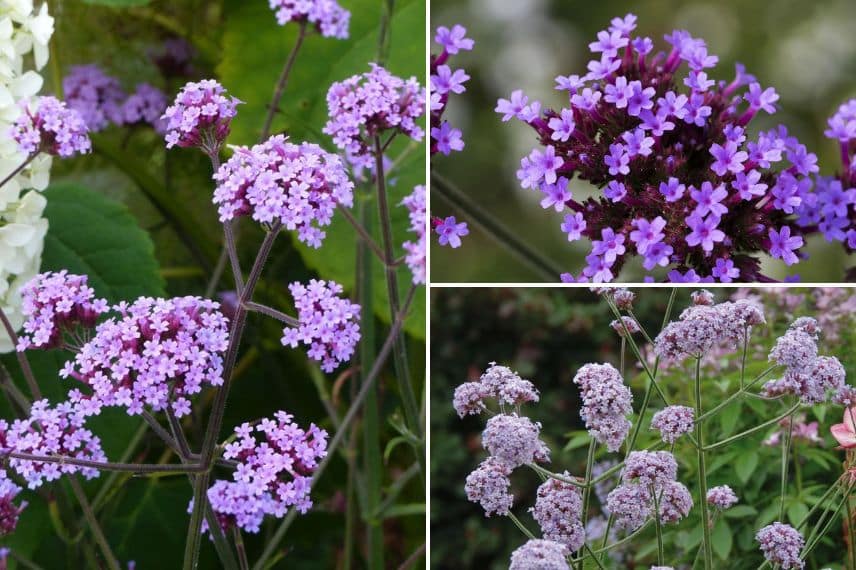 Verbena bonariensis ‘Lollipop’, ‘Vanity’ and ‘Cloud’ are suitable for both pot culture and the garden.
Read also
Self-seeding plantsCaring for Buenos Aires verbena
Low-maintenance, Verbena bonariensis requires little intervention, perfect for gardeners with limited time.
Watering
In the ground, occasional watering during a prolonged drought is usually sufficient.
In pots, watering will need to be more frequent, as the soil dries out more quickly. Allow the surface of the potting mix to dry between waterings.
Fertilising
When grown in the ground, there is no need to fertilise. Once well established, this perennial is hardy and self-sufficient.
To support flowering in a pot, a light application of organic or liquid fertiliser, once a month in summer, can be beneficial. This application is not obligatory, except after a year or two, when the substrate is depleted.
Pruning
To prolong flowering, regularly deadhead the faded flowers during the summer.
Pruning is not essential, but it is advisable to cut back dry stems in late autumn or winter to encourage vigorous new growth.
Propagation
If it thrives, Verbena bonariensis will self-seed naturally in the garden. To do this, leave a few flowers to form seeds. But if you want to prevent it from becoming invasive, simply cut back the faded flowers before they dry and release the seeds.
Mulching
In cold climates, a light, dry mulch around the stump can help it over-winter, even though this plant is often grown as a short-lived perennial or even as an annual. Moreover, mulching helps to space out watering in summer in hot regions and reduces unwanted weeds.
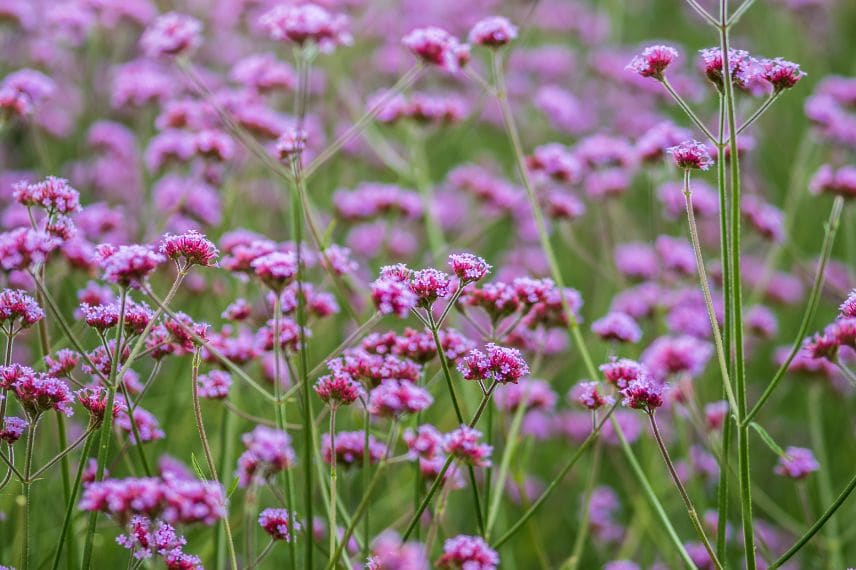
Verbena bonariensis
Frequently asked questions about Buenos Aires verbena
Is Buenos Aires verbena hardy?
It generally tolerates temperatures down to -7 to -10 °C, provided the soil is well-drained. In cold or damp areas, it’s better to regard it as an annual or protect it in winter.
Is it suitable for pots?
Yes, but you must choose a dwarf variety and a deep pot with draining potting compost. Water regularly in summer, but do not overwater.
Can it be propagated?
It self-seeds freely, but you can also collect the seeds at the end of summer to sow them the following spring. Propagation by cuttings is possible, but little used.
What is its lifespan?
It is a short-lived perennial, often replaced naturally by its seedlings. To maintain its presence in the garden, let a few plants go to seed.
- Subscribe!
- Contents
Comments