






























How to maintain a cypress hedge to keep it dense and regular?
All our maintenance tips to keep cypresses in top condition
Contents
Fancy planting your first hedge, and the cypresses tempt you? Looking to give your hedge a new lease of life? Cypress is a garden classic, often prized for its easy cultivation, rapid growth, and evergreen foliage… provided you give it at least a little attention! For a cypress hedge, if you don’t look after it, it can quickly become sparse, unruly, or dreary.
Fortunately, with a few simple, regular steps, you can keep your hedge dense, regular, and in good shape all year round. Discover how to maintain your cypress hedge, with pruning and watering tips, and guidance on preventing diseases and parasites.

Why choosing a cypress hedge?
The cypress (Cupressus) is a conifer with a habit often columnar or conical, sometimes not very hardy, and therefore to be reserved for regions with a Mediterranean climate. That is why the Leyland cypress (Cupressocyparis leylandii), natural hybrid of Cupressus macrocarpa and Chamaecyparis, is one of gardeners’ favourite choices for creating a privacy hedge, elegant and evergreen. It grows quickly (between 60 and 100 cm per year), can reach several metres high, and stays green even in winter, unlike some deciduous hedges. Perfect for shielding from prying eyes, wind or even noise!
We can also opt for false cypress (Chamaecyparis), formerly included in Cupressus, for their ornamental qualities, their hardiness and their ease of cultivation and pruning, which make them ideal hedging shrubs.
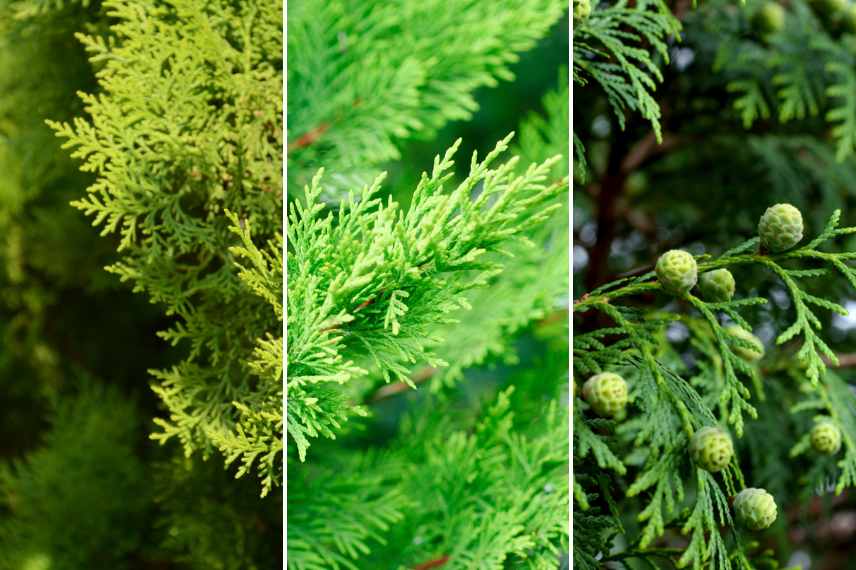
The foliage of the cypress (Cupressus), the Leyland cypress and the false cypress
But beware, rapid growth also means regular maintenance. An unmanaged cypress hedge can quickly become unruly, thinning at the base or losing density.
The secret to a dense cypress hedge: controlled pruning
Pruning is really the key to a successful cypress hedge. It helps control height and width, but above all to stimulate branching—the development of new shoots. Therefore, a regular pruning is the best solution to obtain a dense and uniform hedge, without resorting to pollarding.
When to prune?
- Ideally, twice a year: the first prune takes place in spring (April–May), and a second in late summer/early autumn (August–September)
- Avoid pruning in mid-winter or during frost: this can weaken the branches
- Similarly, avoid the hottest spells of summer: a severe prune in the middle of a heatwave can burn exposed parts
- In cases of extreme growth, a third prune may be considered in July, if it’s not too hot.
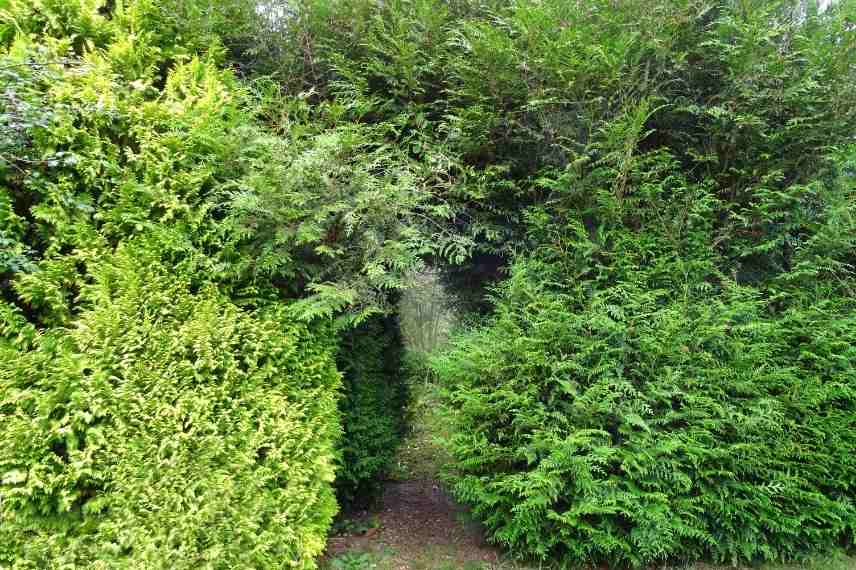
Cypresses tolerate two prunings per year
How to prune?
- Use a well‑sharpened hedge trimmer, electric or manual depending on the size of your hedge, perfectly clean and disinfected
- Always start at the top, then work downwards.
- Prune into a slightly trapezoidal, or bevelled shape : narrower at the top, wider at the base. This allows light to reach all parts of the hedge well. With this shape, it stays dense from bottom to top
- Never prune too far into the old wood (the brown wood inside) as the cypress does not readily regrow from there. Only prune the current year’s growth, identifiable by its pale green colour.
Note that birds may take up residence in cypress. The League for the Protection of Birds (LPO) recommends not pruning your hedge during the nesting period, which runs from mid‑March to the end of August. You can also simply take the care to check within the canopy before intervening.
Watering and fertilisation, two keys to success for a compact hedge
Despite their reputation for relative drought tolerance, more pronounced in Cupressus, cypresses need a minimum of water and nutrients to form a hedge. When well watered and well fed, they will be all the more beautiful, denser and more robust.
Watering
- During the first two or three years after planting, young cypresses require regular watering, especially in summer. This helps root establishment and prevents drying out. In practice, it’s better to provide water once or twice a week in large quantities, rather than watering every day in small amounts. It’s the best way to encourage roots to grow deeper. Otherwise, they stay shallow and the hedge will be less resilient
- Once well established, the hedge tolerates drought better, but supplementary watering remains useful during periods of high heat or drought, especially for false cypresses which prefer cool, moist soils
- Water preferably in the evening or early morning, to limit evaporation, using rainwater or non-calcareous water
- Installing a mulch of pine bark or pine bark or wood chip mulch at the base of the hedge helps retain moisture, suppress weeds and improve the soil in the long term
- Cypresses are extremely sensitive to waterlogged soils and saturated water which can cause root rot. Therefore, during planting, drainage must be ensured with additions of sand or gravel.
Fertilisation
-
In spring, between March and April, apply a complete organic fertiliser for conifers to boost growth and stimulate the onset of new growth and the density of the foliage
-
In autumn, a small addition of compost is recommended, especially in poorer soils. It will improve soil structure and enrich it, while aiding water retention
Preventing cypress diseases and parasitic pests
Cypress hedges are generally robust, but they are not invincible. A weakened or poorly maintained hedge is inevitably more susceptible to attacks. Hence the importance of monitoring your cypress hedge closely to spot diseases or pest infestations as early as possible.
The Cypress canker
The cypress canker is a cryptogamic disease caused by the fungus Seiridium or Coryneum cardinale. Developing under the bark, it shows a preference for Leyland cypress and Provence cypress.
Symptoms : this fungus causes a characteristic browning of entire branches that eventually die. The bark is also affected: it becomes reddish-brown and cracks. Resin exudates appear around the cankers. The cypresses die.
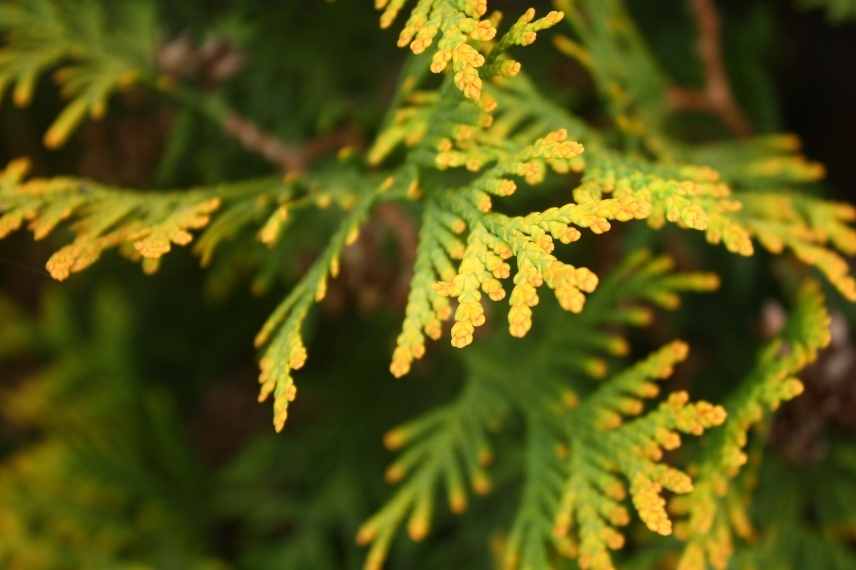
Foliage that yellows, then browns and dries is often a sign of Cypress canker
What to do? Prune the affected branches as soon as the first signs appear and take them to the recycling centre. Do not compost them. In extreme cases, removing the cypress is better to prevent spread to the entire hedge.
A good hedge aeration, achieved through regular pruning, is essential to limit the risks. And it is imperative to use a well-disinfected hedge trimmer.
Pests
In Cypress hedges, you commonly find the same parasitic insects as elsewhere in the garden, namely aphids, the mealybugs and the red spider mites. Especially on young shoots and in dry weather.
In case of a small infestation, a strong jet of water or a spray of diluted black soap can suffice. It is also advisable to encourage the establishment of beneficial insects or birds that will feast on these pests.
Base decline in Cypress hedges
This isn’t a true disease, but rather a consequence of poor maintenance. Base decline in the Cypress hedge is often linked to a lack of light, overly dry soil, or pruning that is too severe.
It is enough to prune the hedge into a flared shape. Do not hesitate to slow the growth at the top so that the bottom can thicken.
Other signs
The Cypress hedge can be affected by other signs of distress:
- Yellowing foliage? It may be due to too much or too little water.
- Brown tips on the foliage? The soil is too poor, so apply compost, or the pruning is poorly done.
- Subscribe!
- Contents
Comments