






























How to incorporate cypress trees into a contemporary garden?
Verticality and minimalism
Contents
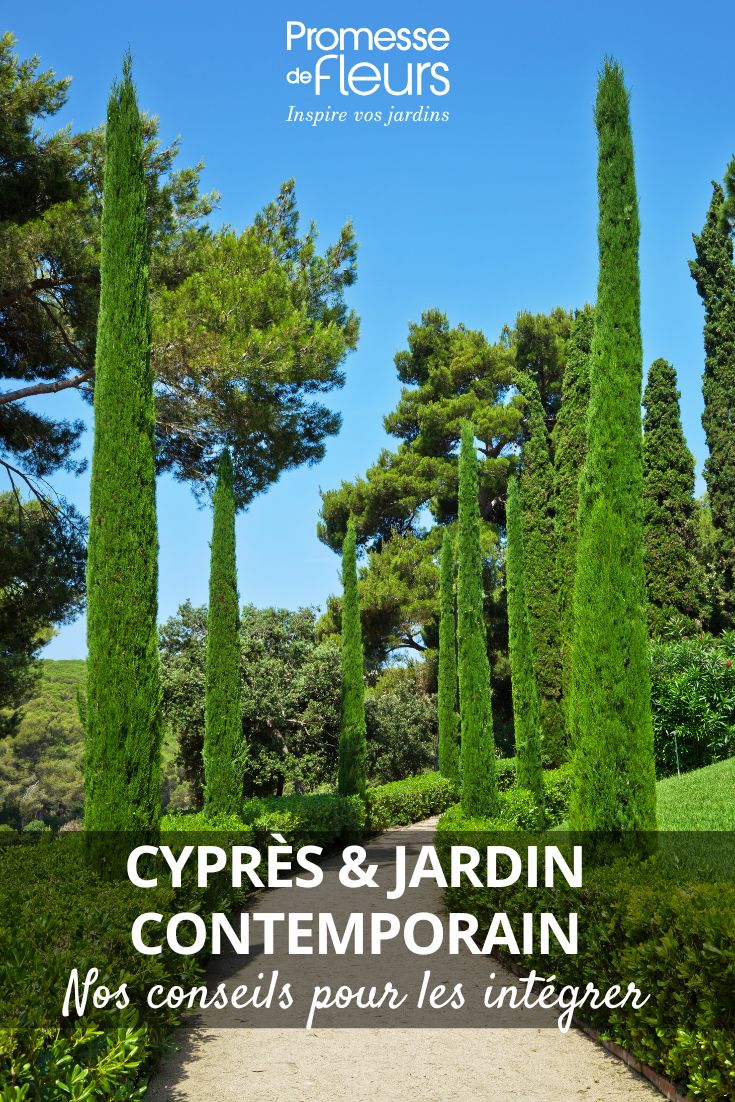
In a contemporary garden, the choice of plants is as important as the choice of materials. Wood, stone or concrete provide structure and atmosphere, but it is often the plants that give the whole ensemble its character. Among them, cypresses, notably the Provence cypress (Cupressus sempervirens), naturally stand out. Their slender habit, their verticality and their evergreen foliage create an elegant contrast with the clean lines and mineral surfaces. A few specimens, well placed, are enough to draw sharp perspectives and give the space a Mediterranean atmosphere. Discover our tips for incorporating the cypress into the contemporary garden.

Why choose cypress for a modern garden?
The cypress offers several advantages that make it an ideal companion for a contemporary-style garden:
-
a slender, vertical silhouette that draws the eye and structures the landscape without weighing it down;
- unlike other larger trees, it lets light pass through and keeps the space airy;
-
an evergreen foliage, ensuring a graphic presence in all seasons;
-
an ability to pair well with both hard landscaping (stone, concrete, gravel) and with plants with single shapes such as the pruned boxwoods or the ornamental grasses;
-
a good heat tolerance and a preference for well-drained soils, which reduce its maintenance requirements.
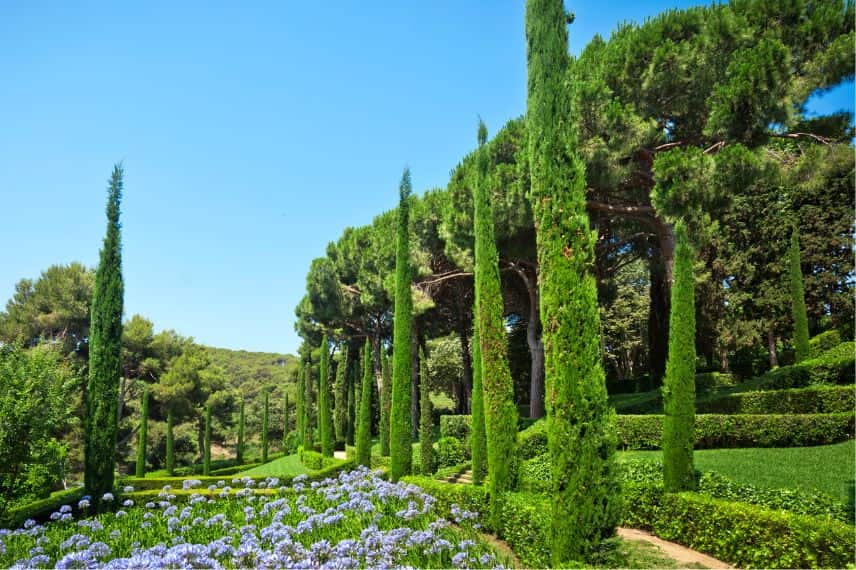
How can you highlight a cypress in a contemporary garden design?
In a contemporary garden, the verticality of the cypress helps balance the horizontal lines of terraces, paths or ponds, and guides the eye skyward. Its columnar silhouette provides a visual rhythm that transforms a space that can sometimes feel a little flat.
The cypress can be used in a variety of ways to reinforce this architectural effect:
-
in regular alignment, to create a majestic avenue and give a sense of depth;
-
in a duo or in a trio, placed along the edge of a terrace or an entrance, to mark a passage and frame the view;
-
in a standalone specimen, to emphasise a corner of the garden or to highlight a mineral feature, such as a wall or a sculpture;
-
in association with low-lying forms (pruned bush cushions, groundcover, and clumps of grasses), to emphasise the contrast between verticality and horizontality.
This arrangement of Provence cypress is not limited to a decorative effect. It also influences the perception of space by creating perspectives, by playing with depth and by reinforcing the overall harmony of the garden.
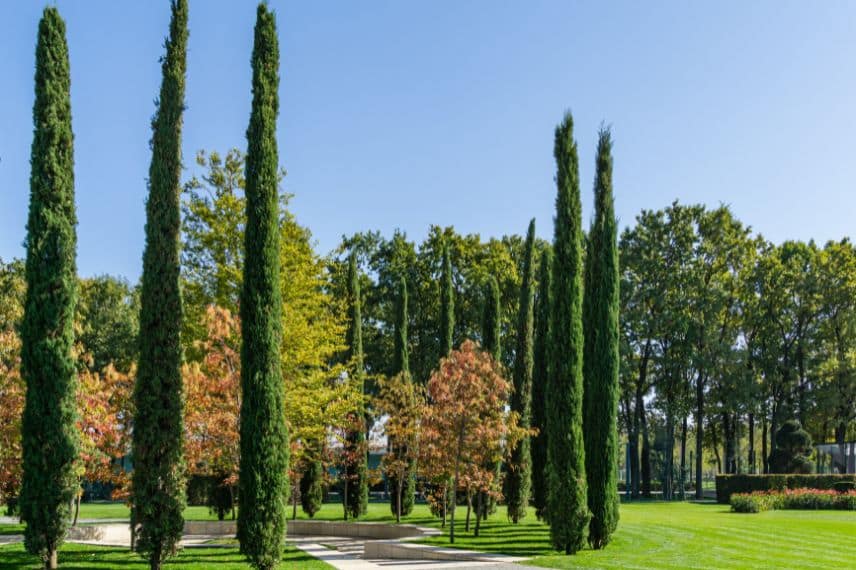
Which varieties of cypress are best suited for a contemporary garden?
For a contemporary garden, it’s important to choose varieties that emphasise verticality whilst remaining in harmony with the minimalist style.
The criteria for choosing the right Cypress:
-
Prioritise varieties with a columnar habit, i.e., very narrow so as not to encroach on space. They generally belong to the Cupressus sempervirens category (also known as Italian Cypress, Tuscan Cypress or Provence Cypress).
-
Choose a Cypress with a height at maturity suited to your garden, selecting a more modest Cypress for a small garden or, conversely, a specimen intended to become a vertical landmark in a large space.
- Anticipate the final height : even though these trees grow slowly, they are built to last. Think about their long-term placement.
-
Take into account its hardiness and resistance to cold winters or drought, depending on your region.
- Observe the desired style : do you prefer a line of cypress or a solitary specimen?
Examples of interesting varieties
-
Cypress ‘Totem’(Cupressus sempervirens ‘Totem’) : one of the narrowest varieties, with a width of 1 m at maturity and a height of 10 m. Its very narrow habit and its slow growth make it the perfect candidate for framing a modern terrace without ever taking up too much space.
-
Cypress ‘Garda’(Cupressus sempervirens ‘Garda’) : a vigorous variety with a very straight habit, perfect for forming alignments or framing a path. Its regular growth and its strict silhouette recall grand avenues of cypress in the Mediterranean.
-
Cypress ‘Pyramidalis’ (Cupressus sempervirens ‘Pyramidalis’) : slightly broader than ‘Totem’ or ‘Garda’, it remains columnar, but offers more volume. It is best used as a solitary specimen or in pairs, to create a strong plant landmark in a mineral or large garden.
-
Cypress ‘Swane’s Golden’(Cupressus sempervirens ‘Swane’s Golden’) : a golden version of Provence Cypress. It is used to bring a bright and original touch to a restrained composition, contrasting with deep greens or light materials such as white stone.
→Find all our Provence Cypress varieties on our site.
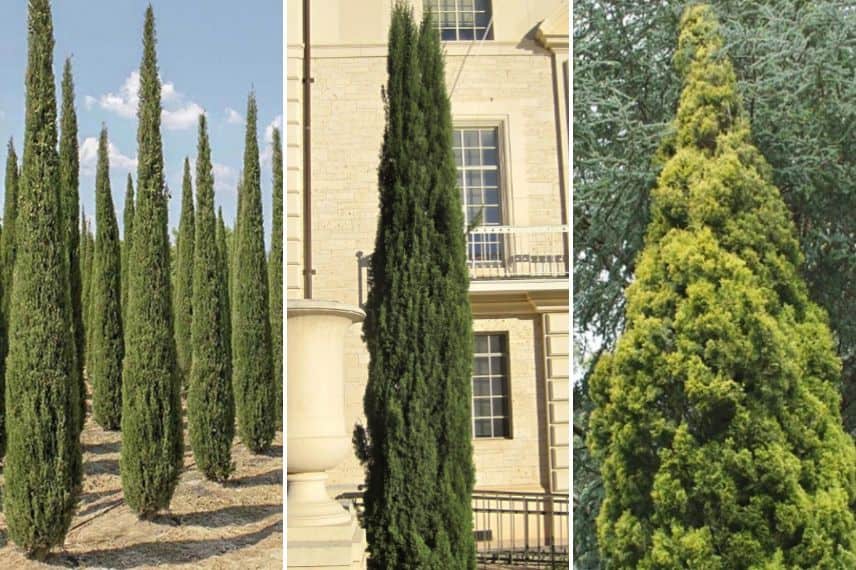
Provence Cypress: Garda, Pyramidalis and Swane’s Golden
Pairing cypresses with other elements for a minimalist effect
In a contemporary garden, the cypress does not live alone: it is often the contrast with other elements that emphasises its slender silhouette.
For example, it can be paired with light mineral surfaces, such as white gravel or smooth concrete paving. The dark green of the foliage creates a striking contrast that emphasises verticality.
In another approach, it pairs perfectly with low, geometric plants, such as boxwood trimmed into spheres or hedges, lavenders pruned into neat lines, or ornamental grasses planted in broad clumps.
For an even more minimalist look, it is wise to limit the plant palette to a few chosen species, to let the cypress’s silhouette take centre stage. The repetition of shapes and hues creates a calming atmosphere and gives the garden a cohesive graphic unity.
Finally, the use of contemporary materials such as corten steel, light wood or rough stone helps reinforce the simple elegance of this iconic tree.
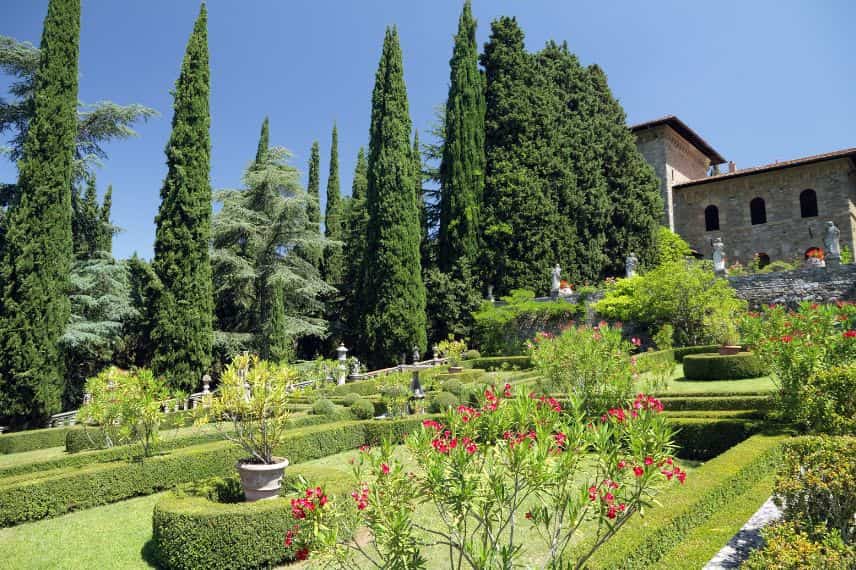
Planting and care tips for Provence Cypress
-
Choose the right exposure : plant it in full sun, in light, well-drained soil. It tolerates heat and drought once established, but dislikes heavy, waterlogged soils.
-
Plant at the right time : autumn and spring are ideal periods, avoiding frost or extreme heat, to promote a good establishment.
-
Respect spacing : allow a minimum of 2 to 3 m between two columnar cypresses, so that each retains its vertical habit.
-
Initial watering care : during the first two years, water regularly to help root establishment if rainfall is scarce. Thereafter, the cypress will thrive on its own, even in dry climates.
-
Limit pruning : no strict pruning is necessary. Simply remove dead or diseased branches. A light correction to the habit is possible if you wish to emphasise the graphic effect.
-
Plan for its long-term placement : some varieties reach 8 to 10 m in height at maturity. Consider their placement from planting so they can grow without constraint.
- Subscribe!
- Contents
Comments