





























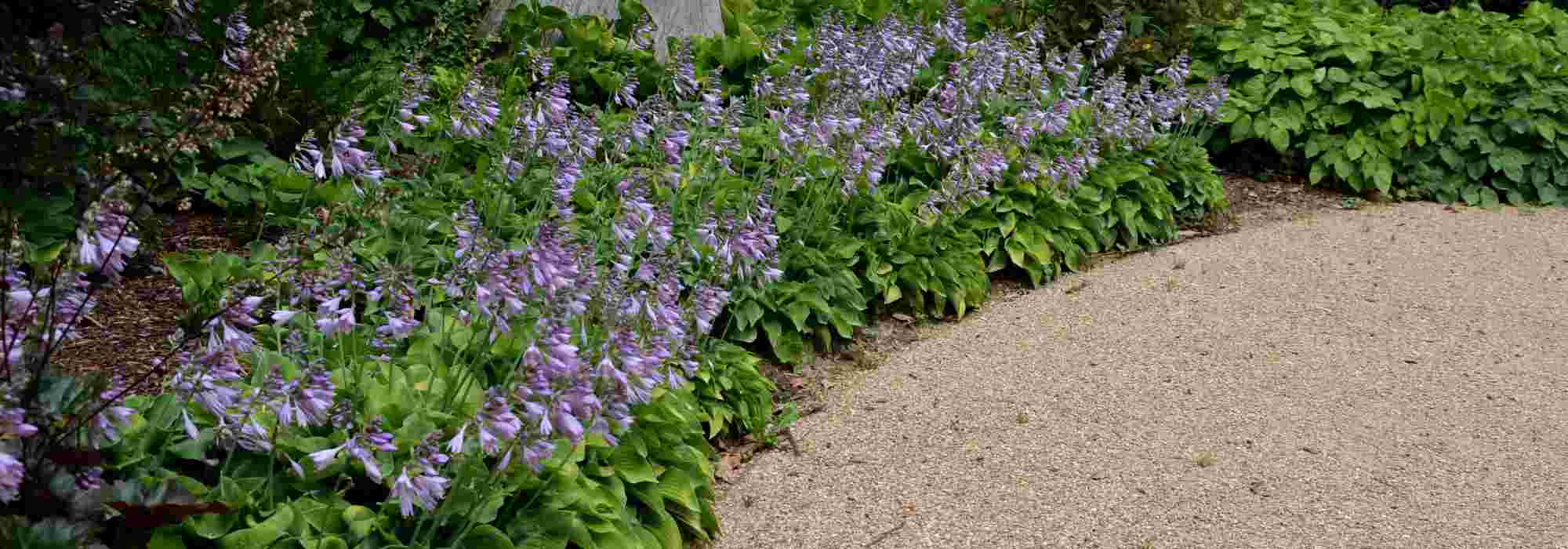
How to cover the soil without taking over? Our favourite groundcover plants
Ground cover, yes... invasiveness, no thanks!
Contents
Opting for a groundcover plant to reduce weeding and dress up a flowerbed—so the soil isn’t left bare—is a great idea in itself. But here’s the thing, sometimes the beautiful groundcover we’d hoped for becomes unmanageable as it proves to be aggressive.
Are you looking for a groundcover that delivers on its promises without being invasive? This article is for you!
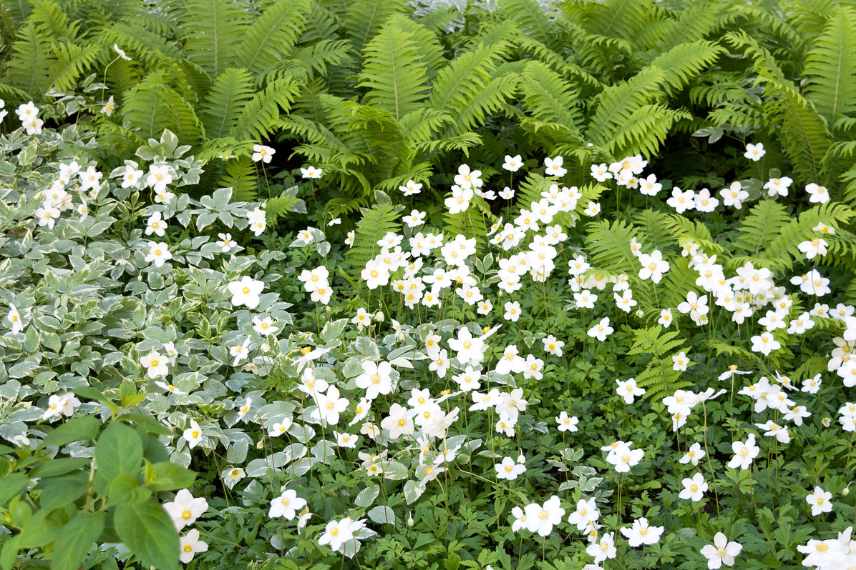
When it comes to groundcover, it is wise to make the right choice!

Why are some groundcovers invasive?
They generally have a colonising root system, with stolons, suckers or rhizomes that spread horizontally, under the soil or on its surface. This type of root system often spreads far more than is desirable. Some herbaceous perennials are thus described as stoloniferous, rooting at the nodes, such as Glechoma hederacea. We naturally think of certain bamboos such as Pleioblastus, but also St John’s wort, periwinkle, Phyla (or Lippia nodiflora), wild violet, yellow archangel (Lamium galeobdolon), some carex or ivy— real pests if you don’t want to have to keep them in check constantly by pruning or division.
Others shed their seeds that germinate all around the parent plant, which also explains their often uncontrolled progression, forming here again unwanted colonies.
Perennial plants and certain grasses are generally more to be feared in this regard than woody plants, though there are exceptions, owing to their ability to spread and to grow not only more quickly but also more vigorously. Their stolons, rhizomes or creeping rootstocks allow them to spread rapidly, but aggressively, and to cover large areas, especially if soil and climate conditions are favourable.
Invasive groundcover plants are finally often a more marked problem in shaded areas and cool, damp soils. These conditions promote the rapid vegetative spread of certain species, as they find an ideal environment to develop (too) vigorously, without strong competition from other plants. But remember that some invasive species prefer sun, such as periwinkle in hot climates, and some grasses.
Some plants thus become difficult to control once established…
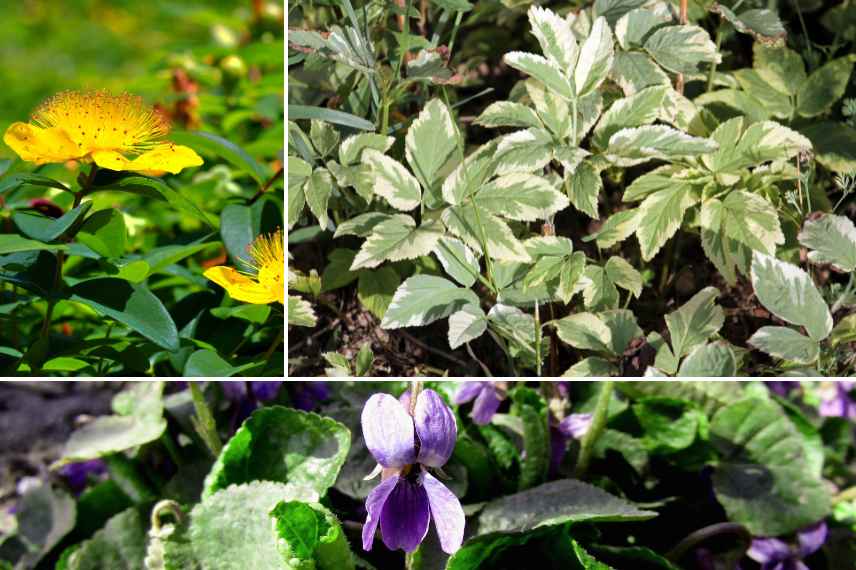
Hypericum calycinum (St John’s wort), Aegopodium podagraria ‘Variegata’ (variegated goutweed) and wild violet: small invaders in the garden…
Read also
How to stop an invasive plant?The best non-invasive groundcovers for shade, partial shade or sun
We will therefore select species with a running root system to form a dense mat, but that do not spread excessively, or else plants forming beautiful cushions. In short, ground-covering perennials or shrubs, but remaining non-aggressive to avoid the risk of invasion. Our search also focuses on plants that naturally have a ground-covering power by their spreading habit.
Here are some options of these low-growing groundcovers, both ornamental and providing good soil cover without becoming invasive: herbaceous perennials and woody shrubs, deciduous or evergreen, with a spreading or creeping habit. These groundcovers are suitable for delineated areas of the border, as in woodland shade, at the garden edge or in a difficult-to-plant area; we would rather look for the opposite effect—a ground-cover plant that does not spread excessively.
For shade
As we have seen, shaded and damp areas often allow certain perennials to spread quickly, because with less competition they eventually dominate the others. It is therefore particularly important to choose well-adapted and non-invasive plants for humus-bearing soil and for shaded, damp areas.
- Creeping Bugle (Ajuga reptans) : we love its beautiful coloured leaves and blue flowers; it is semi-evergreen depending on the region.
- Epimedium : with its superb heart-shaped foliage and delicate flowers, it brings delicacy to shaded areas and is suitable for dry shade.
- Lamium (Lamium maculatum) and its cultivars, which brighten shaded areas with their variegated leaves.
- Hostas : some hostas can serve as ground-cover, as they establish well over time, planted in cool soil (they are deciduous, going into dormancy from November to April).
- Meehania cordata and Meehania urticifolia: with heart-shaped leaves in the cordata species which produces violet flowers and prefers moist, rich soils.
- Asarum (Asarum canadense or Asarum europaeum) with evergreen leaves; they tolerate dense shade and rich, moist soils.
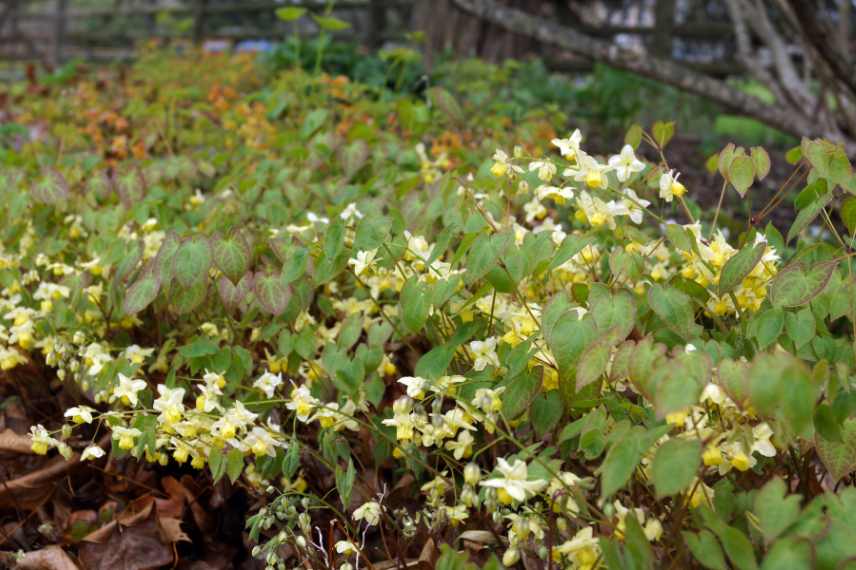
Epimedium x versicolor ‘Sulphureum’
For partial shade
- Hardy geraniums : there are many varieties with different flower colours. Many also suit partial shade as well as full sun. Their clumps are dense. They are easy to grow in various soil types and exposures. NB: avoid the species oxonianum.
- Alchemilla mollis : it forms a pretty tuft that fans out, with lovely lobed, fan-shaped leaves and small yellow flowers.
- Carpathian Campanula (Campanula carpatica) ; with its small blue bell-shaped flowers, it is ideal for rockeries.
- Some shrubby veronicas : they stay compact, in ball form, and will suit full sun in northern regions.
- Deutzia gracilis ‘Nikko’ : a deciduous shrub that bursts into magnificent white flowers in spring. Its moderate spreading makes it a good choice for large borders to protect.
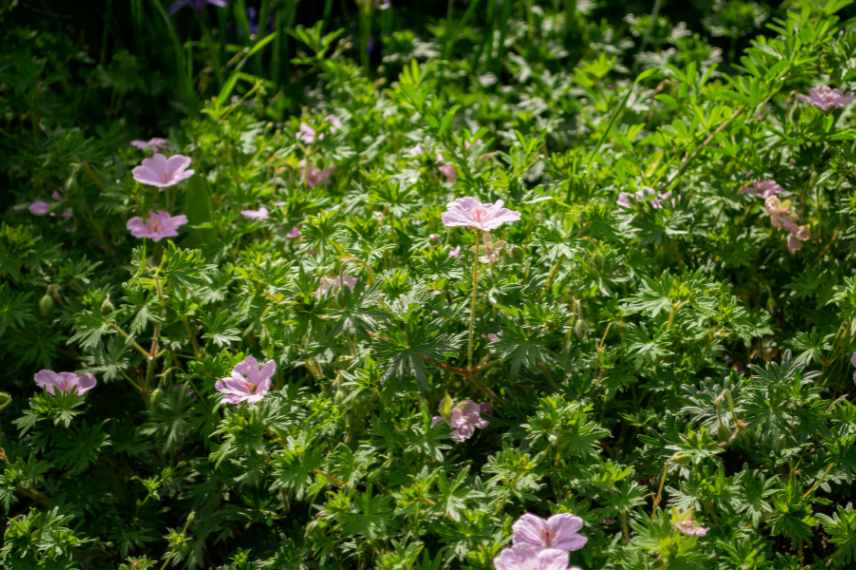
Hardy geraniums come in a wide range of heights and spreads and adapt according to the species to various exposures
Further readi : Hardy geraniums: the best ground covers,
For sun
- Potentillas : the shortest ones are perfect for forming small, spreading shrubs
- Iberis sempervirens : an evergreen ground-cover with pretty white flowers. It is appreciated for its neat appearance and its generous spring bloom.
- Creeping phlox (Phlox subulata) with its charming tiny blue, white or pink flowers in abundance in spring, forming a dense carpet in well-drained soils. It is ideal for rock gardens and sunny gardens.
- Silver Carpet (Cerastium) : with silvery foliage and small white flowers, an excellent option for well-drained soils and sun-drenched gardens.
- Spanish thrift (Armeria maritima): it forms dense tufts with pink or white flowers, ideal for coastal gardens.
- Heather : always perfect for adding colour and texture to the garden, especially in late summer, autumn and winter. They are very hardy and easy to maintain.
- Stonecrops or sedum groundcovers : succulent plants, drought-tolerant, ideal for poor soils. They are suited to sunny exposures and perfectly drained soils.
- Teucrium chamaedrys and Teucrium x lucidrys : low-growing germanders, spreading 40 to 50 cm wide.
- dwarf Abelias such as ‘Sparkling Silver’, or Abelia x grandiflora ‘Prostrata’‘Prostrata’ : their creeping or spreading habit makes them excellent ground-cover choices. They flower to frost, and their foliage is semi-evergreen depending on the region.
- Céanothus prostratus : a prostrate cultivar, excellent for coastal gardens and sunny areas. It offers lavender-blue flowers and evergreen foliage.
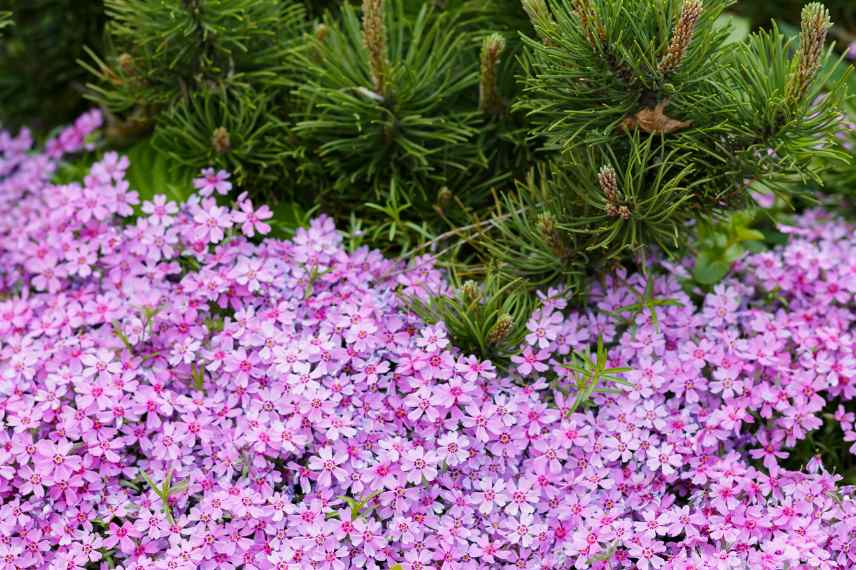
Among the wide choice of sun-ground covers, moss phlox is delightful in rock gardens: fully covering, never invasive!
Further reading : 7 evergreen winter heathers to plant as ground-cover ; 7 evergreen ground-covering shrubs requiring no maintenance ; Borders, slopes, edges: which ground-cover shrubs for partial shade? ; The best winter-flowering ground-cover shrubs ; Succulent groundcovers and Discover 5 sun-loving ground-cover perennials.
→ See also all our ground-cover perennials in our online nursery, as well as our ground-cover shrubs.
Limit or circumvent the spread of certain groundcovers
Several tips help limit the spread of overly vigorous groundcover plants, notably by choosing an appropriate location:
- Plant potentially expansive species in areas where their spread can be easily controlled or limited: they are planted in soil at the edge of their tolerance. For example, groundcovers reputed to be particularly invasive such as goutweed (Aegopodium podagraria) or the Cornus canadensis, which spread quickly and aggressively in humus-bearing and acidic soil, will be far less likely to be planted in cooler soils.
- Choose horticultural cultivars developed for their less invasive behaviour than the typical species. For example, the Pachysandra terminalis ‘Green Carpet’ is less vigorous than the Pachysandra terminalis (but it also grows more slowly…).
- Do not choose groundcovers that self-seed, or control them by removing the faded flowers, as with Alchemilla, for example.
- Avoid proximity to established perennials or planting in ornamental borders for groundcovers that are very invasive: they risk smothering them without scruple.
- Monitor their development closely to prevent too rapid an imbalance with surrounding plants. The groundcover must not become dominant. Keep an eye on the spread of the plant and intervene if it begins to extend beyond the desired area, by trimming or dividing it as soon as it takes on proportions too large relative to the other vegetation.
- Avoid the most invasive species, or reserve them for specific zones that you actually want to see completely covered: Hypericum, periwinkle, ivy, Aegopodium, etc. The Houttuynia cordata also becomes invasive in the very moist soils it loves or in humid climates.
- Subscribe!
- Contents
Comments