






























How to care for an indoor Anthurium throughout the seasons?
Tailor your care for a beautiful indoor plant
Contents
Anthurium is a tropical plant in the Araceae family, a well-known and appreciated family among houseplant enthusiasts. With more than 600 varieties, it comprises a wide range of cultivars. Some varieties are flowering, such as the Anthurium andraeanum, often called the red Anthurium or the white Anthurium depending on the colour of their heart-shaped flowers, often mistaken for petals but which are actually bracts. Among the species prized by collectors of spectacular foliage, we include the Anthurium crystallinum, with velvety foliage marbled with striking white veins.
This versatile plant is relatively easy to care for, provided you give it a suitable environment and appropriate care. Like many tropical plants, the Anthurium requires particular attention to changes in light, humidity and temperature throughout the seasons. A good understanding of its needs is therefore essential to keep it healthy and to continue flowering or developing its magnificent foliage all year round.
In this article, let us explore in detail how to care for an Anthurium, with practical tips on watering, the ideal placement, and the steps to take across the seasons.
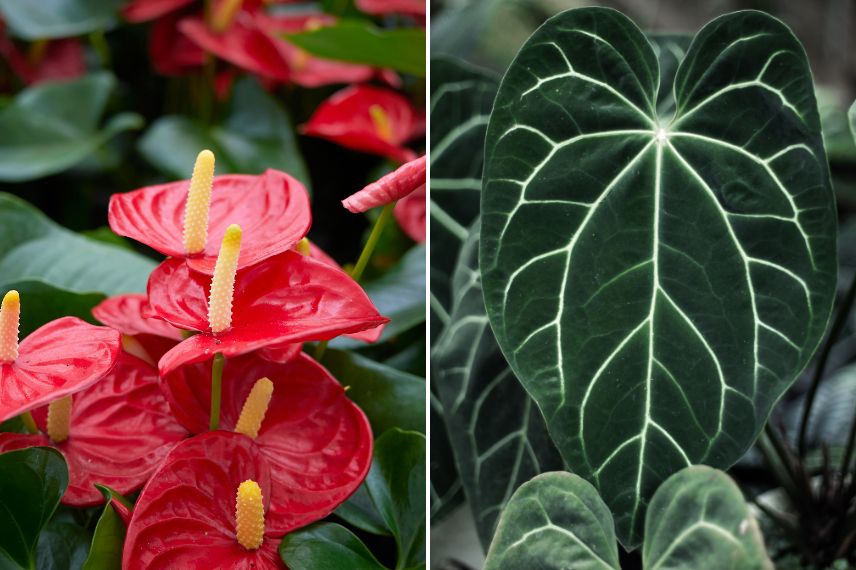
The Anthurium as it has long been known on the left (A. andraeanum) and as it has become known since the recent boom in houseplants (A. crystallinum)

Where to place an Anthurium in the home all year round?
Anthurium is a tropical plant that thrives in a bright, warm and slightly humid environment. That is, an environment readily achieved by placing the plant in a terrarium or a closed glass-fronted cabinet, as is increasingly popular among indoor plant enthusiasts with lush foliage. Many anthuriums commonly available in shops and fairly tolerant can, however, be grown more simply, like a conventional houseplant. The choice of placement is essential to ensure its health, flowering and the beauty of its foliage. Here is how to position it correctly in your home throughout the year.
A bright location, but not overly bright, to be adjusted throughout the year
Anthurium loves light, but it fears direct sun rays, which can burn its leaves or dull its flowers. A well-lit room, near a window facing east or north, is ideal.
- In autumn and winter: during the darkest months, place your Anthurium near a window to capture the limited natural light. Be careful that the location isn’t too cold, as this can happen when windows are too close. If the light levels remain insufficient, you can use a grow light.
- In spring and summer: with the stronger sun, slightly move your plant away from south- or west-facing windows, or use a light curtain to filter the light.
A comfortable, steady temperature
Anthurium loves warmth, but it dislikes sudden temperature fluctuations. Maintain an ambient temperature between 18 and 25 °C, avoiding areas where it could fall below 15 °C, especially in winter.
- To avoid: cold drafts near poorly insulated windows or doors that are often left open.
- In winter: protect your Anthurium from radiators and heaters that dry the air.
An appropriate ambient humidity
As with many tropical plants, the Anthurium thrives in a slightly humid atmosphere. A humidity level of 50 % for flowering Anthuriums, 60 % for Anthurium crystallinum, and 70 % for some rare-leaved Anthuriums (hence the terrarium or the glass-fronted cabinet where the atmosphere is humid and stable).
- For flowering Anthuriums (red or white): they tolerate moderate humidity better, but air that is too dry can slow their flowering.
- For the Anthurium crystallinum: This decorative-leaf variety requires a more humid environment. Place it in a bright bathroom or use a humidifier to recreate a tropical climate.
Tips
- If possible, group several tropical plants to create a more humid microclimate.
- Watch the leaves: if they yellow or the flowers lose their shine, this may indicate a problem with light or placement. Consider using a humidifier.
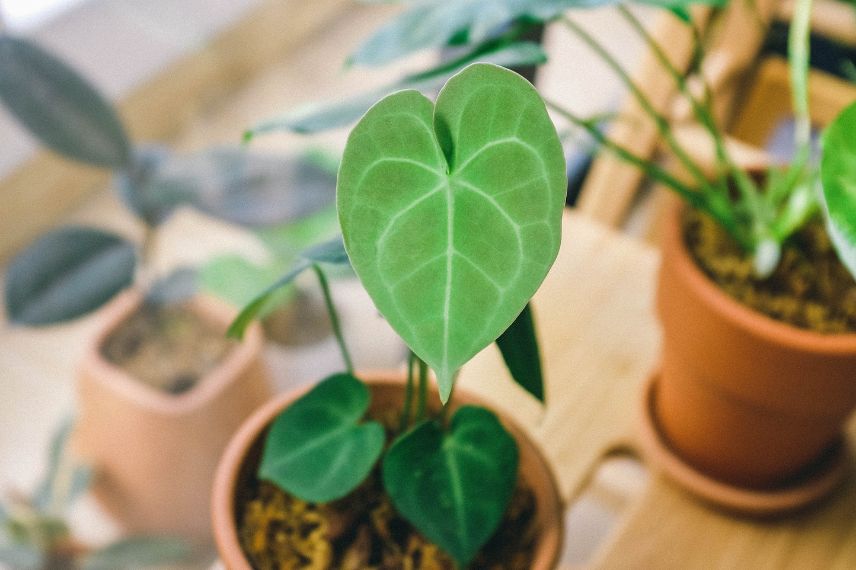
When and how to water anthurium?
As with many tropical plants, Anthurium needs a substrate that stays evenly moist, but it fears waterlogging. Finding the right balance between moisture and drainage is essential to keep its flowers and foliage healthy.
When and how to water an Anthurium?
In spring and summer:
During the active growth period, the potting compost should remain consistently moist. Watering once to twice a week is usually sufficient, but it depends on ambient temperature and humidity.
- Test the soil with your finger: if it is dry to a depth of 2 cm from the surface, it’s time to water.
- Avoid waterlogging of the potting mix, which could cause root rot.
Autumn and winter:
Anthurium enters a resting period, and its water needs decrease. Water about every 10 to 15 days, allowing the potting mix to dry slightly more between two waterings. Adjust according to your indoor conditions: in a cool environment, the substrate stays moist for quite a while in winter. In a room where the temperature exceeds 20°C, you will need to water more often, probably once a week (but test with your finger, it’s the most scientific method!).
How to tell if an Anthurium is thirsty?
Anthurium readily shows its water needs, provided you pay attention:
- Drooping or wilted leaves, or leaves that turn yellow: this indicates either overwatering or underwatering. Your watering practices and observation of your potting mix should help you determine which option applies.
- No new flowers or slow growth: this may be due to underwatering or prolonged water stress. The same applies.
Good watering practices
For optimal watering, adopt a few simple habits:
- Use soft water: tap water high in minerals can harm the plant. Prefer rainfall or filtered water.
- Water at room temperature: water that is too cold can stress the roots.
- Drain the pot properly: ensure your pot has drainage holes to prevent water from stagnating and that your substrate is well-balanced with adequate water retention and drainage elements (→ see the article Growing Anthurium). After watering, empty the excess water from the saucer.
The specific needs of different varieties
- Red and White Anthuriums: These flowering varieties have moderate water needs. Maintain regular moisture without excess to prolong flowering.
- Anthurium crystallinum: With its spectacular foliage, this variety is more sensitive to humidity variations. Ensure constant hydration and avoid the substrate from drying out completely, especially in summer.
Seasonal care for a flourishing Anthurium
Anthurium keeps pace with the seasons, even indoors.
Spring and summer: promote growth and flowering
With the arrival of the sun-filled days, Anthurium enters a phase of active growth. Here’s how to support it during this period:
- Mist the leaves regularly to raise ambient humidity.
- Add a liquid fertiliser for flowering or green young plants every two to three weeks to stimulate flowering or strengthen the foliage, particularly for the Anthurium crystallinum. Always dilute the fertiliser to avoid damaging the roots.
- Cut spent flowers back at their base to encourage the appearance of new inflorescences.
Autumn and winter: conserve the plant’s energy
In autumn and winter, days shorten and temperatures fall, which brings a resting phase for Anthurium. Here are the care tips to prioritise:
- In winter, the dry air from heating can stress the plant. Use a humidifier and/or mist the leaves regularly. This is important for large‑leaved Anthuriums.
- Withhold fertiliser applications until spring to avoid overloading the plant while it is resting.
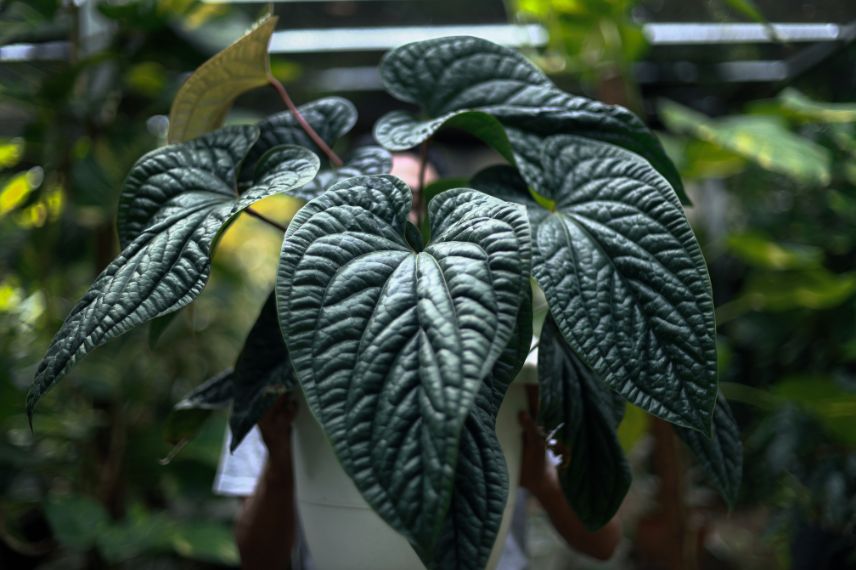
Anthurium radicans
Read also
Misting indoor plantsA few extra tips for year-round Anthurium care
Cleaning the leaves for vibrant foliage
The wider the Anthurium leaves are, the more surface there is for dust that hampers photosynthesis.
- Gently wipe the leaves with a soft, damp cloth every fortnight or monthly.
- Avoid leaf shine products, which can clog the pores of the leaves and harm their health.
Identifying the causes of small problems
- Why does my Anthurium have brown spots on the leaves? This is a sign of air that is too dry or sunburn. Increase ambient humidity or move the plant to a less exposed spot.
- Lack of flowering: a lack of light or nutrients can be the cause. Move your Anthurium closer to a light source and consider using a fertiliser in spring.
Creating a stable and welcoming environment
Anthuriums prefer a stable environment.
- Avoid frequent moving: a change of environment can stress the plant, especially if light or humidity conditions differ.
- Monitor the temperature: don’t leave the plant in a room where the temperature fluctuates abruptly.
- Group your tropical plants: this creates a humid microclimate that benefits all the plants.
- Subscribe!
- Contents
Comments