





























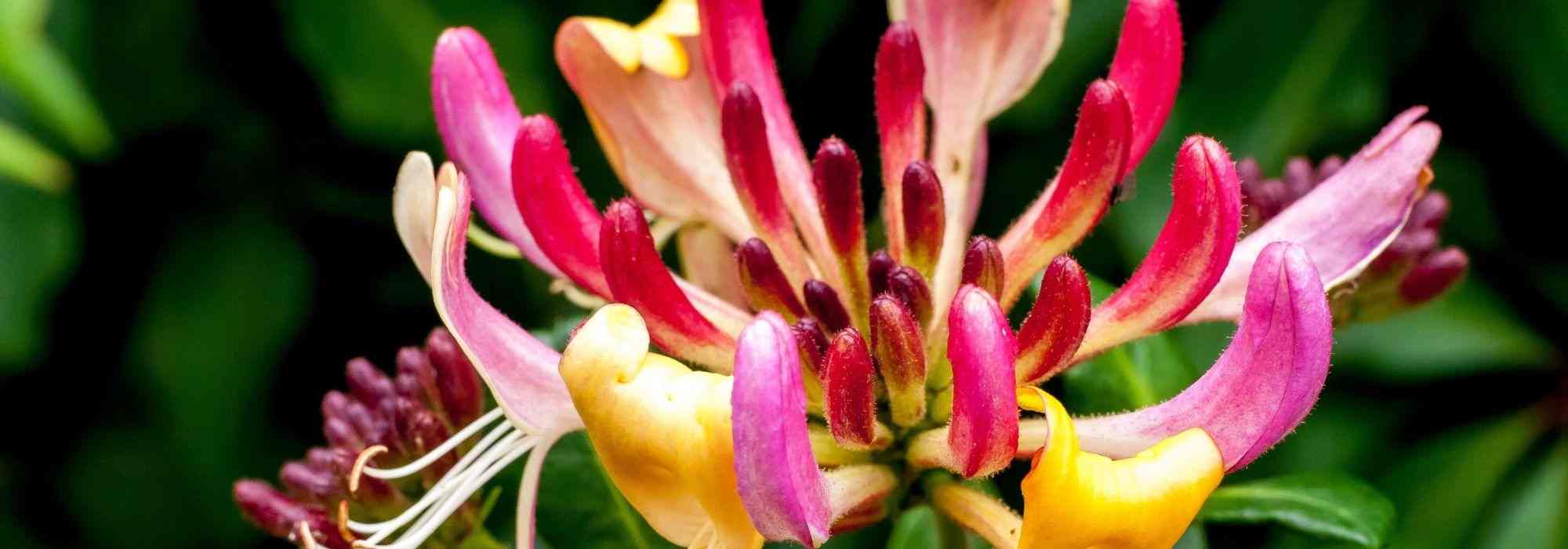
Honeysuckle: the most beautiful varieties
Our selection of 7 stunning loniceras
Contents
Very popular, the Honeysuckle is a plant highly appreciated by gardeners. For certain species and varieties, it is the flowering, whether fragrant or not, that makes an impact. For others, it is the foliage that stands out (variegated or coloured). Climbing honeysuckles are easily used on a support or on a slope as groundcover, while bush honeysuckles are better suited for rockeries or hedges. The Lonicera therefore offers numerous landscaping possibilities. Dwarf or giant honeysuckle, deciduous or evergreen, discover our 7 favourite varieties and species, each with its own aesthetic advantage!
→ Also find all our tips on the planting and care of honeysuckles in our comprehensive guide.

Japanese honeysuckle ‘Aureoreticulata’: an original foliage
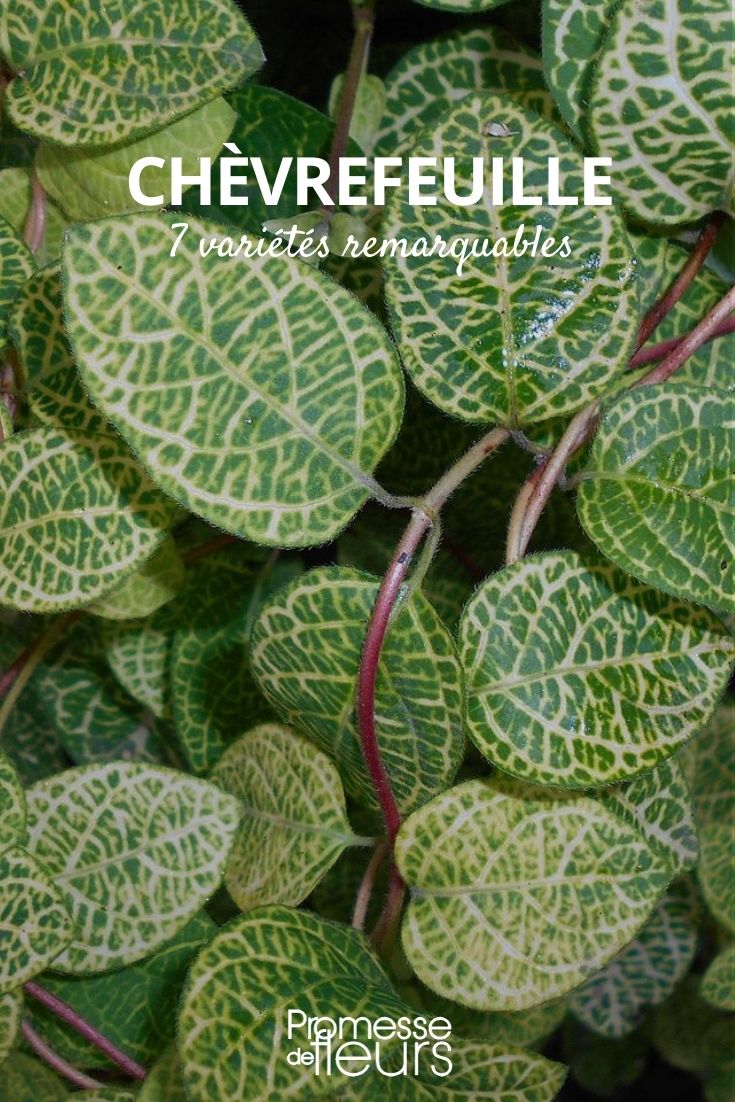
The Lonicera japonica ‘Aureoreticulata’ is a cultivar with surprising variegated foliage! Semi-evergreen, this Japanese honeysuckle boasts stunning bicoloured green and yellow leaves. Its single, bright green leaves are heavily veined with yellow, giving a beautiful marbled appearance to this climbing plant. The honeysuckle ‘Aureoreticulata’ flowers from June to August. These small flowers measuring 2 cm are fragrant. Initially white, they turn creamy yellow at ripeness. Then, successively during flowering, small fleshy berries of dark purple-black appear to adorn this climber. In partial shade, the Lonicera japonica ‘Aureoreticulata’ can reach up to 6 m in height and spread up to 3 m in width. It is therefore perfect for concealing an unsightly wall alongside the clematis Clematis cirrhosa ‘Advent Bells’, which reveals its flowers from February to March, and then from November to December. Finally, the Clematis ‘Mrs Cholmondeley’, flowering in spring and autumn, completes the picture to ensure a long-flowering display for almost the entire year!
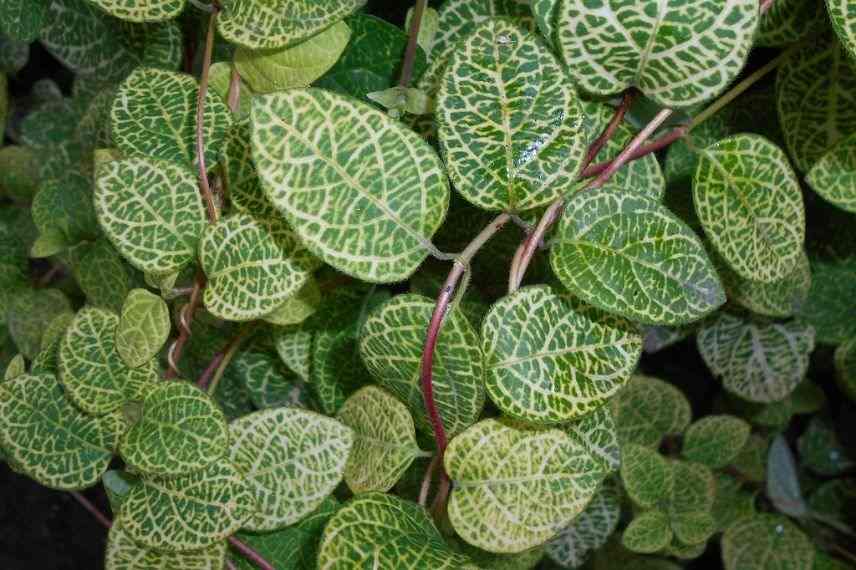
Lonicera japonica ‘Aureoreticulata’ (photo Wikipedia)
Garden honeysuckle: bicoloured inflorescences
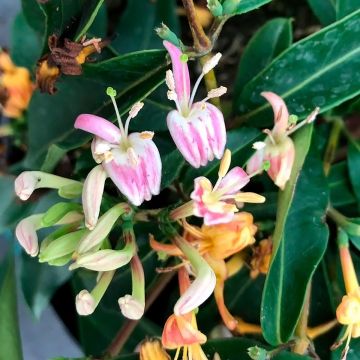
The Lonicera caprifolium is a species that produces beautiful flowers tinged with cream-white, yellow, and pink from May to June, sometimes into July. Before opening, the flower buds are particularly pink. Its deciduous foliage is notably very rounded at the tips of the branches. These grey-green leaves are fused together, forming a cup in which the inflorescences are inserted in clusters. Also known as common honeysuckle and native to Europe, it is very common in our gardens. Moreover, when evening falls and night arrives, it releases a pleasant and strong fragrance. In autumn, the fruits appear as orange-red berries following the flowering. Plan for a large support for this tall honeysuckle, which can reach 5 to 6 m in height and 3-4 m in spread at maturity. Since it loses its leaves (it is deciduous), pair it with an evergreen climbing plant to achieve prolonged decorative effect: the climbing hydrangea Hydrangea seemanii, the ‘Winter Ruby’ star jasmine with purple leaves, the robust Banks rose ‘Rosea’, or the Canary ivy ‘Gloire de Marengo’ with its bright variegated foliage.
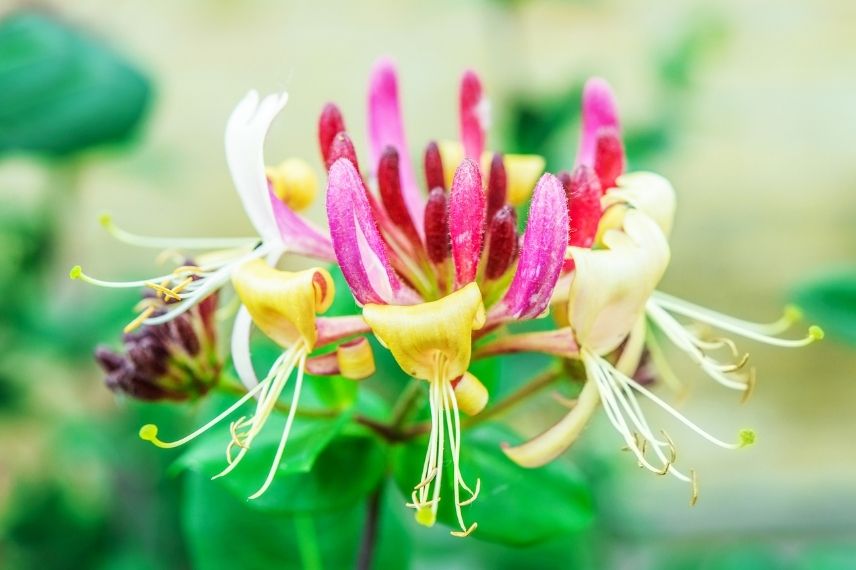
Lonicera caprifolium
Discover other Honeysuckle
View all →
Available in 2 sizes
Available in 2 sizes
Available in 2 sizes
Available in 2 sizes
Available in 1 sizes
Available in 1 sizes
Available in 1 sizes
Available in 1 sizes
Available in 1 sizes
Available in 1 sizes
Dwarf honeysuckle ‘Chic et Choc’: a small multicoloured silhouette
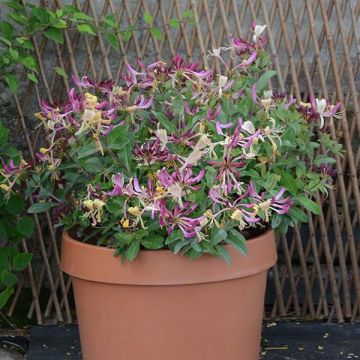
The Lonicera periclymenum ‘Chic et Choc’ is a dwarf, bushy variety. Forming a rounded clump, this honeysuckle reaches a height of no more than 1 m at maturity and 70 cm in width. It grows perfectly in pots on the terrace or balcony, as well as in the ground in small gardens. This small bush delights us with an abundant summer flowering from June to September. At this time, numerous dark pink to purple flower buds appear. These then open into flowers of a rosy white colour, gradually turning to orange-yellow and carmine pink. This recent cultivar (2012) also exudes a sweet fragrance. Depending on the climate, its dark green, slightly bluish foliage can be deciduous, semi-evergreen, or evergreen. Note that the ‘Chic et Choc’ honeysuckle produces very few fruits. Growing quite slowly, plant the Lonicera periclymenum ‘Chic et Choc’ in a border, as a low hedge, or in a rockery alongside small bushes such as the birch-leaved spiraea ‘Pink Sparkler’ with its repeat flowering pale pink blooms, the small Deutzia ‘Yuki Snowflake’ that flowers in spring, or the golden green Japanese spindle ‘Microphyllus Aureovariegatus’.
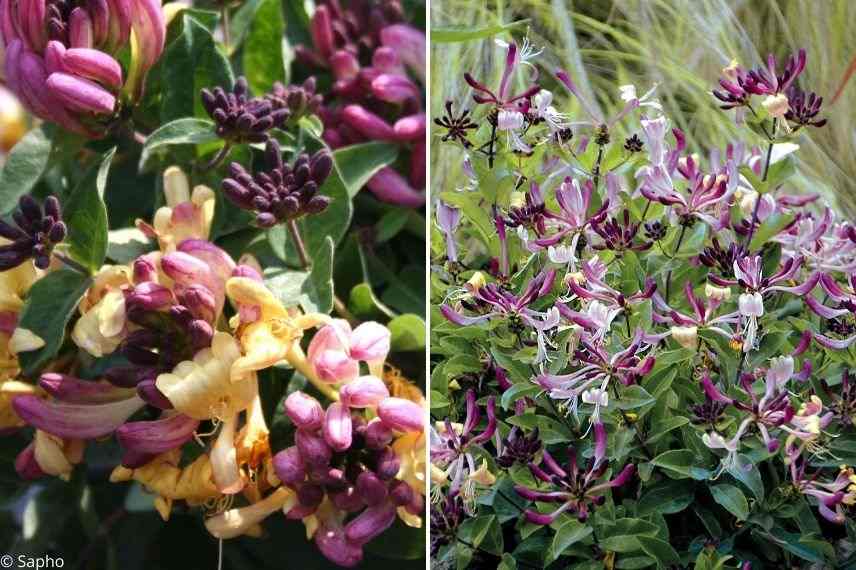
Lonicera periclymenum ‘Chic et Choc’
Japanese honeysuckle 'Halliana': highly floriferous and fragrant
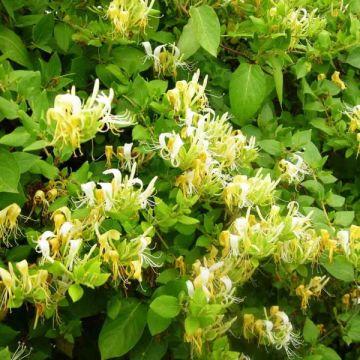
The Lonicera japonica ‘Halliana’ is highly valued for its powerful fragrance. This vigorous climbing honeysuckle produces flowers about 4 cm particularly fragrant from June to October. This long flowering period, initially white, then takes on a cream-yellow hue. Easy to grow, be aware that this honeysuckle is very large (5 to 10 m in height) and it is best reserved for larger spaces in sunny or partially shaded locations. To make the most of this fragrant flowering from June to September, place your Japanese honeysuckle ‘Halliana’ near the house on a support or let it cover a bank. In a scene with warm tones, find it a spot alongside a bright orange-flowered trumpet vine (Campsis grandiflora), a variegated Virginia creeper like Parthenocissus quinquefolia ‘Star Shower’, or even a rambling rose such as the David Austin English rose ‘Malvern Hills’. Don’t hesitate to incorporate the fragrant flowers of honeysuckle ‘Halliana’ into your bouquets!
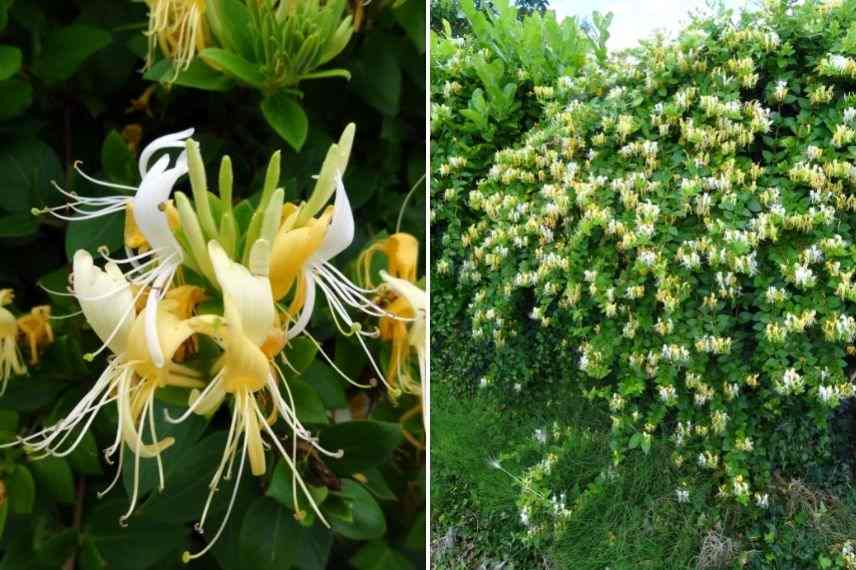
Lonicera japonica ‘Halliana’
Lilac honeysuckle: rare bush with fragrant spring flowering
Introduced to Europe in the late 19th century, Lonicera syringantha is a little-known bush honeysuckle, yet it boasts beautiful qualities. Firstly, its spring flowering is highly fragrant and reminiscent of lilac. From April to June, it is adorned with charming pale pink flowers, distinct from those of traditional honeysuckles. These highly melliferous flowers are perfect for attracting pollinating insects and bringing life to the garden. If the climate suits this bush, it may even bloom again in September. After flowering, small red fruits add a splash of colour. Native to China, the lilac honeysuckle is perfectly hardy and can be used in a country hedge. Also known as lilac honeyberry, it prefers soils rich in humus, well-drained, sandy, or stony, and adapts well to calcareous soils. Forming a spreading clump of 1.5 m in all directions, sometimes reaching 2 m in height, we recommend pruning this bush honeysuckle during the first few years to encourage its branching. Create a flowering hedge by combining the lilac honeysuckle with the white spring flowering of Exochorda racemosa ‘Niagara’, which is of similar size, and a buddleia with purple flowers that takes over the flowering in summer. The ‘Sunny Charm’ abelia will brighten the hedge with yellow flowers until October. The Fortune osmanthus and ‘Heaven Scent’ osmanthus will ensure autumn and winter flowering.
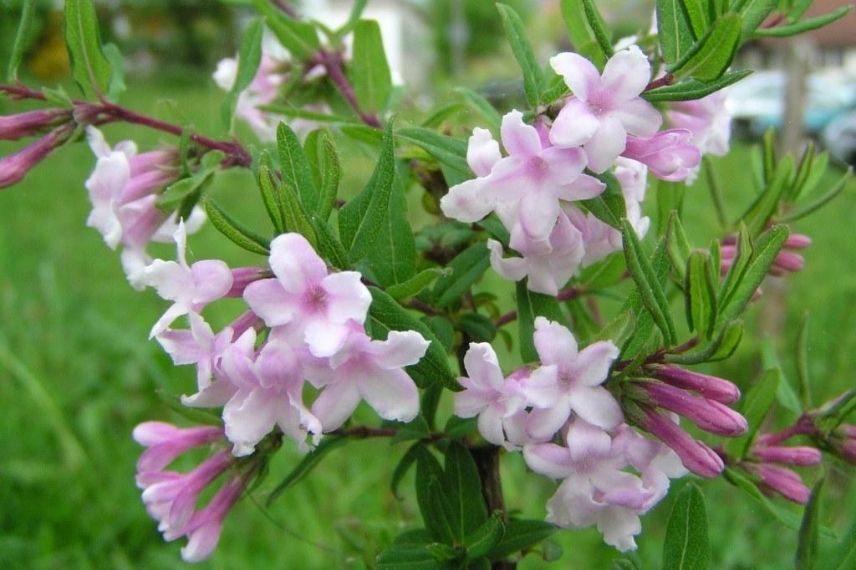
Lonicera syringantha (photo Wikipedia)
Henry's honeysuckle 'Copper Beauty': a decorative leaf
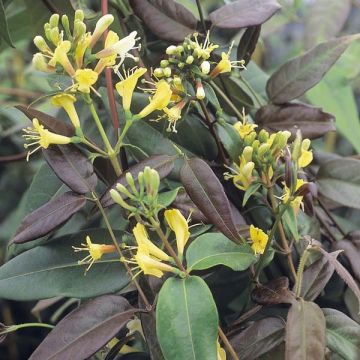
The Lonicera henryi ‘Copper Beauty’ stands out from other climbing honeysuckles due to its colourful foliage. Indeed, the young shoots appearing in spring are tinged with beautiful bronze-purple highlights. Then, the leaves elongate to 8-10 cm and take on a dark, glossy green colour. From June to July, it adorns itself with trumpet-shaped yellow-orange flowers, gradually turning red. Unlike the typical species, which is not fragrant, this variety emits a light floral scent. Henry’s honeysuckle clings to its support with its woody climbing stems. Let it climb on a pergola or arch by planting some perennials or bulb plants at its base to keep the soil cool: heuchera, hardy geranium, lesser periwinkle, muscari, Naples cyclamen, or bluebell.
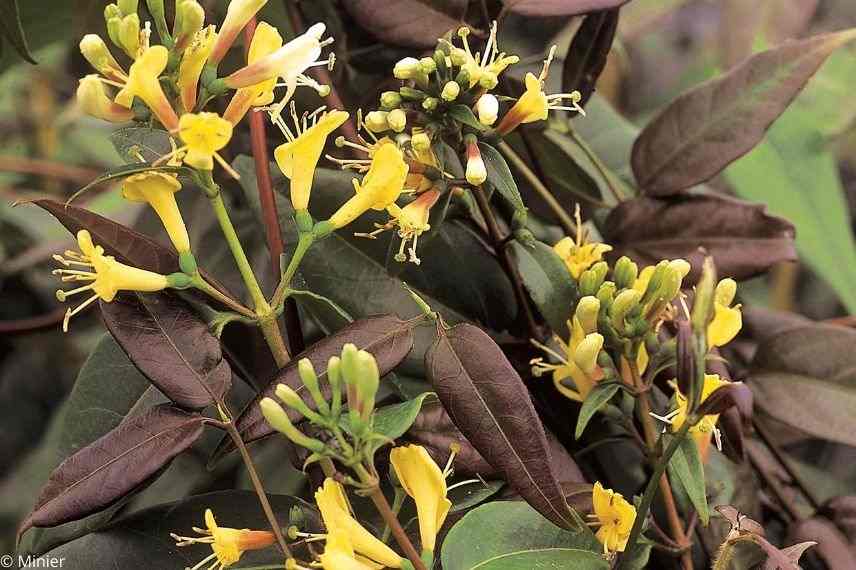
Lonicera henryi ‘Copper Beauty’
Brown's Honeysuckle ‘Dropmore Scarlet’: flowers with a unique shape
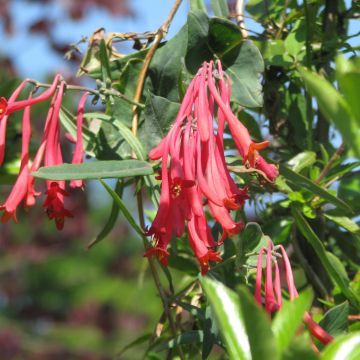
The Lonicera (x) brownii ‘Dropmore Scarlet’ features a rather unique flowering compared to many honeysuckles. Although they are not fragrant, its inflorescences add charm to this honeysuckle. The flowers develop into long tubes and are only slightly flared at their tips. Scarlet red on the outside, they reveal a bright orange throat from which the stamens and pistil emerge. Its bouquets of flowers do not go unnoticed and brilliantly enliven the garden twice a year (June/July, September/October). Reaching no more than 3.5 m in height, create a duo of climbing plants by combining this Brown honeysuckle with a mauve-blue clematis (Clematis diversifolia ‘Juuli’, Clematis integrifolia ‘Durandii’) or a passion flower (‘Purple Haze’, ‘Purple Passion’, ‘Snow Queen’).
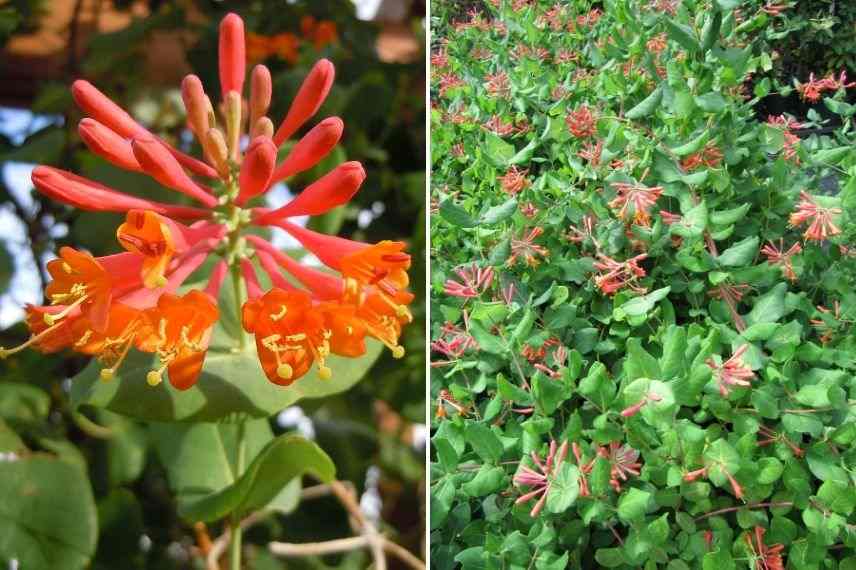
Lonicera (x) brownii ‘Dropmore Scarlet’ (photo left Matt Lavin – Flickr; photo right Leonara Enking – Flickr)
For further reading
Discover our advice sheet on how to Choose a Honeysuckle.
Explore our selection of the most fragrant honeysuckles, as well as the reliable choices.
For inspiration, check out our association sheet: Associate Honeysuckle.
- Subscribe!
- Contents
Comments