





























Growing turmeric in pots: all our tips
Our tips for easy turmeric planting and care
Contents
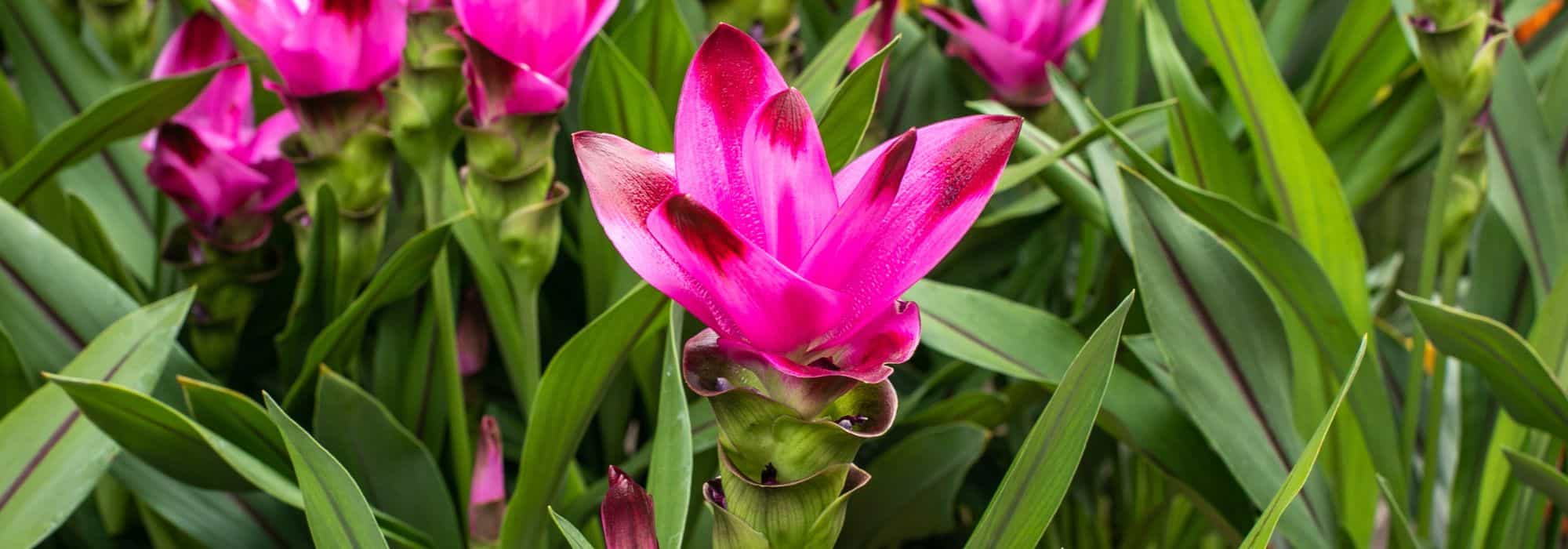
Turmeric, or Curcuma longa, is a tropical perennial plant prized for its rootstocks with multiple uses, notably in cooking for its orange, peppery spice, but also in herbal medicine. Its ornamental cousin, the Curcuma alismatifolia, offers spectacular flowers, but it is not edible. Hardly hardy, turmeric can be grown in the garden in warm climates, but mainly in pots to enjoy this plant in most of our regions and to protect it from the cold in winter. In a pot, turmeric is easy to maintain, while bringing an exotic touch to your outdoor or indoor spaces. Discover everything you need to know about growing turmeric in pots, from planting to daily care.
Why growing turmeric in a pot?
Growing turmeric in pots offers numerous benefits, whether for the edible Curcuma longa or for the Curcuma alismatifolia and its ornamental flowers:
- To move and overwinter a young plant easily: Growing in pots allows you to move the young plant according to its needs. You can expose it to sun on the terrace during the summer and bring it indoors in winter to protect it from the cold, as it cannot tolerate frost.
- To showcase it and enjoy its ornamental qualities: Placed on a terrace or balcony, turmeric in pots is also a very decorative young plant, thanks to its luxuriant foliage and, for some varieties, its distinctive flowers.
- To simplify care: In pots, it is easier to monitor the water needs of the young plant, avoiding excesses that could lead to rootstock rot. Moreover, nutrient inputs and pest or disease control are simpler in this controlled environment.
Read also
Turmeric: planting, harvest, benefitsWhich turmeric young plant should I choose for growing in pots?
As you will have realised, there are two main species of turmeric:
- The Curcuma longa (edible) : This turmeric produces rootstocks rich in curcumin, a substance reputed for its antioxidant properties used in phytotherapy, but also for the orange spice extracted from its rootstocks and highly prized by cooks.
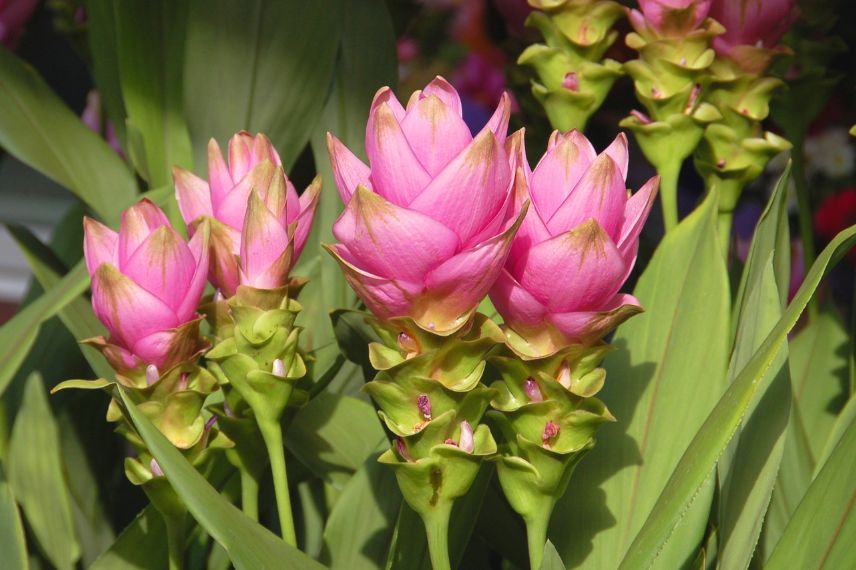
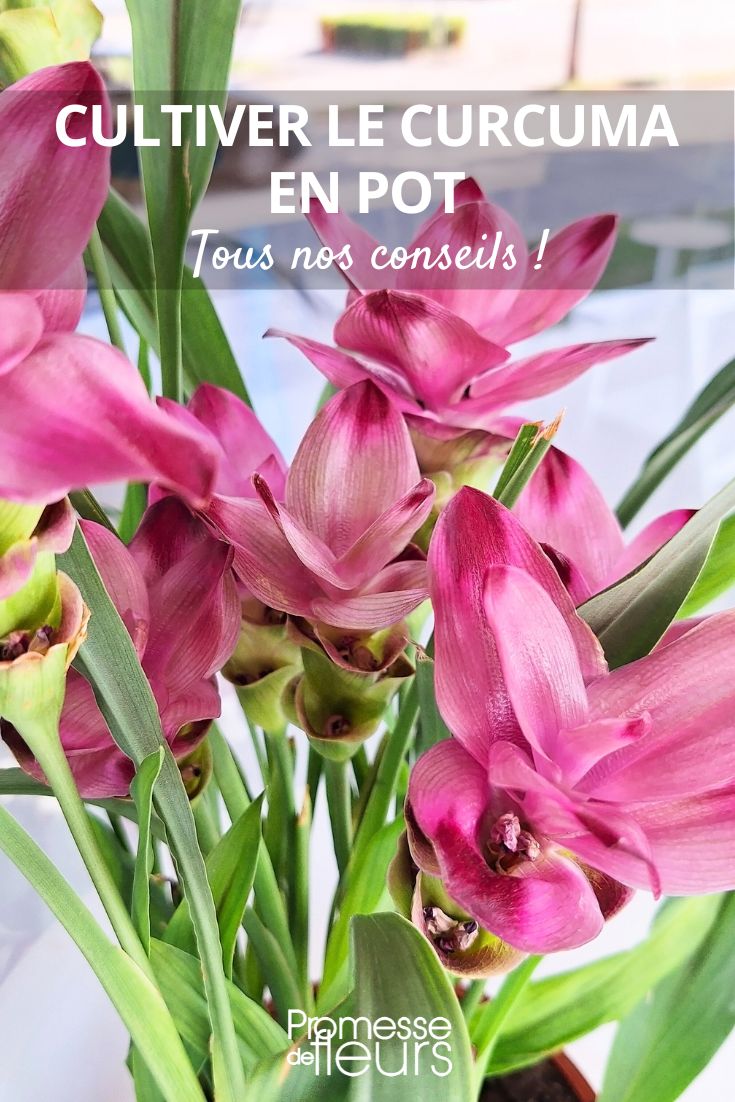
- The Curcuma alismatifolia (ornamental) : These curcumæs are distinguished by their exotic flowers, pink or white, which recall tulips, hence their nickname of the “Siam tulip”. They are perfect for decorating terraces and balconies.
Some varieties of Curcuma alismatifolia:
- Curcuma alismatifolia ‘White’ : An elegant variety with delicate white flowers.
- Curcuma alismatifolia ‘Pink’ : Ideal for its soft pink flowers that brighten outdoor spaces.
- Curcuma alismatifolia ‘Red’ : A remarkable variety with vivid red flowers for a vibrant and exotic touch.
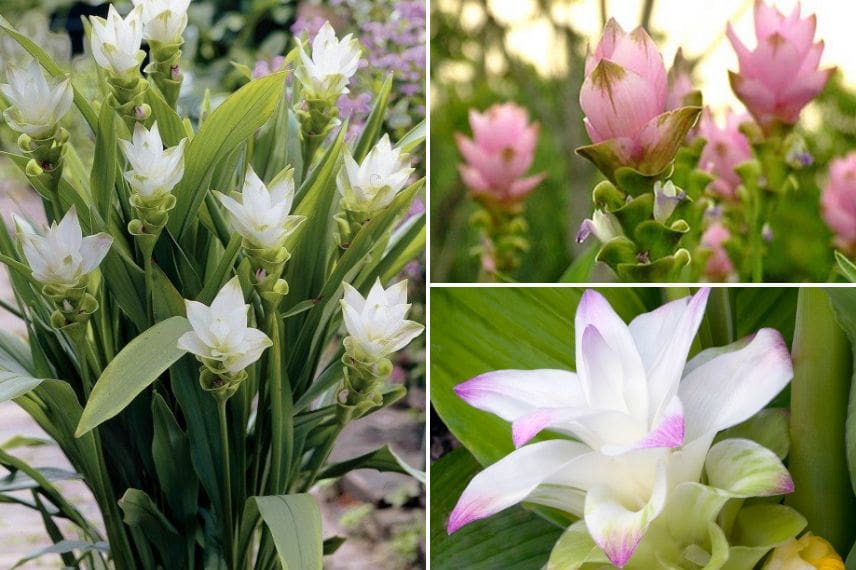
On the left: Curcuma alismatifolia ‘White’ ; on the upper right: Curcuma alismatifolia ‘Pink’ and at the bottom: Curcuma longa
When to plant turmeric in a pot?
The advantage of container gardening is that you can plant indoors almost all year round. But there is still an ideal planting period: spring. Outdoors, you can also plant in spring, around April–May, when night-time temperatures are above 12–15°C.
- Why in spring? Rootstocks then enter a growth phase thanks to the mild temperatures of the season and sufficient sunlight.
- Other possible periods: You can also plant in summer, provided you water regularly and avoid a heatwave. In autumn or winter, planting is not recommended outdoors.
Which pot should I choose to grow turmeric?
A pot of 15 to 20 cm in diameter is sufficient for each rootstock. If you wish to grow several rootstocks in the same container, opt for a pot or planter of 30 to 40 cm in diameter, spacing the rootstocks at least 10–15 cm apart.
The choice of material also plays an important role in the growth of turmeric, especially since this plant dislikes excess moisture. You can choose:
- A terracotta pot: This porous material is ideal for good root aeration and moisture regulation. The substrate dries out more quickly, thereby preventing the rotting of the rootstocks. Watering, however, will be more frequent.
- A plastic pot: Lighter, it is suitable if you need to move your plant often, but be sure to choose a model with drainage holes to evacuate excess water. Watering should be done sparingly to avoid excess moisture, as plastic retains water.
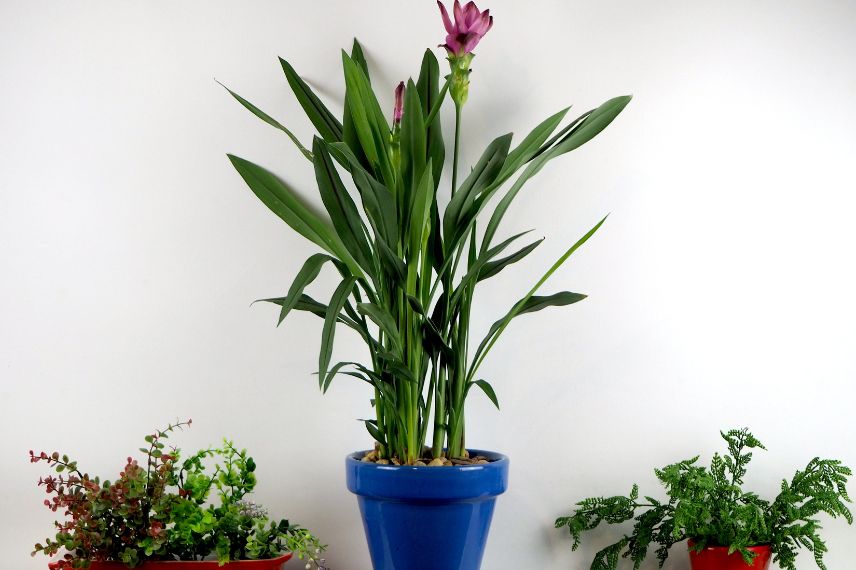
What type of potting mix should you use for turmeric grown in a pot?
Turmeric prefers a well-drained substrate rich in organic matter. Here’s how to mix it:
- half universal potting compost, which will form a rich base for the growth of rootstocks. If you have leaf mould, prefer it. Otherwise, a good-quality universal potting compost will do.
- a quarter of mature compost, to provide essential nutrients and stimulate growth.
- a quarter of coarse sand or perlite, to aerate the mix and ensure good drainage.
Complete this preparation by placing a layer of clay pebbles at the bottom of the pot for perfect drainage.
How to grow turmeric in a pot?
- Prepare the pot: Arrange a layer of clay pebbles at the bottom of the pot to help excess water drain away.
- Fill with the substrate: Fill the pot with the mixture of potting soil, compost and coarse sand as shown in the previous section.
- Plant the rootstocks: Place the rootstocks flat, with the buds facing upwards. For the Curcuma longa (edible), the rootstocks should be planted 5–6 cm deep. For the Curcuma alismatifolia (ornamental), the rootstocks are planted with their upper part flush with the surface of the substrate.
- Water lightly: Moisten the substrate without making it waterlogged. Wait 10 to 15 minutes, then empty the water into the saucer.
- Place the pot: Put it in a well-lit spot, but protected from direct sun.
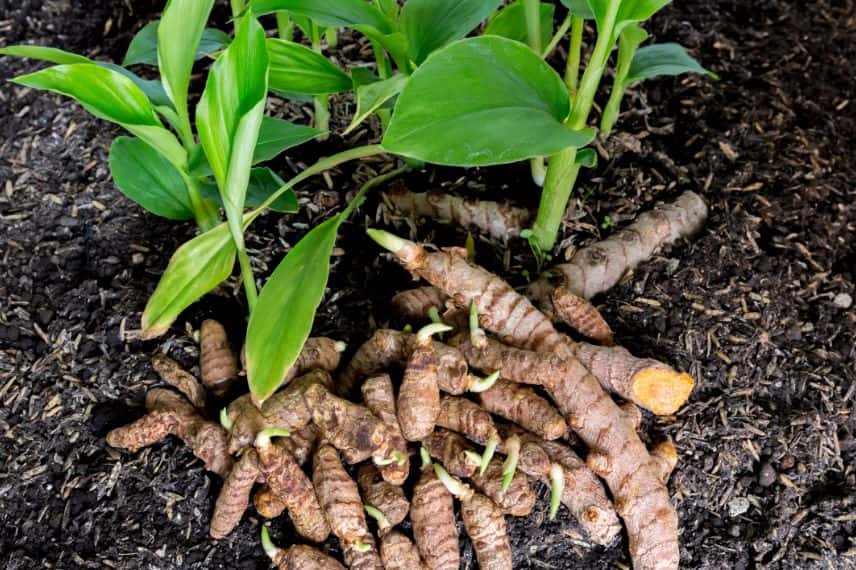
Examples of rootstocks and young shoots of Curcuma
Where should the turmeric pot be placed?
Outside
A position in partial shade is ideal, as turmeric prefers gentle light. Too much direct sunlight can burn its leaves, especially in summer. Place the pot in a wind-sheltered area, such as near a wall or a hedge. The broad and delicate leaves of turmeric are indeed sensitive to drying out and wind damage.
Indoors
Place the pot in a bright room, near a window facing east or south, but behind a sheer curtain to avoid direct sun. This could indeed dry out the plant. Avoid draughts as well, by keeping the pot away from frequently opened windows or doors. Turmeric dislikes abrupt temperature changes. Also ensure the pot is placed away from radiators or heating devices that could dry the air and stress the plant.
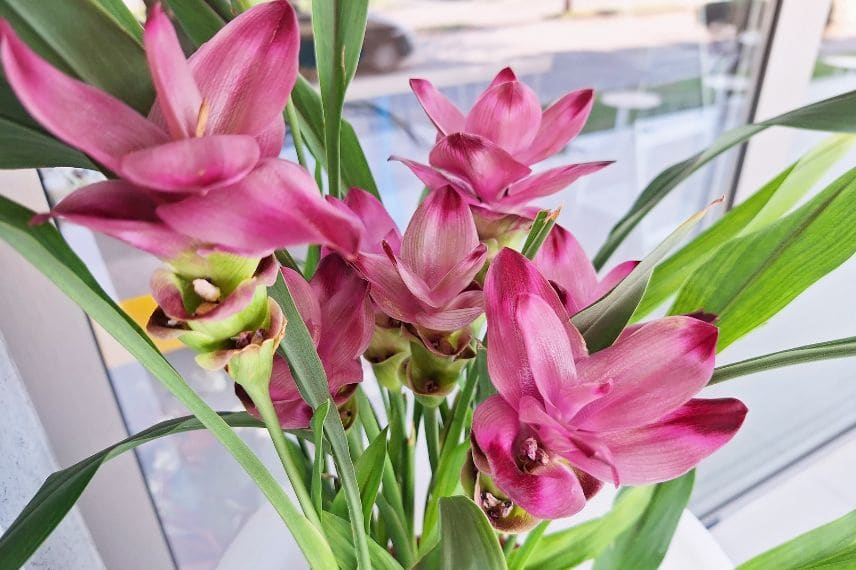
After planting: care and maintenance of turmeric in a pot
Watering
- During the growth period (spring and summer): Water regularly to keep the substrate slightly moist, but not overly wet. Wait until the surface of the substrate begins to dry before watering again. Avoid standing water by emptying the drip tray about 10–15 minutes after each watering.
- During the rest season (autumn and winter): When the foliage begins to yellow and dry, gradually reduce watering. Once the plant has entered full dormancy, water very rarely, just to prevent the substrate from drying out completely.
- Remember to empty the drip tray 10–15 minutes after each watering.
Fertilisation
- In spring and summer: During the period of active growth (that is, in spring), apply a liquid fertiliser rich in potassium once a month to promote the development of the rootstock and foliage. You can also choose a balanced fertiliser (NPK 10-10-10).
- In autumn and winter: As soon as the foliage begins to yellow, stop all fertilisation.
Pest monitoring
Inspect the foliage regularly for any aphids or red spider mites. If you notice pests, treat promptly with a soap solution (15–30 g per litre of water). Spray rainwater regularly on the foliage, morning or evening, to maintain good ambient humidity and to limit red spider mite infestations.
Winter protection
- Bring the pot indoors: Turmeric is a tropical plant that does not tolerate temperatures below 10 °C. From autumn, bring the pot into a temperate room, such as a conservatory or greenhouse, where the temperature stays between 12 and 18 °C.
- Once the foliage is completely dry, you may:
- Leave the rootstock in the pot, reducing watering to the bare minimum.
- Or dig up the rootstock to store it in a cool, dry, dark place until spring.
General maintenance
- Cleaning: Trim yellowing or dead leaves at the base to prevent disease spread and keep the plant tidy.
- Repotting: Repot every 2–3 years in spring to refresh the substrate and give a little more space to the rootstock.
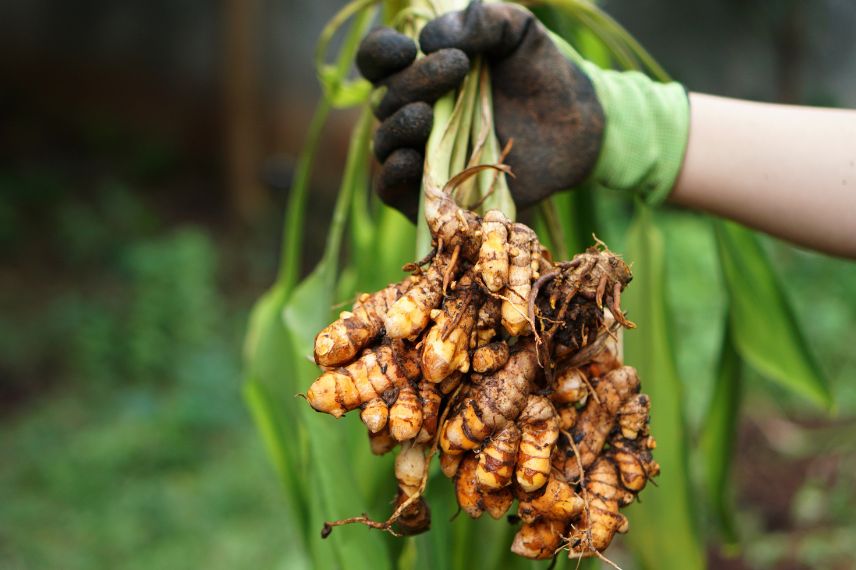
Turmeric rootstock
- Subscribe!
- Contents
Comments