






























Growing Polygala in pots
How to plant it and look after it?
Contents
A pretty little shrub with rose-purple flowering and evergreen grey-green foliage, Polygala thrives just as well in hedges as in borders or rock gardens. It is notably hardy against wind, salt spray, soil salinity and drought. A perfect shrub, you may say? Yes, if not for its limited hardiness which confines it to the Mediterranean and Atlantic coasts when grown in open ground. That said, this shrub in the Polygonaceae family, closely related to the Fabaceae, adapts very well to pot culture. It’s also a real gem for beautifying terraces and balconies!
Discover all the secrets of planting Polygala in a pot, from the ideal location to the best varieties to choose.
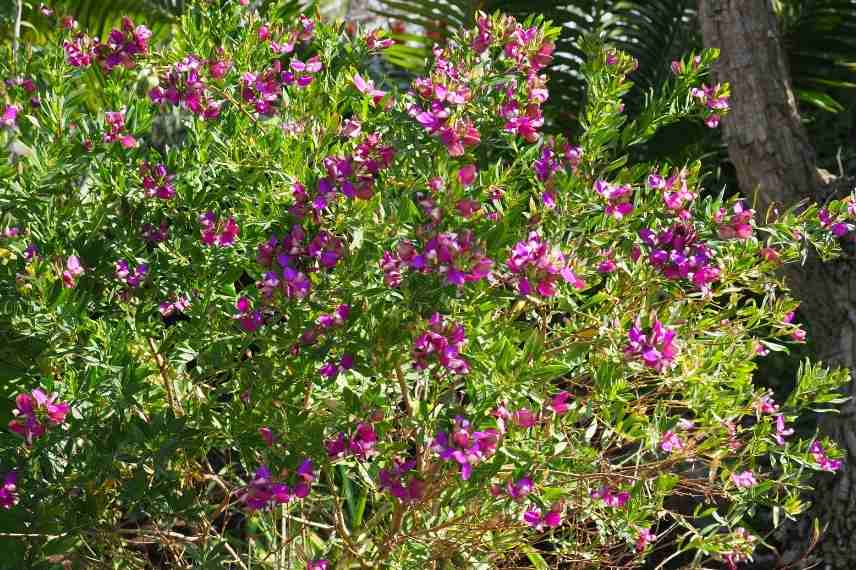
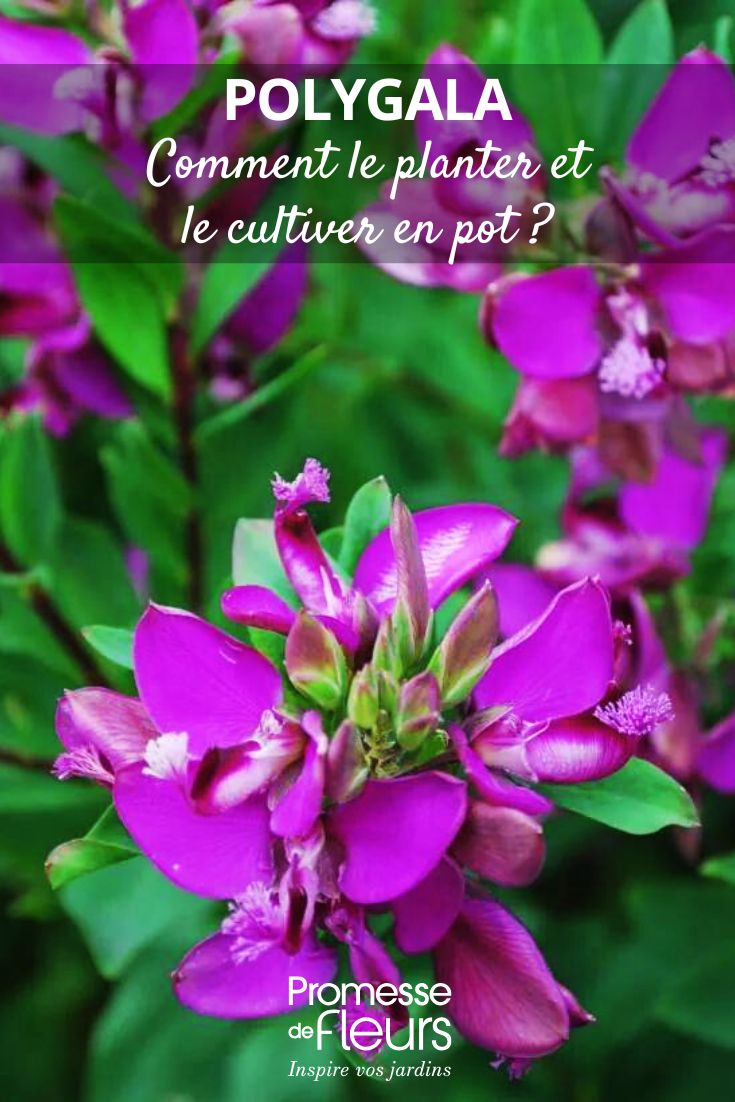
The Polygala myrtifolia

What is the best spot for a Polygala in a pot?
In our latitudes, we mainly cultivate the myrtle-leaved Polygala (Polygala myrtifolia) which prefers a sunny exposure, ideally sheltered from cold and drying winds. That said, it can tolerate partial shade if it’s bright.In a pot, on a terrace, a balcony or in a courtyard or patio, the plant will benefit from excellent light exposure while remaining protected. The pot also allows you to bring it indoors during winter if temperatures fall below −5°C, a situation in which the plant may freeze.
In winter, the ideal location is a cool but bright room (between 5 and 15 °C), such as an unheated veranda. However, keeping it indoors is not suitable for this Mediterranean plant, as the atmosphere would be too dry.
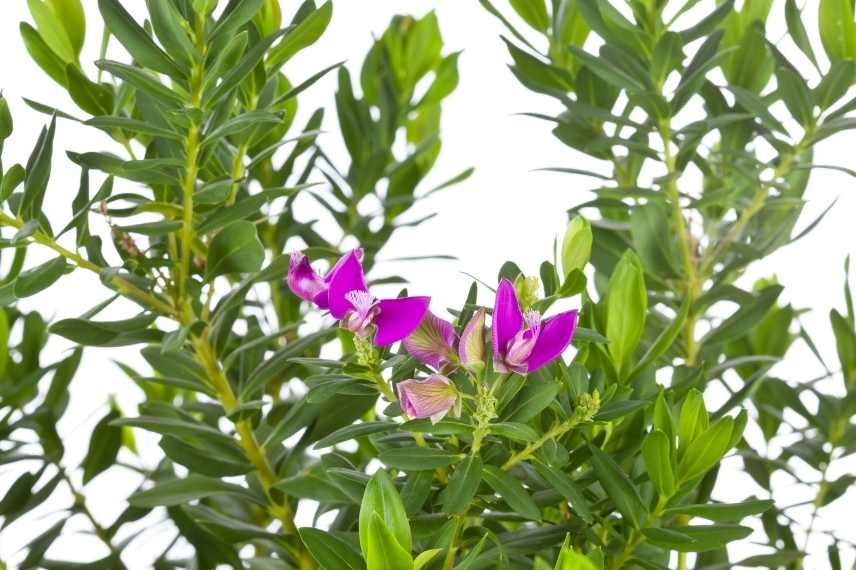
The pretty and long-lasting flowering of Polygala
When should Polygala be potted up?
Potting up takes place in spring, after the last frosts. It’s the ideal time for the roots to establish themselves before the coming winter. Although autumn planting is possible, it is not recommended in cool regions due to frost damage. By contrast, in regions with a mild climate, Polygala can also be planted in autumn.
How to pot a Polygala?
This small shrub is easy to grow in a pot.
The choice of pot and substrate
For Polygala, you should select a pot with drainage holes, large enough, about twice the volume of the original root ball. Terracotta is always preferable, as it is more porous and does not retain water.
For the substrate, prepare a well-drained substrate, mixing potting compost of good quality, coarse sand and, if necessary, a little garden soil.
How to plant?
- Soak the Polygala root ball to hydrate it
- Place a generous layer of expanded clay pebbles or pozzolana at the bottom of the pot
- Fill half the pot with the drainage mix
- Position the root ball and fill the pot with the remaining substrate
- Tamp down lightly without compacting the substrate to maintain good aeration
- Water generously after planting to moisten the substrate.
Then, water regularly during the first two years to ensure good root establishment.
Read also
How to pair Polygala?How to care for it?
Polygala, grown in a pot, requires a degree of regular care, but nothing insurmountable. With good cultural conditions, it will reward you with a beautiful flowering in clusters of pea-like flowers, reminiscent of Fabaceae, lasting from May to October.
Watering
In summer, watering should be regular, from moderate to frequent depending on temperatures, as soon as the surface of the potting mix begins to dry. In dry climates or during heat waves, waterings should be carried out 1–2 times per week.
In winter, Polygala enters dormancy. This is why watering should be reduced to 1–2 times per month, only if the rootball is completely dry.
Feeding
From spring to autumn, i.e. March to October, it is essential to apply a liquid fertiliser specially for flowering plants, ideal for prolonging flowering. Otherwise, top-dress the pot with light compost in spring.
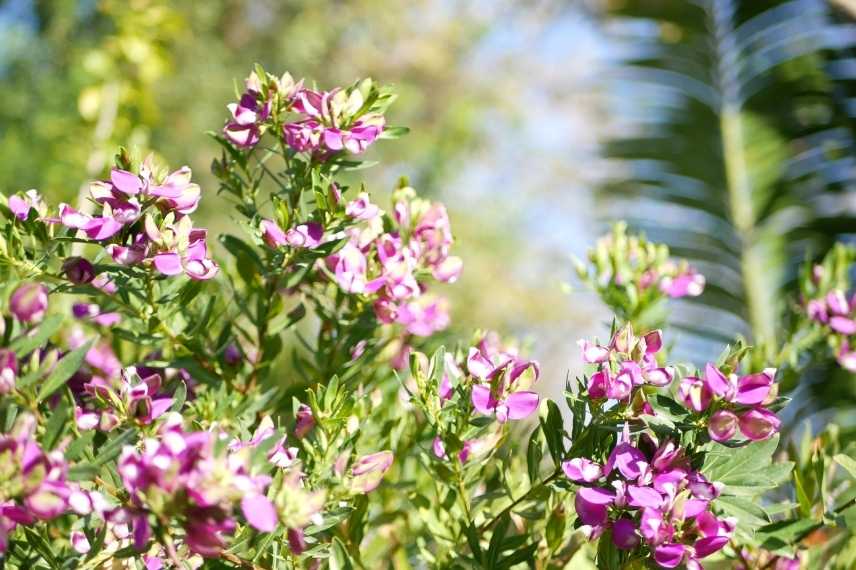
The Polygala myrtifolia
Pruning
- A light formative pruning in spring is possible, but not obligatory, to remove dead or unbalanced branches and maintain a good shape.
- Avoid severe pruning, as Polygala does not re-sprout from old wood
- After flowering, it is possible to pinch the new shoots lightly to encourage density.
Repotting
Repotting occurs every 2–3 years in fresh potting mix to stimulate vigour and flowering.
Protection from the cold
The Myrtle-leaved Polygala has a hardiness down to -5 °C, so it is essential to bring it indoors in regions where winters are cold. A conservatory with a temperature between 5 and 15 °C is ideal.
In regions at the edge of hardiness, laying a winter protection fleece is advised. For more information, read our article “Protecting Polygala from the Cold: Our Wintering Tips.”
Pests and diseases
Polygala is fairly robust. A few aphids, whiteflies or mealybugs can be treated with a mild insecticide or with black soap.
Which variety of Polygala is best suited to growing in pots?
The Polygala x oppositifolia ‘Bibi Pink’ variety is an excellent choice for growing in pots. This hybrid variety indeed has all the qualities for pot culture:
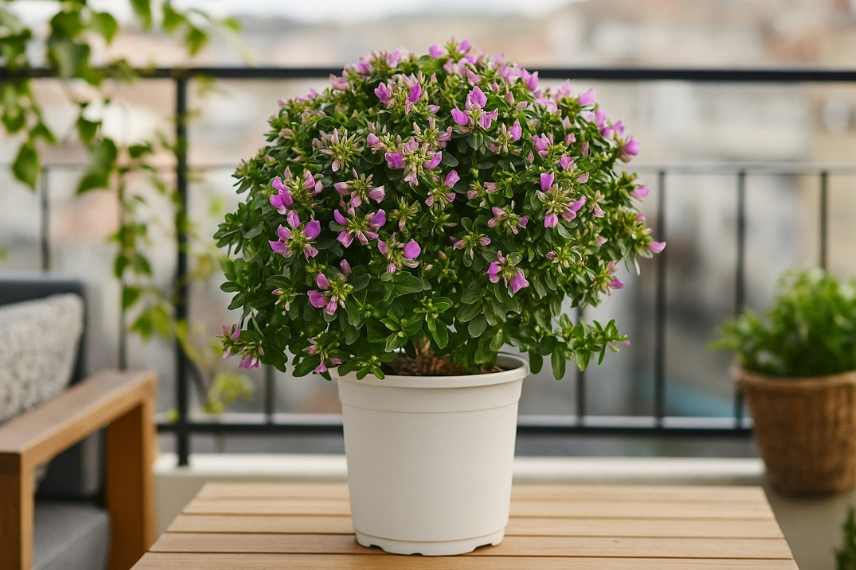
The Polygala x oppositifolia ‘Bibi Pink’ is ideal for pot culture (AI-generated image)
- Its compact habit and rounded form : ‘Bibi Pink’ does not exceed 70 to 80 cm in all directions and develops a dense, rounded, naturally well-proportioned habit, which avoids frequent pruning and the search for a container that is too large
- A long and colourful flowering: this variety offers bi-coloured flowers, from violet to mauve and pale pink, from May or June until autumn, with waves of flowering that are sustained. The decorative impact is long-lasting, without requiring intensive maintenance.
- Improved hardiness: this hybrid variety has increased hardiness, able to withstand frosts down to -12°C, better than Polygala myrtifolia. Cultivated in pots, it can easily be brought to shelter in winter if a cold snap is forecast, but, overall, it can stay outside longer.
- Itslow maintenance: with its dense habit and moderate water needs once established, it requires little care, making it a practical variety for less experienced gardeners or for easy pot maintenance.
- Subscribe!
- Contents
Comments