





























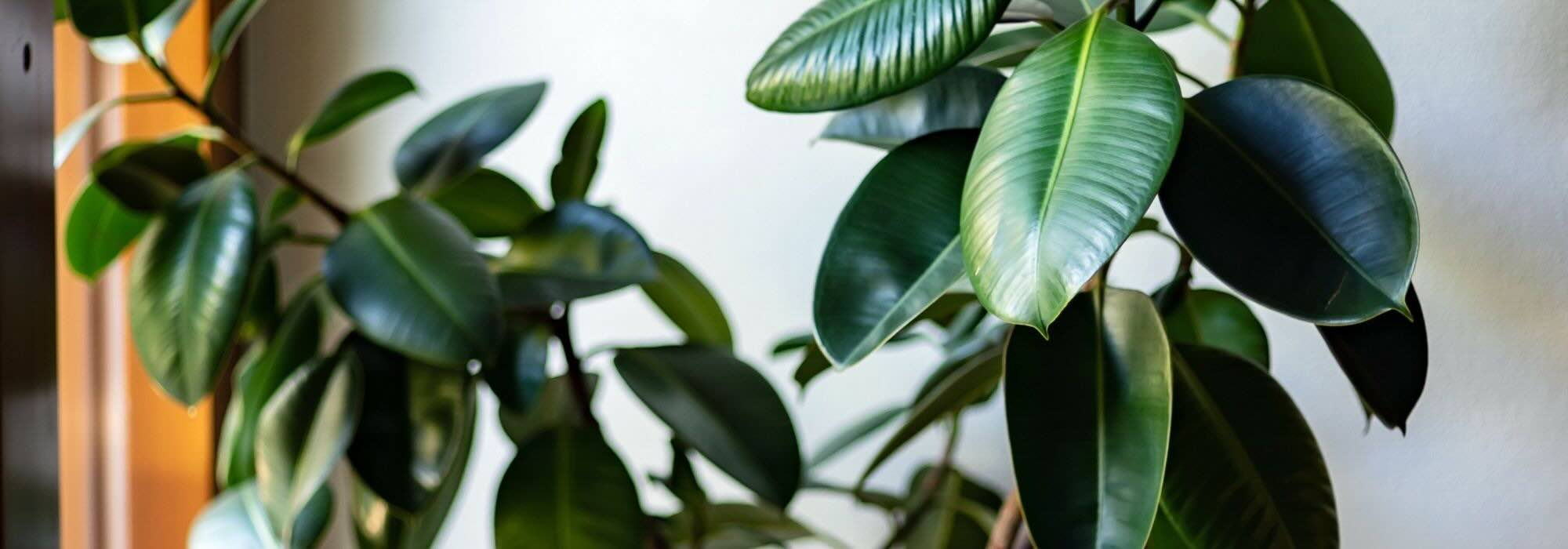
Ficus through the seasons: Discover our tips for a successful care
For a thriving indoor plant
Contents
Ficus are essential houseplants that never go out of fashion, and new species and varieties regularly arrive on the market. Robust and elegant, such as the majestic Ficus lyrata, with its large lyre-shaped leaves, the timeless Ficus elastica, also known as the rubber plant for its thick and glossy foliage, or the graceful Ficus benjamina, each species brings a unique touch to your interior decor.
Yet, despite their reputation as easy-care plants, Ficus require tailored care to thrive. They are sensitive to changes in light, temperature and humidity, factors that naturally vary with the seasons. That is why it is essential to adjust their care to meet their specific needs throughout the year.
Let us mention the popular Ficus ginseng, which will not be covered in this article, as its specific care is that of a bonsai (discover our tips in our article dedicated to bonsai). For other Ficus, care principles remain similar, regardless of type.
In this article, discover how to provide your Ficus with the best conditions to beautify your interior decor season after season, and address common questions: identify possible causes of leaf drop, whether you can move it outdoors, and its lifespan.

Create an ideal environment for your Ficus all year round
The Ficus is a tropical plant which, although adapted to indoor life, thrives in high light, temperature and humidity levels. Providing a stable, suitable environment is essential to maintain its dense foliage, especially for large-leaved species.
Light and placement: where to place a Ficus in the home?
The Ficus needs bright, indirect light to grow well. It tolerates a south or south-west exposure, but is also happy with an exposure near a window facing east or south-east, where it will benefit from the gentle morning light.
In summer, protect it from direct sunlight that could burn its leaves, particularly if it is near a window facing south or west. A light sheer curtain can do the trick.
In winter, when natural light diminishes, move it closer to windows to compensate for the reduced luminosity. Avoid dark corners or areas distant from light sources, as a poorly lit Ficus may lose its leaves and growth may slow. If necessary, add a horticultural lamp.
Temperature and stability: the keys to comfort
The Ficus prefers moderate, stable temperatures similar to those indoors. Maintain a temperature between 18 and 24 °C. Abrupt fluctuations (cold or hot drafts) should be avoided, as they can stress the plant. Place it away from radiators, air conditioners or doors that are frequently opened.
In winter, ensure your Ficus is not exposed to the cold from poorly insulated windows or draughts.
Humidity: an important aspect
Although it tolerates the indoor air of our homes, the Ficus prefers a slightly higher humidity level to mimic its natural conditions.
If the air becomes too dry, especially in winter due to heating, lightly mist its leaves or use a humidifier.
Specific adjustments for each variety
You can generally grow all species under the same conditions, but the Ficus lyrata, with its large, thick leaves, thrives in very bright conditions (though it remains sensitive to direct sunlight), while the Ficus benjamina has few requirements. The Ficus elastica, tougher than the Ficus lyrata, tolerates drier conditions better, but good lighting remains essential to preserve the shine of its glossy foliage.
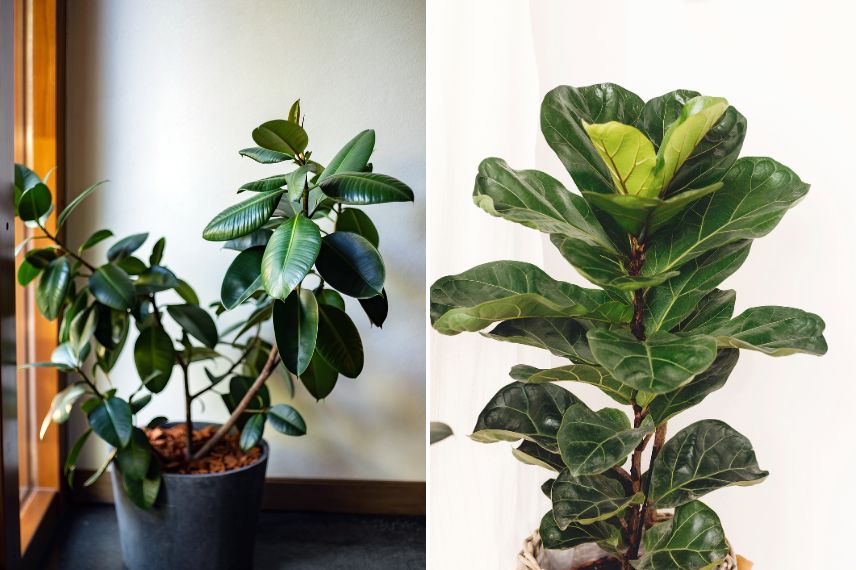
Ficus elastica and Ficus lyrata
Read also
Misting indoor plantsHow to tell if a Ficus needs watering throughout the seasons
Although this tropical plant prefers slightly moist soil, an excess or a lack of water can quickly lead to problems, such as leaf drop or root rot. On this note, watering is directly related to the quality of the substrate, which should be well-drained.
Adapting watering to the seasons is essential to keep a Ficus healthy.
Spring and Summer
During the active growth period, the Ficus uses more water to support the development of new leaves and branches. Here’s how to water it correctly:
- Keep the potting mix slightly moist by regularly checking the surface of the soil. When the soil begins to dry to about 2 cm below the surface, it’s time to water.
- Water generously, but ensure excess water drains through the drainage holes. Empty the saucer to prevent roots from sitting in stagnant water.
- If the summer heat is intense, it may be necessary to water more frequently, especially if the plant is exposed to bright light, which could lead you to water every day.
- Signs of underwatering appear as leaves that wilt or curl slightly.
Autumn and Winter
In autumn, when growth slows, and in winter, during the rest period, water needs decrease significantly. Watering should be adjusted to this slower pace:
- Generally, watering every 10 to 15 days is sufficient, but it depends on ambient humidity and room temperature. Allow the surface of the potting mix to dry a little more deeply before watering again, unless the space is very warm.
- Practice observation and avoid overwatering; in a cooler interior, with a plant that uses less water, the substrate will dry much more slowly. Excess moisture can cause yellowing leaves and root rot.
- If heating makes the air dry, lightly mist the leaves to prevent the plant from dehydrating. If the leaf tips turn brown, it’s often a sign of air too dry.
Practical tips for optimal watering
- Use water at room temperature to avoid stressing the roots.
- If possible, prefer rainwater or filtered water, as limescale can build up and affect leaf health, though Ficus is less susceptible than other indoor plants.
- Always check soil moisture before watering, using your finger or a moisture meter.
Seasonal care for a flourishing Ficus
The Ficus follows a natural rhythm shaped by the seasons. Adjusting your seasonal care helps the plant stay healthy and keep its foliage dense and vibrant all year round.
Spring and Summer
- Fertiliser : apply a liquid fertiliser for green plants every two to three weeks. This will support the growth of new leaves and help your Ficus stay vigorous.
- Pruning : take advantage of this period to prune poorly oriented or bare branches, as well as damaged leaves. This stimulates branching and helps maintain a harmonious shape.
- Can a Ficus be placed outdoors? Yes, it’s possible during spring and summer, provided the temperatures are stable and above 15 °C. Choose a shaded or semi-shaded, but well-lit, spot shielded from winds. Bring it indoors as soon as night-time temperatures drop.
Autumn and Winter
- Fertiliser : suspend fertiliser applications until spring. The Ficus does not need additional nutrients during its resting period.
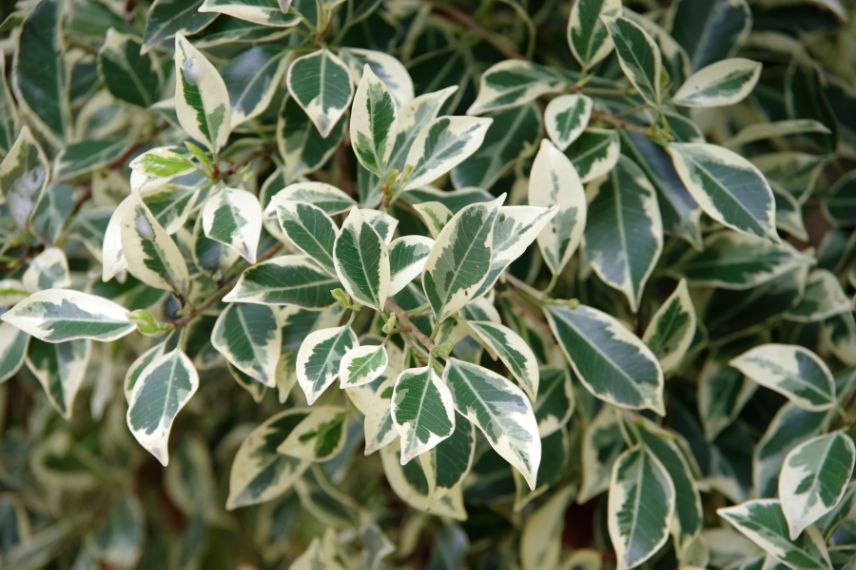
A vividly variegated Ficus benjamina foliage
Read also
XXL indoor plantsBonus: Identify common problems and extend the life of your Ficus
The Ficus is sometimes prone to leaf drop, especially the larger-leaved varieties. Adopting the right care practices helps resolve these issues and ensures your plant a long life, often lasting for several decades.
When a Ficus drops its leaves, what’s causing it?
Leaf drop is one of the clearest signals that something isn’t right. Several factors can be responsible:
- A change in environment: Moving your Ficus, even within the same room, can upset its balance, especially if the light, temperature or humidity differ. Ficus do not like sudden changes and need time to adapt.
- Inadequate watering: Overwatering often leads to yellowing leaves, while underwatering can cause dry or brown leaves that drop.
- A lack of light: Insufficient light, particularly in autumn and winter, can stress the plant and trigger leaf drop.
- Temperature fluctuations: Cold or warm drafts, as well as sudden temperature changes, can weaken the Ficus.
What is the lifespan of a Ficus?
A well-maintained Ficus can live for several decades indoors. Some varieties such as the Ficus lyrata or the Ficus elastica, with their dense and hardy foliage, are particularly durable and can grow very large specimens. Outdoors, in a tropical or subtropical climate, a Ficus can even reach impressive sizes and live even longer.
- Subscribe!
- Contents
Comments