





























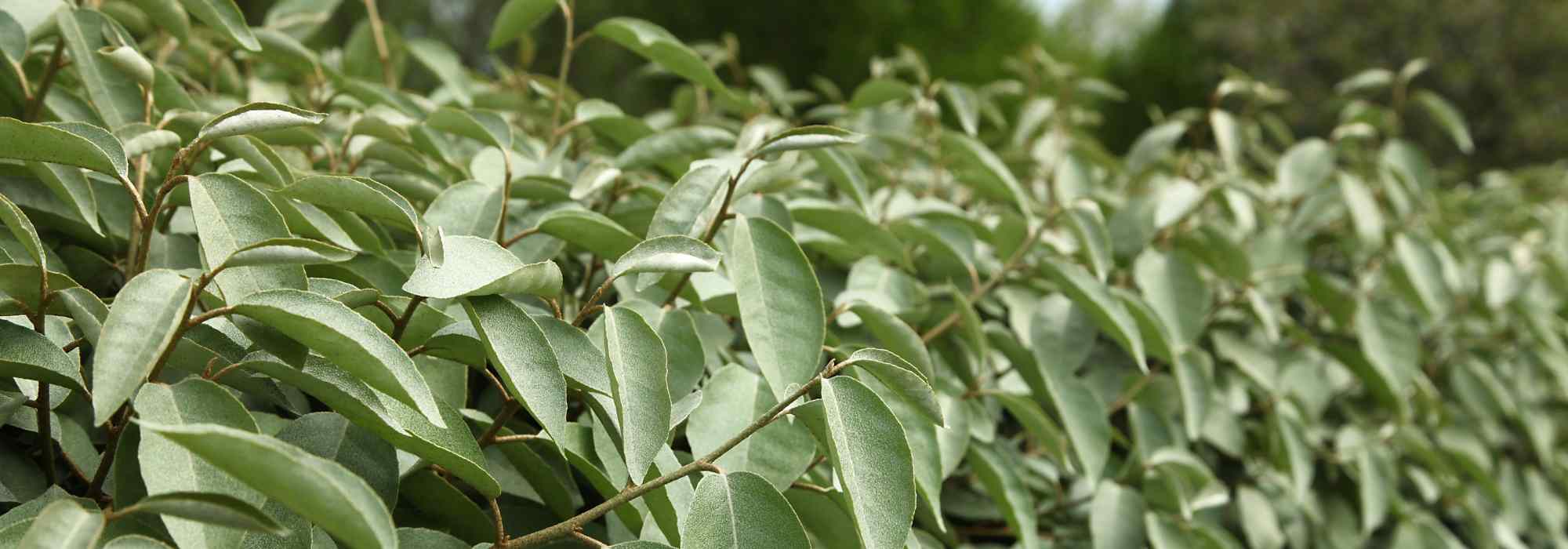
Fast-growing evergreen hedge shrubs
What are the best fast-growing shrubs for an effective privacy hedge?
Contents
To quickly establish or replace a hedge that is failing, evergreen bushes with rapid growth are the plants we’re all after. This is even more the case when there’s a prominent view from a neighbouring property in an urban setting and you want to regain privacy as quickly as possible. By definition, an evergreen bush grows much more slowly than a deciduous-leaved shrub.
So, how can you avoid Photinias and other palm-leaved laurels going out of fashion? On which bushes should you bet so that a new hedge or its replacement looks visually satisfactory in the near term? Which are the densest and best suited to the regular pruning they will undergo? We review the best evergreen shrubs for hedges, taking into account your region of residence, the style of hedge you want to obtain (trimmed or free-growing), and evergreen-bush styles with very different ornamental effects.
Regarding evergreen shrubs for hedges
When it comes to an evergreen hedge, it’s generally wise to avoid varieties prized in the 70s and 80s, which have shown limitations in terms of aesthetics, maintenance, or related phytosanitary problems. Forget Thuja and other palm-leaved laurels, no longer very fashionable, or Pyracantha, excellent as a defensive hedge but rather unruly in their growth.
When talking about fast-growing hedges, you need to know what you’re talking about… and put it into perspective. On average, depending on the species, expect growth of between 30 and 60 cm per year, which is good, but can vary by as much as a factor of two. The shrubs mentioned in this article are selected for their fast growth when young, because there are fast-growing shrubs that only become impressive once established—interesting indeed, but not for today’s topic. Compact and dwarf cultivars will generally grow more slowly.
A multi-species or mixed hedge (formed of several species) is always more attractive than a single-species hedge: it will be more resilient and less susceptible to pest infestations. This will depend on the style of your garden; a contemporary garden, for its part, benefits from plantings that are fairly uniform in a repeated pattern. Choosing two or three shrub types mixed together creates a living, often very harmonious, mixed hedge. In large country gardens or where the view is less of an issue, you can more easily mix two-thirds evergreen shrubs and one-third deciduous shrubs.
Obviously, the shrubs will be chosen to suit the soil type and exposure, in addition to their hardiness. Be mindful of the height of the shrubs, favouring varieties that are more or less low depending on your garden’s layout (height of the building, and any intrusive sightlines). Buying a shrub in a 2–5 L container lets you achieve the desired effect quickly. Finally, growth rate is also influenced by the planting period, and cultivation conditions, such as soil, sun exposure, and how diligently you water.
From classic favourites to shrubs you might not think of as often, here is a list to study for your project!
Evergreen hedge shrubs for all climates
These are the shrubs renowned for their rapid growth, able to adapt to cold or hot climates, in short, reliable choices across all regions!
Cotoneaster lacteus
It’s a classic, and this species, though widely used, is very interesting for several reasons: it grows between 2 and 3 m tall and 3 m wide, offers dark green, heavily veined foliage that creates a good privacy screen, a cream-coloured umbel that is nectariferous and melliferous when not pruned, forming red berries in autumn that adorn the shrub for a long time, right through to winter, a treat for birds. The Cotoneaster lacteus tolerates all exposures and prunes very well, but it looks best when grown as a free-standing hedge. It is hardy to -20°C. Ideally pair it with a shrub with softer, lighter foliage. Over the years it will be very drought-tolerant (and also pollution-tolerant).
→ Also discover: 5 Cotoneasters perfect for hedges.
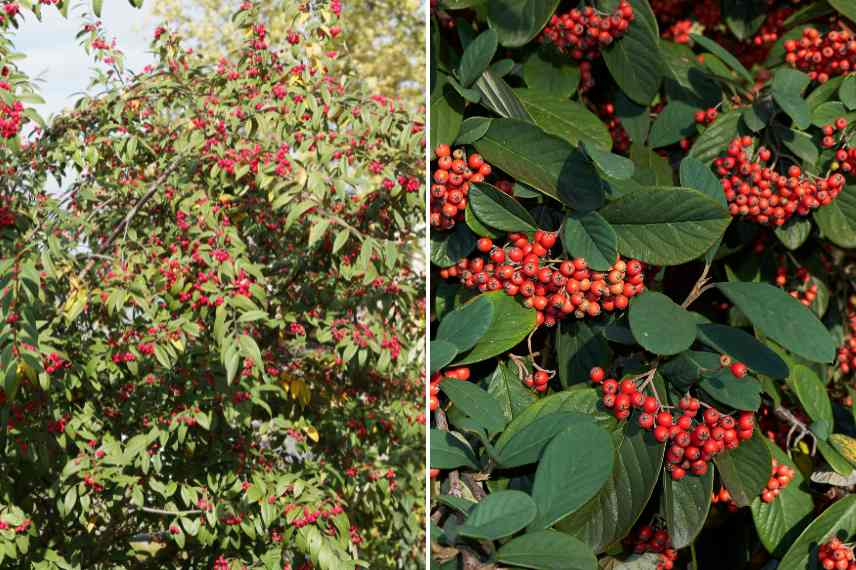
Cotoneaster lacteus: habit, foliage and autumn fruiting
Laurustinus (Viburnum tinus)
It’s a shrub somewhat essential for all its qualities: adaptable to all soils, whether clay, dry or calcareous, fairly hardy to cold and heatwaves, flowering for a long period from November to March, tolerating shade, partial shade and sun… The laurustinus nevertheless grows a little slower than the other shrubs in this selection (about 30 cm per year).
Our pick: the variegated variety, very bright, which lights up the genus.
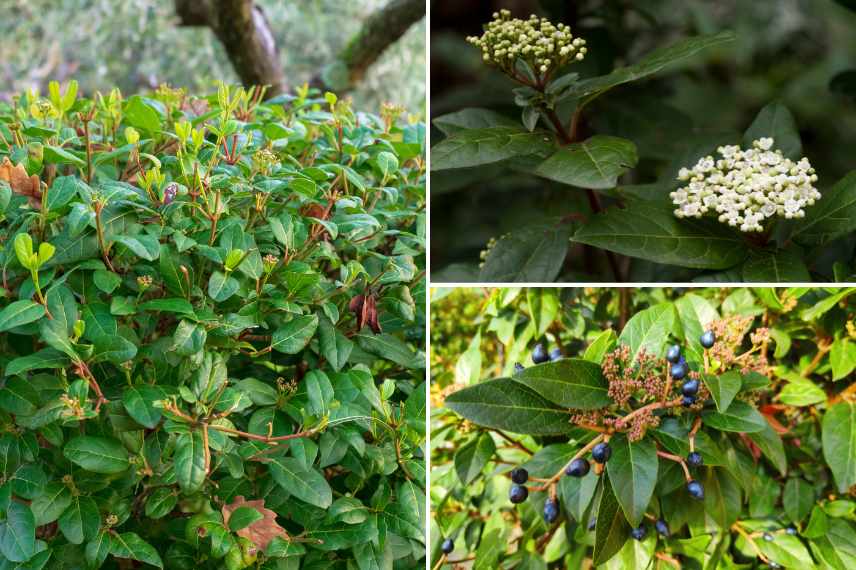
Viburnum tinus, habit and blooms
The wrinkled viburnum or Viburnum rhytidophyllum
Little known, but this Chinese viburnum grows quickly (40–50 cm per year) and can be inserted into a large, evergreen hedge. After a few years it reaches more than 3 m in height and width. Ideally it prefers partial shade, but it also tolerates a sunny exposure. It is perfect for forming a free hedge that you won’t prune. Its plus: large wrinkled and matte leaves that can contrast with the other evergreen hedge shrubs, which usually have much smaller leaves, and a cream-white flowering in early spring. It is completely hardy to -29°C.
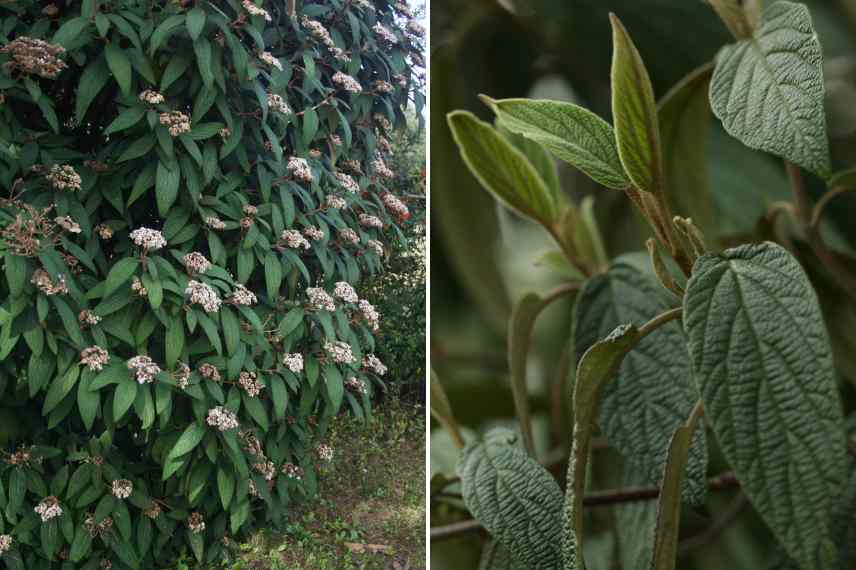
Viburnum rhytidophyllum: habit and wrinkled leaves
Japanese privets
These are valuable shrubs for quickly forming a hedge: they grow at about 40 cm in the first year, then around 50 cm per year, offering dark, glossy green foliage. The flowers in panicles are pale whitish and fragrance in spring. They are generally semi-evergreen.
Opt for the Japanese privet (Ligustrum japonicum) or Californian privet (Ligustrum ovalifolium – Californian privet shrub with small flowers) of which some have variegated foliage such as Ligustrum ovalifolium ‘Aureum’ with light-green leaves bordered in yellow, planted in sun to maintain its colour. They will reach 2–3 m high by 1.5–2 m wide. The Ligustrum japonicum ‘Texanum’ is known for its glossy dark-green foliage and rapid growth, this variety being ideal for formal hedges.
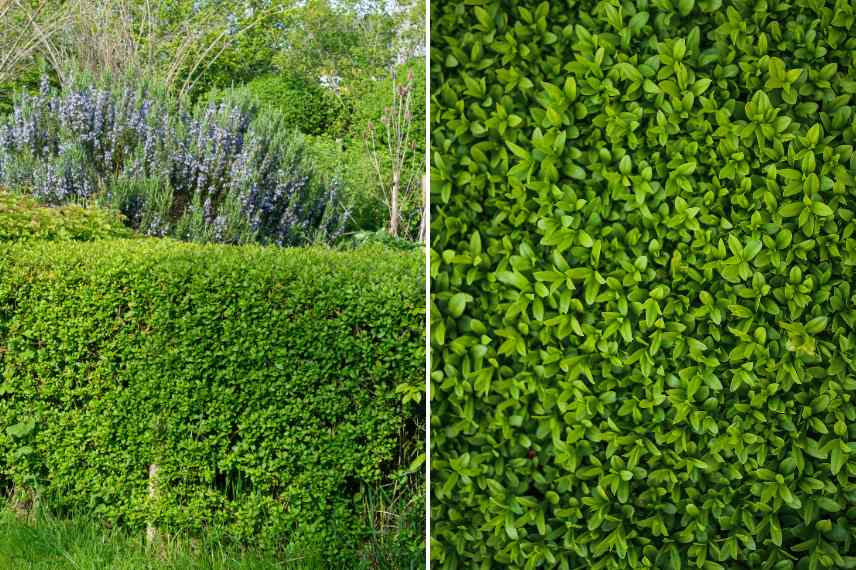
Japanese privet
Evergreen Berberis
If they are mostly deciduous or semi-evergreen, there are some evergreen Berberis, also commonly called barberries. These are shrubs that grow well in partial shade or shade (unlike deciduous species), flowering yellow in May. Hardy to -20°C, we recommend two for their relatively rapid growth: Berberis gagnepainii and the Berberis darwinii, for establishing medium hedges (2–3 m).
→ Also read: 5 Berberis perfect for hedges ; Evergreen Berberis: the most beautiful varieties
The Leyland Cypress
This fast-growing conifer, putting on 50–80 cm in a year, with dense foliage, is a classic evergreen hedge, which would be unfair not to mention here. It is used less nowadays, as it is planted in monospecific hedges, less popular today, and due to its susceptibility to cypress canker which can decimate a hedge. Because of its growth rate, it also requires very regular maintenance to keep it at 2–3 m in height…
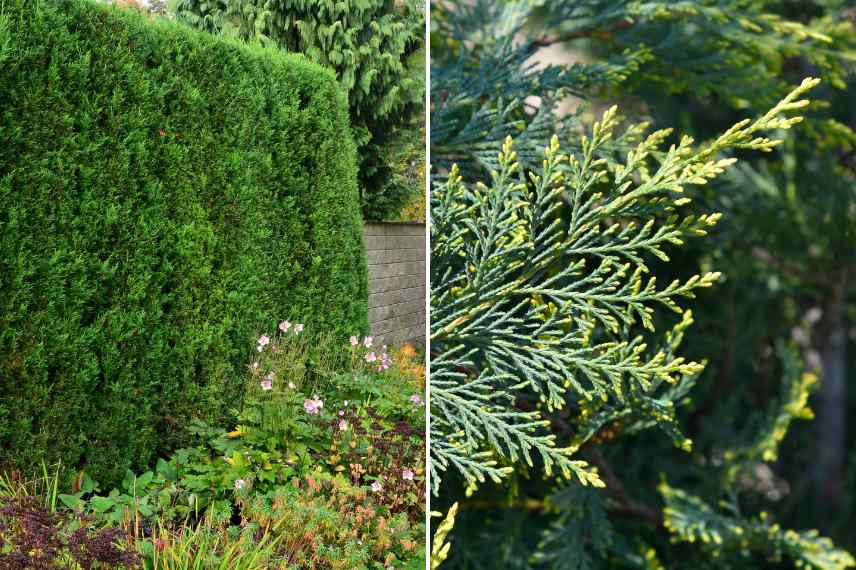
Leyland Cypress
The Evergreen Laurels
The bay laurel, also called cherry laurel with leathery leaves, is certainly the fastest to form an evergreen, well-screening hedge, hence its almost exclusive use in gardens a few decades ago. It indeed grows at about 50–60 cm per year after two years of planting, producing large glossy, leathery leaves, and can reach 4 m in height if left unpruned.
More elegant than bay laurel, Prunus lusitanica is slower to grow (about 30 cm), but makes a good choice in a mixed hedge. It has the advantage of looking good whether pruned or left to grow. Without pruning, its cream-coloured, scented flowers have the merit, as is often the case with this type of hedge shrub, of attracting pollinators.
Fast-growing hedge shrubs for mild climates
Along the coast or in mild climates, one can enjoy a fine range of shrubs . These regions do not experience severe or prolonged frosts, and you can plant many very ornamental shrubs there, a bit tender elsewhere, growing fairly quickly for hedge establishment. Some of the evergreen shrubs mentioned here are particularly suited for their resistance to sea spray in coastal zones. Here are the most interesting:
Eleagnus
One of the fastest-growing is the Eleagnus x ebbingei or common chalef. It grows 50–60 cm per year in its first years. Its dark-green, leathery, glossy leaves with a silvery underside are ornamental, and it can be pruned or left to grow freely. It will form a medium hedge of about 2–3 m in height with a spread of 1.50–2.50 m. It only fears severe frosts and is therefore suitable for coastal planting, all the more so since it is wind- and sea-spray-tolerant. Always plant in well-drained soil, even if poor, in full sun or partial shade.
The variety ‘Limelight’ is particularly attractive with its yellow-variegated leaves, and its growth even more vigorous, as well as ‘pungens Maculata’, a little lower down and very dense. Of course you can combine unvariegated Elaeagnus with variegated Elaeagnus.
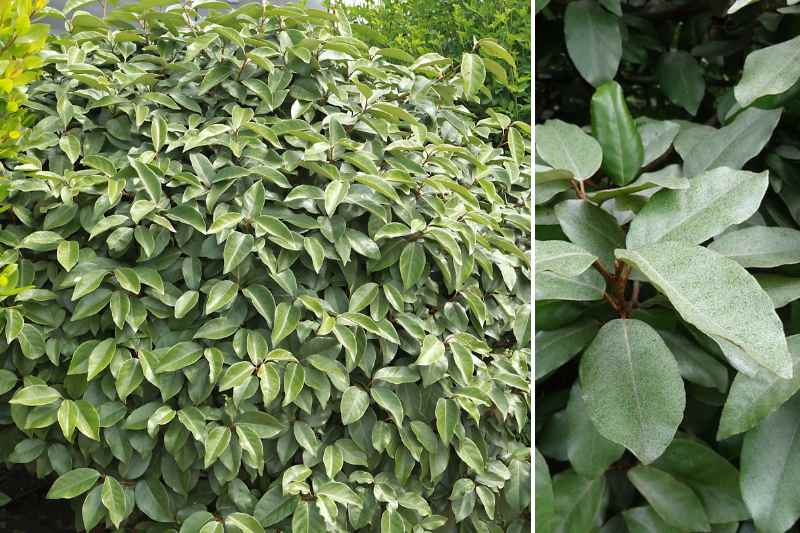
The type species, Eleagnus x ebbingei
Griselinia littoralis
It is one of the essential shrubs in many mild regions, up to altered oceanic climates — a large western zone of France — because its hardiness is limited to -7 °C and -10 °C for very short frost periods (it is a New Zealand shrub). It is recommended for coastal gardens as it proves to be one of the most resistant to sea spray and quick to establish. It grows to around 2 m in height, depending on the variety, at about 45 cm per year, and develops dense foliage. To plant in any soil, in full sun or partial shade. The Griselinia littoralis ‘Variegata’ is a beautiful variegated variety with pale green leaves edged in cream. The Griselinia littoralis ‘Dixon’s Cream’ also offers an interesting contrast in a mixed hedge.
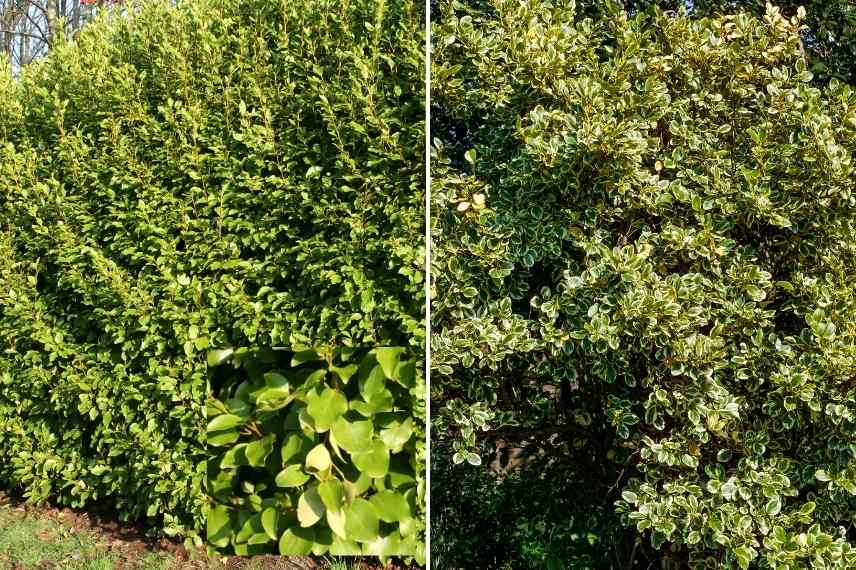
Griselinia littoralis, with the variegated variety on the right.
Pittosporums
New Zealand origin, they are of course best reserved for regions where winter temperatures do not regularly fall below -5°C. The Pittosporums tenuifolium are among the most decorative-leaved shrubs, with a charming lamina of small, edged leaves. Some are variegated with cream, others with yellow. They grow quickly at around 40–50 cm per year. The Japanese Pittosporum (Pittosporum tobira), frequently seen surrounding seaside villas, is another shrub with distinct foliage, leathery, larger and glossy, producing a divine-scented flowering in April–May: it enables a dense hedge of about 1.50–2.50 m in a few years. The Pittosporum tobira Pittosporum tobira ‘Variegata’ with dark green leaves edged in cream adds a lovely touch of colour to the hedge.
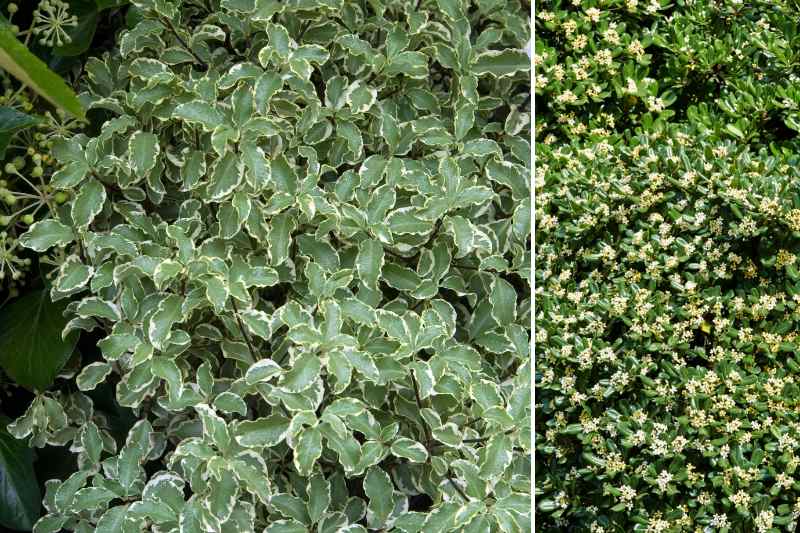
Pittosporum with small leaves and Japanese Pittosporum on the right
Abelias
The Abelias for hedges can be planted in every category of this topic, as they are so versatile: resistant to sea spray, to pollution; there are small ones for compact gardens, and larger ones up to 1.50–2 m in height. They remain somewhat frost-sensitive (down to -10 °C), hence we mention them in this paragraph. Their very long flowering and autumn interest with bracts that colour durably make them a particularly elegant shrub, a punctuation in a hedge. Spreading often to about 2 m in width (‘Edward Goucher’ or ‘Abelia x grandiflora’), they generally grow a little more slowly, at 30–40 cm per year.
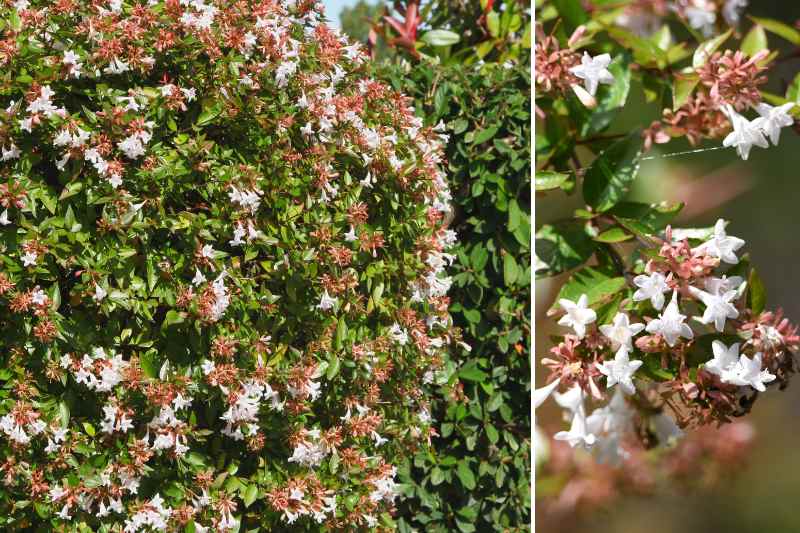
Abelia x grandiflora
The outsider: Atriplex halimus
Finally, the Atriplex halimus, commonly seen along our coasts, is a perfect candidate for those seeking a low or medium hedge, as it grows quickly to form a hedge of about 1.50–1.80 m. A shrub with greyish foliage not to be forgotten, since it tolerates temperatures down to -10 °C if planted in well-drained soil.
Also online, browse our selection of coastal evergreen hedges and our article 5 shrubs for a coastal hedge.
Read also
How to plant a hedge with bare roots?Evergreen hedge shrubs for small or large gardens
Another aspect to consider when planting a hedge is the size of the garden : a small city garden will not be treated as a large country garden where shrubs can be chosen for greater height and more vigorous growth. In the city, we also often want shrubs that are typically pruned, whereas in a country garden we can allow free hedges. Here are our favourites for these two types of garden
– For large gardens
Have you got space or a garden in the countryside? These shrubs are made for you!
- The Elaeagnus, described above, as they can grow up to 4 m in height and keep a free-form habit.
- The Griselinia, suited to mild climates, and likewise may not require pruning.
- The ridged viburnum (see above), which is particularly suited to tall hedges.
In the case of a free hedge not intended to be completely covering, think about pairing them with other deciduous shrubs that grow quickly such as Vitex agnus-castus or Kolkwitzia, two superb shrubs with mauve flowers for one and pink for the other, or elder.
Read also : Which Eleagnus should I choose for a hedge? and 9 shrubs for a hedgerow.
– For small gardens
For an urban garden, some shrubs are more suitable as they tolerate pollution well. It is also their small size at maturity that matters here. Besides the shrubs already mentioned such as Elaeagnus, cotoneaster, laurustinus, or the ridged viburnum which are pollution-tolerant, also note Photinia, bamboo and some Berberis:
Photinia
It is somewhat unbeatable in hedges, seen a lot (perhaps too much?), but it must be said that its growth rate is one of the fastest among evergreen shrubs. In a mixed hedge (multi-species), it works very well when chosen in new, original varieties. Be careful not to choose for a low hedge some dwarf cultivars with much slower growth such as ‘Little Red Robin’, or varieties such as ‘Carré Rouge’. The Photinia fraseri ‘Red Robin’ remains the classic choice with a growth of between 50 and 60 cm per year, its young shoots bright red that will turn green, and its white flowering when not pruned.
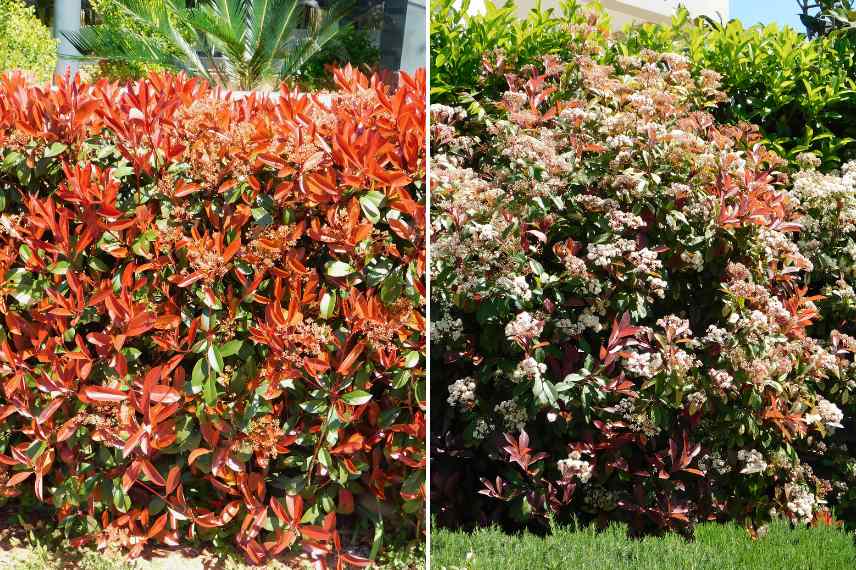
Photinia ‘Red Robin’, foliage and flowering
Some Berberis
Some Berberis can be considered, they often flower in May, yellow in colour, and are prized in defensive hedges for their spiny character. Little-known, Berberis gagnepainii ‘Lanceifolia’ has attractive narrow dentate foliage that reddens in winter, growing up to 2 m in height, ideal for small spaces. This Berberis grows in sun or partial shade, and its shoots trail. The variety ‘Chenaultii’ is shorter, spiny, indifferent to exposure, forming a small defensive hedge.
And what about bamboos in all this?
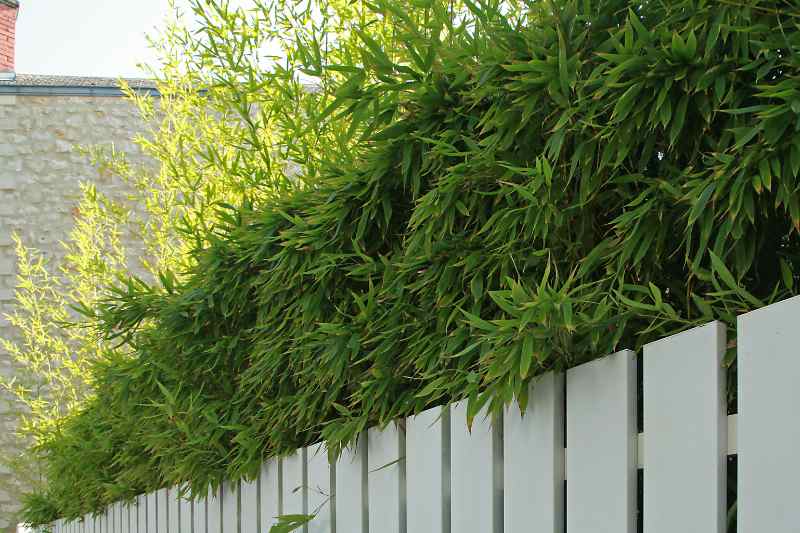
We mention them in this category for small gardens, as they suit them better, and, in an urban garden, allow you to quickly obtain the perfect screen along a street or a neighbour. It is really in this configuration that they will be most useful, provided you choose non-running cespitose bamboos, —we are talking about cespitose bamboos. They are indeed of a compact size like Fargesia nitida and the Fargesia murieale, the most common, as they are of intermediate size (2 to 3 m tall). These bamboos are hardy across the whole territory, thanks to their notable hardiness (-25 to -30 °C). For example, choose the Fargesia murieale ‘Maasai’!
→ Read also : Choosing hedge shrubs for a housing-estate garden
Ornamental flowering shrubs
These shrubs commonly thrive in mild climates, with a growth of around 40 cm per year for Abelias and Japanese Pittosporum.
Abelias
They flower from June to October, providing a long-lasting display for the hedge. Their flowers are pale, white to pink-tinged. These are evergreen shrubs for hedges, ideal for countryside or urban settings, in regions that do not experience severe frosts. Also read 9 Abelias for a flowering hedge.
Pittosporum tobira
This Japanese pittosporum is ideal for medium- and large-sized gardens and offers dense and fairly rapid growth (40 cm per year) when planted in well-drained soil and in a sheltered position. Its major asset is an intensely scented spring flowering, perfuming the air with orange blossom! It tolerates pruning well, but can also be grown as a free-standing hedge, where it can reach up to 4 m tall. As with other shrubs, beware—the compact form ‘Nana’ should be avoided, as it grows much more slowly.
Oleanders, Grevillea, Callistemon and Ceanothus
In the most favourable regions, one might consider oleanders, although they will be less vigorous than the shrubs mentioned above. Expect growth of around 40 cm, or up to 50 cm in Provence, for example, a superb variety with salmon-coloured flowers. Callistemon can also be considered if you’re not in a hurry, or if the hedge has less visibility (around 2 m tall, with C. laevis being the fastest-growing). Finally, evergreen ceanothus, often sought for their distinctive blue flowering, can be suitable, by selecting a variety that grows a little faster than average, such as Ceanothus ‘Concha’ (3 m tall).
All these fine shrubs are therefore best suited for a mixed border due to their more modest growth (an average of 30-40 cm per year).
Also online, explore our selection of evergreen and flowering shrubs for hedges and our articles Flowering hedge, which shrubs to plant, when and how? and 5 Grevilleas for a hedge.
Further reading
Discover our complete range of fast-growing hedge shrubs in our online nursery. You can refine your shrub selection there using our ‘growth’ and ‘foliage type’ filters!
- Subscribe!
- Contents
Comments