






























Everything you need to know about the common Rose mallow, an impressive flowering perennial
Varieties, cultivation, ideas for companion planting and care to be provided
Contents
Among hibiscus, it is mainly the species syriacus, pretty summer-flowering shrubs, that are best known. But the common Rose mallow (Hibiscus moscheutos) and their spectacular flowering deserve just as much our attention. Each flower can reach nearly 20 cm in diameter. They are ideal candidates for naturalising water features, bringing an exotic touch, but they also thrive when grown in pots.
Let’s rediscover the merits of common Rose mallow, the finest varieties, and the best tips for growing them with ease.

Benefits of the common rose mallow
Common rose mallows have several qualities.
- Their flowering is, of course, their main asset. Throughout the summer, sometimes right into early autumn in mild climates, common rose mallows reward us with large flowers, impressive in size. They are simple, with wide, open cups, reminiscent of hollyhocks. They typically display vivid colours, in red or pink shades, but can also be white. If each flower lasts only a short time (one day), they bloom almost continuously if growing conditions are right.
- Their foliage can also be decorative and colourful (purple), adding an extra aesthetic touch.
- Common rose mallows are, of course ideal for greening water features (ponds, lakes, etc.), but can also be grown in pots. They have no equal for bringing a lush touch and a holiday vibe to terraces, balconies or patios.
- They are fairly hardy perennials, generally down to -10°C. They can therefore be grown in the ground in many regions.
- They are easy to grow, relatively disease-resistant and require little maintenance.
- The blooms also attract pollinating insects.
Note that common rose mallows are slow to start growing: they often restart around May. So don’t be surprised if they don’t reappear until late spring.
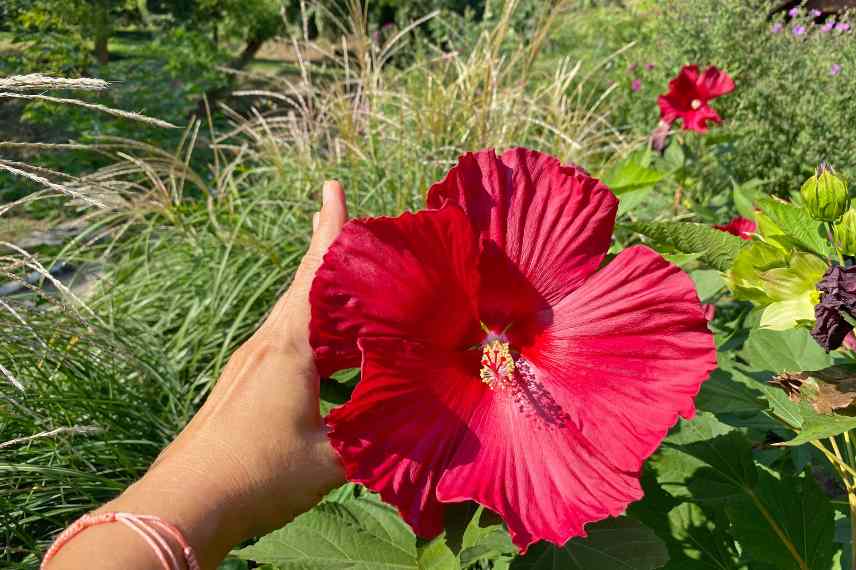
An extraordinary bloom!
The different varieties of common rose mallow
There are several varieties of the common rose mallow. In our latitudes, most of them form handsome shrubs composed of upright, erect stems, reaching about 1.5 metres in height.
Among the truly spectacular flowering displays, we note the impressive Hibiscus moscheutos ‘Rouge’, with its large cup-shaped flowers in a blood-red colour and measuring up to 25 cm in diameter. We also mention ‘Midnight Marvel’ and ‘Geant Red’, equally spectacular. For its part, ‘Red Wine’ features dark purple foliage, depending on the light almost black, which makes the scarlet of the flowering stand out perfectly. Let us also mention Hibiscus coccineus, a herbaceous species that appreciates the same growing conditions, in waterlogged soils. Also known as the “Texas star”, it indeed offers showy five-petalled flowers, well separated, in a vivid red. Each flower measures between 15 and 20 cm in diameter. The foliage is also interesting: finely dissected, it resembles hemp or Japanese maple.
On the pink-flowering side, we mention ‘Pink Passion’ (dark pink), ‘Summerific Berry Awesome’ (deep pink maculated with purple at the centre) or ‘Sweet Caroline’ (pink with a purplish centre). The Hibiscus moscheutos ‘Fujin’ se distingue par sa floraison bicolore, white edged with pink, but also by its habit. It is a dwarf variety that does not exceed 80 cm in all directions, ideal for pot culture. Let us not forget the variety ‘Joli Cœur’, adorable with its white-bicolour flowers, heightened by a vivid red heart. For its part, ‘Carousel Ghost’ offers pure white flowers, highlighted by a deep purple foliage that contrasts well.
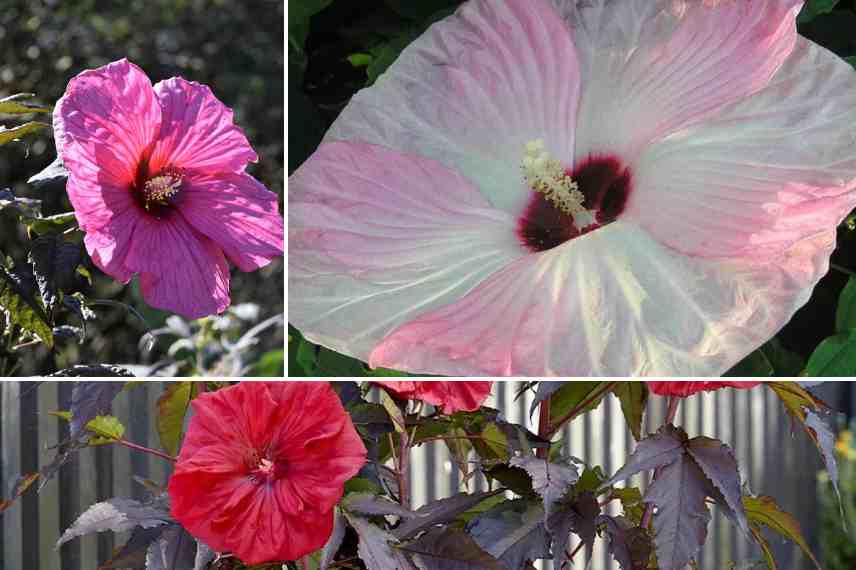
Hibiscus ‘Summerific Berry Awesome’, ‘Fujin’ and below ‘Red Wine’
How to grow and care for these beautiful flowering perennials?
As their name suggests, the common rose mallow loves water. They are indeed plants native to marshy areas of the eastern and southern United States.
They also require full sun for good flowering. In the hot southern regions, however, they can tolerate light shade. Prefer an exposure sheltered from strong winds, which can damage the delicate flowering of Hibiscus.
For planting time, ensure the last frosts have passed, i.e., between March and the end of May, depending on the region.
The Hibiscus appreciate fertile soils, rich in organic matter. The substrate can even be heavy and clayey, as long as it remains moist, even waterlogged, especially between May and October. In autumn, when the foliage begins to yellow, the soil should simply stay moist. Hibiscus will be grown in the ground, especially in Mediterranean or oceanic regions. If grown in pots, consider applying appropriate fertilisers or well-rotted compost in spring. Use a self-watering container or install a saucer or cache-pot, in which water should remain almost constantly.
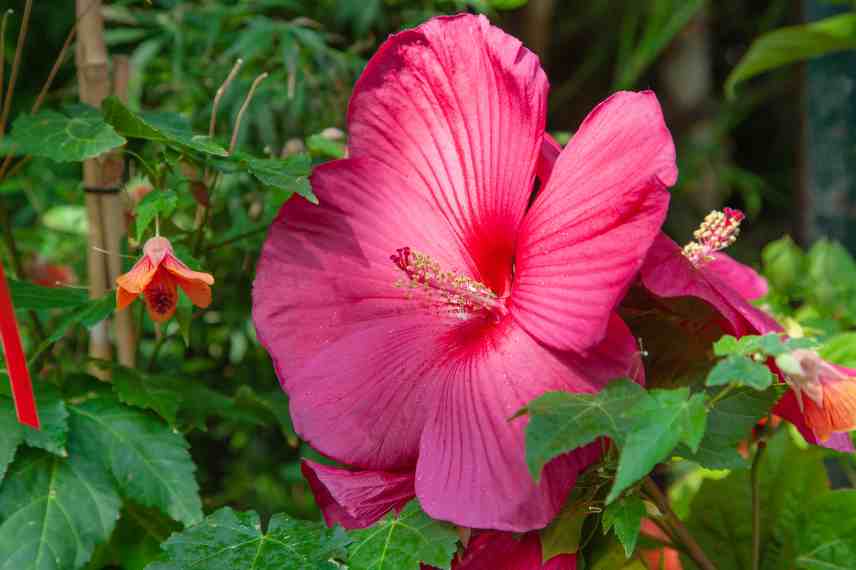
The common Rose mallow are planted in moist soil and in full sun to flower well
In terms of maintenance, the common rose mallow requires little care. They will appreciate being pruned after flowering (spent flowers, damaged stems…), though this is not essential. A severe pruning, about 5 cm from the soil, can also be carried out from time to time to stimulate flowering for the following year. In cold regions, perform it in late winter, to let the aerial parts protect the stump.
In cold climates (intense and persistent frosts), north of the Loire and in mountainous regions, the common rose mallow will require winter protection. Grown in pots, they can be brought under cover to a place that may be somewhat dim, but frost-free. In mild regions where marsh hibiscus are grown in the ground, still add a thick organic mulch (straw, hay, RCW, dead leaves…) around the base.
How to pair the common rose mallow?
Common Rose mallows create beautiful displays in flowering borders, but also perform very well as standalone specimens. In a large pot, they take care of themselves.
In a waterlogged border, they will help create a beautiful ensemble alongside lush Gunneras, Colocasias or Tetrapanax. The blooms of Cannas, of Crocosmias and of Kniphofias will also reinforce this tropical vibe.
But they can also easily find a place in a contemporary garden, for example alongside White Calla Lily (Arum blanc), very graphic and minimalist, with their immaculate flowers.
For a more naturalistic style, pair them with Astilbes, to Aruncus and with ornamental grasses for moist soil.
Alongside a pond, marsh Hibiscus will of course accompany water lilies and Water Iris.
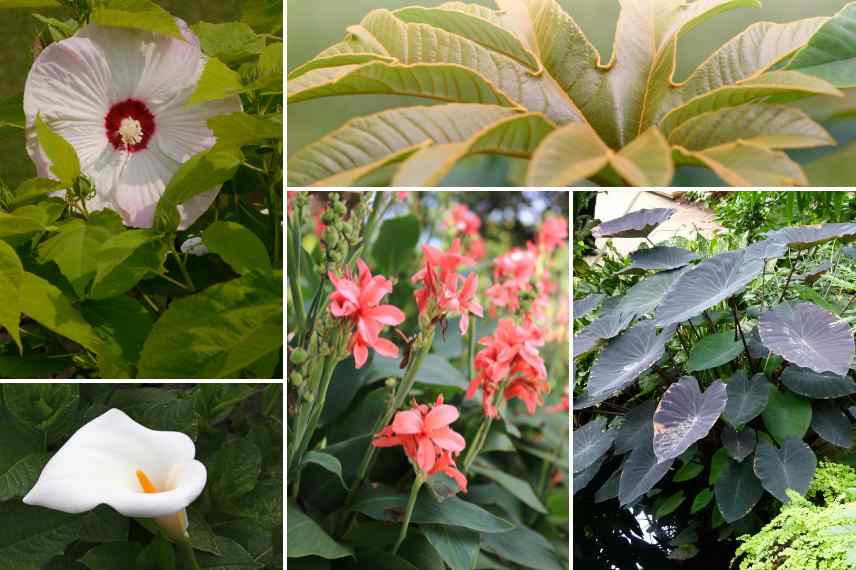
Common Rose mallows, Tetrapanax, arum lilies, Cannas and Colocasia ‘Black Magic’
- Subscribe!
- Contents
Comments