






























Early-flowering perennials: a quick way to emerge from winter!
Our selection of perennial plants that flower very early in spring.
Contents
After a long spell of winter lethargy, the gardener longs to see his garden come back to life. And while patience is the gardener’s virtue, he can’t wait to see the first flowers bloom. This is where early-flowering perennials come into play. Real little miracles of nature, these plants have developed survival strategies to flower while frost still threatens and days are barely longer than nights. Planting these early-flowering perennials is, in a sense, a foretaste of spring.
Discover our selection of leading perennial plants that flower as early as February and March to wake up the garden, still dormant from the winter cold.

Why plant these early-flowering perennials?
As the earth still seems asleep beneath the last frosts of winter, early-flowering perennials bravely face the cold to herald the renewal of spring. While they bring a splash of colour to the garden, they are much more than that. These sentinels of spring are often welcome to the impatient gardener, but not only that…
A boost to wake up the gardener
After months of inactivity, seeing these perennials’ colourful flowers bloom boosts the gardener’s spirits. They act as a genuine remedy for winter torpor and spur a return to the tools. These plants mark the start of a new cycle and the resumption of outdoor activities. Spring is approaching, and we will need to prepare, both physically and mentally, to reintegrate into the garden and the vegetable plot.
A biodiversity issue
At the end of winter, bumblebees and the first solitary bees, and in particular Osmias, emerge from hibernation. At that moment, food sources are scarce. Early-flowering perennials, rich in nectar and pollen, provide a vital nectar and pollen source, crucial for their survival and that of their species. Without these flowers, many pollinator colonies could not survive or reproduce effectively.
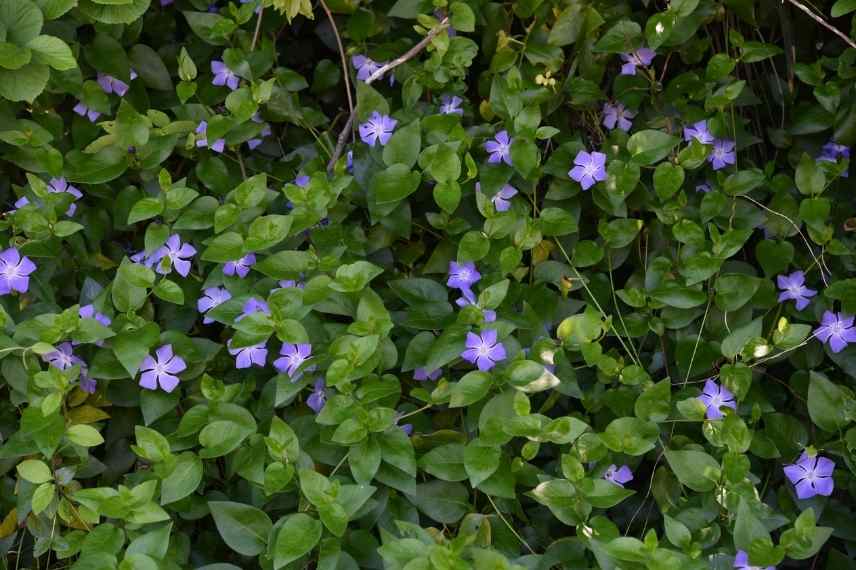
Little periwinkle
Long-lasting greenery
From the end of winter, often in February, spring bulbs such as snowdrops, crocuses and Muscari begin to emerge, offering their first flowers. But once they have faded, these bulbous plants disappear completely to replenish their reserves. By contrast, early-flowering perennials often retain interesting foliage or prepare the ground for summer plants. They occupy space, thereby limiting the proliferation of unwanted weeds on bare soil.
Early perennials for shade or partial shade
Many early-flowering perennials are woodland plants. They have evolved to complete most of their reproductive cycle, flowering and pollination, before the trees sprout their first leaves. Once the trees are foliated, light no longer reaches the ground, and shade becomes too dense.
Discover our selection of nine early-flowering perennials perfect for partial shade or even shade.
The hellebore (Helleborus niger and Helleborus orientalis)
Nicknamed “Christmas rose” (Helleborus niger) or “Lenten rose (Helleborus orientalis), hellebore is the undisputed winter queen. Its flowers, available in shades ranging from pure white to almost black purple, including green and pink speckled, last for several months.
- They hate being moved. Choose a permanent, humus-rich and well-drained position for them.
- Cut away old dry leaves as the flower buds appear to better showcase the flowering
Lungwort (Pulmonaria)
Often overlooked, lungwort is nonetheless an extraordinary plant, very hardy. Its leaves speckled with silver are decorative all year round, but its spring flowers, which often shift from pink to blue on the same stem, are enchanting. They are extremely melliferous. They are also excellent ground-cover plants, which can spread aggressively. So keep an eye on them.
Epimedium (Epimedium)
Also called “elfin flower”, Epimedium is the ideal ground cover for dry shade. Its small delicate flowers, resembling tiny orchids, hanging in the air, appear from late March to early April above evergreen foliage, often bronzed in spring. These are very hardy perennials, sturdy, with new hybrids regularly introduced.
The Caucasian forget-me-not (Brunnera macrophylla)
The Caucasian forget-me-not is a robust plant that forms clumps of large heart-shaped leaves. In April, it is cloaked in a cloud of azure blue flowers, sometimes white, of incredible delicacy. The varieties with silver foliage, such as ‘Jack Frost‘, illuminate literally the darkest corners of the garden before other plants emerge. Some varieties offer variegated foliage in yellow, white or cream.
The primrose (Primula)
These are often the first flowers of the year in most gardens. With flowering in colours very varied, these perennials are very easy to plant and grow. Very hardy, primroses often bloom from late February.
Hepatica (Hepatica nobilis)
Hepatica is a small, unobtrusive but precious plant, in the Ranunculaceae family. It bears star-shaped flowers in pure blue, pink or white from March, rising above trilobed, dense and hardy foliage. It requires calcareous soil and a sheltered position.
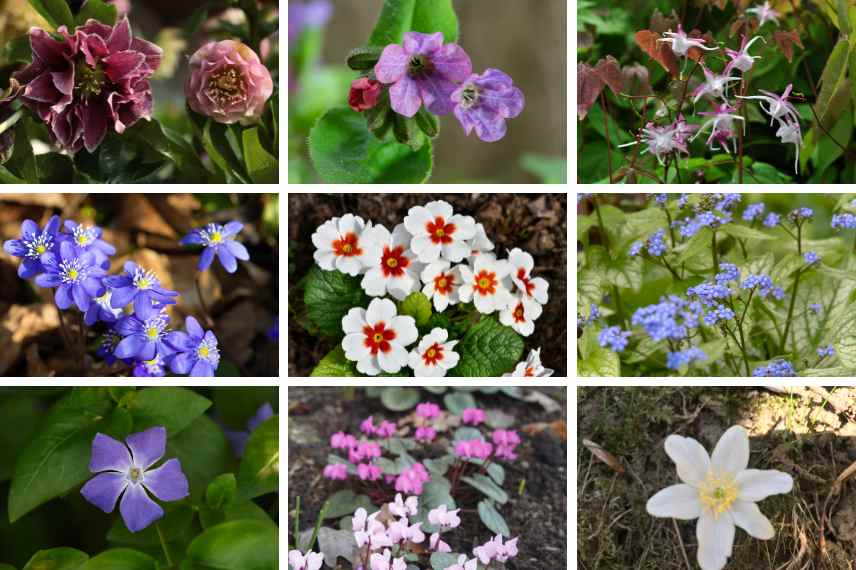
From left to right: hellebore, lungwort, Epimedium, hepatica, primrose, Caucasian forget-me-not, lesser periwinkle, Cyclamen coum and wood anemone
Lesser periwinkle (Vinca minor)
The lesser periwinkle forms an indestructible ground-cover that lights up shady areas with its star-shaped flowers in violet, white or pink from February. Its evergreen foliage stays year-round and forms a true carpet at the foot of trees or on banks. However, beware of its invasive tendency in small spaces.
Cyclamen coum
Cyclamen coum defies the frost by unfurling its delicate pink, purple or white flowers from February. Its round leaves, often marbled with silver, provide an elegant ground-cover. Cyclamen coum thrive where nothing else will grow, quickly forming pretty flowering carpets.
The wood anemone (Anemone nemorosa)
The wood anemone literally forms a pure white carpet that carpets the woodland in March–April. It disappears completely in summer, making way for other perennials, which makes it an ideal companion plant.
Early-flowering perennials that prefer full sun.
On banks or at the edge of borders, these perennials require full sun to display their vibrant colours. Discover our selection of perennials with early flowering.
Aubrieta (Aubrieta)
This alpine perennial is a timeless classic for walls. In March, Aubrieta disappears entirely beneath a carpet of violet, pink or blue flowers. It loves chalky soil and full sun.
Golden alyssum (Alyssum saxatile)
As its name suggests, Golden alyssum blooms with such a vivid yellow that it seems to radiate. It forms dense evergreen cushions. It is a perfect perennial for contrasting with the cool tones of early bulbs.
Evergreen candytuft (Iberis sempervirens)
Evergreen candytuft is a dwarf, woody plant that cloaks itself in pure, opaque white. It stays green all year round thanks to its evergreen foliage and it beautifully structures borders. It is a thoroughly hardy perennial. Do not hesitate to discover ‘Absolutely Amethyst’, a unique variety with violet flowering.
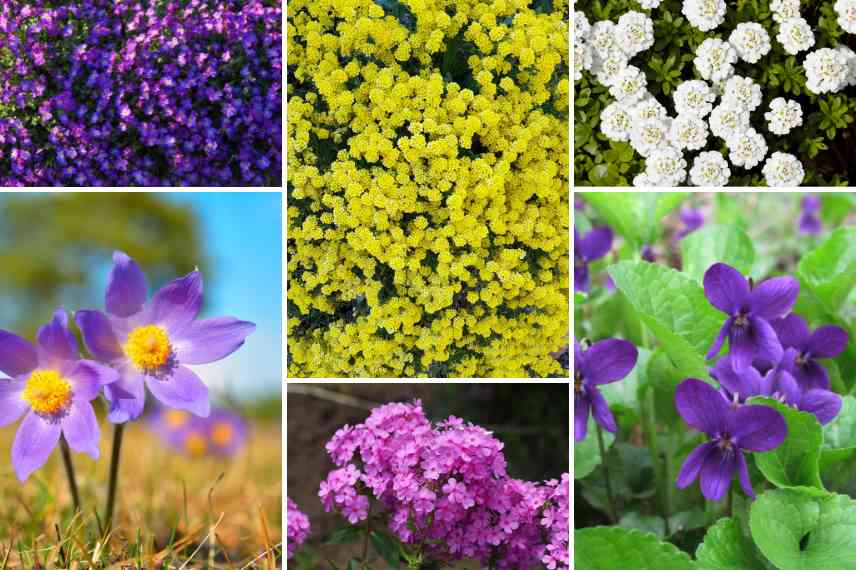
From left to right, Aubrieta, Golden alyssum, Evergreen candytuft, Pulsatilla, Moss phlox and Sweet violet
Pulsatilla (Pulsatilla)
Moss phlox (Phlox subulata)
This species of Moss phlox forms a carpet of flowers so dense that the evergreen leaves are no longer visible. It blooms a little after Aubrieta, taking over to colour rockeries in April. It is a creeping perennial with pink, white or purple flowers.
Sweet violet (Viola odorata)
Small, but powerful in fragrance, sweet violet slips in everywhere, at the foot of hedges or between paving slabs, and blooms from February.
How to plant them and look after them?
Early perennials are generally robust, but they do appreciate a few small touches:
- Planting is best done in autumn to allow their root system to develop before they have to produce their flowers. An application of well-decomposed organic matter such as compost is recommended. Drainage is also essential to avoid waterlogging. If the soil is heavy, plant on light, slightly raised mounds or incorporate a generous amount of pozzolana or gravel at the bottom of the planting hole
- Maintenance involves removing faded blooms to encourage a second flush of blooms. Division is ideally carried out in May
- Winter protection is essential for the more fragile plants, which, with climate change, bloom even earlier: a good mulch and a winter fleece can be useful.
- Subscribe!
- Contents
Comments