





























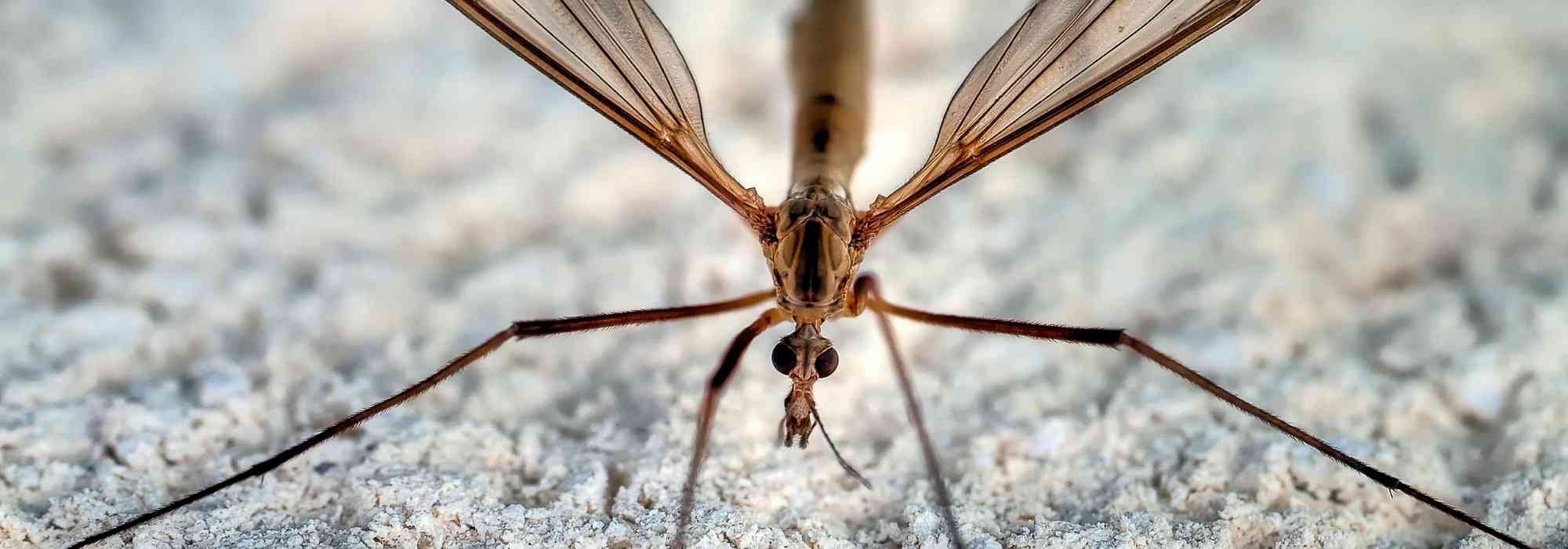
Crane flies, much-maligned long-legged flies
Our natural solutions to combat the larvae of these insects that attack the lawn and the vegetable garden
Contents
If I tell you about crane flies (Tipula spp.), you may not know this dipteran. By contrast, the term “long-legged fly” (cousin in French) is probably more familiar to you. Right away you picture this large mosquito perched on its long, spindly legs, which makes it look quite ungainly. A cousin of the mosquito that isn’t really frightening since it doesn’t bite. Yet it isn’t entirely harmless. More precisely, its larvae aren’t entirely harmless.
Indeed, crane fly larvae attack herbaceous plants in our lawns, and even some vegetable plants. And they can cause quite a bit of damage.
Discover what this crane fly really is, what its life cycle is, and, above all, the solutions to get rid of it effectively and naturally.

What exactly is a crane fly, that big mosquito with long legs?
The crane fly (Tipula) is a dipteran in the family Tipulidae, with around 200 species recorded in our territory. But we will focus on the two most common, namely the cabbage crane fly or vegetable crane fly (Tipula oleracea) and the meadow crane fly (Tipula paludosa).
A large mosquito that does not bite
Commonly called “cousins”, in French these Diptera, insects with a single pair of membranous wings and mouthparts enabling them to bite or suck, are more impressive than they are actually dangerous. In fact, they are completely unable to bite and feed on nectar. Physically, crane flies are easily recognisable by their six long, delicate legs, which seem almost to handicap them. These Diptera also have the peculiarity of possessing “balancers” that replace the hindwings and help balance their flight. It is not uncommon, through clumsiness or in order to escape a predator, for crane flies to deliberately shed a leg or a balancer. If this act saves them, it also considerably hinders their movements.
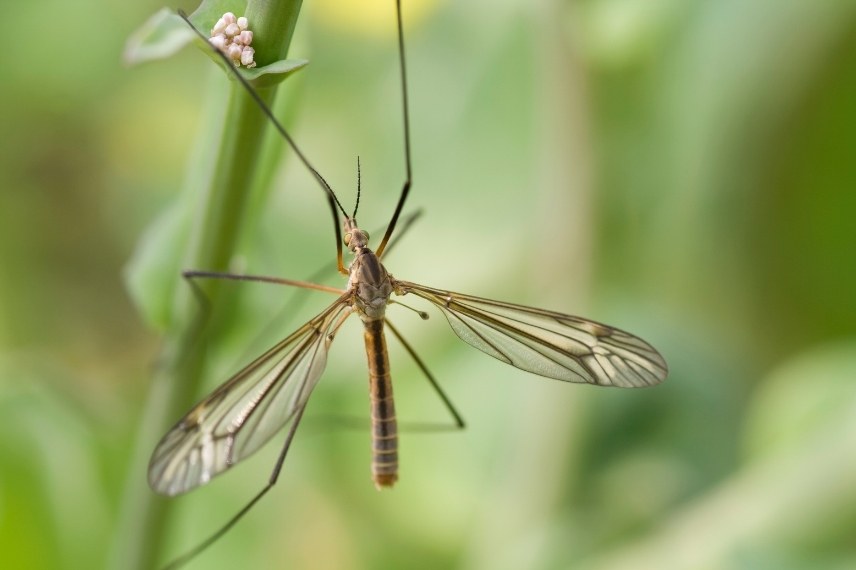
The crane fly is recognised by its six long legs
Sometimes called “scythe flies” due to their resemblance to the scythe-wielding spider, Mr and Mrs Crane Fly are slightly different. The males are, depending on the species, rather grey, while the females are somewhat reddish. Both have large eyes located beneath the head. During their short lifespans, they are solely devoted to mating, even more so, in the evening or at dawn.
An insect that loves damp
Crane flies favour cooler, even damp, areas of the garden, and they are often found on lawns. Thus, the meadow crane fly is visible in September, or October if the weather is mild. Whereas the cabbage crane fly is more noticeable in April–May, then in autumn for a second generation.
If the adults are by no means troublesome or aggressive, their larvae are more to be feared. Indeed, the adult crane flies give rise to large grey grubs. Four centimetres long, these grey, dirty-grey larvae are apodous (without legs), with a black head that is barely visible and six fleshy papillae that earn them the nickname “starry worms.” These larvae do not curl up on themselves. This is one of the main distinctions between crane fly larvae and the larvae of terricolous noctuids, commonly called grey grubs. They are also distinguished from the larvae of the chafer grubs, cream-coloured, or from the larvae of the ‘vine weevil, also cream-coloured.
The life cycle of crane flies
Meadow crane fly (Tipula paludosa) has only one generation per year, while the cabbage or garden crane fly (Tipula oleracea) typically has two. That’s why their life cycle differs slightly in terms of flight period:
- From June to September, the adults emerge, fly and mate

Crane flies devote their short lives to mating
- The female lays between 300 and 400 black eggs, either in the soil, or while it is perched on a leaf, or even in flight, the key is that the atmosphere is sufficiently humid
- 15 days after laying, the larvae hatch. They feed on humus and plant debris
- As soon as the cold arrives, they slow their growth and hide beneath the surface of the soil
- In spring, as soon as the soil warms up, crane-fly larvae resume their activity. And they are especially hungry and voracious
- The larvae grow and become nymphs in June.
Adults are often very visible in autumn, between September and October, as the cold approaches. They then take refuge in well-lit places and circle around light bulbs.
Damage caused by crane fly larvae
Earlier, we noted that crane fly larvae are by no means dangerous, aggressive or harmful to crops. However, the larvae can be so in the event of a severe infestation. Indeed, during their four larval stages, and especially in spring, they can cause substantial damage.
These larvae develop underground, not far from the surface. They feed therefore on herbaceous plants with a shallow root system, such as the grasses in our lawns, forage grasses, clover, and green manures. They also attack the rhizomes and tubers of vegetable crops, such as the beetroot or the potatoes. In general, they feed during the day, and in the evening, when climatic conditions are ideal, they surface through galleries and begin nibbling at the collar, or the nearest above-ground leafy parts.
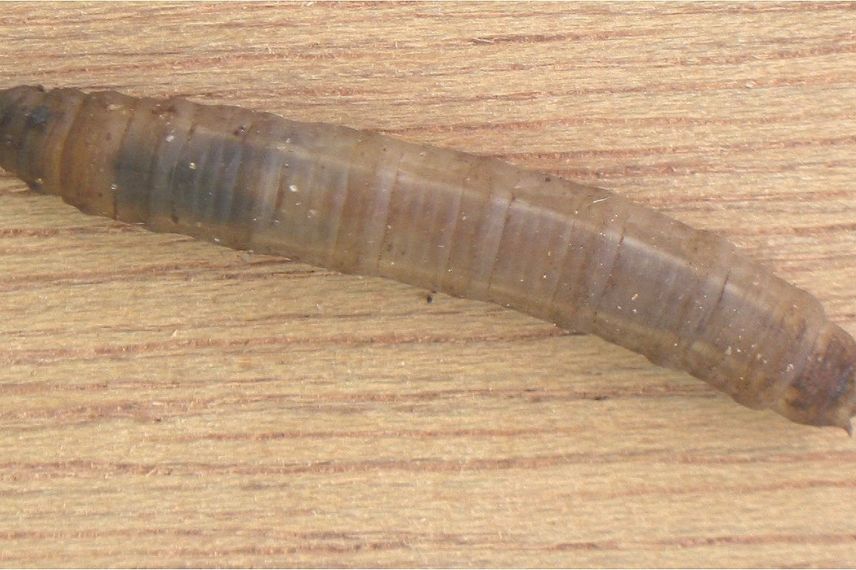 Crane fly larva ©Rasbak Wikimedia Commons</caption]
If proliferation occurs, these larvae can cause the loss of a lawn. Indeed, the plants yellow and dry out, then die, the collar being severed and the roots gnawed. Damage is less common in the vegetable garden, but significant when moisture is very high. However, these larvae are especially damaging to crops of wheat, maize and barley…
Read also
Hedge for birds: which shrubs to choose?How can I naturally control crane flies?
If the presence of larvae is confirmed in your lawn or your vegetable garden, action should be taken fairly quickly. Biologic al control relies on the use of nematodes, and in particular, the species Steinernema carpocapsae, not only highly effective against the larvae of soil-dwelling noctuids, but also against Colorado potato beetles, codling moths, the moth Duponchelia fovealis, but also mole crickets and crane flies. Nematodes are microscopic worms that penetrate the bodies of larvae to parasitise them. The larvae die within 24–48 hours, and the nematodes leave their hosts to seek another. And this continues until there are no crane fly larvae left.

Nématodes contre les vers gris et doryphores Sc Biotop
Prevention comes first!
But the best way to combat crane fly larvae is primarily through prevention. A multitude of small actions can help create an unfavourable environment for crane flies. Of course, during particularly wet years, control will be more difficult, but it remains possible.
As embryonic development and hatching are favoured by high humidity, simply stop or reduce lawn watering during the flights of the adults and the laying of eggs, i.e., roughly from June to September. In the vegetable garden, the same applies. Moreover, well-drained, worked and aerated soil will attract crane flies less than a soil saturated with water.
The main preventive solution is to facilitate the establishment of natural enemies of these crane flies. And there are many! Among the most effective predators of crane flies, in their adult or larval form, include the shrew, the hedgehog, the mole, the bat, garden birds, amphibians… And to attract all these useful fauna, there are many ways. For example, by leaving a pile of branches or dead leaves at the back of the garden, which will provide shelter for hedgehogs and shrews. To attract bats, a pond is essential. In the longer term, the planting of a hedge of berry-bearing shrubs is also advisable, as birds will come to shelter there, nest there and feed there. You can thus plant species such as the dogwood (Cornus), the black elder (Sambucus nigra), the hawthorn (Crataegus), the blackthorn (Prunus spinosa), the cotoneaster, the serviceberry, the laurustinus (Viburnum tinus), the pyracantha…
The ground beetles can also be fond of crane fly larvae. To attract them to your garden, it is often enough to leave an unmowed area in the lawn, perhaps sown with a few plants of phacelia. This wild patch will provide refuge and a pantry for ground beetles. A pile of wood or stones will also prove useful.
- Subscribe!
- Contents
Comments