





























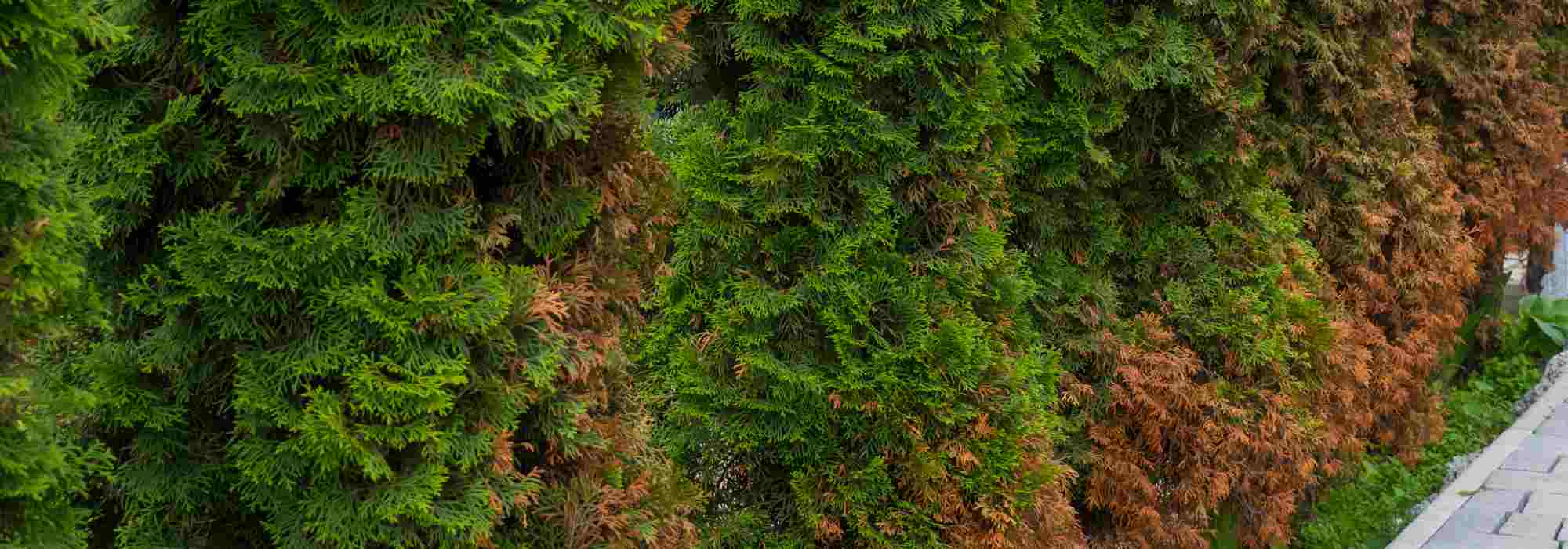
Conifer browning: causes and solutions
Our anti-browning solutions for conifers
Contents
Conifers have long been appreciated for forming monospecific hedges for screening or windbreaks. Their evergreen and dense foliage, slender habit, rapid growth and resistance to harsh conditions have contributed to their success. Today they are often replaced by informal hedges, composed of varied species of bushes, ideal for maintaining biodiversity in the garden. Among other reasons, this loss of interest is certainly due to common browning of foliage, which takes on a yellow-orange hue before drying out. A thuja or a pine turning brown remains a cause for concern for many gardeners…
Let us understand this phenomenon and see treatments for conifer browning for to act quickly and maintain the vitality of your Thuja hedges and other cypresses.

Tell-tale signs
Before we examine the possible causes of browning, let’s review the symptoms generally observed:
- Some shoot tips turning brown and drying out. Browning often progresses inward.
- A conifer that yellows, with the needles turning from green to yellow and then to orange before dropping.
- The foliage changes appearance uniformly, in patches, or on one side only.
- A rapid browning progression over a period of a few months or weeks.
- The presence of cankers, lesions, moulds, fungi…
All these signs should not only alert you but also help establish a diagnosis. However, it’s important not to overreact. Thus, some browning phenomena are normal, especially if they are temporary. For example, if only inner needles change colour, it is often due to temporary stress. Similarly, browning limited to the tips without progression is not serious. If browning is unilateral or directly due to particular weather conditions, wait a little longer too.
Read also
How to replace a conifer hedge?Main causes of browning in conifers
browning of conifers has multiple causes. It is essential to distinguish them to find the most appropriate solutions.
Water stress
This water stress can be linked to a lack of water, for example in summer during droughts or heatwaves. The conifer cannot absorb enough water to offset its transpiration. The outer needles suffer first. Thus, the needles at the base of a fir that turns brown, as seen in ‘Abies nordmanniana, before drying out and dropping, are signs of water deficiency. In thuja (Thuja occidentalis), the outer needles, exposed to sunlight, scorch.
Conversely, browning can be caused by an excess of water, mainly due to poor soil drainage. Roots stay in waterlogged soil, lack oxygen and rot, which can lead to colour changes in the foliage.
Soil problems or nutrient deficiencies
- A soil that is too compact and heavy, overly clayey, prevents water drainage and air exchange
- A soil poor in essential nutrients such as magnesium, iron, phosphorus…
- An unsuitable pH : some conifer species cannot tolerate soil that is too calcareous or too acidic, which blocks nutrient availability, leading to deficiencies.
Fungal diseases
When humidity is persistent and prolonged, when the soil is poorly drained, and rainfall is recurring, fungi can develop and cause browning of the foliage.
- The Phytophthora cinnamomi, which causes decline by attacking the roots, is a major cause of browning of thujas
- Other pathogenic fungi such as Pestalotiopsis, Phomopsis, Kabatina on thuja, leaf-spot disease, rust, and the cypress canker will have deleterious effects on the foliage.
The presence of pests
Many pests can attack conifer foliage :
-
- Mites such as the red spider mites often thrive in hot, dry conditions. Thuja disease caused by red spider mites can quickly weaken the foliage.
- Wood-boring insects or borers such as the thuja buprestid, or the bark beetle settle in their larval stage beneath the bark and disrupt sap flow
- Scale insects and the aphids suck sap and weaken conifers.
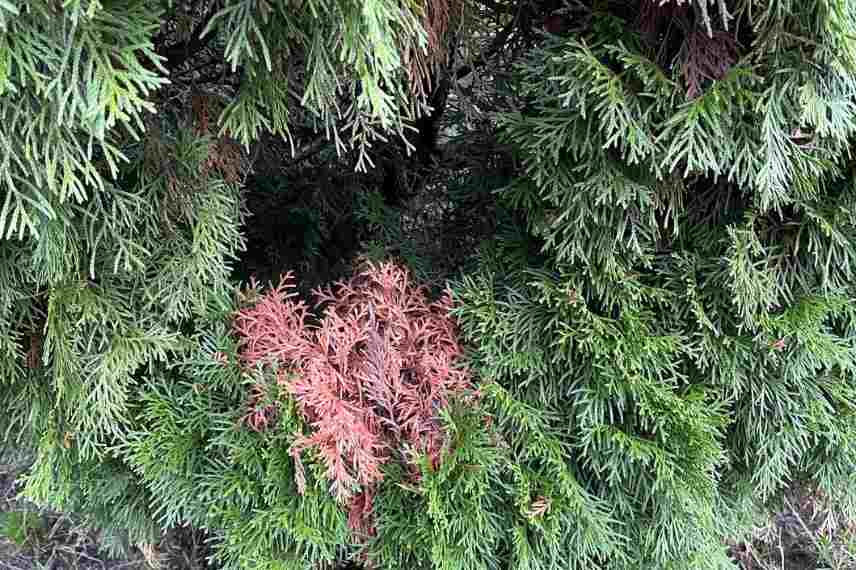
Browning of a conifer can sometimes occur in patches
Climatic or environmental conditions
Adverse climatic conditions can also be the causes of this browning. Some conifers, even hardy ones, may suffer leaf burns from icy winds or dry cold if the roots are not well protected. Intense solar radiation can scorch needles. Late spring frosts can affect newly formed needles.
Inadequate human practices
Sometimes the gardener is indirectly responsible for this foliage weakness:
- Over-pruning or pruning at the wrong time weakens a conifer and leaves wounds prone to infections
- Inadequate planting due to spacing, poor orientation, or entirely unsuitable soil
- Choosing an unsuitable species for the local climate or soil. Some conifer species are more hardy.
- Pollution, salt spray or road salt used for snow clearance can damage the needles.
Natural ageing
- Some older needles brown and fall off naturally. This isn’t serious if browning remains modest.
- After repotting or transplanting, a plant may lose some needles while it readapts its root system.
- In winter, even without disease, browning can occur naturally.
Your conifer or pine tree is turning brown — what to do?
When symptoms are already visible, there is still time to act. Success depends on the stage at which you intervene.
Removal of affected parts
Initially, you can, in the first instance, cut back brown or diseased branches to healthy wood. For this drastic pruning, it is essential to use sterilised tools to avoid spreading the fungi. The affected parts should be taken to the tip. Sometimes simply removing the fallen or rotten needles around the base is enough to limit spore hotspots.
Soil correction
- It is necessary to improve drainage if the soil retains too much water by adding sand or gravel
- Organic amendments can be added, such as compost or manure, to improve soil structure and nutrient-holding capacity
- If a nutrient deficiency is identified, it is essential to use corrective measures, for example magnesium sulfate (Epsom salts) for magnesium deficiency
Treatment for diseases
To treat fungal diseases, you can use biological and natural products such as horsetail decoction or nettle manure, or Bordeaux mixture, to be sprayed sparingly to avoid copper build-up in the soil.
Pest control
As with all other plants infested with aphids or scale insects, or red spider mites, soap-based treatments are fairly effective. It is more difficult for the wood-boring larvae of Lepidoptera or Coleoptera, as they have already penetrated the wood of conifers. It is essential to inspect the bark for holes or lesions.
Regular maintenance
Additional, regular care should be undertaken without delay:
- Regular watering, but without waterlogging. Ensure the substrate remains moist, but not waterlogged
- Mulching can be applied, but it must be managed. Indeed, some mulches can promote fungi if they retain too much moisture near the trunk
- Improving light conditions, if there is excessive shading or competition from roots near other plants.
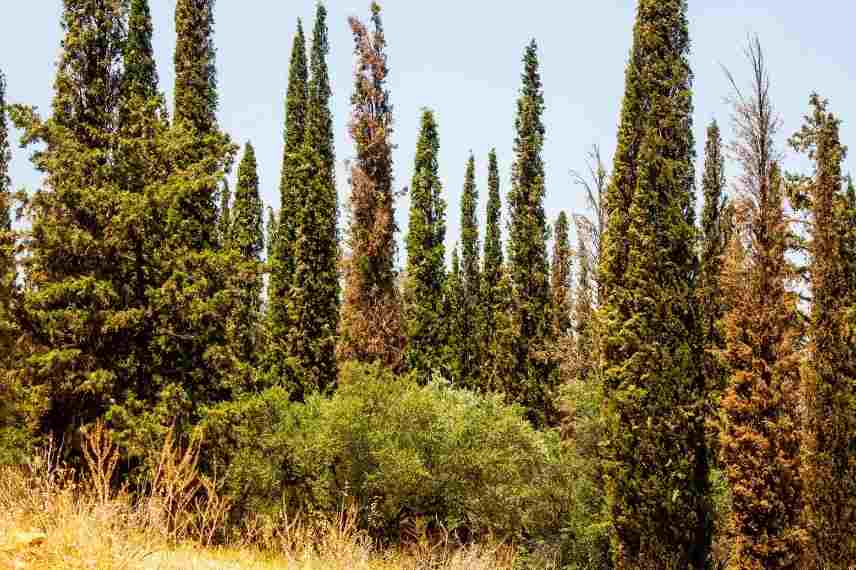
Browning of conifers can be caused by excessive heat or a period of drought
Replacement of the conifer
If a specimen is too badly affected, it may be necessary to fell it to prevent its spread.
Read also
Fast-growing evergreen hedge shrubsOur browning-prevention measures for conifers
To reduce the risk of browning, you can implement a few preventive measures:
- Choose the right species by researching its requirements in terms of soil, climate and hardiness… thus, avoid planting firs or spruces in areas exposed to strong drying winds without natural protection. For the arborvitae, a little afternoon shade can help in very hot regions. The cypress often enjoys full sun, but then requires a deep, well-drained soil.
- Choose suitable soil, well-drained, or improve drainage if necessary with the addition of sand or gravel.
- Avoid overly exposed sites to drying winds.
- Provide adequate space to promote air circulation, especially in a hedge.
- Take care of the planting by loosening the soil, enriching it if needed and watering thoroughly.
- Regularly maintain conifers (watering, fertilisers or organic matter inputs, pruning—preferably light—in spring or late summer).
- Disinfect pruning tools used for pruning and maintenance of conifers.
- Regularly monitor the bark, shoots, the root system… or early signs of pest attack.
- Install winter protection in the coldest regions.
- Subscribe!
- Contents
Comments