





























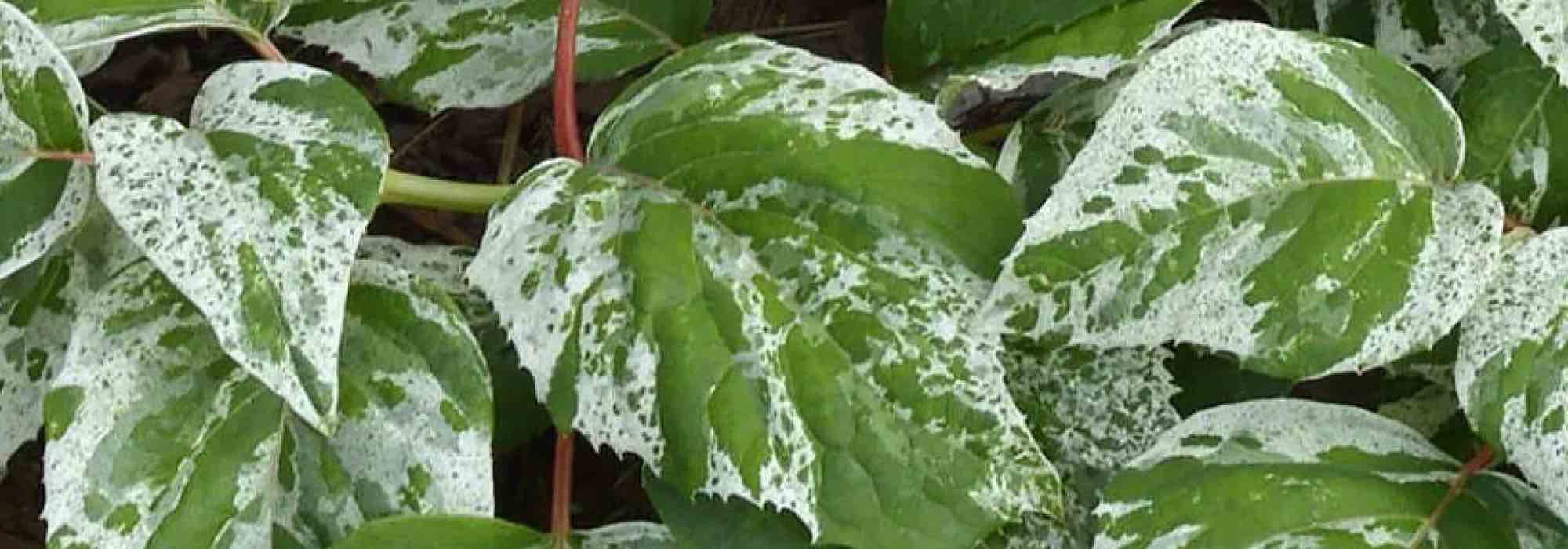
Choose variegated-leaved climbers to brighten up the garden
A luminous and original foliage to dress your garden structures with elegance
Contents
Among plants, foliage can be highly varied, both in shape and colour. Variegated foliage adds light and graphic interest to the garden with ease, while bringing a touch of originality. If you want to dress up a structure elegantly or hide an unsightly construction, climbing plants will be your best allies. And that’s good news: there are many variegated climbing plant varieties. Whether their leaves are marginate, speckled, striate, splashed, two-tone or even multicoloured, they will certainly add texture and depth.
Here we share our tips for choosing variegated climbing plants based on their various advantages and cultivation requirements.

The appeal of variegated foliage
As a reminder, variegated leaves are leaves that feature several colours and, generally, distinct patterns. If it does not display a uniform colour and offers other colours beyond green, foliage is thus described as variegated.
Scientifically, variegation results from a lack of chlorophyll in the lamina of the leaves, the pigment responsible for the famous natural green colour. This can result from an accidental or intentional mutation, but sometimes also from a virus. To learn more, read our article ‘Where do variegated leaves come from?‘.
In the garden, variegated leaves catch the eye, so it’s important to grow them with restraint. They work wonders in low-light areas, where they bring brightness. In a border bed, they help create a focal point and bring dynamism, breaking the monotony of green, especially when flowering is more timid.
To ensure you don’t misjudge when pairing a variegated climbing plant, take into account the colour of the variegation: it will pair very well with other plants that bloom in the same shade or in a complementary shade.
Variegated climbers to grow in pots
These are climbing plants with modest dimensions that will easily dress a balcony, a terrace or an internal courtyard. For this, choose plants that do not exceed 2 metres in height at maturity.
In a sunny position, you can plant compact nasturtiums. These climbing annuals that are very easy to grow offer plenty of inspiration with warm and cheerful colours, such as the Tropaeolum ‘Orange Troika’ with its vibrant orange flowers or the Tropaeolum majus ‘Cream Troika’ which produces cream-yellow flowers maculated with red at the throat. Their round foliage, reminiscent somewhat of water lilies, is green splashed with cream. Plan to reach 20 cm in height and 1 metre in spread. These climbers will look wonderful in hanging baskets from which they will cascade gracefully.
In semi-shade, opt for their variegated foliage of common ivy ‘Goldchild’ (1.5 m tall by 1 m spread). It adds a real touch of light with its green leaves variegated with yellow, turning to cream-white at maturity. The same with ‘Little Diamond’ and its spreading habit (35 cm tall by 1.10 m spread), ideal for planters or hanging baskets. It rewards us with green-grey leaves variegated with white cream. For its part, ‘Clotted Cream’ (1.50 m tall by 60 cm spread) features foliage with an interesting, undulate and plicate texture. It is pale green bordered with pale yellow and a salmon-pink edging.
Toujours à mi-ombre, adoptez en pot les jasmins étoilés panachés, à l’image du Trachelospermum asiaticum Trachelospermum asiaticum ‘Goshiki Chirimen’ (70 cm tall by 1 metre wide). This small-growing climber produces evergreen leaves variegated with green and grey. In the variety ‘Ogon-Nishiki’ (80 cm tall by 1.50 m wide), the foliage is decidedly multicoloured, with green variegated with cream and red, turning orange, yellow and bronze in autumn.
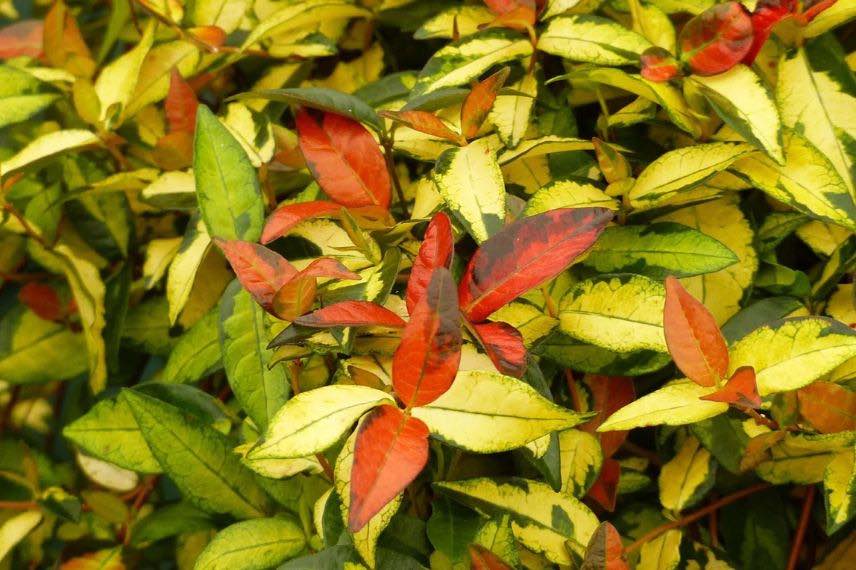
The Trachelospermum asiaticum ‘Ogon-Nishiki’
Variegated evergreen climbers
Evergreen climbers have the advantage of not losing their foliage in autumn. They are therefore perfect for dressing a structure all year round.
Among variegated varieties, you will have, for example, the choice between:
- Star jasmine ‘Star of Milano’ (3 metres high by 2 metres wide), with foliage variegated with cream and white, visible all year round ;
- Bower vine Pandorea jasminoides ‘Variegata’ (6 metres high by 3 metres spread), with foliage also variegated with cream;
- Bougainvillea glabra Bougainvillea glabra ‘Variegata’ with its foliage variegated green with cream-yellow, to be grown however only in regions where frost does not occur.
Of course, also consider variegated ivies, which will keep their foliage all year round to brighten the semi-shaded or shaded areas of the garden. This is the case for ornamental ivy Hedera helix ‘Yellow Ripple Golden Starlight’ (2.6 m high by 1.1 m wide), with foliage variegated with yellow and cream.
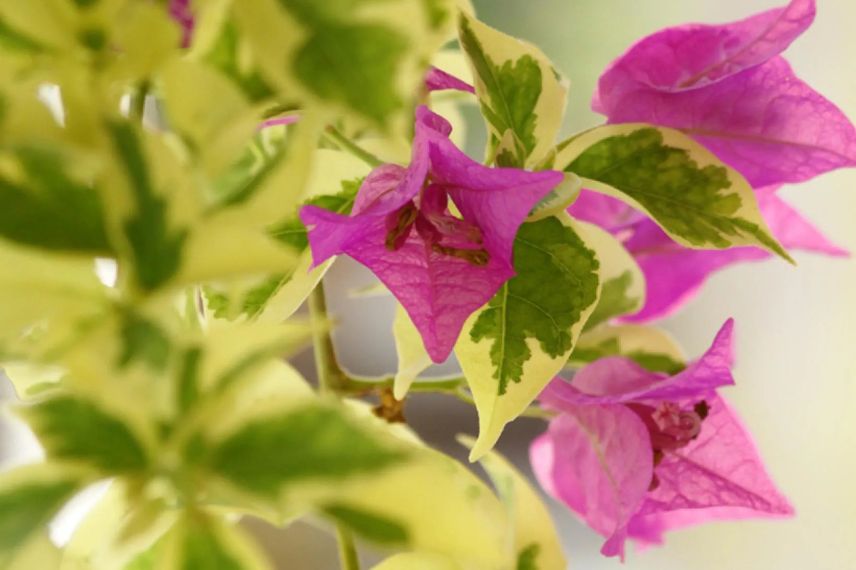
Bougainvillea glabra ‘Variegata’
Variegated climbers with remarkable flowering
Some climbers are not content with their variegated foliage alone and also display a highly ornamental flowering display.
For summer
Choose the honeysuckle, with its trumpet-shaped flowers in white-pink, enhanced by a dark pink-purple throat. They are showcased by lush foliage splashed with cream. This plant is best suited to mild regions, as the rootstock cannot withstand frosts above -5°C.
For a long flowering period throughout the summer, right up to the first frosts, easily grow the dwarf variegated nasturtiums.
Also consider the Lonicera japonica ‘Aureoreticulata’. This honeysuckle, with green foliage veined with yellow, produces fragrant white flowers throughout the summer. The same goes for the Sun Lover star jasmine, which rewards us with a white summer flowering in fragrant spirals. They are enhanced by variegated foliage in green, yellow and cream.
From late spring through to the end of summer, the Lonicera x italica ‘Harlequin’ flowers tirelessly. It reveals slender flowers coloured pink and cream with a white throat. They emit a powerful spicy fragrance. The foliage of this climber is irregularly variegated with cream, and sometimes with pink.
Finally, the variegated Chinese wisteria, a climbing plant with variegated leaves that reveals, at the very start of summer, clusters of white flowers striped with pink, with a heady fragrance.
For spring
Between May and June, the ornamental kiwi Actinidia pilosula Actinidia pilosula produces adorable little candy-pink flowers. They are accompanied by green foliage that gradually develops cream-white variegation.
The climbing hydrangea ‘Silver Lining’ also flowers in late spring, unveiling umbels of flat flowers in a delicate white-cream shade, exuding a suave fragrance. They are enhanced by variegated foliage in dark green and light green, sometimes yellow.
For autumn
Autumn is notably the season for ivy’s flowering. The flowers, produced in globular inflorescences, are fairly discreet and do not offer much aesthetic appeal. However, they are nectariferous, and therefore very attractive to insects, particularly bees.
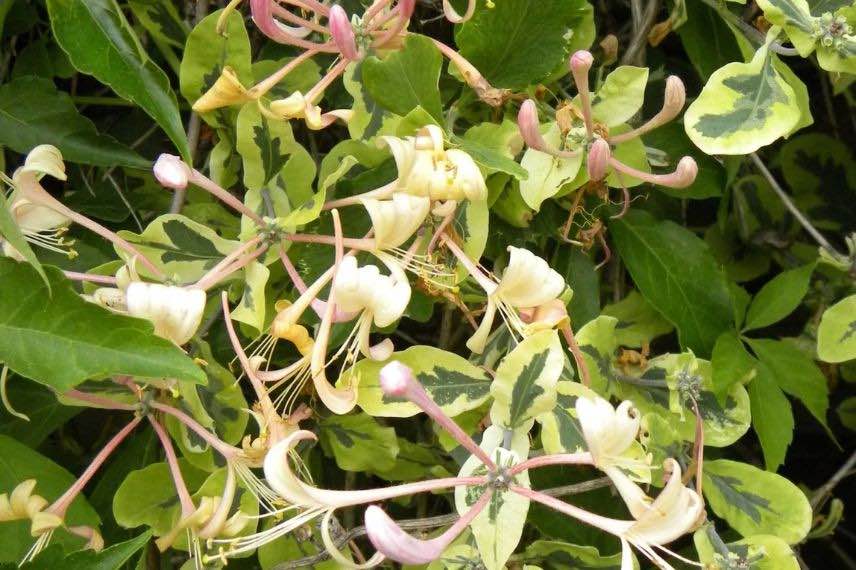
Lonicera x italica ‘Harlequin’
Variegated climbing plants with remarkable fruiting.
If some climbing plants have a fairly modest flowering, they make up for it with their fruiting. This is the case with Virginia creeperAmpelopsis brevipedunculata ‘Elegans’. First, it is particularly decorative with its deeply lobed foliage, coloured green, white and pink from spring to autumn. Then, it produces blue-to-turquoise berries, decorative throughout autumn. A small decorative jewel for many months.
Also noteworthy is the Parthenocissus quinquefolia ‘Star Shower’, which produces blue-to-black berries highly appreciated by birds, at a time when food is scarcer. The changing foliage is initially variegated with white and green, before turning pink-tinged red in autumn.
Ornamental kiwi Actinidia kolomikta ‘Eve’ graces us with beautiful variegated foliage of pink and cream-white. If pollinated, its flowers yield small edible green fruits.
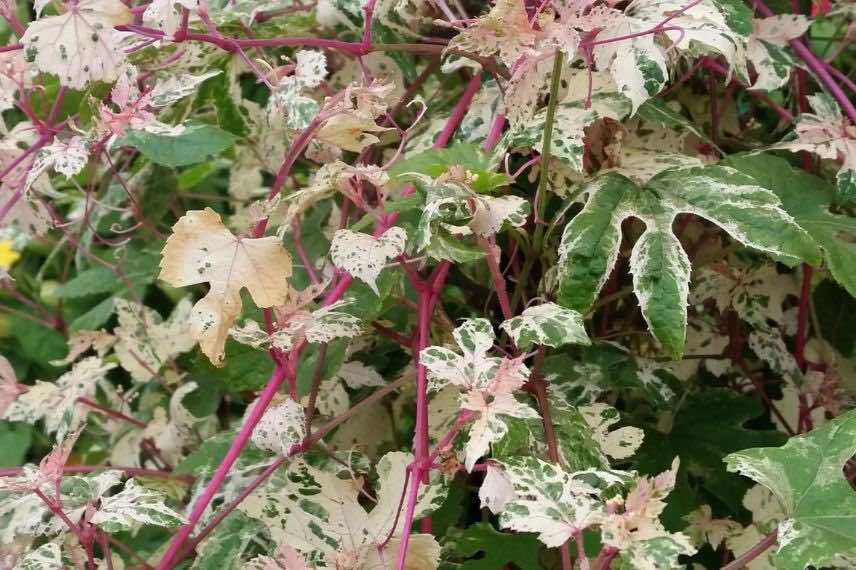
Ampelopsis brevipedunculata ‘Elegans’
Variegated climbing plants for shade
Variegated climbers are particularly interesting in the shaded areas of the garden, where they will brighten the space naturally. And that’s handy, as many varieties thrive in such exposure.
This is obviously the case for the ivies mentioned earlier. Let us add Colchian ivy (Colchian ivy) (6 metres tall by 4 metres wide), with its broad pale green leaves widely and randomly variegated with pale yellow. It is an ideal climbing plant for dressing a wall, a tree trunk or a shed. For its part, Canary ivy has the advantage of being suited to hot, dry climates. It produces grey-green, silvery foliage variegated with cream to pale yellow.
Climbing hydrangea ‘Silver Lining’ thrives well in a north-facing, low-light exposure, and will brighten it with its leaves variegated in grey and white.
Finally, let us mention Schizophragma hydrangeoides ‘Burst Of Light’, a climbing hydrangea with green leaves variegated with white, which also thrives in shade.
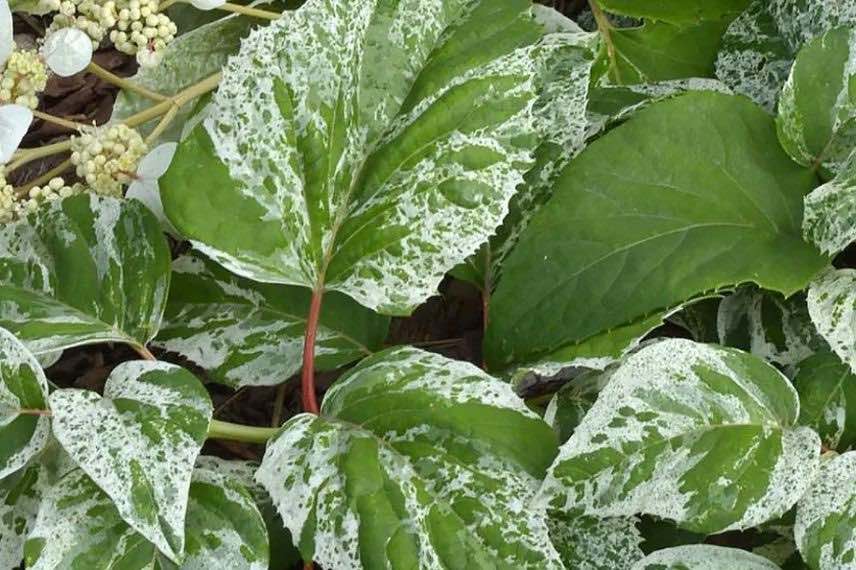
Schizophragma hydrangeoides ‘Burst Of Light’
Hardy variegated climbers.
If you live in a region that experiences fairly harsh winters, but you still want to enjoy the many benefits of variegated climbers, no problem.
Of course, go for ivy, but also climbing hydrangea, or even Japanese hop ‘Variegatus’, with its light green foliage marbled with metallic white. Both are hardy down to -20°C.
Withstanding frosts down to -25°C, Lonicera japonica ‘Pink Aperitif’ will also be an excellent choice for regions with severe winters. Variegated, it bears juvenile foliage green tinged with cream and shrimp-pink. It also features a fragrant summer flowering.
- Subscribe!
- Contents

Comments