






























Carex are a good solution for banks and damp soils!
Discover our range of sedges suited to moist soils
Contents
Carex, or sedges, are a fascinating genus of perennial plants in the Cyperaceae family, often mistaken for grasses. With more than 2,000 species, distributed mainly in the northern hemisphere, Carex display a remarkable diversity of leaf shapes, textures and colours, ranging from deep green to blue-grey, including variegated, golden or rust-brown shades. Their adaptability to varying water conditions, including areas that are constantly waterlogged or periodically flooded, makes them essential in the design of aquatic gardens, pond margins, ponds or wetlands.
Discover our selection of the best Carex for shoreline planting and for enhancing damp or marshy soils.

Why planting Carex in damp soil?
Obviously, we can simply answer this question on aesthetic grounds. Carex, or sedges, are ornamental plants, quite similar to grasses, that add texture and density to the garden throughout the year, thanks to their evergreen foliage.
However, the importance of Carex extends far beyond their mere aesthetic appeal. In wetland ecosystems, they play a fundamental ecological role:
-
- They stabilise the banks: the most valuable characteristic of Carex for bank stabilisation is their well-developed and often running root system. This network of rootstocks forms a dense and powerful mesh that anchors the soil, preventing erosion caused by runoff or fluctuations in water level. Along the shores of ponds, streams or in ditches, Carex act as a natural barrier, far more effective and aesthetically pleasing than artificial landscaping;
- They filter and purify the water : many species of Carex are helophytes, capable of living with their feet in water. They are recognised for their purifying qualities. By drawing up excess nutrients (such as nitrates and phosphates) present in the water and soil, they help to filter the water, thereby reducing the risk of algal blooms and improving the overall quality of the aquatic ecosystem. They are therefore frequently used in phyto-purification systems;
- They provide habitat for wildlife : their dense tufts, whether evergreen or semi-evergreen, offer vital shelter to a diverse fauna. They serve as refugia for small amphibians, aquatic insects and larvae, and provide ideal nesting sites for certain shorebirds. They thus actively contribute to biodiversity of the aquatic ecosystem, and thereby to the biodiversity of the terrestrial ecosystem.
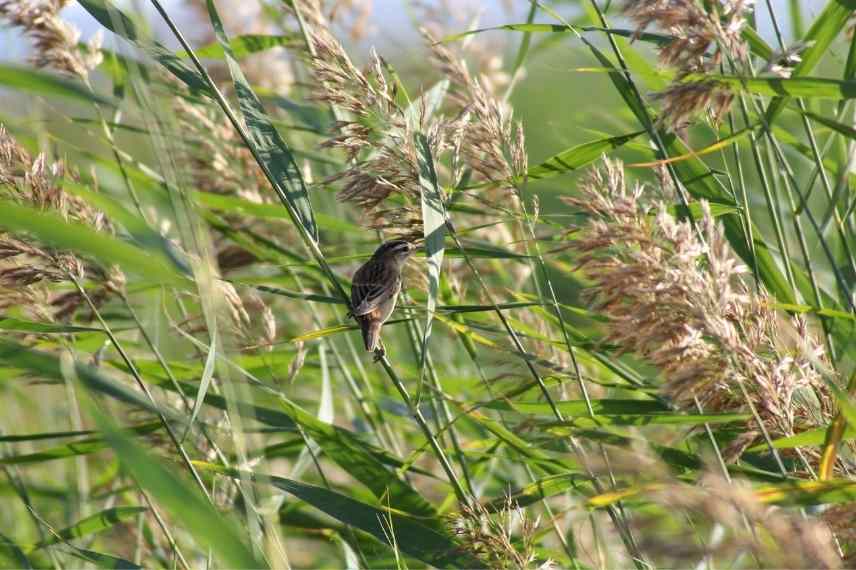
Carex play a fundamental ecological role
Read also
Carex: planting, dividing and careHow to plant and care for wet-soil sedges?
Although the genus Carex is broad and requirements vary from species to species, the sedges suited to banks and damp soils generally share several common cultural characteristics:
-
The soil : sedges are naturally suited to fresh, damp soils, even marshy or waterlogged. For bank plantings they often tolerate immersion of a few centimetres, typically from 0 to 15 cm below the water surface for the more aquatic varieties. They generally cope with a soil rich, neutral to acidic, though some can tolerate poorer soils. Good drainage is not a priority in these areas; on the contrary, constant moisture is required ;
-
Exposure : exposure can vary considerably, ranging from full sun to partial shade, even shade for some varieties, particularly those naturally woodland plants. In very sunny areas, soil moisture must be maintained at all times to prevent foliage desiccation;
-
Maintenance : sedges are known for their low maintenance requirements. For evergreen varieties, a simple late-winter tidy-up, consisting of removing dry or damaged leaves by hand, is sufficient to keep a neat appearance. For deciduous varieties, it is advisable to cut back dry foliage before the start of new growth in spring. They generally do not require fertilisers and are resistant to diseases and pests ;
-
Propagation : the most common and effective method for propagating Carex is clump division in spring. This practice regenerates the crowns and increases the number of plants for rapid ground cover of the area.
Which species and varieties of Carex are suitable for moist soils?
To landscape waterlogged areas efficiently and aesthetically, it is essential to choose Carex species whose characteristics specifically meet the constraints of banks and wet soils. Building on suitable selections, notably those recommended for shorelines, several species and varieties prove particularly effective.
The riverbank sedge (Carex riparia)
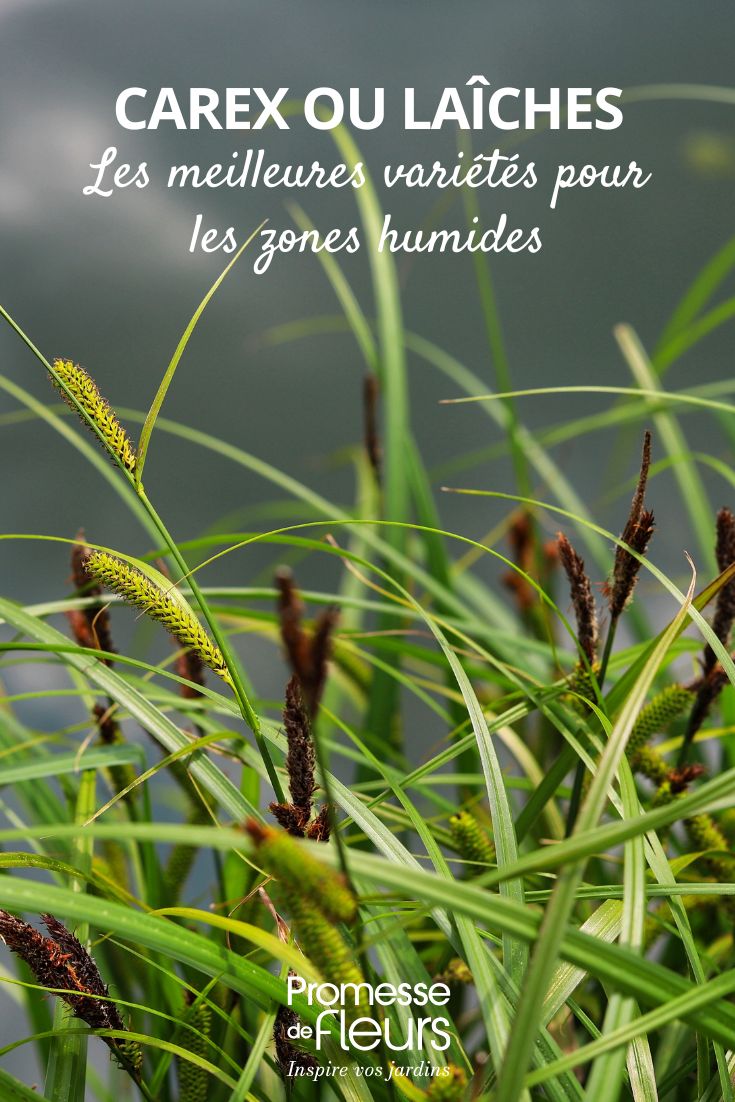
Carex riparia, also known as riverbank sedge, is undoubtedly one of the most suitable species. Vigorous and able to thrive directly in water (up to 15 cm deep), it is ideal for stabilising banks with its blue-green foliage and dark brown spikes. It forms a dense, natural effect in marshy areas and tolerates full sun or partial shade.
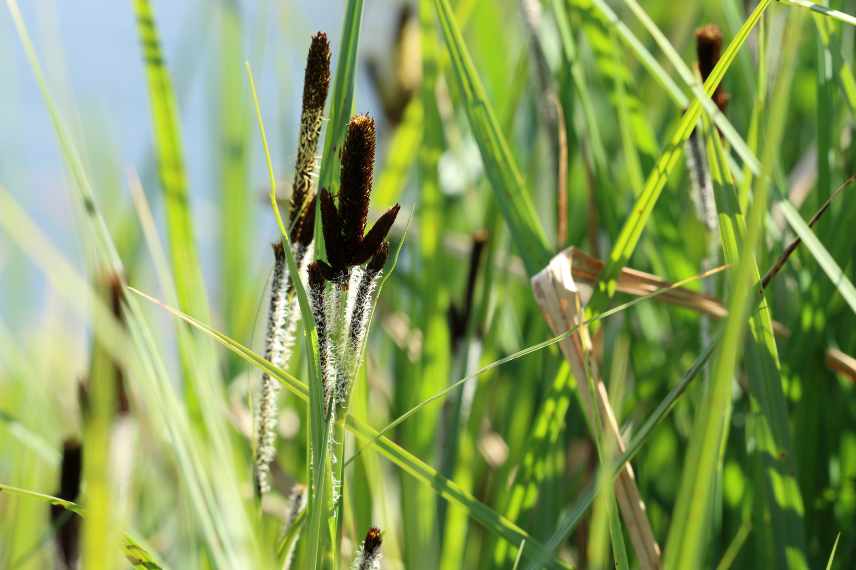
Carex riparia
It is a perennial with evergreen foliage that reaches 1 m in height and 80 cm in width. There is a riverbank sedge with deciduous foliage variegated green and white: Carex riparia ‘Variegata’.
The acute sedge (Carex acuta)
Carex acuta (or Carex gracilis), or acute sedge or marsh sedge, is another top performer for banks. Very creeping, it is excellent for stabilising soils and is renowned for its phytoremediation qualities. With its fine, bluish foliage, it grows at a shallow depth (0 to 5 cm below the surface) and has an elegant habit. This Carex forms a soft clump of evergreen foliage, 65 cm high by 40 cm wide. Between May and August, it produces pretty brown to black cylindrical spikes.
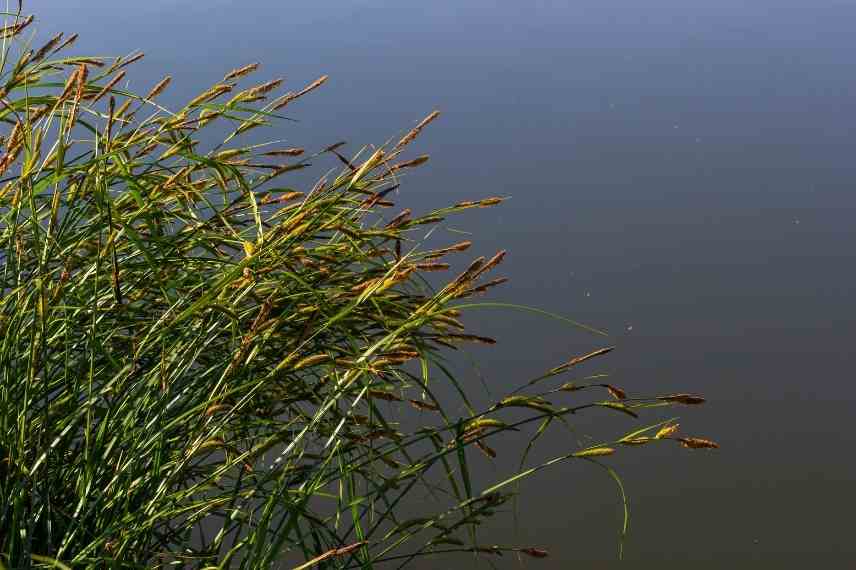
Carex acuta
The golden sedge (Carex elata ‘Aurea’)
Carex elata ‘Aurea’, often called golden elevated sedge, is a very bright variety whose foliage is a vivid green leaning toward golden yellow, highlighted in full sun. However, in hot regions it is best planted in partial shade to avoid drying out. This sedge can be planted with its roots in water up to about 10 cm deep.
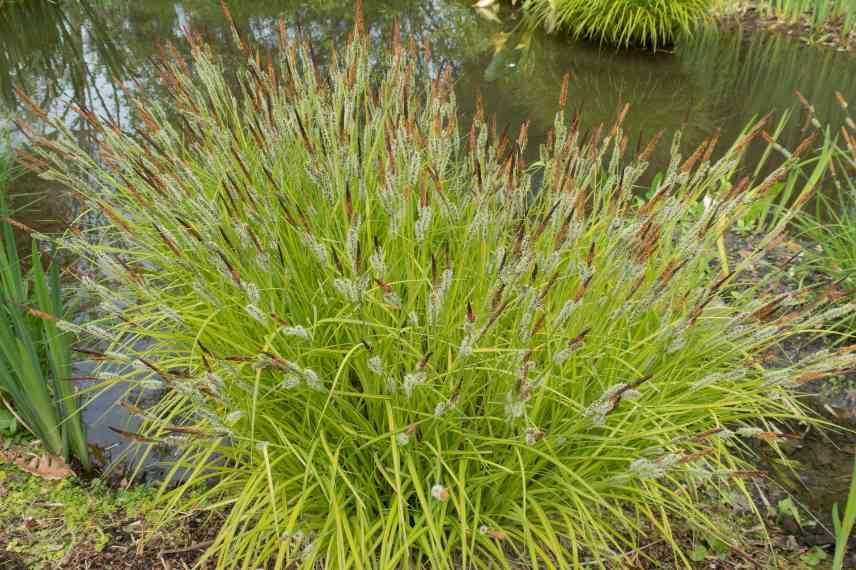
Carex elata ‘Aurea’
Very similar to grasses, it forms a dense clump that reaches 70 cm high by 40 cm wide. Its spring flowering consists of slender brown to brownish spikes.
The false acute sedge (Carex acutiformis)
Very hardy and vigorous, Carex acutiformis grows naturally along the water’s edge. It is ideal for large wetlands and ditches, as it tolerates immersion. It forms a handsome tuft with stiff green-grey foliage, reaching 1 m high by 60 cm wide. It bears beautiful cylindrical flower spikes in brown-black colours, from May to July.
The Japanese sedges (Carex morrowii)
Carex morrowii is a sedge that prefers damp but well-drained or cool soils, rather than being waterlogged. It is excellent for banks in semi-shade or shade and damp woodlands. It shows very good frost resistance.
Depending on the varieties, foliage can vary in colour and is often variegated. Thus, ‘Ice Dance’ has emerald green foliage with cream margins. The leaves of ‘Goldband’ are dark green margined with cream-yellow, those of ‘Variegata’ are green margined with cream, and those of ‘Aureovariegata’ are vividly yellow with green marbling. Finally, the variety ‘Irish Green’ produces glossy green foliage with bluish reflections.

Carex morrowii
The false-sedge (Carex pseudocyperus)
Carex pseudocyperus, nicknamed the false papyrus sedge, is appreciated for its papyrus-like appearance. It is distinguished by its pendulous and distinctive spikes, green then brown, and its upright habit (50–90 cm). This sedge loves moisture, tolerates sun and partial shade, and is perfect for pond margins or in a water-reservoir container.
The paniculated sedge (Carex paniculata)
Carex paniculata or the panicle sedge or pendulous sedge is ideal for giving a natural look to water features. With its evergreen foliage, it provides good wildlife cover and contributes effectively to stabilising banks in moist or wet soil, up to the water level.
Read also
Carex: 5 Pairing IdeasThe role of Carex in the landscape
The use of Carex in a wetland landscape design brings a distinctive graphical and textural dimension:
-
Movement and structure: the foliage of Carex, often linear and trailing, provides a sense of constant movement at the slightest breeze, creating a dynamic and soothing atmosphere. Their clumps offer a elegant and graphic habit, particularly appreciated in winter when many other perennials have disappeared
-
Associations with other plants: Carex are ideal companion plants for other shoreline and marsh perennials. Species with deep green or blue-green foliage serve as a backdrop to highlight the colourful flowering of other plants. They can be paired with marsh iris (marsh iris (Iris pseudocarus), whose flowers add bright colour. They also pair very well with marsh marigolds (Caltha palustris) for an early yellow or white flowering, the Pontederia cordata Pontederia cordata for their blue spikes, or the Molinias Molinias (Molinia caerulea) for their lightness. The association with rushes (Juncus), allows playing on contrasts of shapes and heights, creating rich and complex natural scenes.
-
A natural groundcover: some shorter or running species act as excellent groundcovers in shaded, damp areas. They quickly form a dense carpet of vegetation that suppresses weed growth, while stabilising the soil surface.
- Subscribe!
- Contents
Comments