





























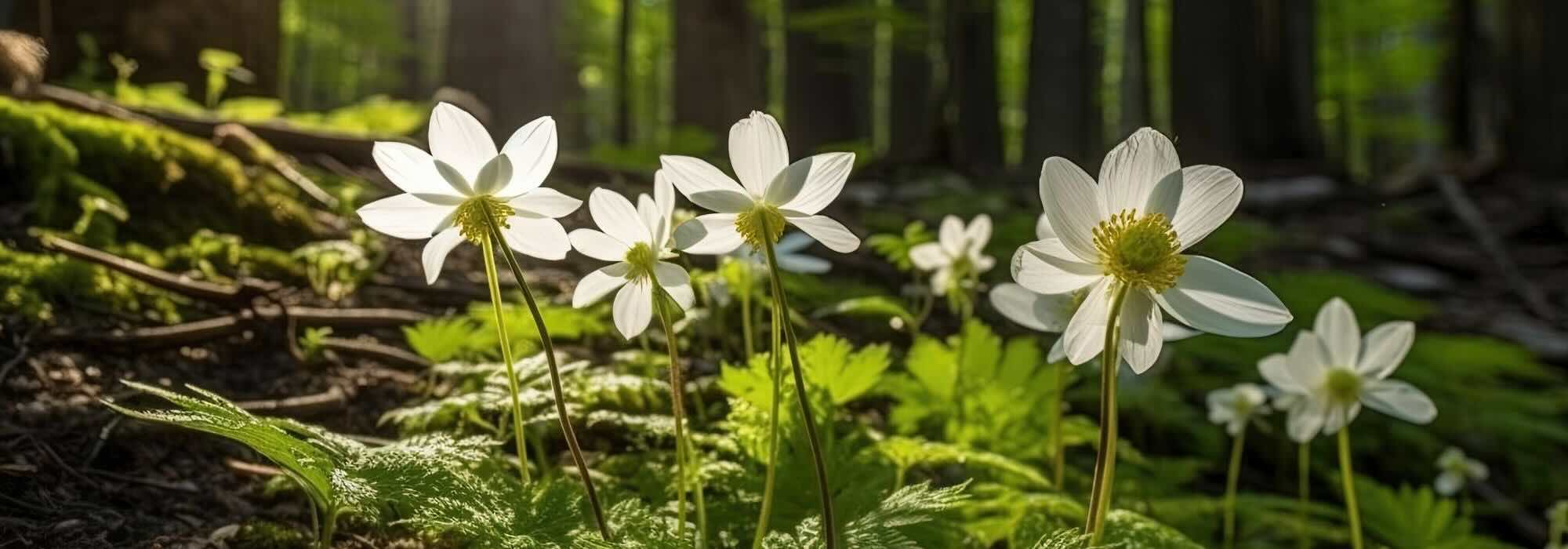
Brighten up shady spots with spring bulbs!
For a colourful and flowering spring garden, even in the shade
Contents
The spring bulbs are second to none for heralding the end of the cold season and bringing life and vitality to the garden. But they are not limited to bright or sunny gardens. Some species of bulbs will quite happily thrive in shaded spots, where they will readily provide colour and light. Let’s take a look at their various virtues and how to integrate them into the garden without any trouble.

Shaded areas: sometimes difficult to plant
Partial shade or dense shade areas are spots that can readily deter a gardener at first glance. It is true that the conditions do not seem optimal for plant development, and especially for flower production. But the lack of light does not prevent certain plants from developing, on the contrary: many plants prefer to avoid bright sun for shadier or dimmer exposures.
These are situations one can encounter in city gardens (spaces are tight and surrounding buildings will quickly cast shade), but also in gardens where large trees will provide shade, sometimes all year round if they are evergreen. The exposure there can be constantly shaded or bright for only a small part of the day (often only in the morning).
If shaded areas may seem dreary, a few adjustments are all that’s needed to make them bright and cheerful. Indeed, you will need to leave out certain flowering plants that require a minimum amount of sunlight, but there are plants, sometimes little-known, that can indeed flower in these conditions. If the choice is more restricted, it is by no means non-existent!
And let’s not forget that a garden or shaded areas also have their advantages, particularly in summer, when the heat can be intense. You will then benefit from a natural cool corner, which will require less watering and overall less maintenance, since plants tend to grow less quickly.

Shade, but colour with spring bulbs (wood hyacinth)
Why choosing spring bulbs for shade?
Spring bulbs offer numerous benefits for the garden.
- They herald with poetry the end of winter and the return of brighter days, but can also ensure the transition between spring and the start of summer. By pairing spring bulbs with early-flowering and late-flowering spring bulbs, you will enjoy a display that will last for many months.
- Spring bulbs reward us with a wide diversity of flower colours, flower shapes or foliage. They can thus be integrated into all garden styles, from romantic and rustic to exotic or contemporary.
- They are generally very easy to grow, and not fussy about their growing conditions. Many of them can naturalise and return faithfully each year without any human intervention.
- They lend themselves to a number of uses: in borders, in bedding schemes, in pots, in rockeries, on a lawn that is a little tame, etc.
- Many melliferous blooms also have a positive impact on biodiversity, notably by feeding precious pollinators. Early-flowering bulbs are all the more valuable as they are available at a time when food is still scarce, at the end of winter.
How to plant spring bulbs in shade?
To successfully design a shaded garden or other dimly lit areas, there’s no secret: it’s essential to choose plants that tolerate dense shade or low light. At the same time, consider your cultivation constraints: dry or wet soil, the intensity of winter frosts, heavy or well-drained substrate, the size of the areas to be landscaped, etc.
In a shade garden, as flowering and colour are often more limited, it is important to also play with the shapes or textures of foliage to add depth and visual interest.
Think particularly of variegated foliage, highly ornamental and perfect for bringing a touch of light, such as those of hostas or heucheras. The same goes for certain varieties of ivies.
In an exotic garden, for example, opt for plants with luxuriant foliage, such as Aspidistra elatior, the ophiopogons or the Astilboides tabularis. For shrubs, if your soil is acidic, turn to ericaceous plants (Japanese azaleas, rhododendrons…) or even sarcococcas. Don’t forget ferns, which add lightness but also structure with their striking, graphic fronds.
Additionally, of course add shrubs and perennials with ornamental flowering, such as shade-loving roses or hellebores.
To ensure shaded spaces aren’t too dreary in winter, install a few evergreen foliage plants (shrubs, groundcovers…) (shrubs, groundcovers…), such as Aucuba, the holly, the Pachysandra terminalis or even boxwood.
Different flower colours in spring bulbs for shade
White, pink, yellow, mauve, blue, and even multicoloured… Did you think you’d get bored designing your shaded area? That’s unlikely, given the beautiful diversity of flower colours offered by spring bulbs.
A pretty white accentuated by golden anthers at the wood anemone, hanging bells of immaculate white at the snowdrop, pure white at Cyclamen coum ‘White’, or a white lightly tinged with green at the Siberian squill ‘Alba’. In even shadier spots, white will be essential to bring light and clarity. You can go for a truly monochrome scheme or add touches of brighter colours.
For a sunny touch, adopt Eranthis hyemalis which flowers in bright yellow, just like the winter aconite and the Erythronium ‘Pagoda’.
On the pink-flowered side, let’s mention Corydalis solida with its rose-purple flowering, the pink wood hyacinth, the pink campanulate squill and the Cyclamen x persicum ‘Djix Red’, a frost-hardy plant often grown as an annual, but whose flowering lights up shaded areas with its pink fuchsia and white colouring.
Don’t forget multicoloured blooms, which will bring originality to shaded areas:
- the double snowdrop Galanthus nivalis f. pleniflorus ‘Dionysus’, with its double and swollen corolla, white on the outside and variegated with dark green on the inside;
- Erythronium tuolumnense ‘White Beauty’, whose white bells are tinged with yellow and red;
- the Cyclamen x persicum ‘Djix Red’, a frost-hardy plant often grown as an annual, but whose flowering brightens shaded areas with its pink fuchsia and white colouring;
- Anemone nemorosa ‘Bracteata Plena’, with its exotically looking flowers that are white and semi-double, surrounded by green petaloid bracts.
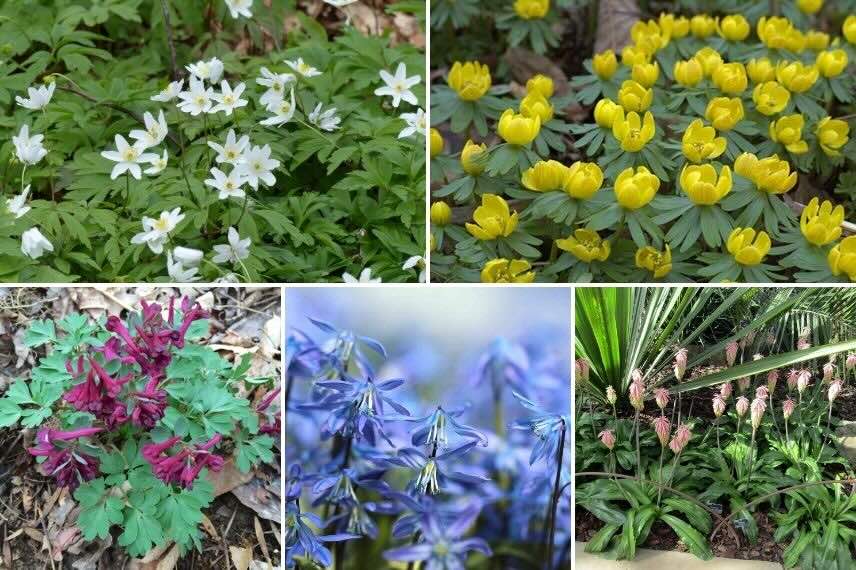
From clockwise: Anemone nemorosa, Eranthis hyemalis, Forest lily, Siberian squill, Corydalis solida ‘Purple Bird’
Bulbs to flower in shaded areas from late winter to late spring
As we’ve said, spring bulbs can dress the garden for many months. By pairing early-flowering bulbs, which begin as early as mid-winter, with late-flowering bulbs, which bloom until the end of spring, you can easily achieve a colourful display that is continually renewed in shaded spots.
Among the earliest spring bulbs, we should of course mention snowdrops, but also Cyclamen coum or Siberian squill, which bloom from January or February.
Among the latest spring bulbs, let us mention wood anemones, bulbous Corydalis, ramsons or the lesser celandine, which come into bloom from April or May.
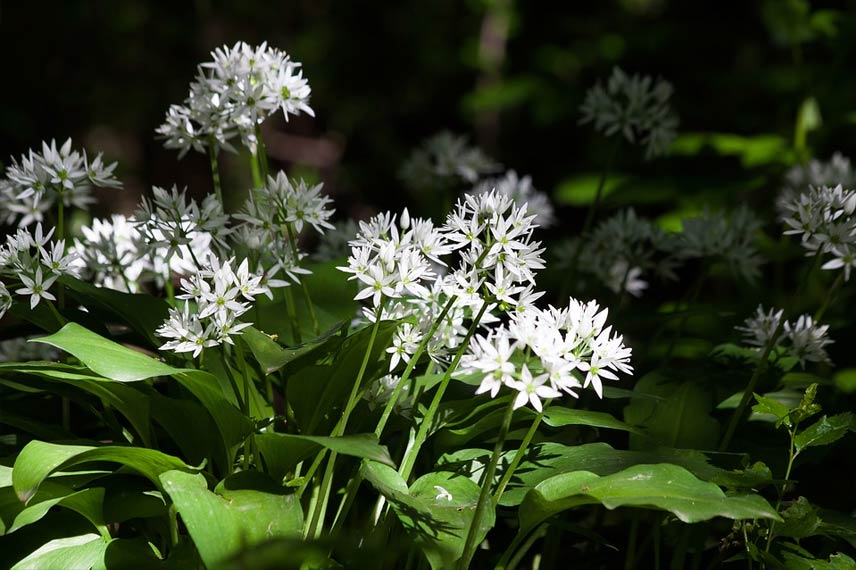
Ramsons, an ornamental and edible idea for shade
Fragrant spring bulbs for shady spots
To brighten a shady area, let’s also appeal to our sense of smell. Some spring bulbs diffuse a light fragrance that will help make the space pleasant and bring an extra touch of charm. For this, install, for example, Galanthus nivalis ‘S. Arnott’, whose flowering gives off notes of honey, or Cyclamen pseudibericum, whose flowers have a violet fragrance. Also consider wood hyacinth or winter aconite, both lightly scented.
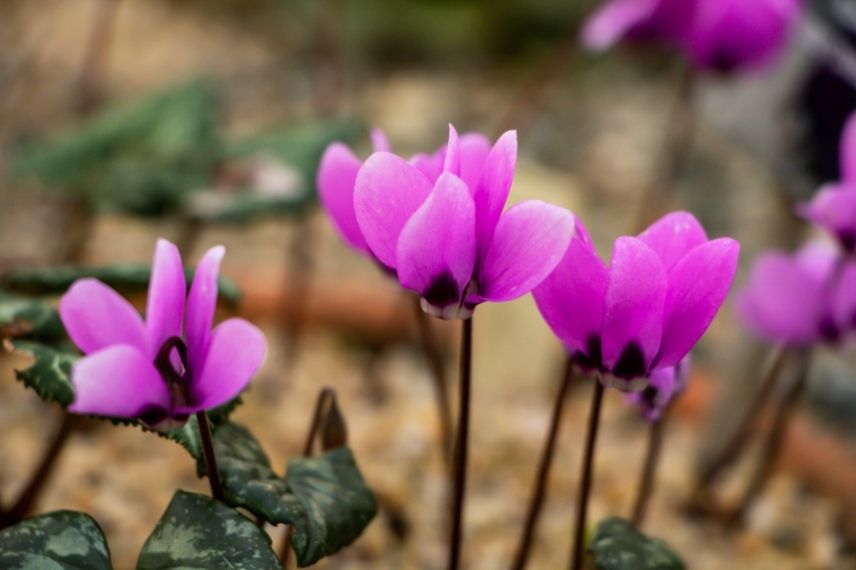
Cyclamen pseudibericum
Spring bulbs for shade with ornamental foliage
In the shade, it is all the more important to vary the shades of green, to create a more dynamic and cheerful display. For this, plant Cyclamen coum with its pretty rounded foliage, often marbled with silver, which appears from autumn through to late spring. This foliage will bring a real touch of light, even in shaded areas. You will also have a choice of pretty colours, with flowering that can be white, mauve, pale pink or fuchsia.
Let us also mention the Erythronium dens-canis, a small bulbous plant with pink flowers that resemble dog’s teeth. Its variegated foliage combines purple and green.
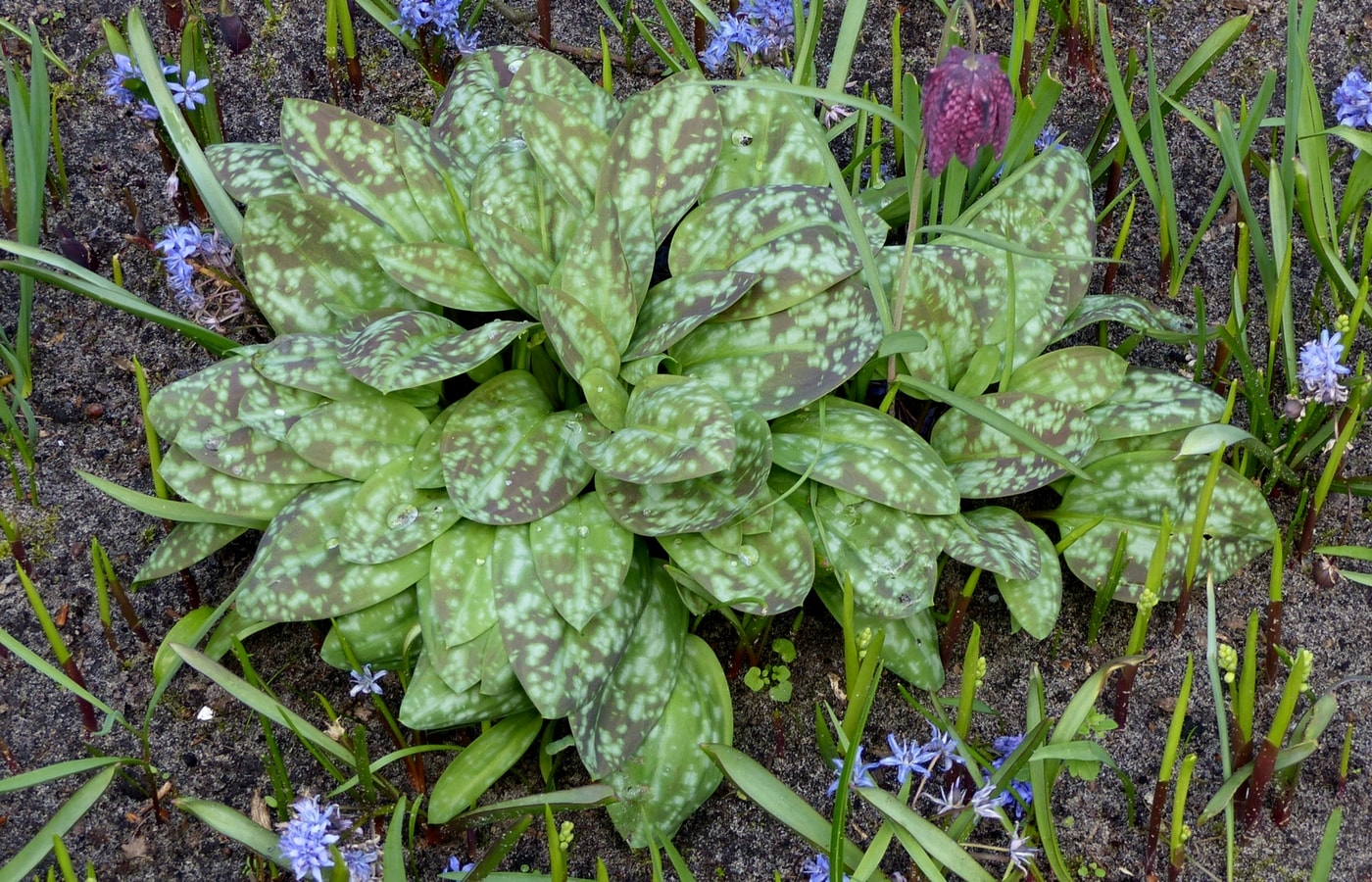
The foliage of Erythronium dens-canis
Spring-flowering bulbs for shade that can withstand hard frosts
If you live in a region with harsh winters and you can’t grow plants in pots that will be sheltered during winter, choose hardy spring bulbs from the outset. That comes in handy; many of them can withstand frosts down to -15°C, such as Cyclamen coum, wood anemones, Spanish hyacinths or snowdrops.
- Subscribe!
- Contents
Comments