






























Bare-root perennials planting: mistakes to avoid!
Our tips for planting bare-root perennials to get the best results.
Contents
Planting bare-root perennials is both economical and environmentally friendly
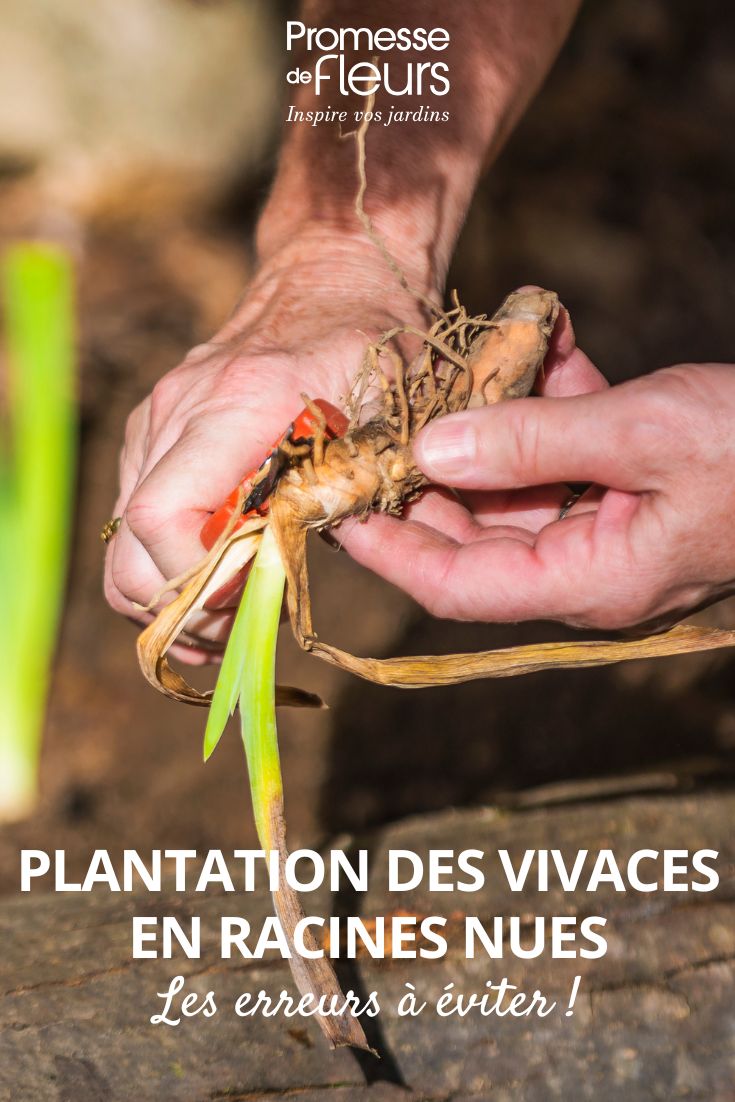
Unlike container-grown plants (in plastic!), these plants are sold without soil around their roots, generally during their dormancy period, in autumn or early spring.
Cheaper to buy, these perennials have a robust root system that promotes better establishment.
However, planting can be tricky: a bare root is vulnerable to drying out, frost and rough handling.
Discover our comprehensive guide to the most common mistakes made by gardeners looking to plant bare-root perennials.

Buying or planting at the wrong time
The most common mistake often lies in choosing the planting moment. Bare roots are available only when the plant is in its physiological dormancy, usually from November to March. Planting too late in spring, for example in April or May, as temperatures rise and sap begins to rise, is a frequent error. If bud burst has already occurred, the plant will mobilise its energy reserves to produce leaves before establishing new, small roots. This imbalance creates true water stress: leaves transpire and demand water that the roots are unable to supply.
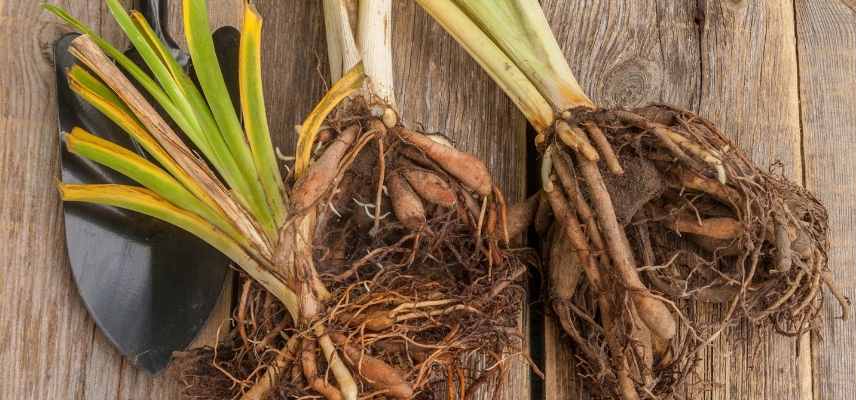
Des hémérocalles en racines nues
Conversely, planting too early in autumn on soil that is still too warm and dry can cause tissue desiccation.
The solution: prefer October for root establishment before winter, or late winter to early spring, between February and March, before bud burst.
Waiting too long to plant
A potted plant has its own moisture reserve in the substrate. A bare-root perennial has nothing! Its roots are therefore directly exposed to drying out. And it happens very quickly indeed! Thus, simply leaving the package open in a dry garage or, worse, leaving the roots exposed to sun and wind at the edge of the planting hole while you prepare the ground will dry them out very quickly. And rootlets, i.e., the finest roots responsible for absorbing water, die within minutes in air. This “drying shock” is often invisible to the naked eye at the time, but it dooms the plant once in the ground.
The solutions :
- If the perennials are kept in a damp moss wrap, keep them in a cool, dark place until the precise moment of planting. Not too long either… so no more than 48 hours!
- If you cannot plant immediately, practise a ‘gauge planting’: temporarily bury the roots in a tray of sand or light, damp soil, at a slant.
Forget pralinage
Removing the perennial from its sachet packaging and placing it directly, as is, into the planting hole is also a common mistake. After transit and storage, the roots are naturally dehydrated. And a simple watering will not be enough to ensure this rehydration. The recovery will therefore be slower and more labour-intensive.
The pralinage technique involves soaking bare roots in a thick mud, called pralin, made from garden soil, compost or cow dung and water. This action is essential as it performs two functions: it rehydrates the tissues deeply and, above all, it creates a protection that eliminates air pockets.
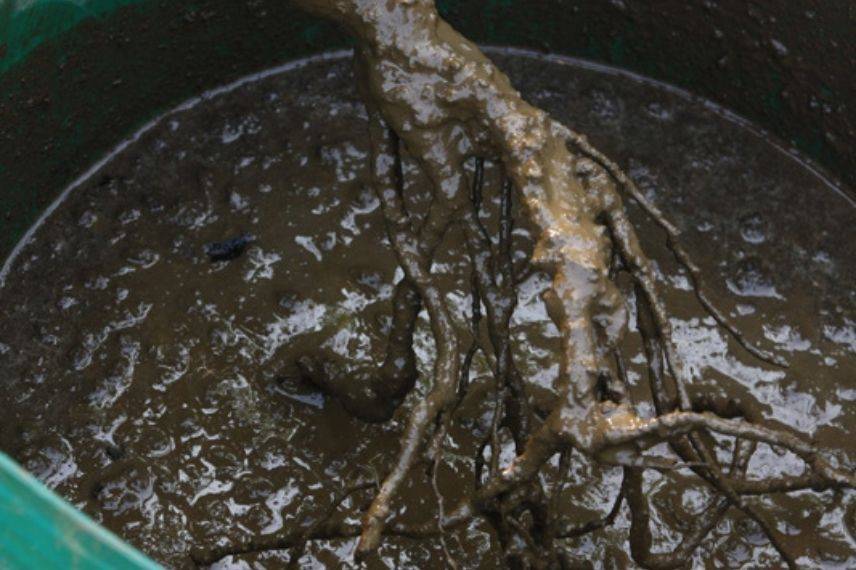
Bare-root pralining
The solution : before planting, soak the roots in a bucket of water for at least 30 minutes to 2 hours. For best results, use pralin that you make yourself. There are also ready-made mixes available commercially.
Poor soil preparation
It is often imagined that a bare-root perennial, because it is compact and small, needs less space than a potted plant. It is exactly the opposite. In a pot, the roots tend to be constrained; with bare roots, they need to be allowed to spread out as they were in the ground. The mistake is therefore to dig a narrow hole where the roots end up folded back on themselves or pointing upwards. This is what is called ‘forced root circling’. Roots that are not laid out in a spreading fashion will choke each other as they grow. Moreover, a hole whose sides have not been decompacted becomes a trap: young roots fail to pierce the soil wall smoothed by the spade and end up circling, limiting the plant’s drought tolerance.
The solution : dig a hole at least twice as wide and deep as the volume of the roots. Loosen the bottom and sides with a garden fork. Loose soil is essential for the young roots to colonise the space without effort.
Planting at the wrong depth
The error is having a growth point, i.e., the collar, buried too deeply or too exposed. This collar is, in fact, a hinge zone between the root system and the stem buds. Placing it badly is a fatal error for certain species such as peonies.
- Planting too deeply causes the buds to suffocate. For some species such as the peonies (Paeonia), burying the buds more than three centimetres below the surface condemns the plant to a lack of flowering for years, or even rot.
- Planting too superficially exposes the collar to frost and to desiccation. The upper roots end up exposed to the air after a few waterings that cause the soil to drop, weakening the plant’s structure.
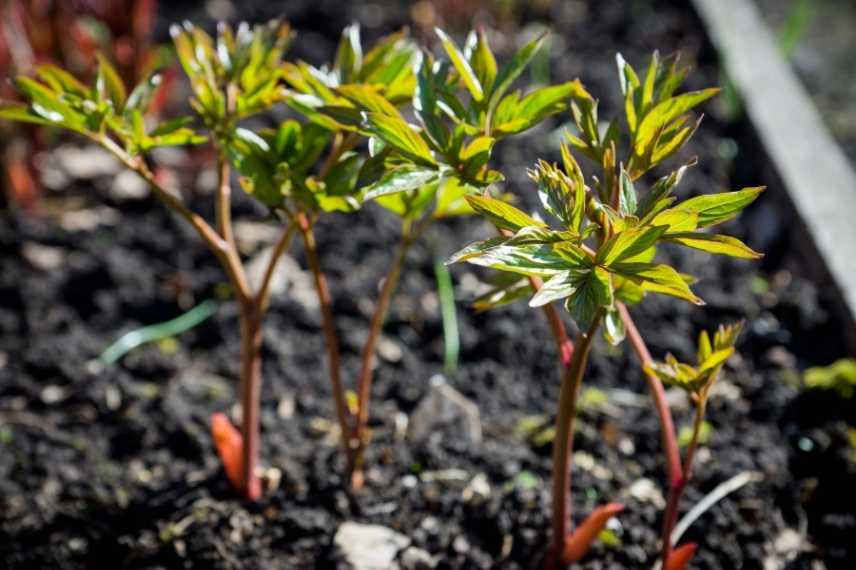
For peonies (Paeonia), burying the buds more than three centimetres below the surface condemns the plant to a lack of flowering for years
The solution: observe the soil trace on the plant as it indicates the level at which it was planted in the nursery. As a general rule, the growth bud should be flush with the surface of the soil.
Over-fertilising
Trying to ‘feed’ a plant that does not yet have active roots is a common mistake. Thus, the application of nitrogen-rich granular fertilisers to the bottom of the hole is to be avoided, as they can ‘burn’ the roots.
The solution : add well-decomposed compost or leaf mould mixed with the backfill soil. If you are determined to use a fertiliser, choose slow-release fertilisers such as roasted crushed horn, placed at the bottom of the hole and covered with a little soil to prevent direct contact.
Neglecting to water after planting
Finally, another mistake after planting is to rely solely on the weather. ‘It’s going to rain tomorrow, no need to water’ is the phrase that dooms many plantings.
Immediate watering after planting, called “plombage”, is not only to provide water. Its function is to evacuate air pockets trapped between the roots and the soil. Without this copious watering, the roots end up in air voids where they cannot draw nutrients and end up drying out, even if the surrounding soil is moist.
Thus, manual firming, but without excess, followed by a generous watering, is the only guarantee of a good establishment.
The solution: tpress firmly but gently with your hands. Then pour a full watering can, even if it is raining. Water will push soil particles down into every nook around the roots, ensuring perfect contact with the soil.
Skip mulching
Once the plant is installed and the backfilling watered-in, many gardeners consider the planting finished. But bare soil is soil in distress. The mistake of leaving the soil ‘clean’, i.e., without organic cover, around a newly planted perennial is negligence with multiple consequences:
- Under rainfall, a crust can form, hindering the gas exchange essential for root respiration.
- More seriously, in the absence of mulch, evaporation is greatly increased, so the perennial suffers even more from water shortage.
- Sun or wind dry the upper layer of soil, where growth buds are located.
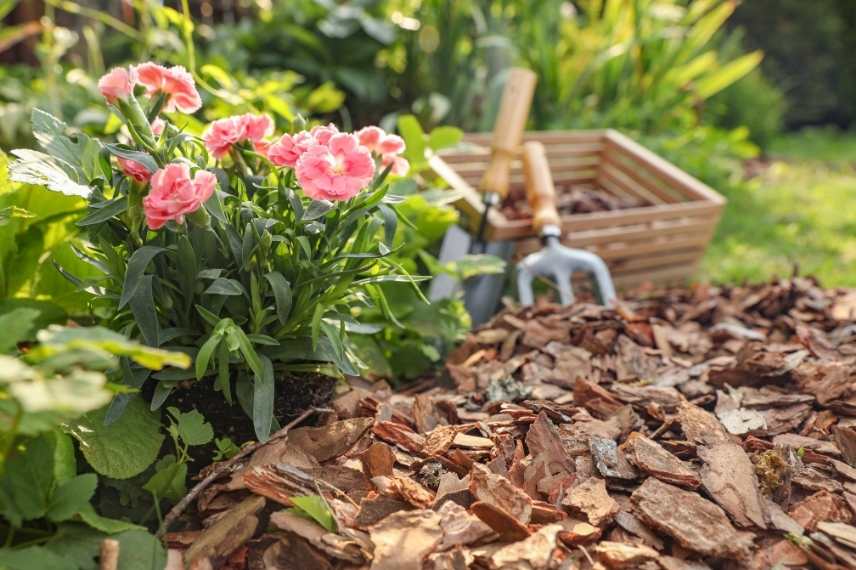
Mulching after planting, including bare roots
The solution: it consists of immediately applying an organic mulch of ramial chipped wood, shredded fallen leaves or hemp straw. This thermal shield maintains a stable temperature, promoting root growth even when the air cools. However, it is advisable to leave a small clear space around the young shoots to prevent the mulch’s stagnant moisture from causing fungal diseases.
Lack of patience
The ninth mistake is a gardener’s lack of patience! Bare-root perennials do not follow the same pace as nursery stock grown under glass. They must first rebuild their underground structure before showing any sign of above-ground life.
The classic mistake is worrying about not seeing anything emerge from the soil after several weeks. This anxiety often drives the gardener to scratch at the soil, or even to dig up the plant to ‘check whether it is still alive’! It’s a big mistake. By handling the root system in this way, one damages micro-rootlets invisible to the naked eye that were only just starting to colonise the substrate. This trauma resets the recovery process, assuming the plant survives. Thus, some species, such as Hostas or the Asclepias, are known for their late awakening. It can happen that a plant shows its first leaves only two months after spring planting.
The solution: trust the plant! A plant’s time is not man’s time, and its unseen underground growth is the foundation of its vigour.
- Subscribe!
- Contents
Comments