





























Pairing ideas with Kalmia
and congratulate yourself for having planted it!
Contents
Kalmia, or mountain laurel, is a so-called heather soil shrub that deserves to be better known. Native to the forests, marshes, and meadows of North America, it thrives in cool, acid, humus-bearing, well-drained soil, in partial shade, away from scorching sun. It actually prefers cool, humid climates and absolutely detests cold winds.
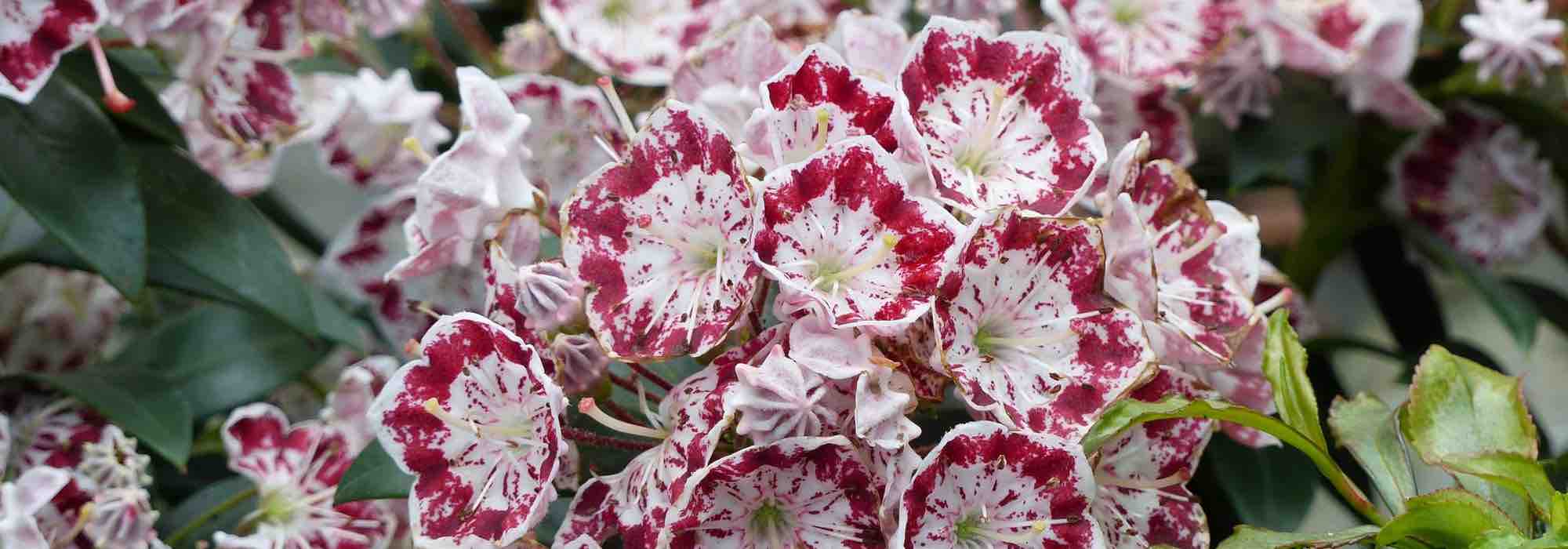
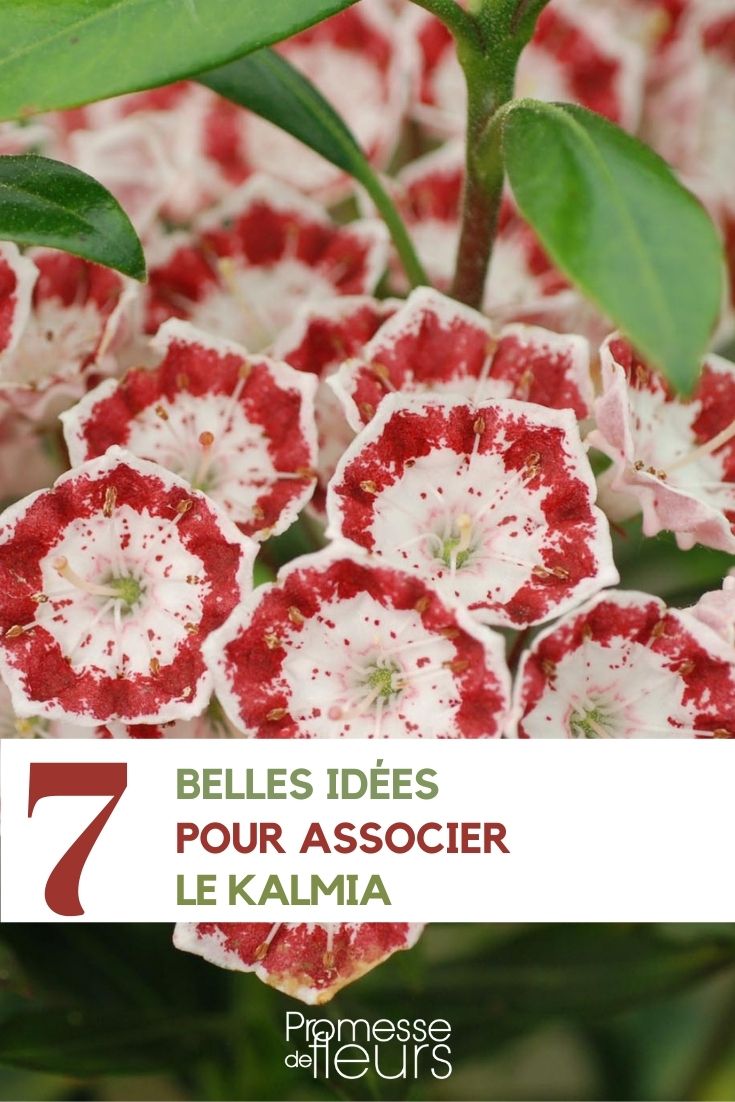
Of relatively small size, ranging from 60 cm to 2 m in height depending on the cultivars, the kalmia has evergreen foliage reminiscent of that of the Rhododendron and vaguely of the Laurel. It produces a spectacular flowering in May and June. Not spectacular for their size, as the flowers average 2.5 cm, but for their abundance, their sugar porcelain beauty, intricate and delicate, and the ornamental quality of the flower buds, which are plicate geometric shapes resembling small meringues. The countless buds and flowers coexist simultaneously on the shrub, offering a delightful spectacle.
Here are some ideas for plants to pair with the kalmia, in a partial shade bed, in woodland, or in a cool rockery, or even in a pot on the terrace or balcony, provided you can offer it good growing conditions.

In an acidic soil bed
Kalmias are shrubs known as heather soil plants, like Rhododendrons, Azaleas, Pieris, and many other plants. These plants have roots that spread outwards, superficially. They are more dependent on moisture, as they dehydrate more quickly than a plant whose roots seek water at depth. Thus, they prefer non-scorching exposures, where the soil is generally cooler, rich humus understoreys, and acidic soil, free from lime. A heather soil bed must therefore meet these conditions, either naturally or sometimes with the help of various amendments in the planting soil.
Kalmias are thus in good company with plants that have the same needs. You can create a heather soil bed in partial shade with a backdrop featuring a Hydrangea aspera villosa ‘Anthony Bullivant’ that blooms after the kalmia in pink and mauve, and a Rhododendron edgeworthii in shades of pink (this one is only hardy down to -10° C). At the front, you can find our smaller Kalmia, for example, the variety ‘Tofka’, perhaps accompanied by an Azalea canescens, which blooms before the foliage appears in pale pink. Below, in the foreground, a Daphne transatlantica ‘Pink Fragrance’ blooms abundantly for six months! Additionally, both it and the Azalea and Rhododendron are fragrant. A few bulbs of Bluebell accompany and enliven the whole arrangement.
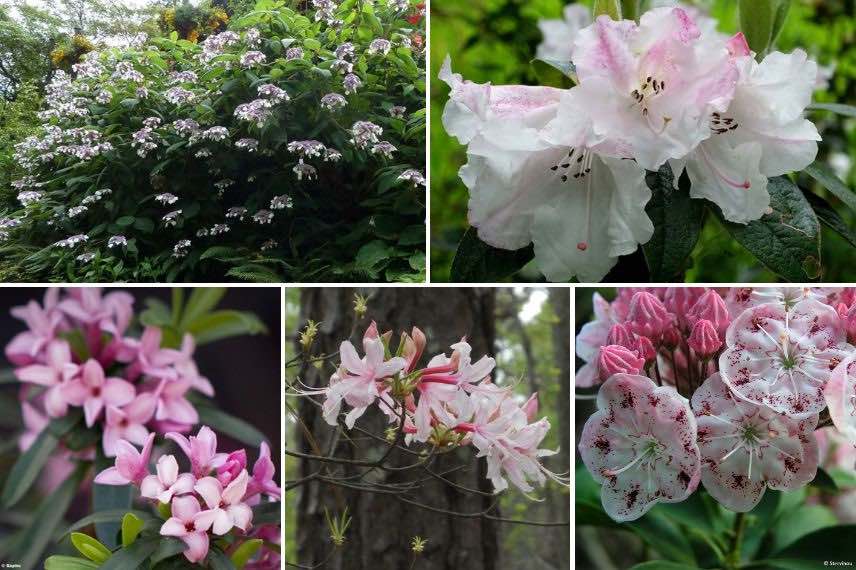
Clockwise from top: Hydrangea aspera villosa ‘Anthony Bullivant’, Rhododendron edgeworthii, Kalmia latifolia ‘Tofka’, Azalea canescens, Daphne transatlantica ‘Pink Fragrance’
On a a terrace or a balcony
On a terrace or balcony, in a mineral medium, it is beneficial to surround the Kalmia with abundant plants and greenery to increase the ambient humidity. It can be planted in a pot in an east or north-west exposure to ensure it does not receive direct sunlight during the hottest hours. If the location is more exposed to the sun, it is imperative that it is shaded by a roof, a wall, or by taller plants that create shade.
With potted plants, you can create different substrates for each plant, and you are not required to group ericaceous plants together. However, you must take into account the sunlight exposure that each receives based on its position and ensure it is suitable. Also consider hardiness, as a potted plant is more sensitive to frost than one in the ground. Finally, favour plants with limited water needs, as in pots they are also more dependent on your watering. The Kalmia needs water, preferably rainwater. It is best if this is not the case for all the plants on the balcony or terrace.
Surround a small potted Kalmia like the Kalmia latifolia ‘Bull’s Eye’ with a Nandina domestica ‘Twilight’, Heucheras like ‘Berry Smoothie’, a grass Phaenosperma globosa, a fern Polystichum makinoi, a Begonia ‘Garden Angel Blush’, and a Glechoma hederacea ‘Dappled Light’ with trailing foliage. Also consider Brunneras and the hardy geranium ‘Rozanne’, among others.
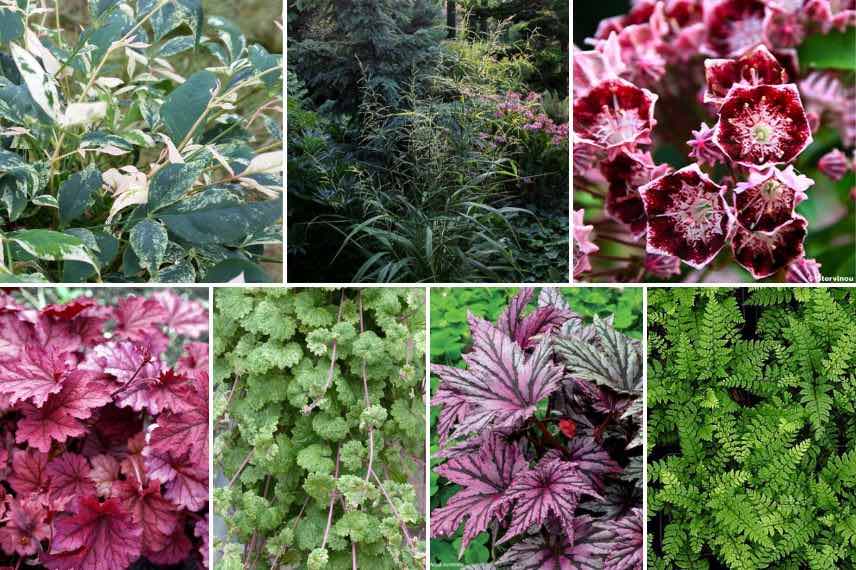
Nandina domestica ‘Twilight’, Phaenosperma globosa, Kalmia latifolia ‘Bull’s Eye’, Polystichum makinoi, Begonia ‘Garden Angel Blush’, Glechoma hederacea ‘Dappled Light’, Heuchera ‘Berry Smoothie’
A spring scene in shades of pink
If you wish to create a border with maximum impact, you can either concentrate the flowering at the same time as the late spring flowering of Kalmia, or stagger it slightly, but within a limited period in spring, for example. This is entirely possible when considering Rhododendrons, Camellias, and Azaleas, the quintessential heather soil shrubs, many species and varieties of which bloom between April and June.
Here, a very spring-like scene unfolds, in delicate shades of pink, a bright colour in partial shade. An Enkianthus campanulatus, a beautiful yet little-known shrub with small lily-of-the-valley-like bells, blushes alongside a Azalea japonica ‘Kirin’ with small flowers, a wild Camellia ‘Sweet Jane’, and another species of Kalmia, the Kalmia latifolia from which all varieties are derived: a Kalmia polifolia, with cheerful bright pink flowers. They are accompanied by a lovely heather with golden foliage and dark pink flowers, Erica darleyensis ‘Eva Gold’.
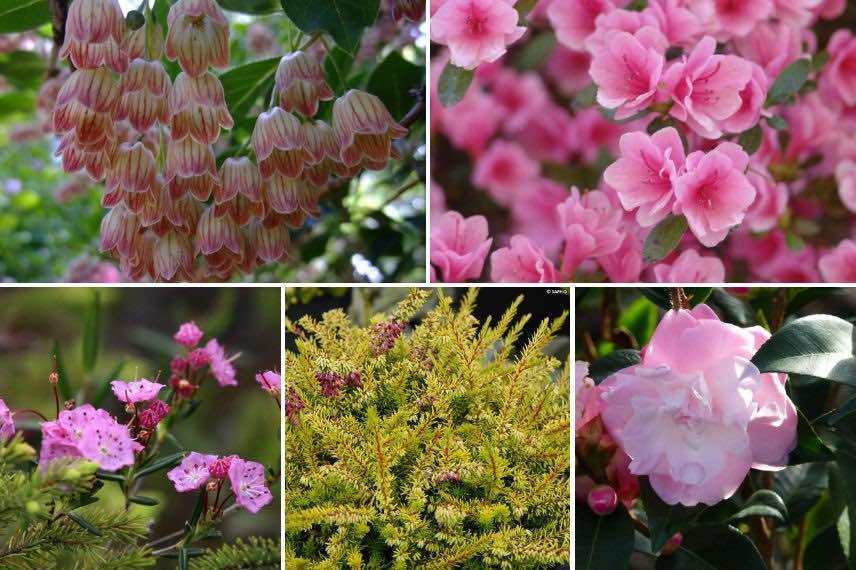
Enkianthus campanulatus, Azalea japonica ‘Kirin’, Camellia ‘Sweet Jane’, Erica darleyensis ‘Eva Gold’, and Kalmia polifolia
Read also
Kalmia: succeeding in pot cultivationIn a white garden
The varieties of Kalmia with white flowers have an even more delicate appearance than other varieties. This colour enhances this aspect of their personality. Moreover, white Kalmias often have flowers that are barely punctate or marked with pink or red. A white-flowered Kalmia fits perfectly in a white garden or in a white scene, in partial shade, where white flowers stand out best, alongside more opulent white flowers or different graphic elements.
Plant a white Kalmia with a Skimmia japonica ‘Kew White’, a large Pieris japonica ‘Mountain Fire’, a heather Erica darleyensis ‘White Perfection’, a Japanese Azalea Azalea japonica ‘Palestrina’, a Cornus canadensis as a carpet, and our Kalmia, here the Kalmia latifolia ‘Peppermint’, which has a distinct pattern.
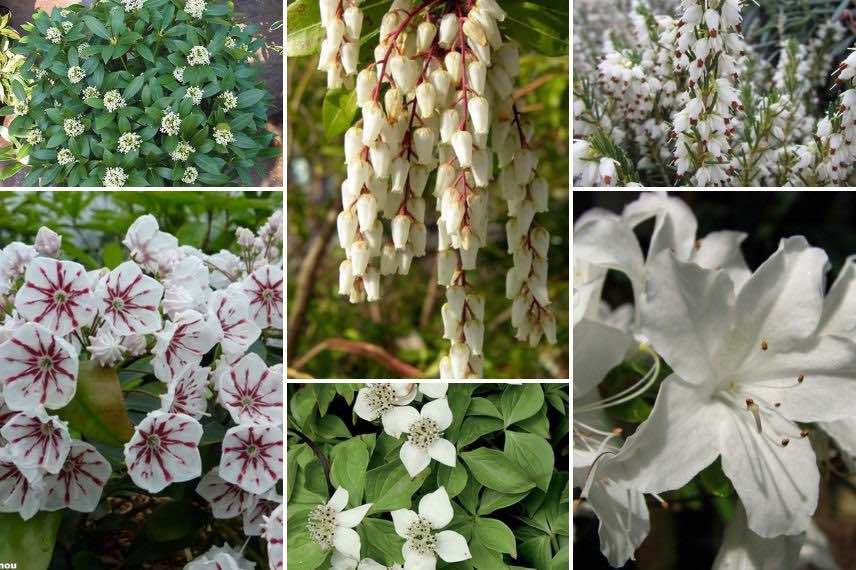
Skimmia japonica ‘Kew White’, Pieris japonica ‘Mountain Fire’, Erica darleyensis ‘White Perfection’, Azalea ‘Palestrina’, Cornus canadensis, Kalmia latifolia ‘Peppermint’ (© Stervinou)
In purple beds
Sometimes, the flowers of Kalmias are very dark: purple in the variety ‘Latchmin’, chocolate for ‘Tad’, and dark red in ‘Heart’s Desire’. Many combinations can be imagined from these rich and deep colours, with plants of the same condition, plants for cool, shaded soil, which often prefer acidic or neutral soil, without lime.
Here, a Kalmia latifolia ‘Latchmin’ is alongside a Japanese maple ‘Trompenburg’ with finely cut, dissected leaves, oscillating between red and purple, and a Hydrangea aspera villosa ‘Velvet & Lace’ with purple, lilac, and mauve corymbs from July. They are accompanied by a lovely Daphne mezereum var.rubra that blooms in late winter. Bulbs of Kamchatka Lily or Fritillaria camschatcensis grow at the foot of the shrubs and bloom at the same time as the Kalmia. Also consider Hellebores, which are not lacking in cultivars with rich and vibrant colours.
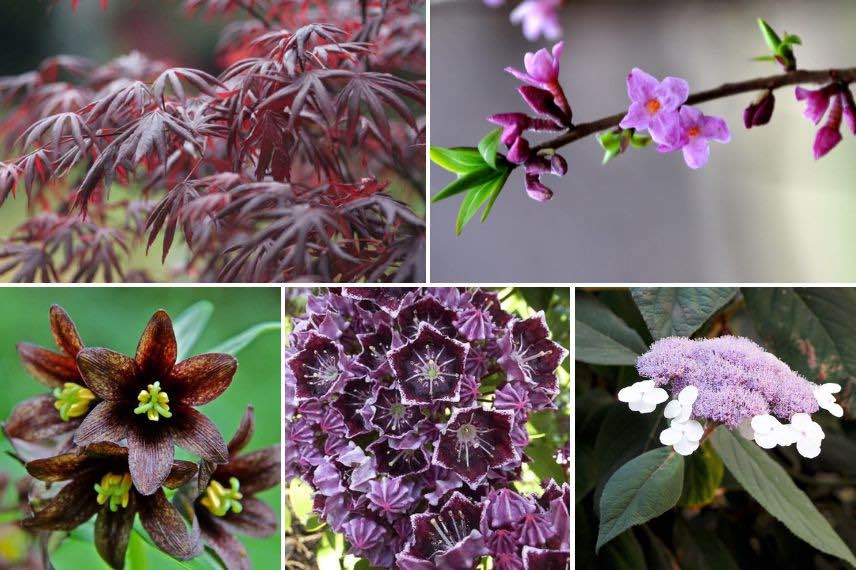
Acer japonica ‘Trompenburg’, Daphne mezereum var.rubra, Hydrangea aspera villosa ‘Velvet & Lace’, Kalmia latifolia ‘Latchmin’, Fritillaria camschatcensis
In a cool rockery, with beautiful lush foliage
Kalmia, which prefers well-drained soils, thrives in a cool, shaded rockery setting. As it is a small bush, it can easily be accompanied by only perennials that it slightly overshadows, depending on whether a small cultivar of 60 cm in height or one of the larger varieties reaching 2 m at ripeness is chosen. It can also be planted in groups of three of the same variety to create a lovely mass effect.
For example, plant a Kalmia with ferns and Hostas. If you desire a bit more flowering, you can plant a taller shrub nearby, such as Cornus kousa, which adds the silhouette of a small tree and enchanting flowering, with a graphic style quite different from that of Kalmia. Here, a Kalmia latifolia ‘Tad’ with German ferns or Matteuccia struthiopteris, variegated white Hostas for ‘Emily Dickinson’, and yellow for Hosta sieboldiana ‘Frances Williams’. A Cornus kousa var. chinensis dominates the ensemble.
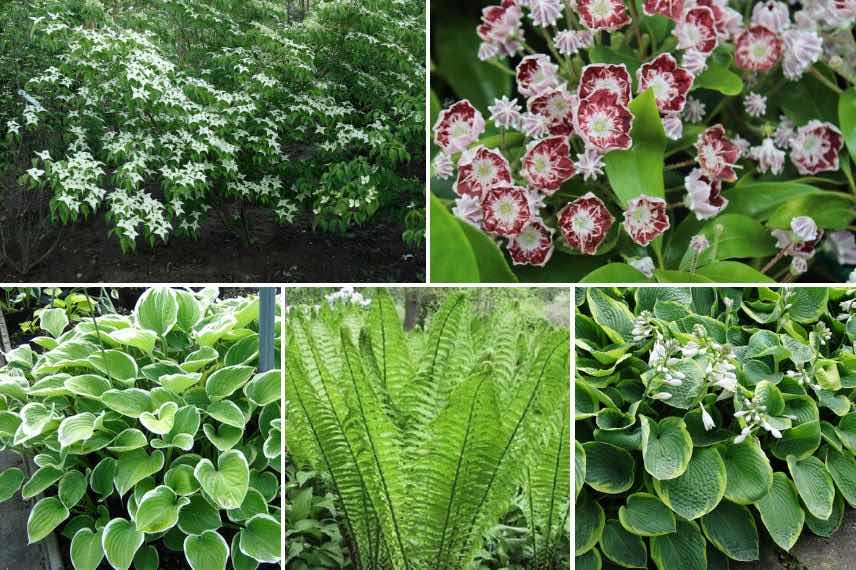
Cornus kousa var. chinensis, Kalmia latifolia ‘Tad’, Hosta sieboldiana ‘Frances Willliams’, Matteuccia struthiopteris, Hosta ‘Emily Dickinson’
On its own, under large trees or at the edge of woodlands
Even though it forms a rather small bush, Kalmia is a beautiful specimen to plant in isolation to draw all the attention during its splendid flowering. Admittedly, its evergreen foliage is the same colour all year round, but it is quite ornamental, resembling that of Rhododendrons.
Plant it under large trees, either alone or at the outer edge of a thicket, with space around it.
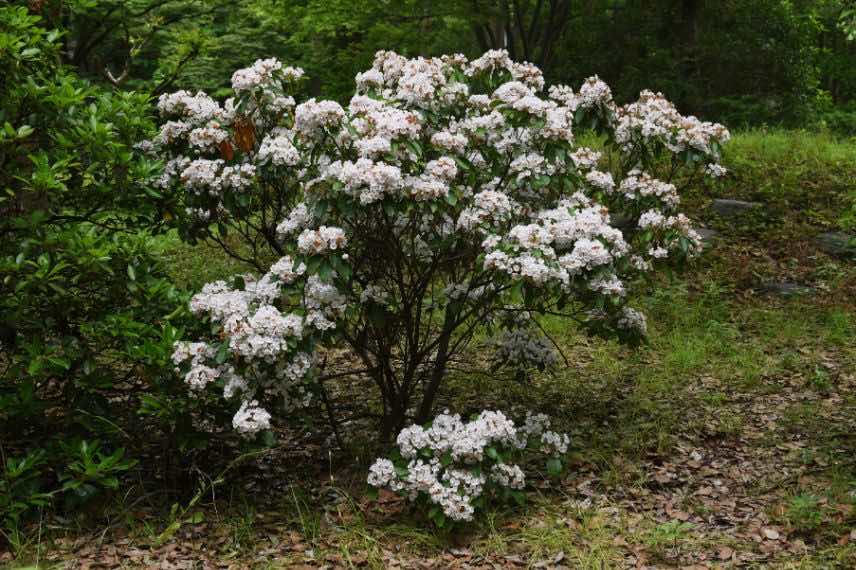
A beautiful specimen at the edge of a thicket
- Subscribe!
- Contents
Comments