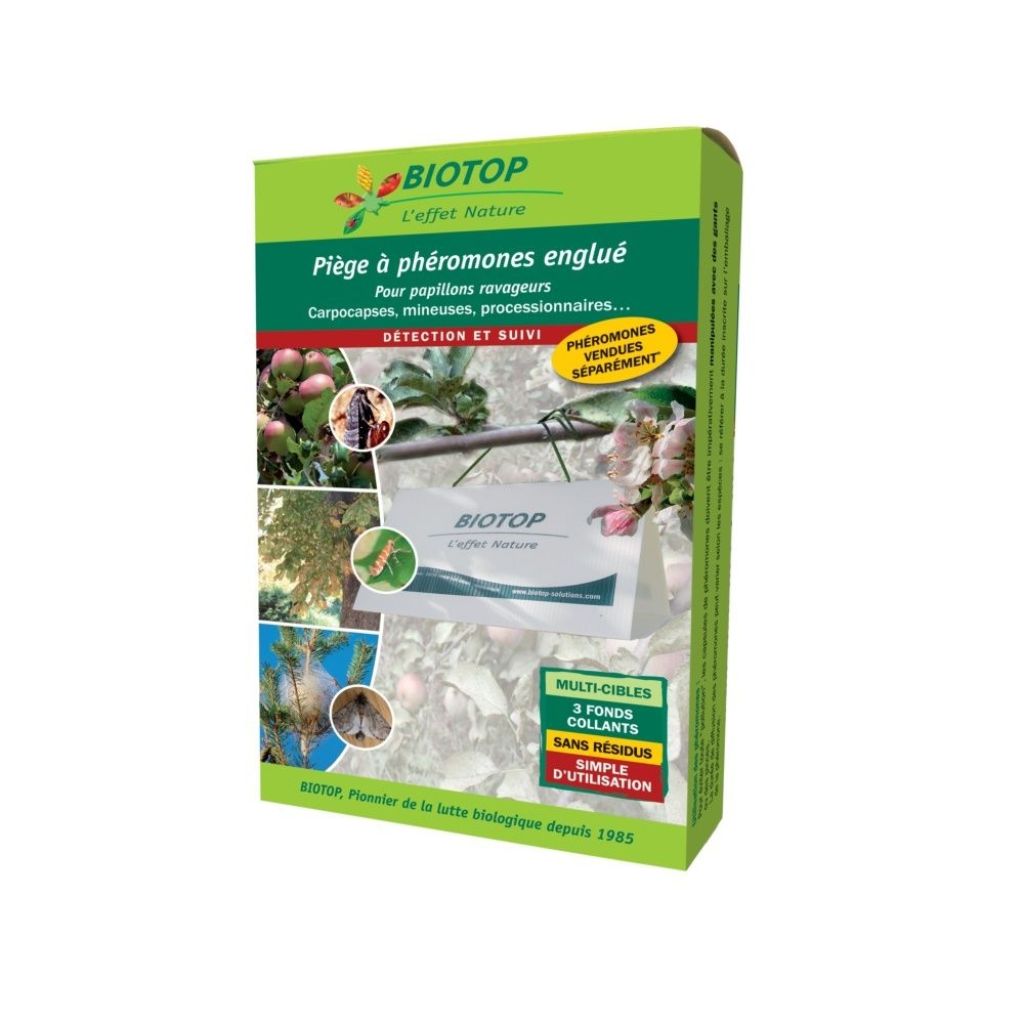
Biotop Delta Trap for Pest Moths (1 roof + 3 sticky bases)
Biotop Delta Trap for Pest Moths (1 roof + 3 sticky bases)
Back-to-school special offer!
Get €10 off for every €50 you spend! And get up to €40 off on a single order.
How does it work?
1. Shop your favourites
Add your favourite plants to your basket. For every €50 you spend (excluding delivery charges, store credit and the plastic-free option), you’ll receive a €10 voucher.
€50 spent = €10 voucher
€100 spent = €20 voucher
€150 spent = €30 voucher
€200 spent = €40 voucher
2. Place your order
Once your basket reaches one of the spending thresholds, place your order. You can even choose your delivery date!
3. Receive your voucher
As soon as your order has been shipped, you’ll receive an email containing your personal voucher code and its value.
4. Use it on your next order
Your voucher is valid for 90 days from the date you receive it. It can be used once only, on a new order worth at least the value of the voucher, excluding delivery charges.
Please note: Vouchers can be combined with other offers, but cannot be split or refunded.
Home or relay delivery (depending on size and destination)
Important: You may be charged customs duties by your country’s customs authorities upon delivery.
Schedule delivery date,
and select date in basket
We guarantee the quality of our plants for a full growing cycle, and will replace at our expense any plant that fails to recover under normal climatic and planting conditions.
This Biotop Delta trap is designed for the detection and capture of the main pest moths of crops, including codling moths, box tree moths, pine processionary moths, and leaf miners. It attracts male moths by deploying a species-specific pheromone capsule (sold separately) and then captures them on the sticky plate, preventing their mating with females and consequently the proliferation of this pest.
This device is for both detection and determination of the pest activity period, and the assessment of potential damage risk for an appropriate response if needed. Pesticide-free, it is environmentally friendly and significantly reduces the use of chemical treatments in the garden. It is easy to use, it can be set up quickly and without protective gear. It is possible to place several traps, each equipped with a pheromone specific to the targeted moth, to simultaneously combat different pests.
The kit includes:
- 1 polypropylene Delta trap with printed instructions
- 3 sticky bases (refills sold separately)
- 1 hanging cord
- 1 latex glove
To be used with 1 species-specific pheromone capsule (sold separately).
Main targeted pests:
- Horse-chestnut leaf miner Cameraria ohridella
- Goat moth Cossus cossus
- Plum fruit moth Cydia funebrana
- Coding moth Cydia pomonella
- Pine processionary moth Thaumetopoea pityocampa
- Tomato leaf miner Tuta absoluta
- Box tree moth Cydalima perspectalis
- Citrus leaf miner Phyllocnistis citrella
- Leopard moth Zeuzera pyrina
- Oriental fruit moth Cydia molesta
Assembly instructions:
1. Thread the cord through the 2 holes in the roof ridge.
2. With the white polypropylene sheet in front of you, printed side facing outwards, fold the sheet along the pre-scored lines to form a triangle (instructions readable).
3. Secure the assembly by folding the tabs inwards using your thumb from the outside towards the inside of the trap.
4. Unfold the sticky plate and position it in the trap, sticky side facing upwards. The roof walls and the tabs folded inwards are sufficient to hold it in place.
5. After putting on the latex glove, remove the pheromone from the bag (never touch the pheromone directly) and place it on the plate.
Usage instructions:
Trap placement: slightly before the suspected flight start of the insect to be detected.
Trap positioning: hang the trap using the cord, in the foliage of the tree at a height of 1.5-2 m, or on a stake for vegetable beds.
Number of traps: 1 trap for 1 to 5 trees, depending on pest numbers.
Pheromone capsule renewal: every 4 to 6 weeks for 'standard' pheromones, depending on climatic conditions.
Sticky base replacement: as soon as it becomes too dirty, it may no longer capture moths.
Pheromone storage and handling:
Awaiting use: store for 1 year in the refrigerator (3-5°C) to avoid loss of efficacy.
Use in the next season: storage for 2 years in the freezer (-18°C) is recommended.
Capsules must be handled with gloves or tweezers to avoid 'contaminating' the pheromone contained in the capsule and thus preserve its efficacy.
Uses and advantages
Tips
Tips
This item has not been reviewed yet - be the first to leave a review about it.
Recently viewed products
Haven't found what you were looking for?
Hardiness is the lowest winter temperature a plant can endure without suffering serious damage or even dying. However, hardiness is affected by location (a sheltered area, such as a patio), protection (winter cover) and soil type (hardiness is improved by well-drained soil).
In temperate climates, pruning of spring-flowering shrubs (forsythia, spireas, etc.) should be done just after flowering.
Pruning of summer-flowering shrubs (Indian Lilac, Perovskia, etc.) can be done in winter or spring.
In cold regions as well as with frost-sensitive plants, avoid pruning too early when severe frosts may still occur.
The harvesting period indicated on our website applies to countries and regions in USDA zone 8 (France, England, Ireland, the Netherlands).
In colder areas (Scandinavia, Poland, Austria...) fruit and vegetable harvests are likely to be delayed by 3-4 weeks.
In warmer areas (Italy, Spain, Greece, etc.), harvesting will probably take place earlier, depending on weather conditions.
The sowing periods indicated on our website apply to countries and regions within USDA Zone 8 (France, UK, Ireland, Netherlands).
In colder areas (Scandinavia, Poland, Austria...), delay any outdoor sowing by 3-4 weeks, or sow under glass.
In warmer climes (Italy, Spain, Greece, etc.), bring outdoor sowing forward by a few weeks.
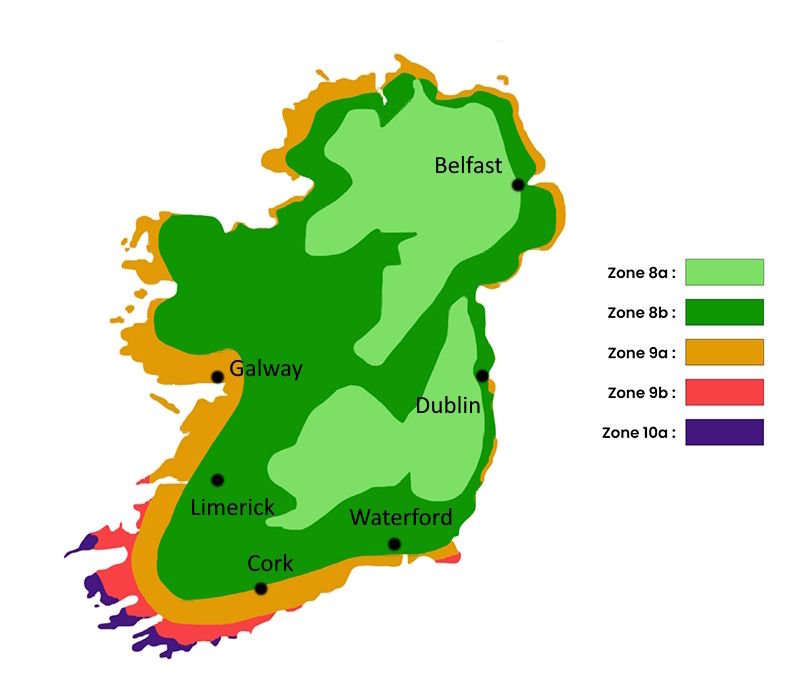
The planting period indicated on our website applies to regions in USDA Zone 9a (East Coast and Midlands: Dublin, Wexford, Waterford, Kilkenny, Portlaoise). It will vary depending on where you live:
- On the west coast and in the north-west (Galway, Limerick, Sligo, Donegal, Westport), delay planting by 1 to 2 weeks in spring and bring it forward by 1 to 2 weeks in autumn compared to the dates given, preferably choosing periods without strong winds.
- In the inland hills and plateaus (Wicklow Mountains, Macgillycuddy’s Reeks, Connemara, Killarney), it is best to plant in spring (April–May) or autumn (September–October), avoiding periods of waterlogged soil in winter and strong winds, which pose the main risk to newly planted trees in these areas.
The flowering period indicated on our website applies to regions in USDA Zone 9a, such as the East Coast and Midlands, including Dublin, Wexford, Waterford, Kilkenny and Portlaoise.
This will vary depending on where you live:
- On the west coast and in the northwest (Galway, Limerick, Sligo, Donegal and Westport), it will be delayed by one to two weeks compared to the given dates, due to stronger Atlantic winds and less spring sunshine.
- In the inland hills and plateaus (the Wicklow Mountains, the Macgillycuddy's Reeks, Connemara and Killarney), flowering will be delayed by two to three weeks. Flowering mainly occurs between May and July, with the limiting factors being less frost and more of the excessive humidity, strong winds and lack of sunshine that are characteristic of these areas.
Shipping country and language
Your country of residence may be:
Your country of residence is:
For a better user experience on our website, you can select:
Your shipping country:
-
 Austria
-
 Belgium
-
 Bosnia & Herzegovina
-
 Bulgaria
-
 Croatia
-
 Cyprus
-
 Czechia
-
 Denmark
-
 Estonia
-
 Finland
-
 France
-
 Germany
-
 Greece
-
 Hungary
-
 Iceland
-
 Ireland
-
 Italy
Italy
-
 Latvia
-
 Liechtenstein
-
 Lithuania
-
 Luxembourg
-
 Malta
Malta
-
 Netherlands
-
 Poland
-
 Portugal
-
 Romania
-
 Serbia
-
 Slovakia
-
 Slovenia
-
 Spain
Spain
-
 Sweden
-
 Switzerland
Language:
-
French
-
 English
-
Spanish
-
Italian
-
German
-
Portuguese
-
Dutch
-
Finnish
My Account
Hello
My wish lists
My cart
Log in / Register
Existing customer?
This form is protected by reCAPTCHA - the Google Privacy Policy and Terms of Service apply.
New customer?
Create an account to track your orders, access our customer service and, if you wish, make the most of our upcoming offers.